Manual Larson Scanner Invites You To Crank It

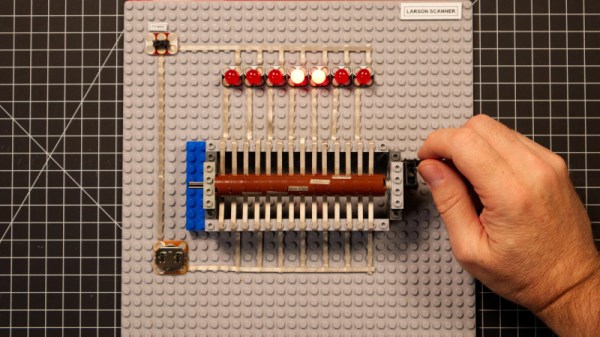
Hasselhoff make Larson Scanners famous. That’s the name for the scanning red lights on the front of KITT, the hero car from the popular 1980s TV series Knight Rider. Despite serving a solely aesthetic role, they remain a fun and popular LED project to this day. Putting a new twist on the old concept, [Pete Prodoehl] whipped up a Larson Scanner that you crank to operate.

Built out of LEGO, the project relies on a hand crank to work. The crank turns a drum, onto which is placed several strips of conductive Maker Tape – a steel/nylon material which we’ve looked at before. Strips of tape running side-by-side are bridge by segments of tape on the drum as it turns. The LEDs are switched on in the requisite pattern of a traditional Larson scanner.

The project has inspired further possibilities, such as using similar techniques to produce an electronic music box or player piano that will change tempo as the user changes the speed with the crank. [Pete] notes that turning the crank is an inherently enjoyable experience, and given the wonder inherent in hand-cranked musical projects like Marble Machine X, we can’t wait to see where this one goes next. Video after the break.

Continue reading “Manual Larson Scanner Invites You To Crank It”

Seeing The Skill Is Better Than Seeing The Project

Pulling off a flashy project that gets the viral-media hug of widespread approval feels great. Getting there is no easy path to walk and often times the craft that went into a finished project doesn’t even take the back seat but gets no mention at all. Often I find I’m more impressed by — or a least my attention is more strongly captured by — the skills put on display as prominently as the finished build.

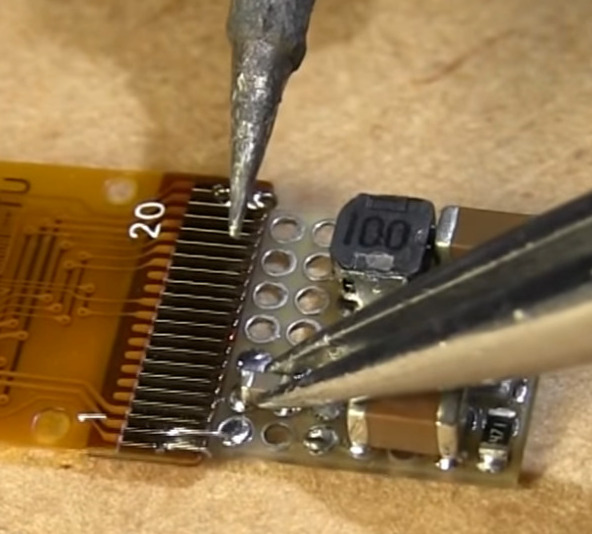
Case-in-point this week comes from the model railroad work of [Diorama111]. Seeing an OLED screen in the nose of an HO scale locomotive just like the real-life version is impressive, but how many people missed the one-off soldering masterpiece that went into this one? You’ll marvel at the SMD techniques used with through-hole protoboard on this one.

Occasionally we do get to look over the shoulder of the master as decades of skills are shared for the purpose of passing them on. So was the case back in May when we watched as [Leo] walked through his tips and tricks for prototyping at the electronics bench. This included a lot of non-obvious but clever stuff; tips on working with copper tape for solder buses, using Teflon tubing with bare wire instead of stripping PVC-insulated wire, and a deep dive into copper clad prototyping.

So remember all of us hardware geeks when you look to tell the story of your project. We want to know how it was done at least as much as what was done. There was a time when electronic designers were a separate work group from electronic technicians (and wow, those technicians were in a league of their own). These days we all have that technician hat hanging on our workbenches and I’m always interested in packing in yet another unlearnt skill. Throw us a bone!

Stealing Keys From The Sound Of The Lock

If you are smart, you wouldn’t hand your house key over to a stranger for a few minutes, right? But every time you use your key to unlock your door, you are probably broadcasting everything an attacker needs to make their own copy. Turns out it’s all in the sound of the key going into the lock.

Researchers in Singapore reported that analyzing metallic clicks as the key slides past the pins gives them the data they need to 3D print a working key. The journal published research is behind a paywall, but there is a copy on co-author [Soundarya Ramesh’s] website which outlines the algorithm used to decode the clicks of key teeth on lock pins into usable data.

The attack didn’t require special hardware. The team used audio capture from common smartphones. While pushing your phone close to the lock while the victim inserts a key might be problematic, it isn’t hard to imagine a hacked phone or smart doorbell picking up the audio for an attacker. Long-range mikes or hidden bugs are also possible.

There are practical concerns, of course. Some keys have a plateau that causes some clicks to skip, so the algorithm has to deal with that. It sounds like the final result be a small number of key possibilities and not just converge on one single key, but even if you had to carry three or four keys with you to get in, it is still a very viable vulnerability.

The next step is to find a suitable defense. We’ve heard that softening the pins might reduce the click, but we wondered if it would be as well to put something in that deliberately makes loud clicks as you insert the key to mask the softer clicks of the pins.

While a sound recording is good, sometimes a picture is even better. Of course, if you want to go old school, you can 3D print your lockpicks.

Continue reading “Stealing Keys From The Sound Of The Lock”

Unique LED Display Inspired By Fighter Jet Dashboard

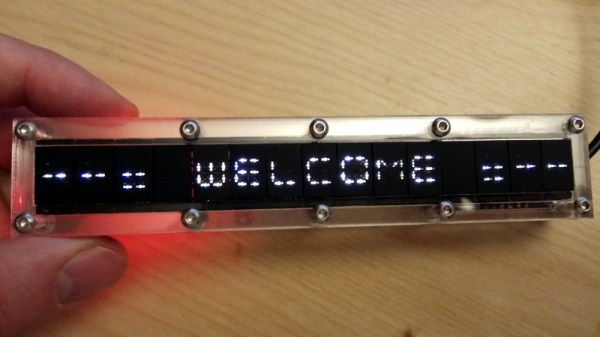
Last year, [Mangy_Dog] was asked by a few friends to consult on a project they were working on. The goal was to build an authentic replica of an F-18 cockpit, apparently for the purposes of creating a film. The project never materialized, but it did inspire him to take a hard look at the 1970s era alphanumeric displays utilized in the real aircraft. One thing lead to another, and he ended up using his own take on the idea to build his own “starburst” digit display.

As [Mangy_Dog] explains, while the faces of these original displays might have been quite small, there was a lot going on behind the scenes. Due to the technical limitations of the time, each alphanumeric character was made up of an array of incandescent light bulbs and fiber optic cables. This worked well enough, but was bulky and complex to manufacture.

Today, we can do better, even on the hobbyist level. As it turns out, 0402 LEDs are just about the right size to recreate the segments of the original starburst displays. So [Mangy_Dog] came up with a simple PCB design to not only align the LEDs properly, but drive them with a 74HC595 shift register and an array of MOSFETs. While assembly wasn’t without its challenges, he made good use of his custom built reflow oven to get all the diminutive components in place.

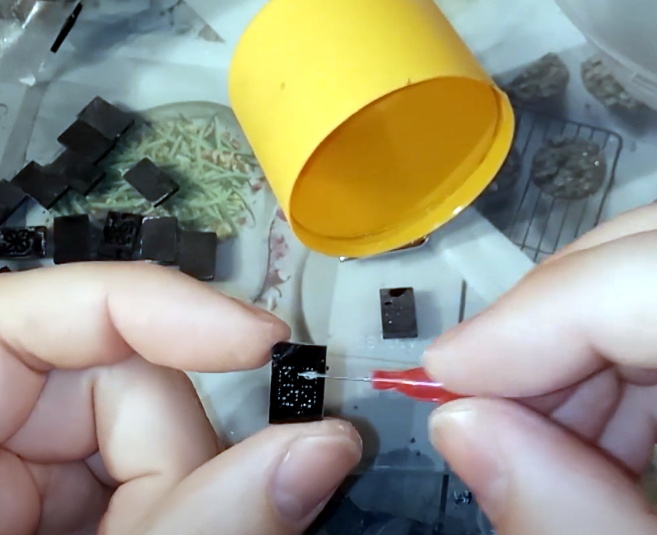
He went through a few different ideas for the diffuser, but eventually settled on black plastic with tiny holes drilled through courtesy of his laser cutter. Behind each set of three holes is a small pocket that got filled from both sides with transparent UV resin, which was then sanded down after curing. The end result isn’t perfect as you can still tell the center dot is brighter than its peers, but the overall effect is still very nice and definitely has a sort of faux-retro appeal.

The military naturally has access to some incredible technology, though they have a tendency to hold onto it for decades. That an individual with a meager budget and homemade tools can improve upon a piece of hardware installed in a $60+ million airplane is a testament to just how fast things are moving.

Continue reading “Unique LED Display Inspired By Fighter Jet Dashboard”

Student Rover Explores The Backyard In Tribute

Three students were a little sad when NASA’s Opportunity rover went silent after 15 years on the Martian surface. So they decided to build their own rover inspired by Opportunity to roam their backyards using an off-the-shelf robot chassis, a Raspberry Pi, and the usual list of parts like motors, H-bridges, and batteries.

Like the real rover, the vehicle uses a rocker-bogie system, although it is a little less complex than the version NASA sent blasting off towards the Red Planet. The plucky vehicle comes complete with miniature solar panels to recharge its onboard battery, courtesy of some dollar-store garden lights. A pair of videos after the break show how the rover is controlled, as well as the view sent back from its onboard camera.

The rover ran a simulated Mars mission as part of a school project where it had to find an object and transmit an image of it back to home base, and by the looks of it, is was a rousing success. But the young explorers aren’t resting on their laurels, and are already working on a second version of their exploration vehicle that can operate in inclement weather and includes some new tools such as a robotic arm and infrared illumination for low-light imaging.

We’ve seen plenty of Mars rover clones in the past, but there’s always room for more. Of course, if you’re looking for something a bit easier to start with, you can always go the LEGO route.

Continue reading “Student Rover Explores The Backyard In Tribute”

Cool Off With A Piezo And A Glass Of Water

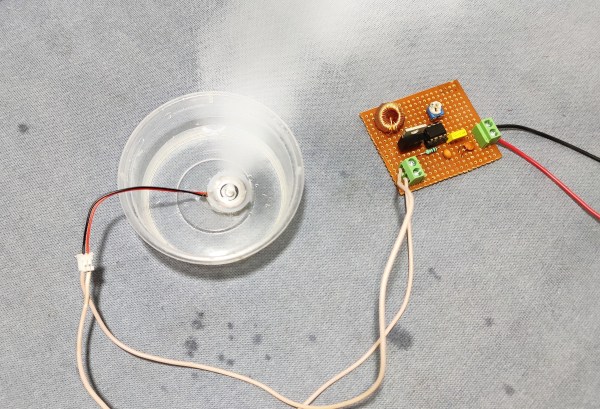
Some cool-mist humidifiers work by flinging water at a vaporizer, but our favorite kind uses a piezoelectric transducer. These work by using high-frequency sound waves to pound the surface of the water with mechanical energy. That energy introduces standing waves that force the water to break apart into a fine mist on the surface of the piezo disk.

The driving circuit for this DIY mist maker uses a 555 to generate 113 KHz, a trimmer potentiometer to fine-tune it, and a MOSFET to amplify the signal. You don’t need much more than that and a handful of passives to recreate this cool junk box experiment, but the spec of the piezo disk is quite important. The circuit is designed for atomizing transducers, which have a resonant frequency of 113 KHz — much higher than your average junk box piezo. Check out the demo and build video after the break.

Atomizing transducers can do way more than than moisten the air for our comfort. They’re not picky about where the water comes from, so if you have enough of them, you can dry a load of laundry in a few minutes.

Continue reading “Cool Off With A Piezo And A Glass Of Water”

Get Creative With This ESP8266 Photography Light

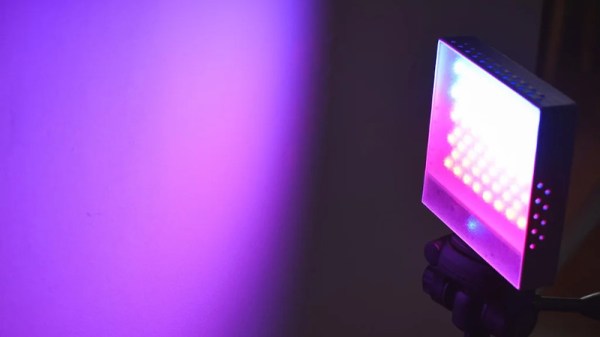
In today’s fast-paced world of social media, if you want your photos to grab attention, you’ve got to have an edge. Whether it’s a deft touch in Photoshop or an amazing lens, it’s important to stand apart. Another great way is to experiment with lighting and color. To do just that, [Andrei] built a pocket RGB photo light for the home studio.

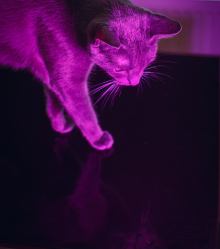
[Andrei]’s cat models for the camera.
This is a project that any experienced maker should be able to whip up in a weekend. Not that there’s anything wrong with that, of course. The basic enclosure is 3D printed and readily reproducible on any FDM printer. Lighting is provided via the venerable WS2812B LED, 68 of them, to be exact. Finally there’s an ESP8266 running WLED, a webserver for the platform that’s dedicated to controlling LED strips. This makes it easy to tweak the LEDs with your smartphone.

Thanks to the WS2812Bs LEDs, a full range of RGB colors are available for [Andrei] to experiment with. He’s done a great job showing off the light with a few choice cat pics that serve to show its capabilities. While we wouldn’t expect to use such a device for clean white lighting in a serious photographic sense, it’s a perfect tool for art photography.

We’ve covered other studio light builds before, too. Video after the break.

Continue reading “Get Creative With This ESP8266 Photography Light”