Motorcycle Builder Makes Downhill Mountain Bike

[Allen Millyard] is a premier British motorcycle builder. In these circles he is widely regarded and his custom motorcycles are nearly world-famous. But when his son took up downhill mountain biking, he decided to put his skills building a different type of vehicle. This is the Millyard MR001, one of the most unique mountain bikes ever built thanks to some design choices that solve many problems otherwise inherent in bicycles.

Perhaps the most immediately striking design of this bike is the aluminum space frame, a lightweight but extremely strong frame necessary for the high speeds and stresses of downhill mountain biking. Upon closer inspection, however, the sealed drivetrain warrants further inspection. Unlike most mountain bikes with gears, this one eliminates the typical derailleur which hangs below the rear gears. The gears are instead above the pedals in front of the rear tire, are completely sealed eliminating the maintenance requirements of a typical bike, and are designed in such a way that they can be shifted without the bike moving.

Despite the bike being built in 2007, it still includes plenty of features that still aren’t widely adopted in mountain biking. It’s also nearly completely silent thanks to the custom drivetrain, and [Allen] reports that it still sneaks up on other mountain bikers as a result. This is essentially the opposite problem of another bike we’ve seen around.

Continue reading “Motorcycle Builder Makes Downhill Mountain Bike”
ADSL Router As Effects Pedal

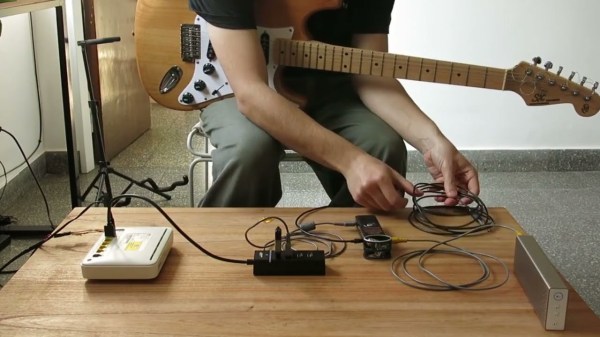
Moore’s law might not be as immutable as we once though thought it was, as chip makers struggle to fit more and more transistors on a given area of silicon. But over the past few decades it’s been surprisingly consistent, with a lot of knock-on effects. As computers get faster, everything else related to them gets faster as well, and the junk drawer tends to fill quickly with various computer peripherals and parts that might be working fine, but just can’t keep up the pace. [Bonsembiante] had an old ADSL router that was well obsolete as a result of these changing times, but instead of tossing it, he turned it into a guitar effects pedal.

The principle behind this build is that the router is essentially a Linux machine, complete with ALSA support. Of course this means flashing a custom firmware which is not the most straightforward task, but once the sound support was added to the device, it was able to interface with a USB sound card. An additional C++ program was created which handles the actual audio received from the guitar and sound card. For this demo, [Bonsembiante] programmed a ring buffer and feeds it back into the output to achieve an echo effect, but presumably any effect or a number of effects could be programmed.

For anyone looking for the source code for the signal processing that the router is now performing, it is listed on a separate GitHub page. If you don’t have this specific model of router laying around in your parts bin, though, there are much more readily-available Linux machines that can get this job done instead.

Continue reading “ADSL Router As Effects Pedal”

The Ease Of Wireless Charging, Without The Wait

Historically, there have been a few cases of useful wireless power transmission over great distances, like a team at MIT that was able to light up a 60 W bulb at several meters, and of course Nikola Tesla had grand dreams of drawing energy from the atmosphere. But for most of us wireless power is limited to small, short-range devices like cellphone chargers. While it’s not a lot of work to plug in a phone when it needs a charge, even this small task can be automated.

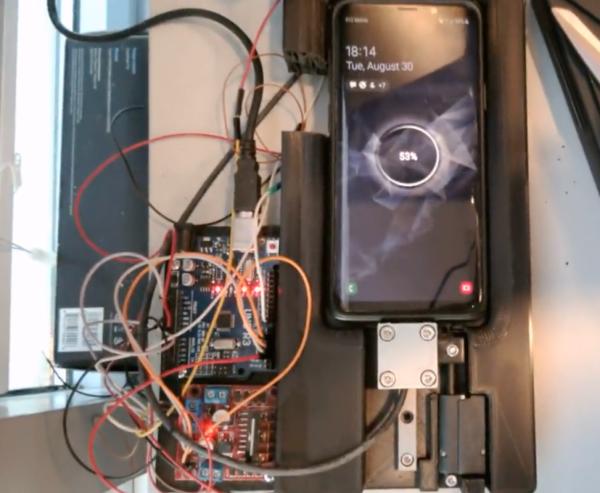
This build begins with a 3D printed cradle for the smartphone to sit in. When the device detects that the phone has been placed in the cradle, it uses a linear actuator to drive a custom-built charging cable into the phone’s USB port. Similarly, when the phone is lifted from the cradle the cable is automatically removed. It appears that there is some play in the phone’s position that lets the charger be plugged in smoothly, and the project’s creator [Larpushka] points out that the linear actuator is not particularly strong so we don’t imagine the risk of damage is very high.

While wireless charging still may have the edge when it comes to keeping debris out of the port, we still really enjoy a project like this that seems to be done for its own sake. There are some improvements that [Larpushka] plans to make, but for now we’re delighted by this build. For anyone looking to add true wireless charging to any phone that doesn’t have it, though, it’s not too difficult to accomplish either.

Custom Calculator Brings Us Back To The 70s

There are certain design aesthetics from every era that manage to survive the fads of their time and live throughout history. Ancient Greek architecture is still drawn upon for design inspiration in modern buildings, the mid-century modern style from the 60s still inspires various designs of consumer goods, and the rounded, clean looking cars from the 90s are still highly desirable qualities in automotive design. For electronics, though, we like this 70s-inspired calculator that [Aaron] recently built.

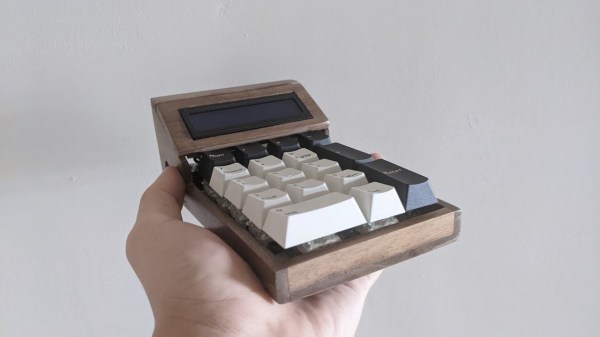
The calculator hearkens back to the days of calculators like the HP-29C with its large buttons and dot-matrix display. [Aaron] built the case out of various woods with a screen angled towards the user, and it uses a LCD display similar to those found in antique calculators. The brain of the calculator is an Arduino which fits easily into the case, and [Aaron] also built the keyboard from scratch with Cherry MX-style mechanical keys soldered together into a custom shape.

The software to run the calculator is fairly straightforward, but we are most impressed with the woodworking, styling, and keyboard design in this build. [Aaron] is also still ironing out some bugs with the power supply as it uses a DC-DC converter to power the device from a single lithium battery. For those who are more fond of early 2000s graphing calculators instead, be sure to take a look at this graphing calculator arcade cabinet.

Continue reading “Custom Calculator Brings Us Back To The 70s”

Solar Cells As Art Form

When most of us approach a project, we have a certain problem to solve. 3D printing, microcontrollers, batteries, and all kinds of technologies are usually tools to accomplish some task. This is not necessarily true in the art world, though, where the intrinsic nature of these tools can be explored for their own sake rather than as a means to an end. The latest one that came across our desk is this light-powered sound generator.

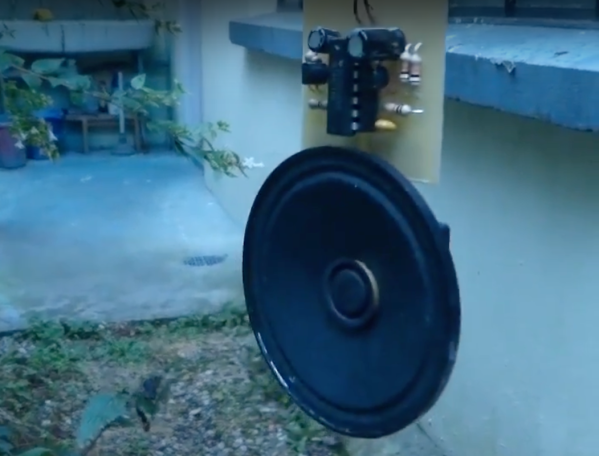
The art piece looks a bit like a mobile with rotating arms, holding various small solar cells each connected to a speaker. As the arms pivot, the light falling on the cells changes which drives a specially-designed circuit connected to a speaker. The circuit acts as an oscillator, passing the changing voltage from the cell through various capacitors and transistors to produce changing tones in the speaker.

The effect of the rotating solar panels is not only oscillations from the speakers as the light changes, but oscillations in the sound of the speakers as they rotate towards and away from the observer. It’s a unique project and perfect for the art show it was in. It’s also not the only sound-focused art installation we’ve ever seen before, be sure to check out this one based on an ESP32.

Water Level Sensor Does Not Use Water Level Sensor

When interfacing with the real world, there are all kinds of sensors available which will readily communicate with your microcontroller of choice. Moisture, pH, humidity, temperature, location, light, and essentially every other physical phenomenon are readily measured with a matching sensor. But if you don’t have the exact sensor you need, it’s sometimes possible to use one sensor as a proxy for another.

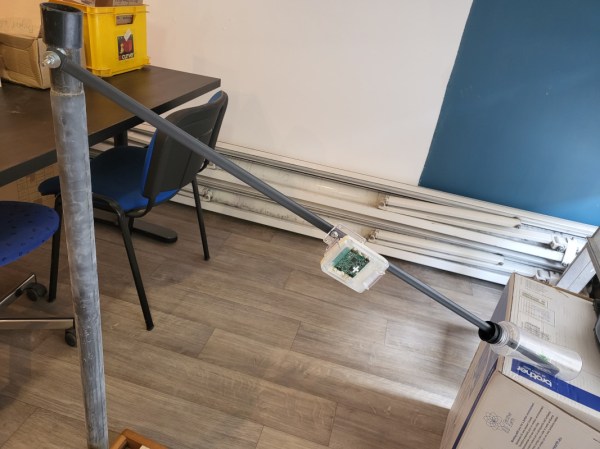
[Brian Wyld] needed a way to monitor the level of a remote body of water but couldn’t use a pressure or surface-level sensor, so he used a sensor typically intended for geolocation instead. This particular unit, an STM-type device with a built-in accelerometer, is attached to a rotating arm with a float at one end. As the arm pivots, the microcontroller reports its position and some software converts the change in position to a water level. It’s also paired with a LoRa radio, allowing it to operate off-grid.

Whether there is a design requirement to use an esoteric sensor to measure something more common, or a personal hardware limitation brought about by a shallow parts drawer, there’s often a workaround like this one that can accomplish the job. Whatever the situation, we do appreciate hacking sensors into other types of sensors just as much as anything else.

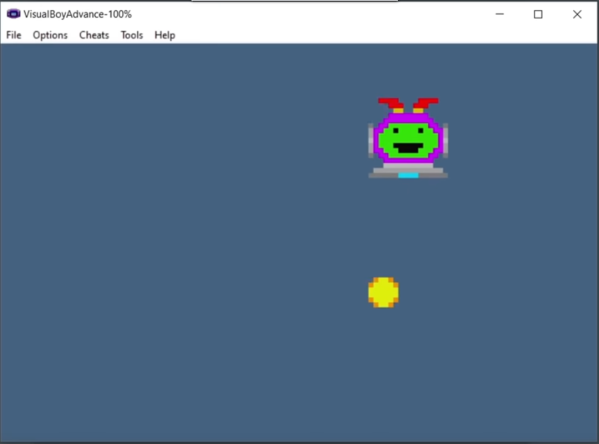
A Primer For The Homebrew Game Boy Advance Scene

As video game systems pass into antiquity, some of them turn out to make excellent platforms for homebrew gaming. Not only does modern technology make it easier to interact with systems that are now comparatively underpowered and simpler, but the documentation available for older systems is often readily available as well, giving the community lots of options for exploration and creativity. The Game Boy Advance is becoming a popular platform for these sorts of independent game development, and this video shows exactly how you can get started too.

This tutorial starts with some explanation of how the GBA works. It offered developers several modes for the display, so this is the first choice a programmer must make when designing the game. From there it has a brief explanation of how to compile programs for the GBA and execute them, then it dives into actually writing the games themselves. There are a few examples that [3DSage] demonstrates here including examples for checking the operation of the code and hardware, some simple games, and also a detailed explanation the framebuffers and other hardware and software available when developing games for this console.

While the video is only 10 minutes long, we recommend watching it at three-quarters or half speed. It’s incredibly information-dense and anyone following along will likely need to pause several times. That being said, it’s an excellent primer for developing games for this platform and in general, especially since emulators are readily available so the original hardware isn’t needed. If you’d like to build something from an even more bygone era than the early 2000s, though, take a look at this tutorial for developing games on arcade cabinets.

Continue reading “A Primer For The Homebrew Game Boy Advance Scene”