DIY Airless Tires Work Surprisingly Well

Airless tires have been “a few years away” from production for decades now. They’re one of the automotive version of vaporware (at least those meant for passenger vehicles), always on the cusp of being produced but somehow never materializing. They have a number of perks over traditional air-filled tires in that they are immune to flats and punctures, and since there aren’t any airless tires available at the local tire shop, [Driven Media] decided to make and test their own.

The tires are surprisingly inexpensive to make. A few pieces of drainage tubing of varying diameters, cut to short lengths, and then bolted together with off-the-shelf hardware is all it takes, although they note that there was a tremendous amount of hardware needed to fasten all the pipe lengths together. With the structure in place they simply cut a tread off of a traditional tire and wrapped it around each of the four assemblies, then bolted them up to their Caterham street-legal race car for testing.

While the ride quality was notoriously (and unsurprisingly) rough and bumpy, the tires perform admirably under the circumstances and survive being driven fairly aggressively on a closed-circuit race course. For such a low price and simple parts list it’s shocking that a major tire manufacturer like Michelin hasn’t figured out how to successfully bring one to a light passenger car yet.

Thanks to [Itay] for the tip!

Continue reading “DIY Airless Tires Work Surprisingly Well”

Performing Magic With A Little High-Tech Help

Doing magic with cards involves a lot of precise dexterity to know which card is where. For plenty of tricks, this is often knowledge and control of a single card or a small number of cards. But knowing the exact position of every single card in the deck could certainly be helpful, so the Nettle Magic Project was created to allow magicians to easily identify the location of cards in the deck.

The system works through the use of computer vision to identify a series of marks on the short edge of a stack of cards. The marks can be printed in IR- or UV-sensitive ink to make them virtually invisible, but for demonstration these use regular black ink. Each card has landmarks printed on either side of a set of bit markers which identify the cards. A computer is able to quickly read the marks and identify each card in order while the deck is still stacked, aiding the magician in whichever trick they need to perform.

The software only runs on various Apple devices right now, including iPhones and iPads, but the software is readily available fore experimentation if you are a magician looking to try something like this out. Honestly, we don’t see too many builds focusing on magic, sleight-of-hand or otherwise, and we had to go back over a decade to find a couple of custom magical builds from a magician named [Mario].

Thanks to [Tim] for the tip!

Gym Equipment Converted To Generator

Energy cannot be created or destroyed, but the most likely eventual conclusion of changing it from one form or another will be relatively useless heat. For those that workout with certain gym equipment, the change from chemical energy to heat is direct and completely wasted for anything other than keeping in shape. [Oliver] wanted to add a step in the middle to recover some of this energy, though, and built some gym equipment with a built-in generator.

Right now he has started with the obvious exercise bike stand, which lends itself to being converted to a generator quite easily. It already had a fairly rudimentary motor-like apparatus in it in order to provide mechanical resistance, so at first glance it seems like simply adding some wires in the right spots would net some energy output. This didn’t turn out to be quite so easy, but after a couple of attempts [Oliver] was able to get a trickle of energy out to charge a phone, and with some more in-depth tinkering on the motor he finally was able to get a more usable amount of energy to even charge a laptop.

He estimates around 30 watts of power can be produced with this setup, which is not bad for a motor that was never designed for anything other than mechanical resistance. We look forward to seeing some other equipment converted to produce energy too, like a rowing machine or treadmill. Or, maybe take a different route and tie the exercise equipment into the Internet connection instead.

Arduino Drum Platform Is Fast

Drums are an exciting instrument to learn to play, but often prohibitive if there are housemates or close neighbors involved. For that problem there are still electronic drums which can be played much more quietly, but then the problem becomes one of price. To solve at least part of that one, [Jeremy] turned to using an Arduino to build a drum module on his own, but he still had to solve yet a third problem: how to make the Arduino fast enough for the drums to sound natural.

Playing music in real life requires precise timing, so the choice of C++ as a language poses some problems as it’s not typically as fast as lower-level languages. It is much easier to work with though, and [Jeremy] explains this in great detail over a series of blog posts detailing his drum kit’s design. Some of the solutions to the software timing are made up for with the hardware on the specific Arduino he chose to use, including an even system, a speedy EEPROM, hardware timers, and an ADC that can sample at 150k samples per second.

With that being said, the hardware isn’t the only thing standing out on this build. [Jeremy] has released the source code on his GitHub page for those curious about the build, and is planning on releasing several more blog posts about the drum kit build in the near future as well. This isn’t the only path to electronic drums, though, as we’ve seen with this build which converts an analog drumset into a digital one.

Continue reading “Arduino Drum Platform Is Fast”

Building A Serial Bus To Save An Old Hard Drive

Universal Serial Bus has been the de facto standard for sending information to and from computer peripherals for almost two decades, but despite the word “universal” in the name this wasn’t always the case. Plenty of competing standards, including USB, existed in the computing world in the decades before it came to dominance, and if you’re trying to recover data from a computer without USB you might have to get creative with how it’s done.

[Ben] recently came across a 80486 with this problem, so he had to get creative to recover the contents of the drive. He calls it the “lunchbox” computer due to its form factor, and while it doesn’t have USB it does have a tried-and-trusted serial port to communicate with other computers. [Ben] wrote up a piece of software for both the receiving computer and the sending computer in order to copy the drive sectors one by one across a serial link to a standalone computer running Windows XP, and was able to recover the contents of the drive that way instead.

All of the code [Ben] wrote is available on his GitHub page for anyone looking to boot up a 30-year-old computer again. While it might sound uncommon, computers of this vintage are still around running things like CNC machines or old mainframes.

Reverse-Engineering Forgotten Konami Arcade Hardware

When fully-3D video games started arriving in the early 90s, some companies were more prepared for the change than others. Indeed, it would take nearly a decade of experimentation before 3D virtual spaces felt natural. Even then, Konami seems to have shot themselves in the foot at the beginning of this era with their first foray into 3D arcade games. [Mog] shows us the ins-and-outs of these platforms while trying to bring them back to life via MAME.

These arcade machines were among the first available with fully-3D environments, but compared to offerings from other companies are curiously underpowered, even for the time. They include only a single digital signal processor which is tasked with calculating all of the scene geometry while competing machines would use multiple DSP chips to do the same job. As a result the resolution and frame rate are very low. Nonetheless, [Mog] set out to get it working in MAME.

To accomplish this task, [Mog] turned to a set of development tools provided to developers for Konami in the early 90s which would emulate the system on the PCs of the time. It surprisingly still worked on Windows 10 with minor tweaking, and with some other tools provided over the decades of others working on MAME these old Konami machines have some new life with this emulator support.

Not everything works perfectly, but [Mog] reports that most of the bugs and other issues were recently worked out or are being actively worked on by other experts in the field. If you remember these games from the arcade era of the 80s and early 90s, it might be time to grab an old CRT and fire this one up again.

Continue reading “Reverse-Engineering Forgotten Konami Arcade Hardware”

Metal Detector Gets Help From Smartphone

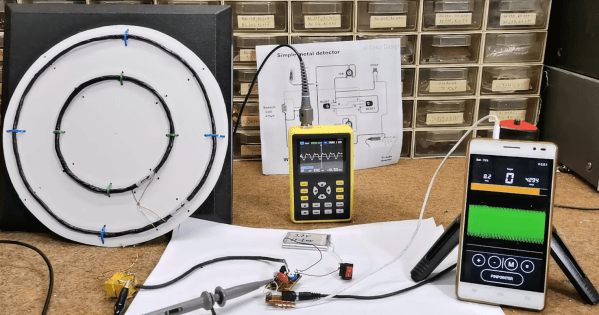
[mircemk] is quite a wizard when it comes to using coils of wires in projects, especially when their application is within easy-to-build metal detectors. There are all kinds of ways to send signals through coiled wire to detect metal objects in the ground, and today [mircemk] is demonstrating a new method he is experimenting with which uses a smartphone to detect the frequency changes generated by the metal detector.

Like other metal detectors, this one uses two coils of wire with an oscillator circuit and some transistors. The unique part of this build, though, is how the detector alerts the user to a piece of metal. Normally there would be an audible alert as the frequencies of the circuit change when in the presence of metal, but this one uses a smartphone to analyze the frequency information instead. The circuit is fed directly into the headphone jack on the smartphone and can be calibrated and used from within an Android app.

Not only can this build detect metal, but it can discriminate between different types of metal. [mircemk] notes that since this was just for experimentation, it needs to be calibrated often and isn’t as sensitive as others he’s built in the past. Of course this build also presumes that your phone still has a headphone jack, but we won’t dig up that can of worms for this feature. Instead, we’ll point out that [mircemk] has shown off other builds that don’t require any external hardware to uncover buried treasure.

Continue reading “Metal Detector Gets Help From Smartphone”