New Resin Printing Method Creates Objects In Seconds

For anyone looking to buy a 3D printer at home, the first major decision that needs to be made is whether to get a resin printer or a filament printer. Resin has the benefits of finer detail, but filament printers are typically able to produce stronger prints. Within those two main camps are various different types and sizes to choose from, but thanks to some researchers at Switzerland’s École polytechnique fédérale de Lausanne (EPFL) there’s a new type of resin printer on the horizon that can produce prints nearly instantaneously.

The method works similarly to existing resin printers by shining a specific light pattern on the resin in order to harden it. The main difference is that the resin is initially placed in a cylinder and spun at a high speed, and the light is shined on the resin at different angles with very precise intensities and timings in order to harden the resin in specific areas. This high-speed method allows the printer to produce prints in record-breaking time. The only current downside, besides the high price for the prototype printer, is that it’s currently limited to small prints.

With the ability to scale in the future and the trend of most new technologies to come down in price after they have been on the market for some amount of time, it would be groundbreaking to be able to produce prints with this type of speed if printers like these can be scalable. Especially if they end up matching the size and scale of homemade printers like this resin printer.

Thanks to [suicidal.banana] for the tip!

Automatic Water Turret Keeps Grass Watered

Summer is rapidly approaching (at least for those of us living in the Northern Hemisphere) and if you are having to maintain a lawn at your home, now is the time to be thinking about irrigation. Plenty of people have built-in sprinkler systems to care for their turf, but this is little (if any) fun for any children that might like to play in those sprinklers. This sprinkler solves that problem, functioning as an automatic water gun turret for anyone passing by.

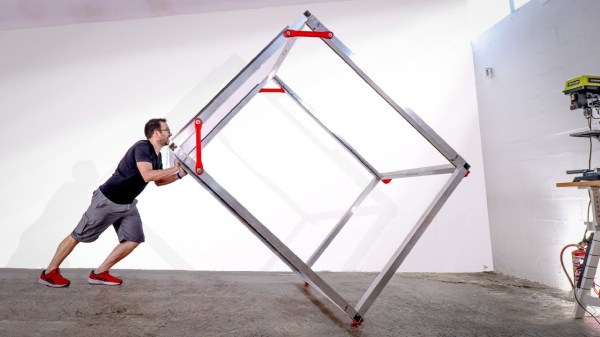
This project was less a specific sprinkler build and more of a way to reuse some Khadas VIM3 single-board computers that the project’s creator, [Neil], wanted to use for something other than mining crypto. The boards have a neural processing unit (NPU) in them which makes them ideal for computer vision projects like this. The camera input is fed into the NPU which then directs the turret to the correct position using yaw and pitch drivers. It’s built out of mostly aluminum extrusion and 3D printed parts, and the project’s page goes into great details about all of the parts needed if you are interested in replicating the build.

[Neil] is also actively working on improving the project, especially around the turret’s ability to identify and track objects using OpenCV. We certainly look forward to more versions of this build in the future, and in the meantime be sure to check out some other automated sprinkler builds we’ve seen which solve different problems.

Continue reading “Automatic Water Turret Keeps Grass Watered”

Saving Birds With 3D Printed Boats

Montana, rightfully nicknamed the big sky country, is a beautiful state with abundant wide open landscapes, mountains, and wildlife. It’s a fantastic place to visit or live, but if you happen to reside in the city of Butte, that amazing Montana landscape is marred by the remnants of an enormous open pit mine. Not only is it an eyesore, but the water that has filled the pit is deadly to any bird that lands there. As a result, a group of people have taken to some ingenious methods to deter birds from landing in the man-made toxic lake for too long.

When they first started, the only tool they had available was a rifle. Scaring birds this way is not the most effective way for all species, though, so lately they have been turning to other tools. One of which is a custom boat built on a foam bodyboard which uses a plethora of 3D printed parts and sensors to allow the operator to remotely pilot the boat on the toxic lake. The team also has a drone to scare birds away, plus an array of other tools like high-powered lasers, propane cannons, and various scopes in order to put together the most effective response to help save wildlife.

While this strategy runs the gamut of the tools most commonly featured here, from 3D printers to drones to lasers, the only thing that’s missing is some automation like we have seen with other drone boat builds we’ve featured in the past. It takes quite a bit of time to continually scare birds off this lake, even through the winter, so every bit of help the team can get could go even further.

Continue reading “Saving Birds With 3D Printed Boats”

Remote Screen Viewer Is Text-Only

Have you been slowly falling down a rabbit hole of Stallman-like paranoia of computers ever since installing Ubuntu for the first time in 2007? Do you now abhor anything with a GUI, including browsers? Do you check your mail with the command line even though you’re behind seven proxies? But, do you still want to play Minecraft? If so, this command-line-only screen viewer might just be the tool to use a GUI without technically using one.

This remote screen viewer is built in Python by [louis-e] and, once installed, allows the client to view the screen of the server even if the client is a text-only console. [louis-e] demonstrates this from within a Windows command prompt. The script polls the server screen and then displays it in the console using the various colors and textures available. As a result, the resolution and refresh rate are both quite low, but it is still functional enough to play Minecraft and do other GUI-based tasks as long as there’s no fine text to read anywhere.

The video below only shows a demonstration of the remote screen viewer, and we can imagine plenty of uses beyond this proof-of concept game demonstration. Installing a desktop environment and window manager is not something strictly necessary for all computers, so this is a functional workaround if you don’t want to waste time and resources installing either of those components. If you’re looking for remote desktop software for a more specific machine, though, take a look at this software which enables remote desktop on antique Macs.

Continue reading “Remote Screen Viewer Is Text-Only”

Electronic Dice Is Introduction To Microcontroller Programming

By now most of us are familiar with the Arduino platform. It’s an inexpensive and fairly easy way into the world of microcontrollers. For plenty of projects, there’s no need to go beyond that unless you have a desire to learn more of the inner workings of microcontrollers in general. [Cristiano] was interested in expanding some of his knowledge, so he decided to build this electronic dice using a PIC microcontroller instead of the Arduino platform he was more familiar with.

As a result, this project is set up as a how-to for others looking to dive further into the world of microcontrollers that don’t have the same hand-holding setup as the Arduino. To take care of the need for a random number for the dice, the PIC’s random number generator is used but with the added randomness of a seed from an internal timer. The timer is started when a mercury tilt switch signals the device that it has been rolled over, and after some computation a single digit number is displayed on a seven-segment display.

While it might seem simple on the surface, the project comes with an in-depth guide on programming the PIC family of microcontrollers, and has a polish not normally seen on beginner projects, including the use of the mercury tilt switch which gives it a retro vibe. For some other tips on how to build projects like this, take a look at this guide on how to build power supplies for your projects as well.

Continue reading “Electronic Dice Is Introduction To Microcontroller Programming”

Electronic Catan Game Board Is Modular

Plenty of gamers around these parts require an expensive PC to play games, often spending thousands of dollars for a gaming machine. Believe it or not, though, there are entire classes of games that don’t require any electronics at all, but that doesn’t mean that they don’t benefit from the addition of some neat gadgets. This Settlers of Catan game uses custom LCD tiles with a built-in custom mesh network.

The tiles for the game board themselves are hexagonal and snap together using magnetic pogo pins in order to form a board of any size or shape. The pogo pins also allow communication for a pseudo-mesh network to operate with each tile’s built-in PCB to allow the game board to know exactly which tiles are placed where and to display the correct image on each one. Each tile contains it own RP2040 microcontroller, keeping the overall cost of each tile to a minimum.

For those regularly hosting game night, a project like this could really change the traditionally analog game’s dynamic for the better. It was mostly a project that [Colin Iuliano] built just for fun, and if he ever builds a second one he does plan on some improvements, but we’d say that it looks like a success already. For other Catan-based electronic design inspiration, take a look at this complete and non-modular electronic game board.

Hackaday Prize 2022: Upcycling Acrylic Scraps

Living and working in a remote rain forest may sound idyllic to those currently stuck in bland suburbia, and to be sure it does have plenty of perks. One of the downsides, though, is getting new materials and equipment to that remote location. For that reason, [Digital Naturalism Laboratories], also known as [Dinalab], has to reuse or recycle as much as they can, including their scraps of acrylic leftover from their laser cutter.

The process might seem straightforward, but getting it to actually work and not burn the acrylic took more than a few tries. Acrylic isn’t as thermoplastic as other plastics so it is much harder to work with, and it took some refining of the process. But once the details were ironed out, essentially the acrylic scraps are gently heated between two steel plates (they use a sandwich press) and then squeezed with a jack until they stick back together in one cohesive sheet. The key to this process is to heat it and press it for a long time, typically a half hour or more.

With this process finally sorted, [Dinalab] can make much more use of their available resources thanks to recycling a material that most of us would end up tossing out. It also helps to keep waste out of the landfill that would otherwise exist in the environment indefinitely. And, if this seems familiar to you, it’s because this same lab has already perfected methods to recycle other types of plastic as well.

Continue reading “Hackaday Prize 2022: Upcycling Acrylic Scraps”