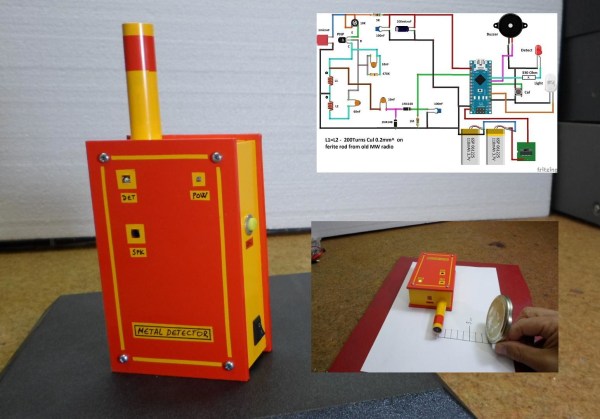
Metal detectors work because of the way metal behaves around electromagnetic fields. [mircemk] reused the ferrite core from an old MW radio to build the antenna coils. When metal objects are close enough, the induced electromagnetism changes the frequency, and the Arduino blinks an LED and beeps a buzzer in time with the new frequency.
[mircemk]’s handheld metal detector is quite sensitive, especially to smaller objects. As you can see in the demo video after the break, it can sense coins from about 4cm away, larger objects like lids from about 7 cm, and tiny things like needles from a few millimeters away. There’s also an LED for treasure hunting in low light.
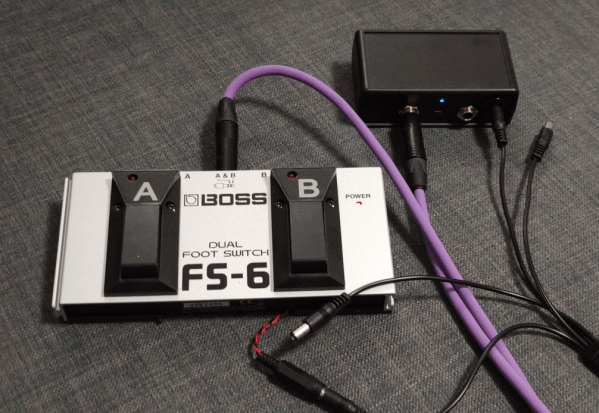
Buying things to make your life easier certainly has its therapeutic joys, but if you really wanna feel good, you gotta make the thing yourself whenever possible. [Bjørn Brandal] happened to have a two-switch BOSS pedal just lying around, so it made sense to turn it into a wireless page turner for reading sheet music.
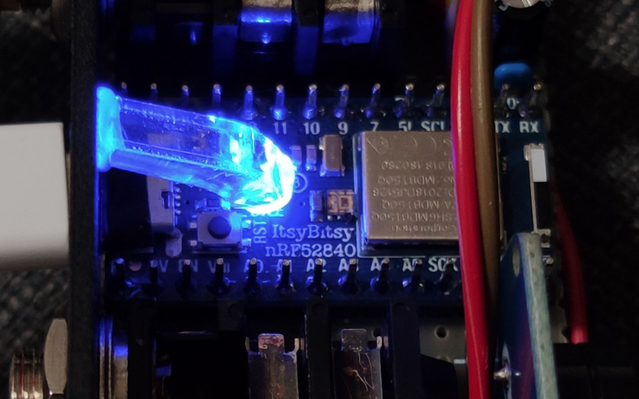
As [Bjørn] says, the circuit is simple — just two 1/4″ TRS jacks and an ItsyBitsy nRF52840 Express. The jacks are used to connect to the pedal outputs to the ItsyBitsy, which sends keystrokes over BLE.
The cool thing about this pedal is that it can work with a bunch of programs, like forScore, Abelton Live, Garage Band, and more. The different modes are accessed by holding down both pedals, and there’s confirmation via blinking LED and buzzing buzzer.
Our favorite part has to be the DIY light guide [Bjørn] that bends the ItsyBitsy’s RGB LED 90° and points it out the front of the enclosure. Nicely done!
In America, corn syrup is king, and real sugar hovers somewhere around prince status. We’re addicted to corn, and corn, in turn, is addicted to nitrogen. A long time ago, people figured out that by rotating crops, the soil will stay nutrient-rich, which helps to an extent by retaining nitrogen. Then we figured out how to make nitrogen fertilizer, and through its use we essentially doubled the average crop yield over the last hundred years or so.
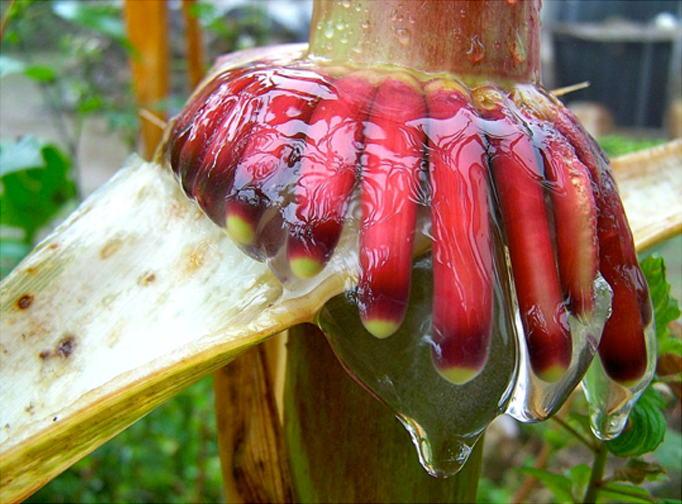
The aerial roots of the Sierra Mixe corn stalk help the plant produce its own nitrogen. Image via Wikimedia Commons
Not all plants need extra nitrogen. Legumes like beans and soybeans are able to make their own. But corn definitely needs nitrogen. In the 1980s, the now-chief of agriculture for Mars, Inc. Howard-Yana Shapiro went to Mexico, corn capital of the world, looking for new kinds of corn. He found one in southern Mexico, in the Mixes District of Oaxaca. Not only was this corn taller than American corn by several feet, it somehow grew to these dizzying heights in terrible soil.
So if we already have nitrogen fertilizer, why even look for plants that do it themselves? The Haber-Bosch fertilizer-making process, which is an artificial form of nitrogen fixation, does make barren soil less of a factor. But that extra nitrogen in ammonia-based fertilizer tends to run off into nearby streams and lakes, making its use an environmental hazard. And the process of creating ammonia for fertilizer involves fossil fuels, uses a lot of energy, and produces greenhouse gases to boot. All in all, it’s a horrible thing to do to the environment for the sake of agriculture. But with so many people to feed, what else is there to do?
Over the last decade, the UC Davis researchers use DNA sequencing to determine that the mucus on the Sierra Mixe variety of the plant provides microbes to the corn, which give it both sugars to eat and a layer of protection from oxygen. They believe that the plants get 30-80% of their nitrogen this way. The researchers also proved that the microbes do in fact belong to nitrogen-fixing families and are similar to those found in legumes. Most impressively, they were able to transplant Sierra Mixe corn to both Davis, California and Madison, Wisconsin, and have it grow successfully, proving that the nitrogen-fixing trick isn’t limited to the corn’s home turf. Now they are working to identify the genes that produce the aerial roots.
One Step in a Longer Journey of Progress
We probably won’t be switching over to Sierra Mixe corn anytime soon, however. It takes eight months to mature, which is much too slow for American appetites used to a three-month maturation period. If we can figure out how to make other plants do their own nitrogen fixation, who knows how far we could go? It seems likely that more people would accept a superpower grafted from a corn cousin instead of trying to use CRISPR to grant self-nitrogen fixation, as studies have shown a distrust of genetically modified foods.
The issue of intellectual property rights could be a problem, but the researchers started on the right foot with the Mexican government by putting legal agreements in place that ensure the Sierra Mixe community benefits from research and possible commercialization. We can’t wait to see what they’re able to do. If they’re unable to transplant the power of self-fixation to other plants, then perhaps there’s hope for improving the Haber-Bosch process.
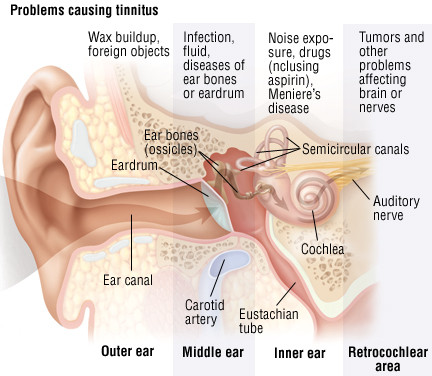
Do you suffer from tinnitus? We were surprised to learn that 15-20% of people have this condition that amounts to constant ringing in the ears. Science doesn’t fully understand the ringing part, but one possible explanation is that the brain is compensating for the frequencies it can’t hear any more.
Then [Lim] and his team tested guinea pigs, searching here, there, and under the armpits for the best place to suppress tinnitus. As it turns out, the tongue is one of the best places when used along with a specific soundscape. So then they did a human trial with 326 people. Each person had a small paddle electrode on their tongue and headphones on their ears.
As the electrodes sparkled like Pop Rocks against their tongues, the trial participants listened to pure frequencies played over a background of sound resembling vaporwave music. The combination of the two overstimulates the brain, forcing it to suppress the tinnitus reaction. This discovery certainly seems like a game changer for tinnitus sufferers. If we had tinnitus, we would be first in line to try this out given the chance. Armed with the soundscape, we’re left to wonder how many 9V batteries we’d have to lick to approximate the paddle.
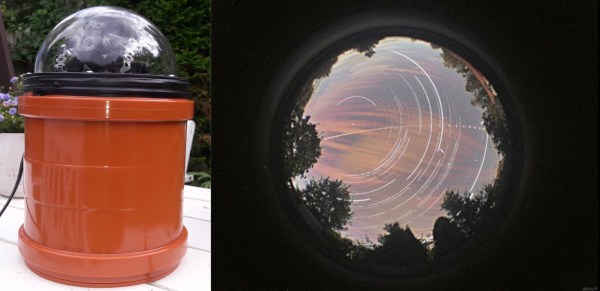
Combining a Raspberry Pi HQ camera and a waterproof housing, [jippo12] made an all-sky, all-Pi meteorite tracking camera on the cheap, and it takes fantastic photos of the heavens. It’s even got its own YouTube channel. Inside there’s a Raspberry Pi 4 plus an HQ camera to take the pictures. But there’s also a system in place to keep everything warm and working properly. It uses a Raspberry Pi 3+, a temperature sensor, and a relay control HAT to pump pixies through a couple of 10 W resistors, making just enough heat to warm up the dome to keep it from fogging.
Decades ago, Einstein predicted the existence of something he didn’t believe in — black holes. Ever since then, people have been trying to get a glimpse of these collapsed stars that represent the limits of our understanding of physics.
For the last 25 years, Andrea Ghez has had her sights set on the black hole at the center of our galaxy known as Sagittarius A*, trying to conclusively prove it exists. In the early days, her proposal was dismissed entirely. Then she started getting lauded for it. Andrea earned a MacArthur Fellowship in 2008. In 2012, she was the first woman to receive the Crafoord Prize from the Royal Swedish Academy of Sciences.
Now Andrea has become the fourth woman ever to receive a Nobel Prize in Physics for her discovery. She shares the prize with Roger Penrose and Reinhard Genzel for discoveries relating to black holes. UCLA posted her gracious reaction to becoming a Nobel Laureate.
A Star is Born
Andrea Mia Ghez was born June 16th, 1965 in New York City, but grew up in the Hyde Park area of Chicago. Her love of astronomy was launched right along with Apollo program. Once she saw the moon landing, she told her parents that she wanted to be the first female astronaut. They bought her a telescope, and she’s had her eye on the stars ever since. Now Andrea visits the Keck telescopes — the world’s largest — six times a year.
Andrea was always interested in math and science growing up, and could usually be found asking big questions about the universe. She earned a BS from MIT in 1987 and a PhD from Caltech in 1992. While she was still in graduate school, she made a major discovery concerning star formation — that most stars are born with companion star. After graduating from Caltech, Andrea became a professor of physics and astronomy at UCLA so she could get access to the Keck telescope in Mauna Kea, Hawaii.
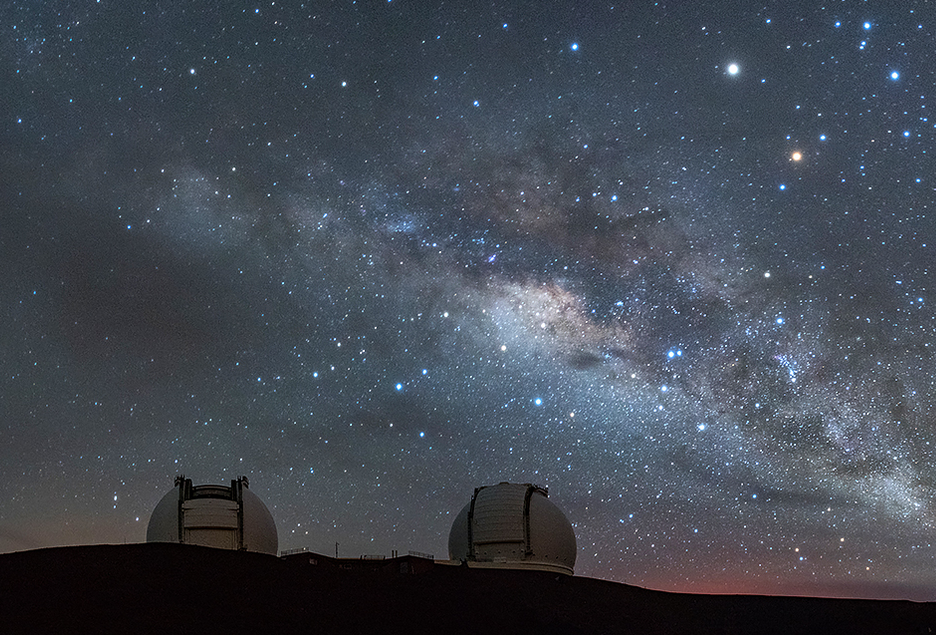
The Keck telescopes and the Milky Way. Image via Flickr
The Center of the Galaxy
Since 1995, Andrea has pointed the Keck telescopes toward the center of our galaxy, some 25,000 light years away. There’s a lot of gas and dust clouding the view, so she and her team had to get creative with something called adaptive optics. This method works by deforming the telescope’s mirror in real time in order to overcome fluctuations in the atmosphere.
Thanks to adaptive optics, Andrea and her team were able to capture images that were 10-30 times clearer than what was previously possible. By studying the orbits of stars that hang out near the center, she was able to determine that a supermassive black hole with four millions times the mass of the sun must lie there. Thanks to this telescope hack, Andrea and other scientists will be able to study the effects of black holes on gravity and galaxies right here at home. You can watch her explain her work briefly in the video after the break. Congratulations, Dr. Ghez, and here’s to another 25 years of fruitful research.
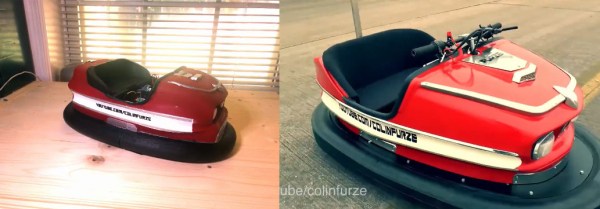
[Forsyth Creations] started by CAD-modeling the chassis right on top of a still from the video. The entire body is 3D-printed in four large pieces, which took several days because each piece took around 24 hours. Inside the car there’s an Arduino brain driving a motor in the back and a servo in the front. This bad boy runs on a couple of rechargeable battery packs and can be controlled with either a Wii balance board or a PS2 controller. This thing really moves, although it doesn’t quite reach 100MPH. Watch it zoom around in the video after the break.