Join us on Wednesday, October 13 at noon Pacific for the Resin Printing Hack Chat with Andrew Sink!
At its heart, 3D printing is such a simple idea that it’s a wonder nobody thought of it sooner. Granted, fused deposition modeling does go back to the 80s, and the relatively recent explosion in cheap, mass-market FDM printers has more to do with cheap components than anything else. But really, at the end of the day, commodity 3D printers are really not much more than glorified hot-glue guns, and while they’re still a foundational technology of the maker movement, they’ve gotten a bit dull.
So it’s natural that we in this community would look for other ways to push the 3D printing envelope, and stereolithography has become the new hotness. And with good reason — messy though it may be, the ability to gradually pull a model from a tank of goo by selective photopolymerization looks magical, and the fine level of detail resin printers are capable of is just as enchanting. So too are the prices of resin printers, which are quickly becoming competitive with commodity FDM printers.
If there’s a resin printer in your future, then you’ll want to swing by the Hack Chat when Andrew Sink visits us. Andrew has been doing a lot of 3D printing stuff in general, and resin printing in particular, over on his YouTube channel lately. We’ve featured a couple of his tricks and hacks for getting the most from a resin printer, and he’ll be sharing some of what he has learned lately. Join us as we discuss the ins and outs of resin printing, what’s involved in taking the dive, and the pros and cons of SLA versus FDM.
It is by no means an overstatement to say that life as we know it would grind to a halt without cargo ships. If any doubt remained about that fact, the last year and a half of supply chain woes put that to bed; we all now know just how much of the stuff we need — and sadly, a lot of the stuff we don’t need but still think we do — comes to us by way of one or more ocean crossings, on vessels specialized to carry everything from shipping containers to bulk liquid and solid cargo.
While the large and complex vessels that form the backbone of these globe-spanning supply chains are marvelous engineering achievements, they’re still utterly dependent on their crews to make them run efficiently. So it’s not at all surprising to learn that some shipping lines are working on ways to completely automate their cargo ships, to reduce their exposure to the need for human labor. On paper, it seems like a great idea — unless you’re a seafarer, of course. But is it a realistic scenario? Will shipping companies realize the savings that they apparently hope for by having fleets of unmanned cargo vessels plying the world’s oceans? Is this the right way to automate the freight?
We have to admit, it was hard not to be insufferably smug this week when Facebook temporarily went dark around the globe. Sick of being stalked by crazy aunts and cousins, I opted out of that little slice of cyber-hell at least a decade ago, so Monday’s outage was no skin off my teeth. But it was nice to see that the world didn’t stop turning. More interesting are the technical postmortems on the outage, particularly this great analysis by the good folks at the University of Nottingham. Dr. Steve Bagley does a great job explaining how Facebook likely pushed a configuration change to the Border Gateway Protocol (BGP) that propagated through the Internet and eventually erased all routes to Facebook’s servers from the DNS system. He also uses a graphical map of routes to show peer-to-peer connections to Facebook dropping one at a time, until their machines were totally isolated. He also offers speculation on why Facebook engineers were denied internal access, sometimes physically, to their own systems.
It may be a couple of decades overdue, but the US Federal Communications Commission finally decided to allow FM voice transmissions on Citizen’s Band radios. It seems odd to be messing around with a radio service whose heyday was in the 1970s, but Cobra, the CB radio manufacturer, petitioned for a rule change to allow frequency modulation in addition to the standard amplitude modulation that’s currently mandatory. It’s hard to say how this will improve the CB user experience, which last time we checked is a horrifying mix of shouting, screaming voices often with a weird echo effect, all put through powerful — and illegal — linear amps that distort the signal beyond intelligibility. We can’t see how a little less static is going to improve that.
Can you steal a car with a Game Boy? Probably not, but car thieves in the UK are using some sort of device hidden in a Game Boy case to boost expensive cars. A group of three men in Yorkshire used the device, which supposedly cost £20,000 ($27,000), to wirelessly defeat the security systems on cars in seconds. They stole cars for garages and driveways to the tune of £180,000 — not a bad return on their investment. It’s not clear how the device works, but we’d love to find out — for science, of course.
There have been tons of stories lately about all the things AI is good for, and all the magical promises it will deliver on given enough time. And it may well, but we’re still early enough in the AI hype curve to take everything we see with a grain of salt. However, one area that bears watching is the ability of AI to help fill in the gaps left when an artist is struck down before completing their work. And perhaps no artist left so much on the table as Ludwig von Beethoven, with his famous unfinished 10th Symphony. When the German composer died, he had left only a few notes on what he wanted to do with the four-movement symphony. But those notes, along with a rich body of other works and deep knowledge of the composer’s creative process, have allowed a team of musicologists and AI experts to complete the 10th Symphony. The article contains a lot of technical detail, both on the musical and the informatics sides. How will it sound? Here’s a preview:
And finally, Captain Kirk is finally getting to space. William Shatner, who played captain — and later admiral — James Tiberius Kirk from the 1960s to the 1990s, will head to space aboard Blue Origin’s New Shepard rocket on Tuesday. At 90 years old, Shatner will edge out Wally Funk, who recently set the record after her Blue Origin flight at the age of 82. It’s interesting that Shatner agreed to go, since he is said to have previously refused the offer of a ride upstairs with Virgin Galactic. Whatever the reason for the change of heart, here’s hoping the flight goes well.
When it comes to getting signals from an analog world into our computers, most of us don’t give much thought to how the hardware that does the job works. But as it turns out, there are a number of ways to skin the analog to digital conversion cat, and building your own homebrew successive approximation register ADC is a great way to dispel some of the mystery.
From his description of the project, it’s clear that [Mitsuru Yamada] wasn’t looking to build a practical ADC, but was more interested in what he could learn by rolling his own. A successive approximation register ADC works by quickly cycling through all possible voltage levels in its input range, eventually zeroing in on the voltage of the input signal at that moment and outputting its digital representation. The video below shows how the SAR ADC works visually, using an oscilloscope to show both the input voltage and the output of the internal R-2R DAC. The ADC has an input range of 0 V to 5 V and seven bits of resolution and uses nothing but commonly available 74xx series logic chips and a couple of easily sourced analogs for the sample-hold and comparator section. And as usual with one of his projects, the build quality and workmanship are impeccable.
Most of the horror stories you hear about air travel seem to center around luggage. Airlines do an admirable job of getting people safely to their destinations, but checked baggage is a bit of a crapshoot — it could be there when you land, it could end up taking the scenic route, or it could just plain disappear. That’s bad enough when it contains your clothes, but when it contains your livelihood? Talk about stress!
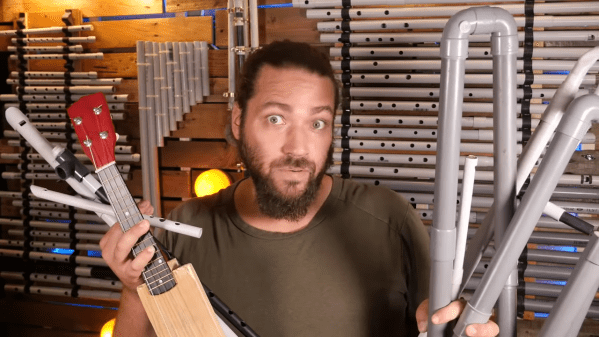
This was the position musician [Nicolas Bras] found himself in after a recent trip. [Nicolas] was heading for a gig, but thanks to Brussels Airlines, his collection of musical instruments went somewhere else. There was nothing he could do to salvage that evening’s gig, but he needed to think about later engagements. Thankfully, [Nicolas] specializes in DIY musical instruments, made mostly with PVC tubes and salvaged parts from commercial instruments, so the solution to his problem was completely in his hands.
Fair warning to musical instrument aficionados — harvest the neck from a broken ukelele is pretty gruesome stuff. Attached to a piece of pallet wood and equipped with piezo pickups, the neck became part of a bizarre yet fascinating hybrid string instrument. A selection of improvised wind instruments came next, made from PVC pipes and sounding equally amazing; we especially liked the bass chromojara, sort of a flute with a didgeridoo sound to it. The bicycle pump beatbox was genius too, and really showed that music is less about the fanciness of your gear and more about the desire — and talent — to make it with whatever comes to hand.
Here’s hoping that [Nicolas] is eventually reunited with his gear, but hats off to him in the meantime for hacking up replacements. And if he looks familiar, that’s because we’ve seen some of his work before, like his sympathetic nail violin and “Popcorn” played on PVC pipes.
LEONARDO, a somewhat tortured name derived from “LEgs ONboARD drOne,” is actually just what it appears to be: a quadcopter with a set of legs. It comes to us from Caltech’s Center for Autonomous Systems and Technologies, and the video below makes it easy to see what kind of advantages a kinematic mash-up like this would offer. LEO combines walking and flying to achieve a kind of locomotion that looks completely alien, kind of a bouncy, tip-toeing step that really looks like someone just learning how to walk in high heels. The upper drone aspect of LEO provides a lot of the stabilization needed for walking; the thrust from the rotors is where that bouncy compliance comes from. But the rotors can also instantly ramp up the thrust so LEO can fly over obstacles, like stairs. It’s also pretty good at slacklining and skateboarding, too.
It’s easy to see how LEO’s multimodal locomotion system solves — or more accurately, avoids — a number of the problems real-world bipedal robots are going to experience. For now, LEO is pretty small — only about 30″ (76 cm) tall. And it’s rather lightly constructed, as one would expect for something that needs to fly occasionally. But it’s easy to see how something like this could be scaled up, at least to a point. And LEO’s stabilization system might be just what its drunk-walking cousin needs.
The inventor in question, one [William E. Urschel] of Valparaiso, Indiana, really seemed to be onto something with his “Machine for Building Walls,” as his 1941 patent describes the idea. The first video below gives a good overview of the contraption, which consists of an “extruder” mounted on the end of a counterweighted boom, the length of which determines the radius of the circular structure produced. The boom swivels on a central mast, and is cranked up manually for each course extruded. The business end has a small hopper for what appears to be an exceptionally dry concrete or mortar mix. The hopper has a bunch of cam-driven spades that drive down into the material to push it out of the hopper; the mix is constrained between two rotating disks that trowel the sides smooth and drive the extruder forward.
The device has a ravenous appetite for material, as witnessed by the hustle the workers show keeping the machine fed. Window and door openings are handled with a little manual work, and the openings are topped with lintels to support the concrete. Clever tools are used to cut pockets for roof rafters, and the finished structure, complete with faux crenellations and a coat of stucco, looks pretty decent.


 Our Hack Chats are live community events in the Hackaday.io Hack Chat group messaging. This week we’ll be sitting down on Wednesday, October 13 at 12:00 PM Pacific time. If time zones have you tied up, we have a handy time zone converter.