A musical cyberdeck

Musical Cyberdeck Is Part Synth, Part MIDI Controller, And All Cool

When a new project type starts to get a lot of exposure, it’s typically not long before we see people forking the basic concept and striking out in a new direction. It happened with POV displays, it happened with Nixie clocks, and now, it seems to be happening with cyberdecks. And that’s something we can get behind, especially with cyberdecks built to suit a specialized task, like this musical cyberdeck/synth.

Like many musicians, [Benjamin Caccia] felt like he needed a tool to help while performing with his band “Big Time Kill.” He mainly needed to trigger track playbacks on the fly, but also wanted something to act as a mega-effects pedal and standalone synth. And while most of that could be done with an iPad, it wouldn’t look as cool as a cyberdeck. The build centers around a Raspberry Pi 4 and a 7″ LCD display. Those sit on top of a 25-key USB MIDI keyboard and a small mixer. Alongside the keyboard is a USB keypad, which has custom mappings to allow fast access to buried menu functions in the cyberdeck’s Patchbox OS. Everythign was tied together on a 3D-printed frame; the video below shows it in action, and that it sounds as good as it looks.

We think [Benjamin]’s cyberdeck came out great. Need to see some other specialized cyberdecks? Why not take a look at this battle-ready cyberdeck, one that aims to be distraction-free, or a cyberdeck for patrolling the radioactive wastelands.

Continue reading “Musical Cyberdeck Is Part Synth, Part MIDI Controller, And All Cool”

What the Antikythera workshop may have looked like

Clickspring Imagines The Workshop That Built The Antikythera Mechanism

When you look at the mechanisms of antiquity, it’s hard not to wonder, “How did they ever do that?” Just a look around our own shops shows how many things are bought from suppliers that benefit from the latest in automated machinery, computer control, and clean, safe electrical power. And that’s not to mention the high-tech stuff like electronics, which were centuries in the future for the ancient master craftsmen.

And yet, they built. Granted, not every artifact was as complex as the Antikythera mechanism, but still, this ancient astronomical computer exists, and must have come from someone’s workshop. What did that place look like? That’s the question [Chris], aka [Clickspring], sets out to answer in his new video.

Like any good academician would, he relies on evidence locked in the device itself to provide clues as to how it was produced, and to make educated guesses as to the contents of the shop (or shops) that made it. For example, the intricacy of the work would have required ample lighting, so the shop was likely at least partially open-air. There must have been a source of heat for working the brass and bronze materials of the original. There had to be workbenches, storage for stock, and probably places for apprentices to turn their hands to simple tasks under their master’s watchful eye. In short, it probably would have been quite recognizable to our eyes, and probably would have been a model of ergonomic efficiency.

[Chris] kindly gave us a sneak peek at the video and a few hours of exclusivity before it goes live to the general public, and we really appreciate that. We’re really looking forward to more of the Antikythera build, and can’t wait to see the finished product.

Continue reading “Clickspring Imagines The Workshop That Built The Antikythera Mechanism”

Industrial Design Hack Chat

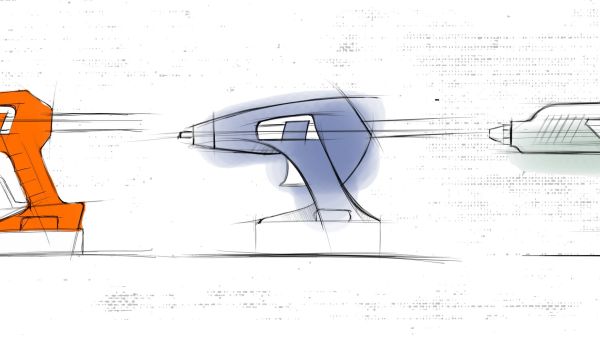
Join us on Wednesday, September 8 at noon Pacific for the Industrial Design Hack Chat with Eric Strebel!

At Hackaday, we celebrate all kinds of hardware hacks, and we try not to judge based on appearance. After all, every product starts out on the breadboard, or as a prototype built with hot glue and tape. What’s important is getting it to work, at least at first. But there comes a time when you’ve got to think about how to make your project look like something people want to use, how to position controls and displays in a logical and attractive way, and how to make sure your thing can actually be built.

Turning a project into a product is the job of an industrial designer. Pretty much everything you use, from the toothbrush by your sink to the car you drive to work in bears the marks of industrial design, some more successfully than others. Eric Strebel has been doing industrial design for years, and he keeps feeding us a steady diet of design tips and tricks through his popular YouTube channel. He’ll stop by the Hack Chat to get a little more in-depth on industrial design principles, and how you can make your projects look as good as they work.

join-hack-chatOur Hack Chats are live community events in the Hackaday.io Hack Chat group messaging. This week we’ll be sitting down on Wednesday, September 8 at 12:00 PM Pacific time. If time zones have you tied up, we have a handy time zone converter.

Scanning electron micrograph of a microfabricated lens array

Getting A Fly’s-Eye View With Microfabricated Lens Arrays

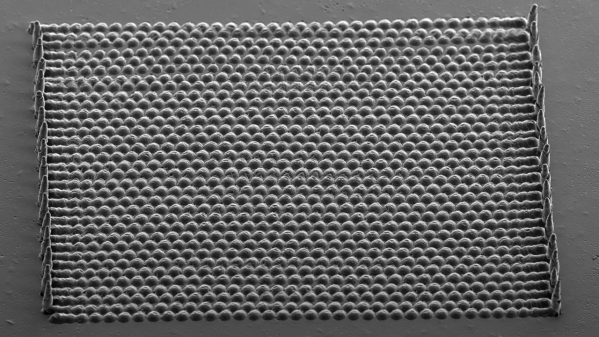
Atomic force microscopy, laser ablation, and etching with a witches brew of toxic chemicals: sounds like [Zachary Tong] has been playing in the lab again, and this time he found a way to fabricate arrays of microscopic lenses as a result.

Like many of the best projects, [Zach]’s journey into micro-fabrication started with a happy accident. It happened while he was working on metal-activated chemical etching (MACE), which uses a noble metal catalyst to selectively carve high-aspect-ratio features in silicon. After blasting at a silver-coated silicon wafer with a laser, he noticed the ablation pits were very smooth and uniform after etching. This led him to several hypotheses about what was going on, all of which he was able to test.

The experiments themselves are pretty interesting, but what’s really cool is that [Zach] realized the smooth hemispherical pits in the silicon could act as a mold for an array of microscopic convex lenses. He was able to deposit a small amount of clear silicone resin into the mold by spin-coating, and (eventually) transfer the microlens array to a glass slide. The lenses are impressively small — hundreds of them over only a couple hundred square microns — and pretty well-formed. There’s always room for improvement, of course, but for an initial attempt based on a serendipitous finding, we’d call it a win. As for what good these lenses are, your guess is as good as ours. But novel processes like these tend to find a way to be useful, and the fact that this is coming out of a home lab doesn’t change that fact.

We find this kind of micro-fabrication fascinating. Whether it’s making OLED displays, micro-machining glass with plasma, or even rolling your own semiconductors, we can’t get enough of this stuff.

Continue reading “Getting A Fly’s-Eye View With Microfabricated Lens Arrays”

Homebrew Sounder Maps The Depths In Depth

For those who like to muck around in boats, there’s enough to worry about without wondering if you’re going to run aground. And there’s really no way to know that other than to work from charts that show you exactly what lies beneath. But what does one do for places where no such charts exist? Easy — make your own homebrew water depth logger.

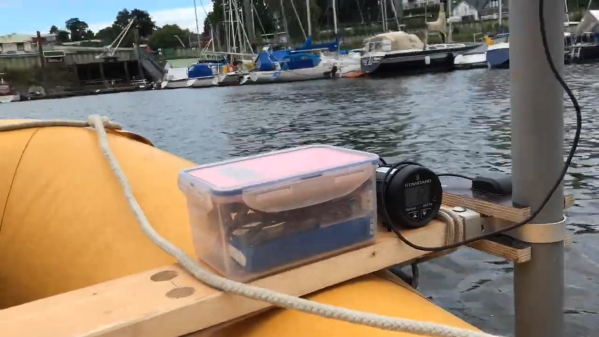
Thankfully, gone are the days when an able seaman would manually deploy the sounding line and call out the depth to the bottom. [Neumi]’s sounding rig uses an off-the-shelf sonar depth sounder, one with NMEA, or National Marine Electronic Association, output. Combined with a GPS module and an Arduino with an SD card, the rig can keep track not only of how much water is below it, but exactly where the measurement point is. The whole thing is rigged up to an inflatable dinghy which lets it slowly ply the confines of a small marina, working in and out of the nooks and crannies. A bit of Python and matplotlib stitches that data together into a bathymetric map of the harbor, with pretty fine detail. The chart also takes the tides into account, as the water level varies quite a bit over the four hours it takes to gather all the data. See it in action in the video after the hop.

There’s something cool about revealing the mysteries of the deep, even if they’re not that deep. Want to go a little deeper? We’ve seen that before too.

Continue reading “Homebrew Sounder Maps The Depths In Depth”

Hackaday Links Column Banner

Hackaday Links: September 5, 2021

Good news from Jezero crater as the Mars rover Perseverance manages to accomplish for the first time what it was sent to do: collect and cache core samples from rocks. Space buffs will no doubt recall that Perseverance’s first attempt at core sampling didn’t go as planned — the rock that planetary scientists selected ended up being too soft, and the percussive coring bit just turned the core sample into powder. The latest attempt went exactly as planned: the cylindrical coring bit made a perfect cut, the core slipped into the sample tube nested inside the coring bit, and the core broke off cleanly inside the sample tube when it was cammed off-axis. Operators were able to provide visible proof that the core sample was retained this time using the Mastcam-Z instrument, which clearly shows the core in the sample tube. What’s neat is that they then performed a “percuss to ingest” maneuver, where the coring bit and sample tube are vibrated briefly, so that the core sample and any dust grains left around the sealing rim slide down into the sample tube. The next step is to transfer the sample tube to the belly of the rover where it’ll be hermetically sealed after some basic analysis.

Did any Android users perhaps oversleep this week? If you did, you’re not alone — lots of users of the Google Clock app reported that their preset alarms didn’t go off. Whether it was an actual issue caused by an update or some kind of glitch is unclear, but it clearly didn’t affect everyone; my phone mercilessly reminded me when 6:00 AM came around every day last week. But it apparently tripped up some users, to the point where one reported losing his job because of being late for work. Not to be judgmental, but it seems to me that if your job is so sensitive to you being late, it might make sense to have a backup alarm clock of some sort. We all seem to be a little too trusting that our phones are going to “just work,” and when they don’t, we’re surprised and appalled.

There seem to be two kinds of people in the world — those who hate roller coasters, and those who love them. I’m firmly in the latter camp, and will gladly give any coaster, no matter how extreme, a try. There have been a few that I later regretted, of course, but by and large, the feeling of being right on the edge of bodily harm is pretty cool. Crossing over the edge, though, is far less enjoyable, as the owners of an extreme coaster in Japan are learning. The Dodon-pa coaster at the Fuji-Q Highland amusement park is capable of hitting 112 miles (180 km) per hour and has racked up a sizable collection of injuries over the last ten months, including cervical and thoracic spine fractures. The ride is currently closed for a safety overhaul; one has to wonder what they’re doing to assess what the problem areas of the ride are. Perhaps they’re sending crash test dummies on endless rides to gather data, a sight we’d like to see.

And finally, you may have thought that phone phreaking was a thing of the past; in a lot of ways, you’d be right. But there’s still a lot to be learned about how POTS networks were put together, and this phone switch identification guide should be a big help to any phone geeks out there. Be ready to roll old school here — nothing but a plain text file that describes how to probe the switch that a phone is connected just by listening to things like dial tones and ring sounds. What’s nice is that it describes why the switches sound the way they do, so you get a lot of juicy technical insights into how switches work.


A homemade seven-segment OLED display

Making OLED Displays In The Home Lab

Just a general observation: when your project’s BOM includes ytterbium metal, chances are pretty good that it’s something interesting. We’d say that making your own OLED displays at home definitely falls into that category.

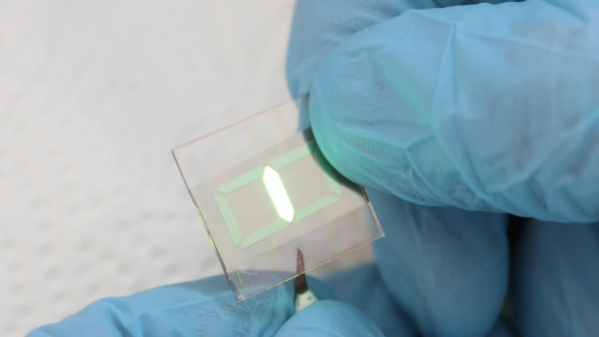
Of course, the making of organic light-emitting diodes requires more than just a rare-earth metal, not least of which is the experience in the field that [Jeroen Vleggaar] brings to this project. Having worked on OLEDs at Philips for years, [Jeroen] is well-positioned to tackle the complex process, involving things like physical vapor deposition and the organic chemistry of coordinated quinolones. And that’s not to mention the quantum physics of it all, which is nicely summarized in the first ten minutes or so of the video below. From there it’s all about making a couple of OLED displays using photolithography and the aforementioned PVD to build up a sandwich of Alq3, an electroluminescent organic compound, on a substrate of ITO (indium tin oxide) glass. We especially appreciate the use of a resin 3D printer to create the photoresist masks, as well as the details on the PVD process.

The displays themselves look fantastic — at least for a while. The organic segments begin to oxidize rapidly from pinholes in the material; a cleanroom would fix that, but this was just a demonstration, after all. And as a bonus, the blue-green glow of [Jeroen]’s displays reminds us strongly of the replica Apollo DSKY display that [Ben Krasnow] built a while back. Continue reading “Making OLED Displays In The Home Lab”