Cocktail Of Chemicals Makes This Blueprint Camera Unique

When you’re looking at blueprints today, chances are pretty good that what you’re seeing is anything but blue. Most building plans, diagrams of civil engineering projects, and even design documents for consumer products never even make it to paper, let alone get rendered in old-fashioned blue-and-white like large-format prints used to produced. And we think that’s a bit of a shame.

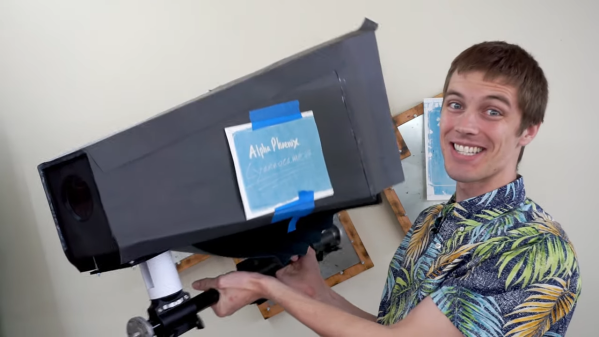
Luckily, [Brian Haidet] longs for those days as well, so much so that he built this large-format cyanotype camera to create photographs the old-fashioned way. Naturally, this is one of those projects where expectations must be properly scaled before starting; after all, there’s a reason we don’t go around taking pictures with paper soaked in a brew of toxic chemicals. Undaunted by the chemistry, [Brian] began his journey with simple contact prints, with Sharpie-marked transparency film masking the photosensitive paper, made from potassium ferricyanide, ammonium dichromate, and ammonium iron (III) oxalate, from the UV rays of the sun. The reaction creates the deep, rich pigment Prussian Blue, contrasting nicely with the white paper once the unexposed solution is washed away.

[Brian] wanted to go beyond simple contact prints, though, and the ridiculously large camera seen in the video below is the result. It’s just a more-or-less-lightproof box with a lens on one end and a sheet of sensitized paper at the other. The effective ISO of the “film” is incredibly slow, leading to problematically long exposure times. Coupled with the distortion caused by the lens, the images are — well, let’s just say unique. They’ve got a ghostly quality for sure, and there’s a lot to be said for that Prussian Blue color.

We’ve seen cyanotype chemistry used with UV lasers before, and large-format cameras using the collodion process. And we wonder if [Brian]’s long-exposure process might be better suited to solargraphy.

Continue reading “Cocktail Of Chemicals Makes This Blueprint Camera Unique”

Hackaday Links Column Banner

Hackaday Links: May 23, 2021

The epicenter of the Chinese electronics scene drew a lot of attention this week as a 70-story skyscraper started wobbling in exactly the way skyscrapers shouldn’t. The 1,000-ft (305-m) SEG Plaza tower in Shenzhen began its unexpected movements on Tuesday morning, causing a bit of a panic as people ran for their lives. With no earthquakes or severe weather events in the area, there’s no clear cause for the shaking, which was clearly visible from the outside of the building in some of the videos shot by brave souls on the sidewalks below. The preliminary investigation declared the building safe and blamed the shaking on a combination of wind, vibration from a subway line under the building, and a rapid change in outside temperature, all of which we’d suspect would have occurred at some point in the 21-year history of the building. Others are speculating that a Kármán vortex Street, an aerodynamic phenomenon that has been known to catastrophically impact structures before, could be to blame; this seems a bit more likely to us. Regardless, since the first ten floors of SEG Plaza are home to one of the larger electronics markets in Shenzhen, we hope this is resolved quickly and that all our friends there remain safe.

In other architectural news, perched atop Building 54 at the Massachusetts Institute of Technology campus in Cambridge for the last 55 years has been a large, fiberglass geodesic sphere, known simply as The Radome. It’s visible from all over campus, and beyond; we used to work in Kendall Square, and the golf-ball-like structure was an important landmark for navigating the complex streets of Cambridge. The Radome was originally used for experiments with weather radar, but fell out of use as the technology it helped invent moved on. That led to plans to remove the iconic structure, which consequently kicked off a “Save the Radome” campaign. The effort is being led by the students and faculty members of the MIT Radio Society, who have put the radome to good use over the years — it currently houses an amateur radio repeater, and the Radio Society uses the dish within it to conduct Earth-Moon-Earth (EME) microwave communications experiments. The students are serious — they applied for and received a $1.6-million grant from Amateur Radio Digital Communications (ARDC) to finance their efforts. The funds will be used to renovate the deteriorating structure.

Well, this looks like fun: Python on a graphing calculator. Texas Instruments has announced that their TI-84 Plus CE Python graphing calculator uses a modified version of CircuitPython. They’ve included seven modules, mostly related to math and time, but also a suite of TI-specific modules that interact with the calculator hardware. The Python version of the calculator doesn’t seem to be for sale in the US yet, although the UK site does have a few “where to buy” entries listed. It’ll be interesting to see the hacks that come from this when these are readily available.

Did you know that PCBWay, the prolific producer of cheap PCBs, also offers 3D-printing services too? We admit that we did not know that, and were therefore doubly surprised to learn that they also offer SLA resin printing. But what’s really surprising is the quality of their clear resin prints, at least the ones shown on this Twitter thread. As one commenter noted, these look more like machined acrylic than resin prints. Digging deeper into PCBWay’s offerings, which not only includes all kinds of 3D printing but CNC machining, sheet metal fabrication, and even injection molding services, it’s becoming harder and harder to justify keeping those capabilities in-house, even for the home gamer. Although with what we’ve learned about supply chain fragility over the last year, we don’t want to give up the ability to make parts locally just yet.

And finally, how well-calibrated are your fingers? If they’re just right, perhaps you can put them to use for quick and dirty RF power measurements. And this is really quick and really dirty, as well as potentially really painful. It comes by way of amateur radio operator VK3YE, who simply uses a resistive dummy load connected to a transmitter and his fingers to monitor the heat generated while keying up the radio. He times how long it takes to not be able to tolerate the pain anymore, plots that against the power used, and comes up with a rough calibration curve that lets him measure the output of an unknown signal. It’s brilliantly janky, but given some of the burns we’ve suffered accidentally while pursuing this hobby, we’d just as soon find another way to measure RF power.

JavaScript App Uses Advanced Math To Make PCBs Easier To Etch

We all remember the litany from various math classes we’ve taken, where frustration at a failure to understand a difficult concept bubbles over into the classic, “When am I ever going to need to know this in real life?” But as we all know, even the most esoteric mathematical concepts have applications in the real world, and failure to master them can come back to haunt you.

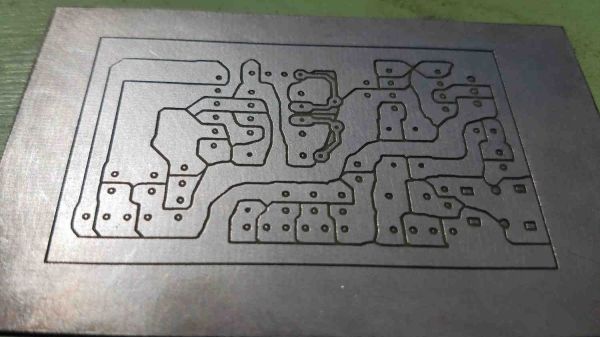
Take Voronoi diagrams, for example. While we don’t recall being exposed to these in any math class, it turns out that they can be quite useful in a seemingly unrelated area: converting PCB designs into easy-to-etch tessellated patterns. Voronoi diagrams are in effect a plane divided into different regions, or “cells”, each centered on a “seed” object. Each cell is the set of points that are closer to a particular seed than they are to any other seed. For PCBs the seeds can be represented by the traces; dividing the plane up into cells around those traces results in a tessellated pattern that’s easily etched.

To make this useful to PCB creators, [Craig Iannello] came up with a JavaScript application that takes an image of a PCB, tessellates the traces, and spits out G-code suitable for a laser engraver. A blank PCB covered with a layer of spray paint, the tessellated pattern is engraved into the paint, and the board is etched and drilled in the usual fashion. [Craig]’s program makes allowances for adding specific features to the board, like odd-shaped pads or traces that need specific routing.

This isn’t the first time we’ve seen Voronoi diagrams employed for PCB design, but the method looks so easy that we’d love to give it a try. It even looks as though it might work for CNC milling of boards too.

Thousands Of Discrete MOSFETs Make Up This Compact CPU-Less Computer

How long has it been since a computer could boast about the fact that it contained 2,500 transistors? Probably close to half a century now, at a guess. So in a world with a couple of billion transistors per chip, is a 2,500-transistor computer really something to brag about? Yes. Yes, it is.

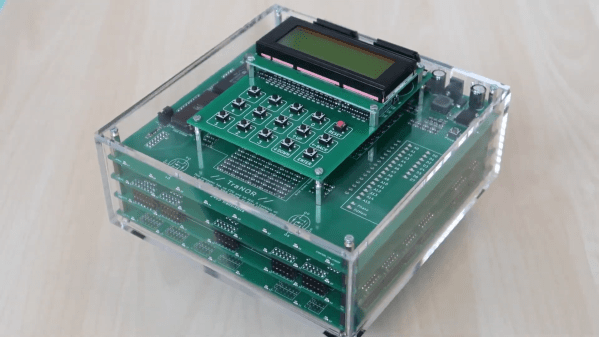
The CPU-less computer, called the TraNOR by its creator [Dennis Kuschel], is an elaboration on his previous MyNOR, another CPU-less machine that used a single NOR-gate made of discrete transistors as the core of its arithmetic-logic unit (ALU). Despite its architectural simplicity, MyNOR was capable of some pretty respectable performance, and even managed to play a decent game of Tetris. TraNOR, on the other hand, is much more complicated, mainly due to the fact that instead of relying on 74HC-series chips, [Dennis] built every single gate on the machine from discrete MOSFETs. The only chips on the four stacked PCBs are a trio of memory chips; we don’t fault him at all for the decision not to build the memory — he may be dedicated, but even art has its limits. And TraNOR is indeed a work of art — the video below shows the beautiful board layouts, with seemingly endless arrays of SMD transistors all neatly arranged and carefully soldered. And extra points for using Wintergatan’s marble machine melody as the soundtrack, too.

As much as we loved the original, TraNOR is really something special. Not only is it beautiful, but it’s functional — it’s even backward-compatible with MyNOR’s custom software. Hats off to [Dennis] for pulling off another wonderful build, and for sharing it with us.

Continue reading “Thousands Of Discrete MOSFETs Make Up This Compact CPU-Less Computer”

2021 Hackaday Prize Hack Chat; Join Us Live On Wednesday

Join us on Wednesday, May 19 at noon Pacific for the 2021 Hackaday Prize Hack Chat with Majenta Strongheart!

At this point last year, we probably all felt like we’d been put through a wringer, and that things would get back to normal any day now. Little did we know how much more was in store for us, and how many more challenges would be heaped on our plates. Everything that we thought would be temporary seems to be more or less permanent now, and we’ve all had to adapt to the new facts of life as best we can.

But we’re hackers, and adapting to new situations more often than not means making the world fit our vision. And that’s why the 2021 Hackaday Prize has adopted the theme of “Rethink, Refresh, Rebuild.” We want you to rethink and refresh familiar concepts across the hardware universe, and create the kind of innovation this community is famous for.

The 2021 Hackaday Prize will have it all. As in previous years, the Prize will have several specific challenges, where we set you to work on a creative problem. There will also be mentoring sessions available, $500 cash prizes for 50 finalists along the way, with $25,000 and a Supplyframe Design Lab residency awarded to the Grand Prize winner.

We know you’re going to want to step up to the challenge, so to help get you started, Majenta Strongheart, Head of Design and Partnerships at Supplyframe, will drop by the Hack Chat with all the details on the 2021 Hackaday Prize. Come prepared to pick her brain on how the Prize is going to work this year, find out about the mentoring opportunities, and learn everything there is to know about this year’s competition. It’s the Greatest Hardware Design Challenge on Earth, so make sure you get in on the action.

join-hack-chatOur Hack Chats are live community events in the Hackaday.io Hack Chat group messaging. This week we’ll be sitting down on Wednesday, May 19 at 12:00 PM Pacific time. If time zones have you tied up, we have a handy time zone converter.

Click that speech bubble to the right, and you’ll be taken directly to the Hack Chat group on Hackaday.io. You don’t have to wait until Wednesday; join whenever you want and you can see what the community is talking about.
Continue reading “2021 Hackaday Prize Hack Chat; Join Us Live On Wednesday”

Gassing Up: Understanding The Liquid Fuel Distribution Network

When someone talks about “The Grid,” as in “dropping off the grid” or “the grid is down,” we tend to think in terms of the electromagnetic aspects of the infrastructure of modern life. The mind’s eye sees The Grid as the network of wires that moves electricity from power plants to homes and businesses, or the wires, optical cables, and wireless links that form the web of data lines that have stitched the world together informatically.

The Grid isn’t just about power and data, though. A huge portion of the infrastructure of the developed world is devoted to the simple but vital task of moving liquid fuels from one place to another as efficiently and safely as possible. This fuel distribution network, comprised of pipelines, railways, and tanker trucks, is very much part of The Grid, even if it goes largely unseen and unnoticed. At least until something major happens to shift attention to it, like the recent Colonial Pipeline cyberattack.

Continue reading “Gassing Up: Understanding The Liquid Fuel Distribution Network”

Hackaday Links Column Banner

Hackaday Links: May 16, 2021

With the successful arrival of China’s first Mars lander and rover this week, and the relatively recent addition of NASA’s Perseverance rover and its little helicopter sidekick Ingenuity, Mars has collected a lot of new hardware lately. But while the new kids on the block are getting all the attention, spare a thought for the reliable old warhorse which has been plying Gale Crater for the better part of a decade now — Curiosity. NASA has been driving the compact-car-sized rover around Mars for a long time now, long enough to rack up some pretty severe damage to its six highly engineered wheels, thanks to the brutal Martian rocks. But if you think Curiosity will get sidelined as its wheels degrade, think again — the rover’s operators have a plan to continue surface operations that includes ripping off its own wheels if necessary. It’s a complex operation that would require positioning the wheel over a suitable rock and twisting with the steering motor to peel off the outer section of the wheel, leaving a rim to drive around on. JPL has already practiced it, but they predict it won’t be necessary until 2034 or so. Now that’s thinking ahead.

With all the upheaval caused by the ongoing and worsening semiconductor shortage, it might seem natural to expect that manufacturers are responding to market forces by building new fabs to ramp up production. And while there seems to be at least some movement in that direction, we stumbled across an article that seems to give the lie to the thought that we can build our way out of the crisis. It’s a sobering assessment, to say the least; the essence of the argument is that 20 years ago or so, foundries thought that everyone would switch to the new 300-mm wafers, leaving manufacturing based on 200-mm silicon wafers behind. But the opposite happened, and demand for chips coming from the older 200-mm wafers, including a lot of the chips used in cars and trucks, skyrocketed. So more fabs were built for the 200-mm wafers, leaving relatively fewer fabs capable of building the chips that the current generation of phones, IoT appliances, and 5G gear demand. Add to all that the fact that it takes a long time and a lot of money to build new fabs, and you’ve got the makings of a crisis that won’t be solved anytime soon.

From not enough components to too many: the Adafruit blog has a short item about XScomponent, an online marketplace for listing your excess inventory of electronic components for sale. If you perhaps ordered a reel of caps when you only needed a dozen, or if the project you thought was a done deal got canceled after all the parts were ordered, this might be just the thing for you. Most items offered appear to have a large minimum quantity requirement, so it’s probably not going to be a place to pick up a few odd parts to finish a build, but it’s still an interesting look at where the market is heading.

Speaking of learning from the marketplace, if you’re curious about what brands and models of hard drives hold up best in the long run, you could do worse than to look over real-world results from a known torturer of hard drives. Cloud storage concern Backblaze has published their analysis of the reliability of the over 175,000 drives they have installed in their data centers, and there’s a ton of data to pick through. The overall reliability of these drives, which are thrashing about almost endlessly, is pretty impressive: the annualized failure rate of the whole fleet is only 0.85%. They’ve also got an interesting comparison of HDDs and SSDs; Backblaze only uses solid-state disks for boot drives and for logging and such, so they don’t get quite the same level of thrash as drives containing customer data. But the annualized failure rate of boot SDDs is much lower than that of HDDs used in the same role. They slice and dice their data in a lot of fun and revealing ways, including by specific brand and model of drive, so check it out if you’re looking to buy soon.

And finally, you know that throbbing feeling you get in your head when you’re having one of those days? Well, it turns out that whether you can feel it or not, you’re having one of those days every day. Using a new technique called “3D Amplified Magnetic Resonance Imaging”, or 3D aMRI, researchers have made cool new videos that show the brain pulsating in time to the blood flowing through it. The motion is exaggerated by the imaging process, which is good because it sure looks like the brain swells enough with each pulse to crack your skull open, a feeling which every migraine sufferer can relate to. This reminds us a bit of those techniques that use special algorithms to detects a person’s heartbeat from a video by looking for the slight but periodic skin changes that occurs as blood rushes into the capillaries. It’s also interesting that when we spied this item, we were sitting with crossed legs, watching our upper leg bounce slightly in time with our pulse.

Continue reading “Hackaday Links: May 16, 2021”