Turning A Waterjet Cutter Into A Wood Lathe, For No Reason

On the shortlist of dream tools for most metalworkers is a waterjet cutter, a CNC tool that uses insanely high-pressure water mixed with abrasive grit to blast sheet metal into intricate shapes. On exactly nobody’s list is this attachment that turns a waterjet cutter into a lathe, and with good reason, as we’ll see.

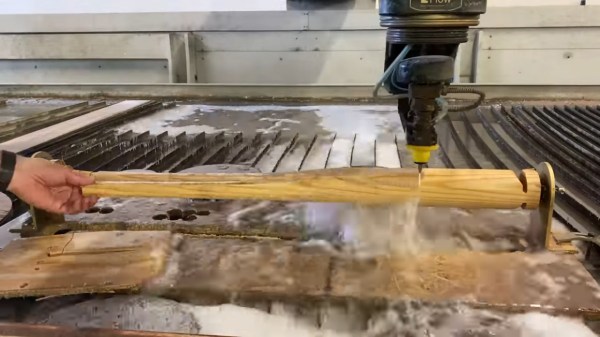
This one comes to us by way of the Waterjet Channel, because of course there’s a channel dedicated to waterjet cutting. The idea is a riff on fixtures that allow a waterjet cutter (or a plasma cutter) to be used on tubes and other round stock. This fixture was thrown together from scrap and uses an electric drill to rotate a wood blank between centers on the bed of the waterjet, with the goal of carving a baseball bat by rotating the blank while the waterjet carves out the profile.

The first attempt, using an entirely inappropriate but easily cut blank of cedar, wasn’t great. The force of the water hitting the wood was enough to stall the drill; the remedy was to hog out as much material as possible from the blank before spinning up for the finish cut. That worked well enough to commit to an ash bat blank, which was much harder to cut but still worked well enough to make a decent bat.

Of course it makes zero sense to use a machine tool costing multiple hundreds of thousands of dollars to machine baseball bats, but it was a fun exercise. And it only shows how far we’ve come with lathes since the 18th-century frontier’s foot-powered version of the Queen of the Machine Shop.

Continue reading “Turning A Waterjet Cutter Into A Wood Lathe, For No Reason”
Open-Source Grinder Makes Compression Screws For Plastic Extruders Easy

In a world that’s literally awash in plastic waste, it seems a pity to have to buy fresh rolls of plastic filament to feed our 3D-printers, only to have them generate yet more plastic waste. Breaking that vicious cycle requires melding plastic recycling with additive manufacturing, and that takes some clever tooling with parts that aren’t easy to come by, like the compression screws that power plastics extruders.

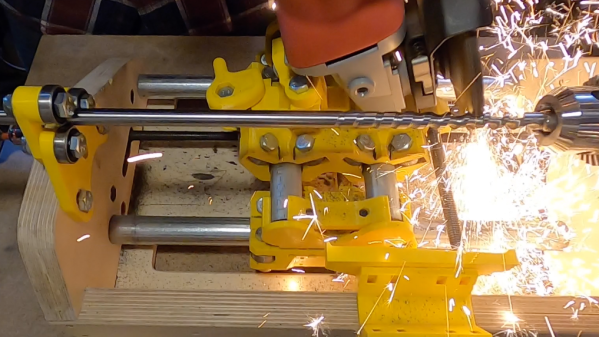
This open-source compression screw grinder aims to make small-scale plastic recyclers easier to build. Coming from the lab of [Joshua Pearce] at the Michigan Technological University in collaboration with [Jacob Franz], the device is sort of a combination of a small lathe and a grinder. A piece of round steel stock is held by a chuck with the free end supported by bearings in a tailstock. On the bed of the machine is an X-Y carriage made of 3D-printed parts and pieces of electrical conduit. The carriage moves down the length of the bed as the stock rotates thanks to a pulley and a threaded rod, carrying a cordless angle grinder with a thick grinding wheel. A template attached to the front apron controls how deep the grinder cuts as it tracks along the rod; different templates allow the screw profile to be easily customized. The video below shows the machine in action and the complicated screw profiles it’s capable of producing.

We’ve seen lots of homebrew plastic extruders before, most of which use repurposed auger-type drill bits as compression screws. Those lack the variable geometry of a proper compression screw, so [Joshua] and [Jacob] making all the design documents for this machine available should be a boon to recycling experimenters.

Continue reading “Open-Source Grinder Makes Compression Screws For Plastic Extruders Easy”

Magnetic Couplings Make This Lego Submarine Watertight

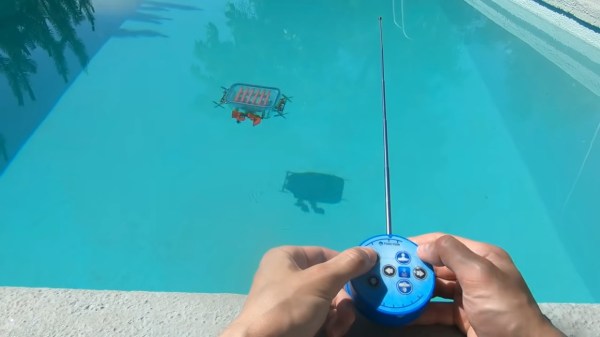
Although you’d be hard-pressed to tell in some areas, it’s summer in the northern hemisphere, which always seems to bring out the projects that require a swimming pool for adequate testing. The [Brick Experiment Channel]’s latest build, a submersible made almost entirely from Lego, is one such project and has us pining for weather that makes a dip sensible rather than suicidal.

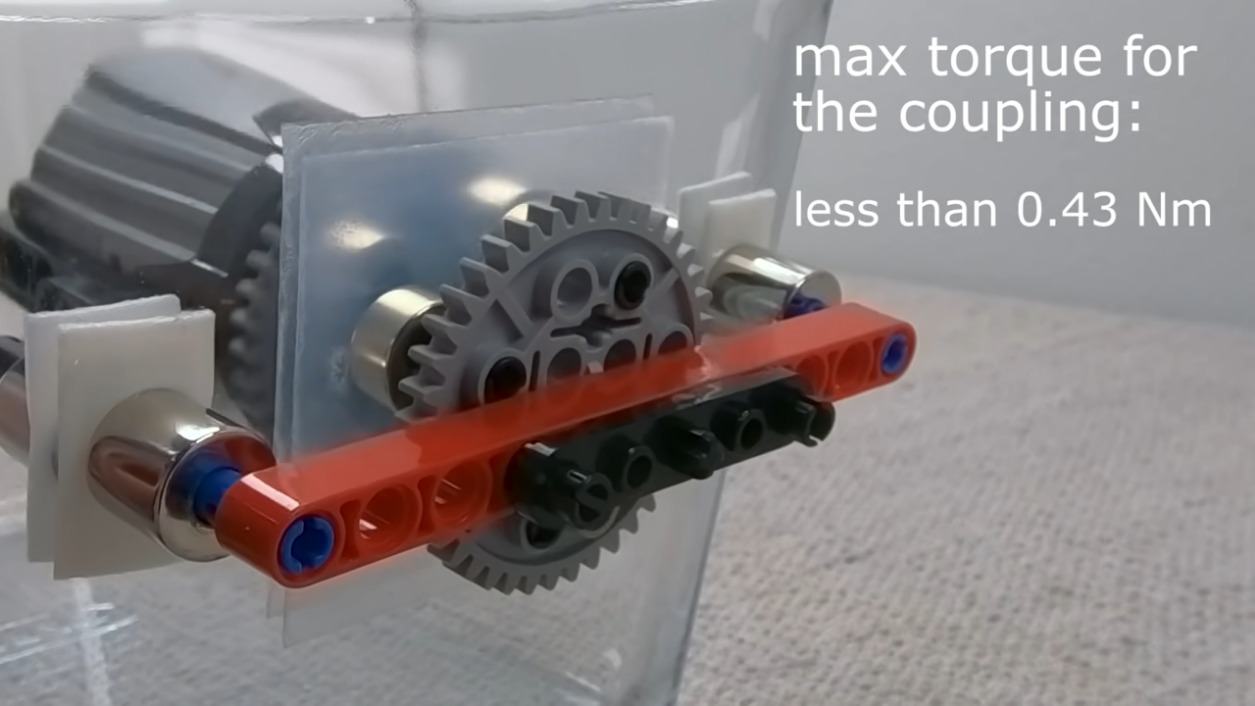
The sub featured in the video below is a significant improvement over the “Sub in a Jug” approach the [Brick Experiment Channel] favored for version 1. Rather than starting with a vessel specifically designed not to hold water, the hull for this vessel is an IKEA food container, with a stout glass body and a flexible lid with silicone seals. And instead of penetrating the hull for driveshafts and attempting to seal them, this time around he built clever magnetic couplings.

The couplings transmit torque from the motors on the inside to gears and props on the outside. And where the first version used a syringe-pump ballast tank to control the depth, this one uses vertical thrusters. The flexible lid proved to be a problem with that scheme, since it tended to collapse as the depth increased, preventing the sub from surfacing. That was solved with some Lego bracing and adjustment of the lead shot ballast used to keep the sub neutrally buoyant.

This looks like a ton of summer fun, and even if you don’t have Legos galore to work with, it could easily be adapted to other materials. There are a ton of other fun [BEC] Lego builds to check out, some of which we’ve covered, including a Lego drone and a playing card shooter.

Continue reading “Magnetic Couplings Make This Lego Submarine Watertight”

Linux In The Machine Shop Hack Chat

Join us on Wednesday, July 8 at noon Pacific for the Linux in the Machine Shop Hack Chat with Andy Pugh!

From the time that numeric control started making inroads into machine shops in the middle of the last century until relatively recently, the power of being able to control machine tools with something other than a skilled human hand was evident. Unfortunately, the equipment to do so was expensive, and so NC technology remained firmly in the big shops, where a decent return on investment could be realized.

Fast forward a few decades, and everything that makes the computerized version of NC possible is cheap and easily available. Servos, steppers, drivers, and motion control components can be plugged together into CNC machines that can move a tool to a fixed point in space with incredible accuracy and repeatability. But without CNC software, none of it means a thing.

Enter Linux CNC, the free and open-source CNC package. With support for realtime operation, one-step installations, and a huge range of capabilities provided by a team of volunteer developers and supported by an active community, Linux CNC has democratized the world of CNC machines.

Andy Pugh is a frequent contributor to the Linux CNC codebase and a moderator on the forum. He knows a thing or two about Linux CNC in particular and Linux in the machine shop in general. He’ll stop by the Hack Chat to share his experiences with the Linux CNC project, tell us how Linux can revolutionize the machine shop, and maybe share a few stories from the world of CAD, CAM, and using Linux to make a few chips.

join-hack-chatOur Hack Chats are live community events in the Hackaday.io Hack Chat group messaging. This week we’ll be sitting down on Wednesday, July 8 at 12:00 PM Pacific time. If time zones have you down, we have a handy time zone converter.

Click that speech bubble to the right, and you’ll be taken directly to the Hack Chat group on Hackaday.io. You don’t have to wait until Wednesday; join whenever you want and you can see what the community is talking about.

Continue reading “Linux In The Machine Shop Hack Chat”

3D-Printing Bigger Wind Turbines

Many decades ago, a much younger version of me was in the car with my dad and my brother, cruising down the highway on some errand or another. We were probably all in the front seat, and none of us were wearing seatbelts; those were simpler times. As we passed under an overpass, my dad said, “Do you know why the overpasses on these roads are so high?” Six-year-old me certainly didn’t, but it was clear dad did and had something to say about it, so we just shook our heads and waited for the lesson. “Because that’s how big nuclear missiles are.” He then went into an explanation of how the Interstate Highway System in the USA, then still in its infancy, was designed to make sure the armed forces could move around the country, so overpasses needed to allow trucks with big loads to pass.

It was an interesting lesson at the time, and over the years I’ve continued to be impressed with the foresight and engineering that went into the Interstate system here in the US. It’s far from perfect, of course, and it’s only recently that the specifications for the system have started to put a pinch on things that seem totally unrelated to overpass dimensions — namely, the size and efficiency of wind turbines.

Continue reading “3D-Printing Bigger Wind Turbines”

Hackaday Links Column Banner

Hackaday Links: July 5, 2020

Remember all the hubbub over Betelgeuse back in February? For that matter, do you even remember February? If you do, you might recall that the red giant in Orion was steadily dimming, which some took as a portent of an impending supernova. That obviously didn’t happen, but we now seem to have an explanation for the periodic dimming: an enormous dark spot on the star. “Enormous” doesn’t begin to describe this thing, which covers 70% of the face of a star that would extend past Jupiter if it replaced the sun. The dimming was originally thought to be dust being blown off the star as it goes through its death throes, but no evidence could be found for that, while direct observations in the terahertz range showed what amounted to a reduction in surface temperature caused by the enormous star spot. We just think it’s incredibly cool that Betelgeuse is so big that we can actually observe it as a disk rather than a pinpoint of light. At least for now.

F-15c cockpit
F-15a cockpit

If you think you’ve seen some challenging user interfaces, wait till you get a load of the cockpit of an F-15C Eagle. As part of a new series on human interfaces, Ars Technica invited Col. Andrea Themely (USAF-ret.) to give a tour of the fighter she has over 1,100 hours on. Bearing in mind that the Eagle entered service in 1976 and has been continually updated with the latest avionics — compare the video with the steam gauges of the cockpit of an F-15A — its cockpit is still a pretty busy place. As much as possible has been done to reduce pilot load, with controls being grouped by function and the use of color-coding — don’t touch the yellow and black stuff! — and the use of tactile feedback. It’s a fascinating deep dive into a workplace that few of us ever get to see, and we’re looking forward to the rest of the series.

Sad news from Seattle, where the Living Computers: Museum + Labs is closing up shop. The announcement only says they’re closing “for now”, so there’s at least some hope that the museum will be back once the COVID-19 downturn has run its course. We hope they do bounce back; it really was a great museum with a lot of amazing hardware on display. The Vintage Computer Festival PNW was held there in its inaugural year, an event we covered and had high hopes for in the future. We hope for the best for these educational and cultural institutions, but we can’t help but fear a little for their future.

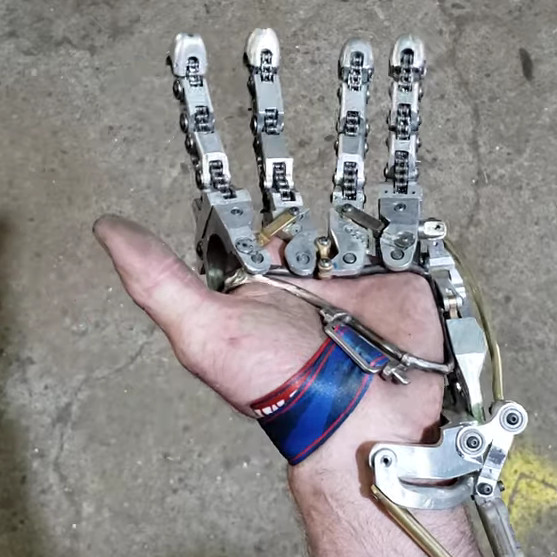
So you suffer a partial amputation of your left hand, leaving you with only your thumb and your palm. That raises an interesting conundrum: you haven’t lost enough to replace the hand with a prosthetic one, but you still don’t have any fingers. That appears to be what happened to Ian Davis, and so he built his own partial prosthetic to replace his fingers. There’s not much backstory on his YouTube channel, but from what we can gather he has gone through several designs, most of which are myomechanical rather than myoelectric. Through a series of complex linkages, he’s able to control not only the opening and closing of the fingers, but also to splay them apart. It’s all in the wrist, as it were — his input gestures all come from flexing and extending his hand relative to his forearm, where the prosthesis is anchored. This results in a pretty powerful grip — much stronger than a myoelectric hand in a head-to-head test. And the coolness factor of his work is just off the scale. We’re looking forward to more from Ian, and hopefully enough background information for a full story on what he has accomplished.

Sky Anchor Puts Radios Up High, No Tower Needed

When it comes to radio communications on the VHF bands and above, there’s no substitute for elevation. The higher you get your antenna, the farther your signal will get out. That’s why mountaintops are crowded with everything from public service radios to amateur repeaters, and it’s the reason behind the “big stick” antennas for TV and radio stations.

But getting space on a hilltop site is often difficult, and putting up a tower is always expensive. Those are the problems that the Sky Anchor, an antenna-carrying drone, aims to address. The project by [Josh Starnes] goes beyond what a typical drone can do. Rather than relying on GPS for station keeping, [Josh] plans a down-looking camera so that machine vision can keep the drone locked over its launch site. To achieve unlimited flight time, he’s planning to supply power over a tether. He predicts a 100′ to 200′ (30 m to 60 m) working range with a heavy-lift octocopter. A fiberoptic line will join the bundle and allow a MIMO access point to be taken aloft, to provide wide-area Internet access. Radio payloads could be anything from SDR-based transceivers to amateur repeaters; if the station-keeping is good enough, microwave links could even be feasible.

Sky Anchor sounds like a great idea that could have applications in disaster relief and humanitarian aid situations. We’re looking forward to seeing how [Josh] develops it. In the meantime, what’s your world-changing idea? If you’ve got one, we’d love to see it entered in the 2020 Hackaday Prize.