Willem Kolff’s Artificial Organs

In my youth I worked for a paid ambulance service, and while we all lived for the emergency calls, the routine transports were the calls that paid the bills. Compared with the glamor and excitement of a lights-and-siren run to a car wreck or heart attack, transports were dull as dirt. And dullest of all were the daily runs from nursing homes to the dialysis center, where rows of comfy chairs sat, each before a refrigerator-sized machine designed to filter the blood of a patient in renal failure, giving them another few days of life.

Sadly, most of those patients were doomed; many were in need of a kidney transplant for which there was no suitable donor, while some were simply not candidates for transplantation. Dialysis was literally all that stood between them and a slow, painful death, and I could see that at least some of them were cheered by the sight of the waiting dialysis machine. The principles of how the kidneys work have been known since at least the 1800s, but it would take until 1945 for the efforts of a Dutch doctor, using used car parts and sausage casings, to make the predecessor of those machines: the first artificial kidney.

Continue reading “Willem Kolff’s Artificial Organs”

Designing Sci-Fi Hack Chat

Join us on Wednesday, October 9 at noon Pacific for the Designing Sci-Fi Hack Chat with Seth Molson!

We all know the feeling of watching a movie set in a galaxy far, far away and seeing something that makes us say, “That’s not realistic at all!” The irony of watching human actors dressed up as alien creatures prancing across a fantasy landscape and expecting realism is lost on us as we willingly suspend disbelief in order to get into the story; seeing something in that artificial world that looks cheesy or goofy can shock you out of that state and ruin the compact between filmmaker and audience.

Perhaps nowhere do things get riskier for filmmakers than the design of the user interfaces of sci-fi and fantasy sets. Be they the control panels of spacecraft, consoles for futuristic computers, or even simply the screens of phones that are yet to be, sci-fi UI design can make or break a movie. The job of designing a sci-fi set used to be as simple as wiring up strings of blinkenlights; now, the job falls to a dedicated artist called a Playback Designer who can create something that looks fresh and new but still plausible to audiences used to interacting with technology that earlier generations couldn’t have dreamed of.

Seth Molson​ is one such artist, and you’ve probably seen some of his work on shows such as TimelessStargate Universe, and recently Netflix’s reboot of Lost in Space. When tasked to deliver control panels for spacecraft and systems that exist only in a writer’s mind, Seth sits down with graphics and animation software to make it happen.

Join us as we take a look behind the scenes with Seth and find out exactly what it’s like to be a Playback Designer. Find out what Seth’s toolchain looks like, how he interacts with the rest of the production design crew to come up with a consistent and believable look and feel for interfaces, and what it’s like to design futures that only exist — for now — in someone’s imagination.

join-hack-chatOur Hack Chats are live community events in the Hackaday.io Hack Chat group messaging. This week we’ll be sitting down on Wednesday, October 9 at 12:00 PM Pacific time. If time zones have got you down, we have a handy time zone converter.

Click that speech bubble to the right, and you’ll be taken directly to the Hack Chat group on Hackaday.io. You don’t have to wait until Wednesday; join whenever you want and you can see what the community is talking about.


2D-Scanner Records Surfboard Profiles For Posterity

[Ryan Schenk] had a problem: he built the perfect surfboard. Normally that wouldn’t present a problem, but in this case, it did because [Ryan] had no idea how he carved the gentle curves on the bottom of the board. So he built this homebrew 2D-scanner to make the job of replicating his hand-carved board a bit easier.

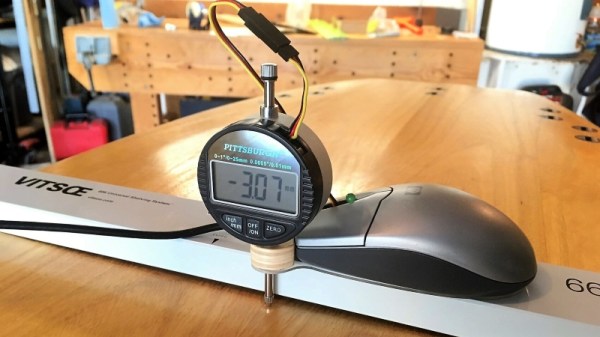
Dubbed the Scanbot 69420 – interpretation of the number is left as an exercise for the reader, my dude – the scanner is pretty simple. It’s just an old mouse carrying a digital dial indicator from Harbor Freight. The mouse was gutted, with even the original ball replaced by an RC plane wheel. The optical encoder and buttons were hooked to an Arduino, as was the serial output of the dial indicator. The Arduino consolidates the data from both sensors and sends a stream of X- and Z-axis coordinates up the USB cable as the rig slides across the board on a straightedge. On the PC side, a Node.js program turns the raw data into a vector drawing that represents the profile of the board at that point. Curves are captured at various points along the length of the board, resulting in a series of curves that can be used to replicate the board.

Yes, this could have been done with a straightedge, a ruler, and a pencil and paper – or perhaps with a hacked set of calipers – but that wouldn’t be nearly as much fun. And we can certainly see applications for this far beyond the surfboard shop.

Hackaday Links Column Banner

Hackaday Links: October 6, 2019

“If you or someone you love has been exposed to questionable quality electrolytic capacitors, you could be entitled to financial compensation.” Perhaps that’s not exactly the pitch behind this class action lawsuit against capacitor manufacturers, but it might as well be. The suit claims that the defendants, a group of capacitor manufacturers that includes Nichicon, Matsuo, ELNA, and Panasonic, “engaged in an unlawful conspiracy to fix, raise, maintain, or stabilize the prices of Capacitors.” Translation: if you bought capacitors between 2002 and 2014 from a distributor, you paid too much for them. The suit aims to recover a bunch of money from the defendants and divide it up between all the class members, so make sure you go back through all your receipts from Mouser and DigiKey over the last 17 years so you can file a claim that could be worth several dozen cents.

When are people going to learn that posting pictures of their illegal activities online is an Official Bad Idea? One SpaceX fan earned a night in jail after posting selfies he took with Starhopper, the SpaceX test article currently residing at Elon Musk’s would-be spaceport at Boca Chica, Texas. JB Wagoner, a SpaceX super-fan, made the pilgrimage from California to Texas — in his Tesla of course — to see the recent Starship Mark 1 unveiling, and decided to take a side trip to see the Starhopper. He parked at a beach, climbed a dune, and was able to walk right up to Starhopper and go selfie-crazy. After posting the pictures on Facebook, he was arrested, interviewed by Homeland Security, charged with criminal trespass, and thrown in a cell overnight. Wagoner has since been bonded out, but the charges might not stick, since Texas trespassing law requires clear signage or verbal notification of trespass, neither of which Wagoner encountered. SpaceX had even let the fence between the beach and the Starhopper collapse, so Wagoner seems to have had no way of knowing he was trespassing. Still, posting the pictures online was probably asking for trouble.

As satire and dark comedy, the 1987 cyberpunk classic RoboCop can’t be beat. But it also managed to accurately foreshadow a lot of what was to come in the world in terms of technology. No, we don’t have cyborg law enforcement — yet — but we do have something predicted by one throwaway scene: robotic realtors. In the movie, kiosks were set up around Murphy’s old house to extol the various virtues of living there, which ended up triggering the cyborg and starting the film’s climactic rampage. The real-life robotic realtor is a little more flexible, more like a telepresence robot — described aptly as “a Segway with an iPad on top.” The robotic realtor is not autonomous; it only lets a remote realtor interact with potential homebuyers without having to travel to multiple homes. It seems a little gimmicky to us, but the robots are reported to have made 25 sales in their first year on the job.

We’ve been seeing a lot of cheap resin printers these days, enough to make us want to jump into the market and start playing with them. But the cheap ones are all cheap for the same reason — they’re so dang small! They all use LCD screens from phones to mask off the UV light used to cure the resin, and the resulting print volume is tiny. Clem Mayer from MayerMakes has bigger ideas, though: he wants to make a giant resin printer using an LCD monitor as the mask. It’s not as simple as using a bigger screen, though; the film used between the screen and the resin, a fluoropolymer film called FEP, gets deformed when used on larger screens. So Clem is looking at a new built-plate interface that floats the resin on a layer of denser, immiscible liquid. It’s an interesting idea that is still clearly in the proof-of-concept phase, but we look forward to seeing what progress Clem makes.


Monochrome CRT And Liquid Crystal Shutter Team Up For Color Video

If you were tasked with designing a color video monitor, it’s pretty clear how you’d go about it. But what if you’d been asked to do so 20 years ago? Would it have been a cut and dried from an engineering standpoint? Apparently not, as this hybrid LCD-CRT video monitor demonstrates.

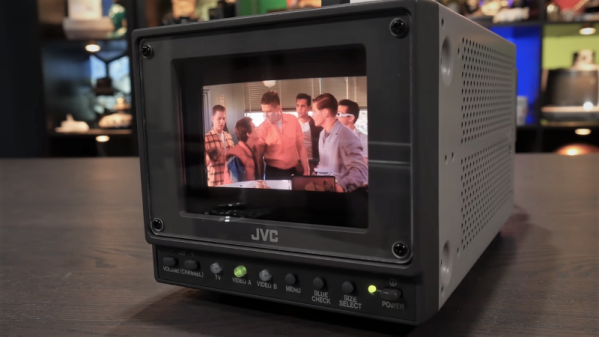
We’d honestly never heard of this particular design, dubbed “LCCS”, or liquid crystal color shutter, until [Technology Connections]’ partial teardown of the JVC monitor and explanation of its operation. The idea is simple and hearkens back to the earliest days of color TV in the United States, when broadcasters were busy trying to bring color to a monochrome world in a way that would maximize profits. One scheme involved rotating a color wheel in front of the black-and-white CRT and synchronizing the two, which is essentially what’s happening in the LCCS system. The liquid crystal panel cycles between red, blue, and green tints in time with the CRT’s images behind it, creating a full-color picture. “But wait!” you cry. “Surely there were small color CRTs back in the year 2000!” Of course there were, but they kind of sucked. Just look at the comparison of a color CRT and the LCCS in the video below and you’ll see why this system carved out a niche in the pro video market, especially for video assist monitors in the days before digital cinematography. A similar system was used by Tektronix for color oscilloscopes, too.

As usual, [Technology Connections] has managed to dig up an interesting bit of the technological fossil record and present it in a fascinating way. From video on vinyl to 1980s copy protection to the innards of a toaster, we enjoy the look under the hood of forgotten tech.

Continue reading “Monochrome CRT And Liquid Crystal Shutter Team Up For Color Video”

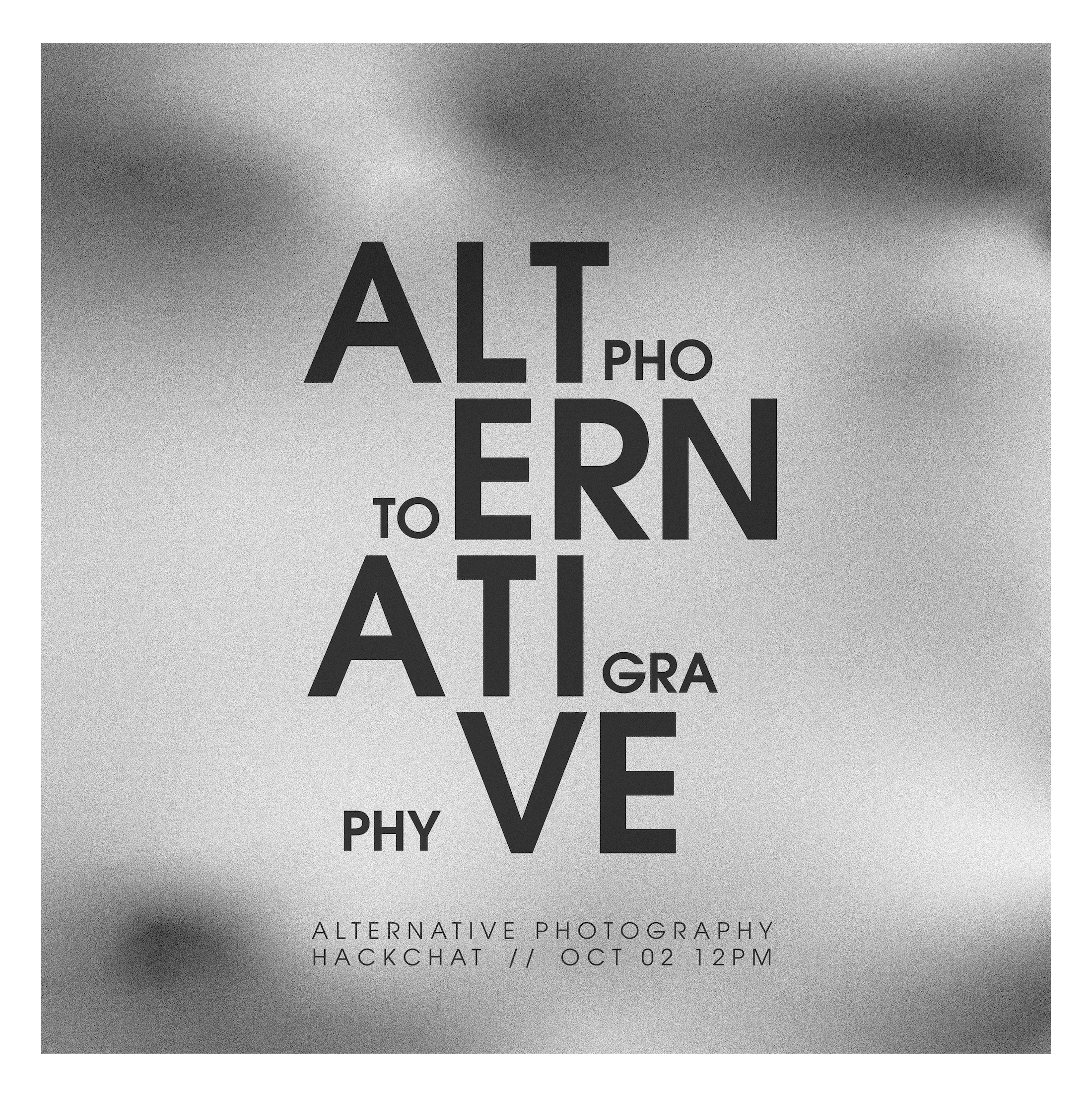
Alternative Photography Hack Chat

Join us on Wednesday, October 2 at noon Pacific for the Alternative Photography Hack Chat with Pierre-Loup Martin!

It seems like the physics of silicon long ago replaced the chemistry of silver as the primary means of creating photographs, to the point where few of us even have film cameras anymore, and home darkrooms are a relic of the deep past. Nobody doubts that the ability to snap a quick photo or even to create a work of photographic genius with a tiny device that fits in your pocket is a wonder of the world, but still, digital photographs can lack some of the soul of film photography.

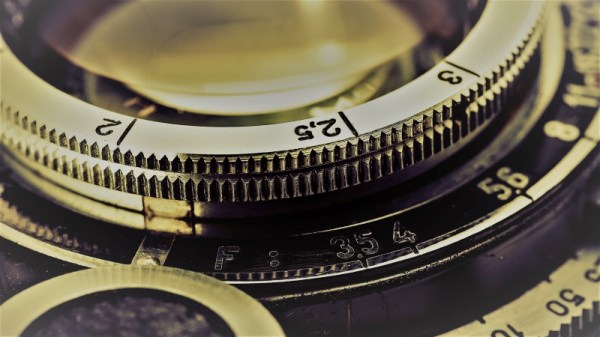
Recapturing the look of old school photography is a passion for a relatively small group of dedicated photographers, who ply their craft with equipment and chemistries that haven’t been in widespread use for a hundred years. The tools of this specialty trade are hard to come by commercially, so practitioners of alternate photographic processes are by definition hackers, making current equipment bend to the old ways. Pierre-Loup is one such artist, working with collodion plateshacked large-format cameras, pinholes camera, and chemicals and processes galore –  anything that lets him capture a unique image. His photographs are eerie, with analog imperfections that Photoshop would have a hard time creating.

Join us as Pierre-Loup takes us on a tour through the world of alternative photography. We’ll look at the different chemistries used in alternative photography, the reasons why anyone would want to try it, and the equipment needed to pull it off. Photography was always a hack, until it wasn’t; Pierre-Loup will show us how he’s trying to put some soul back into it.

join-hack-chatOur Hack Chats are live community events in the Hackaday.io Hack Chat group messaging. This week we’ll be sitting down on Wednesday, October 2 at 12:00 PM Pacific time. If time zones have got you down, we have a handy time zone converter.

Click that speech bubble to the right, and you’ll be taken directly to the Hack Chat group on Hackaday.io. You don’t have to wait until Wednesday; join whenever you want and you can see what the community is talking about.

The Clickspring Playing Card Press Is A Work Of Art

We have no idea what a playing card press is, nor do we care. All we know is that after watching [Chris] from Clickspring make his playing card press, we want it.

Digging a little deeper, [Chris] offered to make this card press for [Chris Ramsay], a magician who specializes in cardistry, or the art of illusions with cards. The feel of playing cards is crucial to performing with them, and a card press keeps a deck of cards in shape. Not a commonly available device, [Clickspring Chris] designed one in an elaborate style that brought in elements from [Chris Ramsay]’s logo.

Like all Clickspring videos, this one is a joy to watch, but in a departure, there’s no narration — just 30 minutes of precision machining and metal finishing. [Chris] has gotten into metal engraving in a big way, and used his skills to add details to everything from the stylized acorn at the top to the intricate press plate, all of which was done freehand. And those snakes! Made from brass rod and bent into shape by hand, they wrap around the side supports to form [Chris Ramsay]’s logo. All the brass ended up gold plated, while all the screws ended up with a heat-blued finish. Settle in and enjoy the video below.

It’s been a while since the Clickspring skeleton clock was finished, in which time [Chris] has been working on a reproduction of the Antikythera mechanism. His video output slowed considerably, though, when he made a new finding about the mechanism, an observation worthy of writing up as a scholarly paper. We can’t begrudge him the time needed to pursue that, and we’re glad he found time for this project too.

Continue reading “The Clickspring Playing Card Press Is A Work Of Art”