10-Way Game Console Lets Everyone Play

[Bitluni]’s motto seems to be, “When you’re busy, get busier.” At least that would explain adding even more work to his plate in the run-up to the Hanover Maker Faire and coming up with a ten-player game console from scratch.

As for this being extra work, recall that [bitluni] had already committed to building a giant ping pong ball LED wall for the gathering. That consisted of prototyping a quarter-scale panel, building custom tooling to get him past the literal pain point of punching 1200 holes, and wiring, programming and testing the whole display. Building a game console that supports ten players at once seems almost tame by comparison. The console is built around an ESP32 module, either WROOM or WROVER thanks to a clever multifunctional pad layout on the slick-looking white PCBs. [bitluni] went with a composite video output using the fast R-2R ladder network DAC that he used for his ESP32 VGA project. The console supports ten Nintendo gamepads for a simple but engaging game something like the Tron light cycles. Unsurprisingly, players found it more fun to just crash into each other on purpose.

Sure, it could have been biting off more than he could chew, but [bitluni] delivered and we appreciate the results. There’s something to be said for adding a little pressure to the creative process.

Continue reading “10-Way Game Console Lets Everyone Play”

Custom Lego Server Case Looks As Though It Came Straight From A Data Center

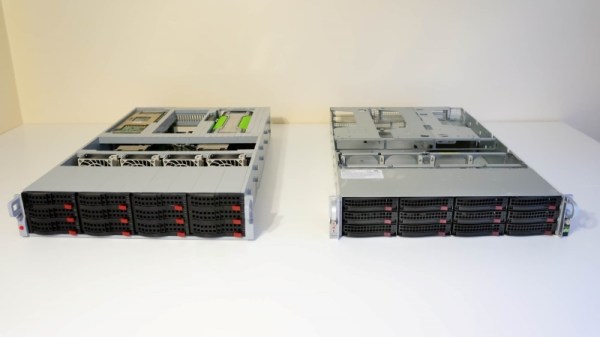
The picture above appears to show two unremarkable 2U rack servers, of the kind that are probably hosting the page you’re reading right now. Nothing special there – until you look carefully and realize that the rack server case on the left is made entirely from Lego. And what’s more, the server even works.

When it comes to building Lego computers, [Mike Schropp] is the guy to call. We’ve previously featured his Lego gaming computer, a striking case wrapped around what was a quite capable machine by 2016 standards, as well as an earlier case that reminds us a little of a NeXT. His reputation for Lego-clad computers led server maker Silicon Mechanics to commission a case for a trade show, and [Mike] jumped at the challenge.

Making a home-grade machine is one thing, but supporting all the heavy drives, power supplies, and fans needed to make the machine work is something else. He used a combination of traditional Lego pieces along with a fair sampling of parts from the Lego Technics line to pull off the build, which looks nearly perfect. Sadly, the Lego unit sizes make the case slightly taller than 2U, but that’s a small quibble when everything else matches so well, even the colors. And the fact that the server works, obviously important for a trade show demo, is pretty amazing too. The power supplies are even hot-swappable!

Congratulations to [Mike] on yet another outstanding Lego creation.

Norovirus Smartphone: Using Megapixels And Microfluidics To Fight The Other Kind Of Virus Infection

Chances are pretty good that at some time in your life, you’ve crossed paths with a norovirus. And chances are that you remember the encounter vividly, or at least its aftermath. I recall a run-in with the bug one Christmas, when my parents brought over more than just toys for the kids when they visited. Within a day, everyone in the house was sharing the joy. Twas the season; they don’t call it the winter vomiting bug for nothing.

Most of the 685 million norovirus infections each year resolve after a few miserable days, but some require hospitalization and 200,000 of them result in death, mainly from dehydration and mainly children. An easy to use, cheap, and accurate means of detecting the virus in the field would be quite a boon to public health. And soon, smartphones may be able to do just that.

Continue reading “Norovirus Smartphone: Using Megapixels And Microfluidics To Fight The Other Kind Of Virus Infection”

Machine Learning With Microcontrollers Hack Chat

Join us on Wednesday, September 11 at noon Pacific for the Machine Learning with Microcontrollers Hack Chat with Limor “Ladyada” Fried and Phillip Torrone from Adafruit!

We’ve gotten to the point where a $35 Raspberry Pi can be a reasonable alternative to a traditional desktop or laptop, and microcontrollers in the Arduino ecosystem are getting powerful enough to handle some remarkably demanding computational jobs. But there’s still one area where microcontrollers seem to be lagging a bit: machine learning. Sure, there are purpose-built edge-computing SBCs, but wouldn’t it be great to be able to run AI models on versatile and ubiquitous MCUs that you can pick up for a couple of bucks?

We’re moving in that direction, and our friends at Adafruit Industries want to stop by the Hack Chat and tell us all about what they’re working on. In addition to Ladyada and PT, we’ll be joined by Meghna NatrajDaniel Situnayake, and Pete Warden, all from the Google TensorFlow team. If you’ve got any interest in edge computing on small form-factor computers, you won’t want to miss this chat. Join us, ask your questions about TensorFlow Lite and TensorFlow Lite for Microcontrollers, and see what’s possible in machine learning way out on the edge.

join-hack-chatOur Hack Chats are live community events in the Hackaday.io Hack Chat group messaging. This week we’ll be sitting down on Wednesday, September 11 at 12:00 PM Pacific time. If time zones have got you down, we have a handy time zone converter.

Click that speech bubble to the right, and you’ll be taken directly to the Hack Chat group on Hackaday.io. You don’t have to wait until Wednesday; join whenever you want and you can see what the community is talking about.

Plasma-Powered Thrusters For Your Homebrew Satellite Needs

It seems as though every week we see something that clearly shows we’re living in the future. The components we routinely incorporate into our projects would have seemed like science fiction only a few short years ago, but now we buy them online and have them shipped to us for pennies. And what can say we’ve arrived in the future more than off-the-shelf plasma thrusters for the DIY microsatellite market?

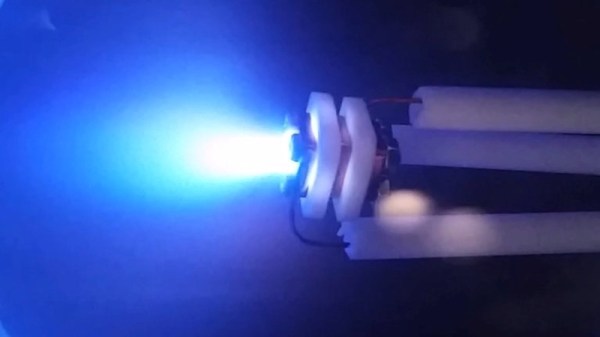
Although [Michael Bretti] does tell us that he plans to sell these thrusters eventually, they’re not quite ready for the market yet. The AIS-gPPT3-1C series that’s currently under testing is designed for the micro-est of satellites, the PocketQube, a format with a unit size only 5 cm on a side – an eighth the size of a 1U CubeSat. The thrusters are solid-fueled, with blocks of Teflon, PEEK, or Ultem that are ablated by a stream of plasma. The gaseous exhaust is accelerated and shaped by a magnetic nozzle that’s integrated right into the thruster. The thruster is mounted directly to a PCB containing the high-voltage supplies and control electronics to interface with the PocketQube’s systems. The 34-gram thrusters have enough fuel for perhaps 500 firings, although that and the specifics of performance are yet to be tested.

If you have any interest at all in space engineering or propulsion systems, [Michael]’s site is worth a look. There’s a wealth of data there, and reading it will give you a great appreciation for plasma physics. We’ve been down that road a lot lately, with cold plasma, thin-film plasma deposition, and even explaining the mystery of plasmatic grapes.

Thanks to [miguekf] for the tip.

Hackaday Links Column Banner

Hackaday Links: September 8, 2019

We start this week with very sad news indeed. You may have heard about the horrific fire on the dive boat Conception off Santa Cruz Island last week, which claimed 33 lives. Sadly, we lost one of our own in the tragedy: Dan Garcia, author of the wildly popular FastLED library. Dan, 46, was an Apple engineer who lived in Berkley; his partner Yulia Krashennaya died with him. Our community owes Dan a lot for the work he put into FastLED over the last seven years, as many an addressable LED is being driven by his code today. Maybe this would be a good chance to build a project that uses FastLED and add a little light to the world, courtesy of Dan.

In happier news, the biggest party of the hardware hacking year is rapidly approaching. That’s right, the 2019 Hackaday Superconference will be upon us before you know it. Rumor has it that there aren’t that many tickets left, and we haven’t even announced the slate of talks yet. That’s likely to clean out the remaining stock pretty darn quickly. Are you seriously prepared to miss this? It seems like a big mistake to us, so why don’t you hop over and secure your spot before you’re crying into your Club-Mate and wondering what all the cool kids will be doing in November.

Of course one of the highlights of Superconference is the announcement of the Hackaday Prize winner. And while we naturally think our Prize is the best contest, that doesn’t mean there aren’t others worth entering. MyMiniFactory, the online 3D-printing community, is currently running a “Design with Arduino” competition that should be right up the alley of Hackaday readers. The goal is simple: submit a 3D-printed design that incorporates Arduino or other electronics. That’s it! Entries are accepted through September 16, so you’ve still got plenty of time.

Sometimes you see something that just floors you. Check out this tiny ESP32 board. It doesn’t just plug into a USB port – it fits completely inside a standard USB Type A jack. The four-layer board sports an ESP32, FTDI chip, voltage regulator, an LED and a ceramic antenna for WiFi and Bluetooth. Why would you want such a thing? Why wouldn’t you! The board is coming soon on CrowdSupply, so we hope to see projects using this start showing up in the tipline soon.

Here’s a “why didn’t I think of that?” bench tip that just struck us as brilliant. Ever had to probe a board to trace signal paths? It’s a common enough task for reverse engineering and repairs, but with increasingly dense boards, probing a massive number of traces is just too much of a chore. Hackaday superfriend Mike Harrison from “mikeselectricstuff” makes the chore easier with a brush made from fine stainless wires crimped into a ring terminal. Attached to one probe of a multimeter, the brush covers much more of the board at a time, finding the general area where your trace of interest ends up. Once you’re in the neighborhood you can drop back to probing one pad at a time. Genius! We’d imagine a decent brush could also be made from a bit of coax braid too.

Another shop tip to wrap up this week, this one for woodworkers and metalworkers alike. Raw materials are expensive, and getting the most bang for your buck is often a matter of carefully laying out parts on sheet goods to minimize waste. Doing this manually can be a real test of your spatial relations skills, so why not automate it with this cut list optimizer? The app will overlay parts onto user-defined rectangles and snuggle them together to minimize waste. The program takes any units, can account for material lost to kerfs, and will even respect grain direction if needed. It’s built for wood, but it should prove useful for sheet metal on a plasma cutter, acrylic on a laser, or even PCBs on a panel.


Capture A Star In A Jar With Sonoluminescence

If nothing else, [Justin Atkin] is persistent. How else do you explain a five-year quest to create sonoluminescence with simple tools?

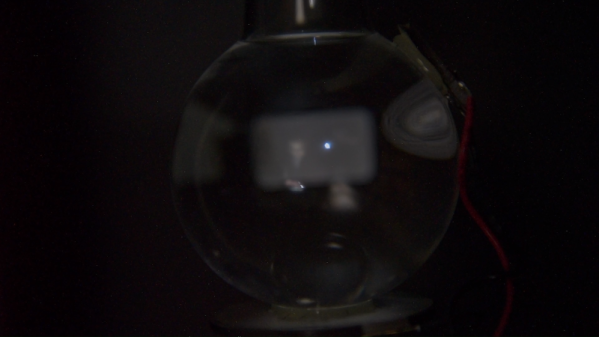
So what exactly is sonoluminescence? The short answer is as the name suggests: a release of light caused by sound. In [Justin]’s case, he used an ultrasonic transducer to set up a standing wave at the resonant frequency of a flask of water. A drop of water is used to entrain a small air bubble, which is held in a stable position in the flask in much the same way as styrofoam beads are in an acoustic levitator. Turn off the lights and you’ll see that the bubble glows with a ghostly blue light.

What causes the glow? Good question. According to [Justin], we just don’t know for sure what causes it, although the leading theory is that cavitation of the bubble causes the trapped gas to compress and heat violently, turning into a brief bit of plasma. But there are problems with that theory, which is one of the reasons he wanted to show just how easy the process can be – now that he’s shaken out the bugs with five years of effort. It wasn’t easy getting the transducers attached and the driver circuit properly tuned, but with little more than a signal generator, an audio amp, and a spool of magnet wire, you too can make your own “star in a jar.”

We applaud [Justin]’s determination to bring this project to a successful conclusion. It’s not unlike his dogged effort to make a cold plasma torch, or even his desktop radio telescope.

Continue reading “Capture A Star In A Jar With Sonoluminescence”