A Scratch-Built Drill Press Vise From Scrap

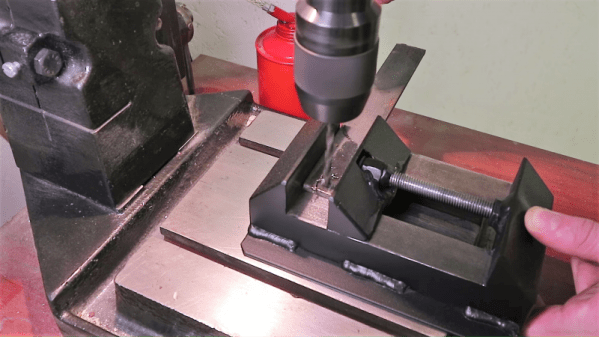
Never underestimate the importance of fixturing when you’re machining parts. No matter what the material, firmly locking it down is the key to good results, and may be the difference between a pleasant afternoon in the shop and a day in the Emergency Room. Flying parts and shattered tooling are no joke, but a lot of times quality commercial solutions are expensive and, well, commercial.  So this scratch-built drill press vise is something the thrifty metalworker may want to consider.

To be sure, [Ollari’s] vise, made as it is almost completely from scrap angle iron, is no substitute for a vise made from precision ground castings. But it’s clear that he has taken great care to keep everything as square and true as possible, and we give him full marks for maximizing his materials. And his tools — nothing more complicated than a MIG welder is used, and most of the fabrication is accomplished with simple hand tools. We like the way he built up sturdy profiles by welding strap stock across the legs of the angle iron used for the jaws, to give them a strong triangular cross-section to handle the clamping force. And using the knurled end of an old socket wrench as the handle was inspired; we’ll certainly be filing that idea away for a rainy day in the shop. Although we might use Acme rather than plain threaded rod.

We always enjoy seeing someone fabricate their own tools, and this one reminds us a bit of the full-size bench vise built up from layers of welded steel we featured a while back. It even looks a little like this 3D-printed vise, too.

Continue reading “A Scratch-Built Drill Press Vise From Scrap”

Publish Or Perish: The Sad Genius Of Ignaz Semmelweis

Of all the lessons that life hands us, one of the toughest is that you can be right about something but still come up holding the smelly end of the stick. Typically this is learned early in life, but far too many of us avoid this harsh truth well into adulthood. And in those cases where being right is literally a matter of life or death, it’s even more difficult to learn that lesson.

For Ignaz Semmelweis, a Hungarian physician-scientist in the mid-19th century, failure to learn that being right is attended by certain responsibilities had a very high cost. Ironically it would also save the lives of countless women with a revolutionary discovery that seems so simple today as to be self-obvious: that a doctor should wash his hands before seeing patients.

Continue reading “Publish Or Perish: The Sad Genius Of Ignaz Semmelweis”

Perf Board Pyrotechnics Courtesy Of A High-Voltage Supply

You may have asked yourself at one time or another, “Self, what happens when you pass 100 thousand volts through a printed circuit board?” It’s a good question, and [styropyro] put together this fascinating bit of destructive testing to find out.

Luckily, [styropyro] is well-positioned to explore the high-voltage realm. His YouTube stock-in-trade is lasers, ranging from a ridiculously overpowered diode-laser bazooka to a bottle-busting ruby laser. The latter requires high voltage, of course, and his Frankenstein’s lab yielded the necessary components for this destructive diversion. A chopper drives dual automotive ignition coils to step the voltage up to a respectable 100 kV. The arcs across an air gap are impressive enough, but when applied to a big piece of copper-clad protoboard, the light show is amazing. The arcs take a seemingly different path across the board for each discharge, lighting up the path with an eerie blue glow accompanied by a menacing buzz. Each discharge path may be random, but they all are composed of long stretches across the rows and columns of copper pads that never take the more direct diagonal path. [styropyro]’s explanation of the math governing this behavior is feasible, but really we just liked looking at the pretty and dangerous display. Now if only the board had been populated with components…

No, there’s not much of a hack here, but it’s cool nonetheless. And it’s probably a well-earned distraction from his more serious stuff, like his recent thorough debunking of the “Chinese laser rifle” that was all over the news a while back.

Continue reading “Perf Board Pyrotechnics Courtesy Of A High-Voltage Supply”

Fail Of The Week: Solid State Relay Fails Spectacularly

A lot of times these days, it seems like we hackers are a little like kids in a candy store. With so many cool devices available for pennies at the click of a mouse, it’s temptingly easy to order first and ask questions about quality later. Most of the time that works out just fine, with the main risk of sourcing a dodgy component being a ruined afternoon of hacking when a part fails.

The stakes are much higher when you’re connecting your project to the house mains, though, as [Mattias Wandel] recently learned when the solid-state relay controlling his water heater failed, with nearly tragic results. With aplomb that defies the fact that he just discovered that he nearly burned his house down, [Mattias] tours the scene of the crime and delivers a postmortem of the victim, a Fotek SSR-25DA. It appears that he mounted it well and gave it a decent heatsink, but the thing immolated itself just the same. The only remnant of the relay’s PCB left intact was the triac mounted to the rear plate. [Mattias] suspects the PCB traces heated up when he returned from vacation and the water heater it was controlling came on; with a tank full of cold water, both elements were needed and enough current was drawn to melt the solder build-up on the high-voltage traces. With the solder gone, the traces cooked off, and the rest is history. It’s a scary scenario that’s worth looking at if you’ve got any SSRs controlling loads anywhere near their rated limit.

The morals of the story: buy quality components and test them if possible; when in doubt, derate; and make sure a flaming component can’t light anything else on fire. And you’ll want to review the basics of fire protection while you’re at it.

Continue reading “Fail Of The Week: Solid State Relay Fails Spectacularly”

Low-Quality Capacitors Turned Into High-Quality Temperature Sensors

When life hands you a bunch of crummy capacitors, what do you do? Make a whole bunch of temperature sensors, apparently.

The less-than-stellar caps in question came to [pyromaniac303] by way of one of those all-in-one assortment kits we so love to buy. Stocked with capacitors of many values, kits like these are great to have around, especially when they’ve got high-quality components in them. But not all ceramic caps are created equal, and [pyromaniac303] was determined not to let the lesser-quality units go to waste. A quick look at the data sheets revealed that the caps with the Y5V dielectric had a suitably egregious temperature coefficient to serve as a useful sensor. A fleck of perf-board holds a cap and a series resistor; the capacitor is charged by an Arduino output pin through the resistor, and the time it takes for the input pin connected to the other side of the cap to go high is measured. Charge time is proportional to temperature, and a few calibration runs showed that the response is pretty linear. Unfortunately the temperature coefficient peaks at 10°C and drops sharply below that point, making the sensor useful only on one side of the peak. Still, it’s an interesting way to put otherwise unloved parts to use, and a handy tip to keep in mind.

Temperature sensing isn’t the only trick capacitors can do. We’ve seen them turned into touch sensors before, and used to turn a 3D-printer into a 3D-scanner.

Marines 3D-Print Part To Repair Multi-Million Dollar Fighter

The good news: all you need to complete the repair you’re working on is one small part. The bad news: it’s only available in a larger, expensive assembly. The worst news: shipping time is forever. We’ve all been there, and it’s a hard pill to swallow for the DIYer. Seems like a good use case for 3D-printing.

Now imagine you’re a US Marine, and instead of fixing a dishwasher or TV remote, you’ve got a $123 million F-35 fighter in the shop. The part you need is a small plastic bumper for the landing gear door, but it’s only available as part of the whole door assembly, which costs $70,000 taxpayer dollars. And lead time to get it shipped from the States is measured in weeks. Can you even entertain the notion of 3D-printing a replacement? It turns out you can, and it looks like there will be more additive manufacturing to come in Corps repair depots around the world.

Details of the printed part are not forthcoming for obvious reasons, but the part was modeled in Blender and printed in PETG on what appears to be a consumer-grade printer. The part was installed after a quick approval for airworthiness, and the grounded fighter was back in service within days. It’s encouraging that this is not a one-off; other parts have been approved for flight use by the Marines, and a whole catalog of printable parts for ground vehicles is available too. This is the reality that the 3D printing fiction of Lost in Space builds upon.

And who knows? Maybe there are field-printable parts in the disposable drones the Corps is using for standoff resupply missions.

[via 3D-Printing Industry]

[Cody] Builds A Chlorine Machine

In his continuing bid to have his YouTube channel demonetized, [Cody] has decided to share how he makes chlorine gas in his lab. Because nothing could go wrong with something that uses five pounds of liquid mercury and electricity to make chlorine, hydrogen, and lye.

We’ll be the first to admit that we don’t fully understand how the Chlorine Machine works. The electrochemistry end of it is pretty straightforward – it uses electrolysis to liberate the chlorine from a brine solution. One side of the electrochemical cell generates chlorine, and one side gives off hydrogen as a byproduct. We even get the purpose of the mercury cathode, which captures the sodium metal as an amalgam. What baffles us is how [Cody] is pumping the five pounds of mercury between the two halves of the cell. Moving such a dense liquid would seem challenging, and after toying with more traditional approaches like a peristaltic pump, [Cody] leveraged the conductivity of mercury to pump it using a couple of neodymium magnets. He doesn’t really explain the idea other than describing it as a “rail-gun for mercury,” but it appears to work well enough to gently circulate the mercury. Check out the video below for the build, which was able to produce enough chlorine to dissolve gold and to bleach cloth.

We need to offer the usual warnings about how playing with corrosive, reactive, and toxic materials is probably not for everyone. His past videos, from turning urine into gunpowder to mining platinum from the side of the road, show that [Cody] is clearly very knowledgeable in the ways of chemistry and that he takes to proper precautions. So if you’ve got a jug of mercury and you want to try this out, just be careful.

Continue reading “[Cody] Builds A Chlorine Machine”