How Etak Paved The Way To Personal Navigation

Our recent “Retrotechtacular” feature on an early 1970s dead-reckoning car navigation system stirred a memory of another pre-GPS solution for the question that had vexed the motoring public on road trips into unfamiliar areas for decades: “Where the heck are we?” In an age when the tattered remains of long-outdated paper roadmaps were often the best navigational aid a driver had, the dream of an in-dash scrolling map seemed like something Q would build for James Bond to destroy.

And yet, in the mid-1980s, just such a device was designed and made available to the public. Dubbed Etak, the system was simultaneously far ahead of its time and doomed to failure by the constellation of global positioning satellites being assembled overhead as it was being rolled out. Given the constraints it was operating under, Etak worked very well, and even managed to introduce some of the features of modern GPS that we take for granted, such as searching for services and businesses. Here’s a little bit about how the system came to be and how it worked.

Continue reading “How Etak Paved The Way To Personal Navigation”
Carousel Of Cereals Mixes And Matches Custom Breakfast Blends

There are those who reckon the humble bowl of breakfast cereal to be the height of culinary achievement. Look askance if you must, but cereal junkies are a thing, and they have a point. The magic comes not from just filling a bowl and adding a splash of milk, but by knowing which cereals to mix together.

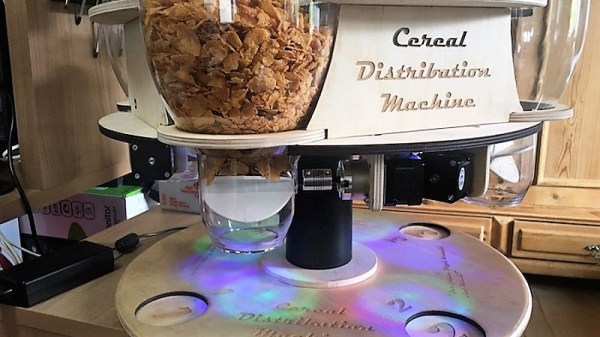
Who needs all that fussy mixing, though, when you can automate and customize your cereal dispensing chores? That’s the approach [Kevin Obermann] and [Adrian Bernhart] took with their Cereal Dispensing Machine, even if they went a little further than necessary. Laser-cut plywood forms a four-station carousel for off-the-shelf dry-good dispensers, each of which got a stepper motor to replace the wrist-twisting. The original motors were a bit too wimpy to handle the more rugged morning selections and were eventually upgraded to gear motors. The platform that supports the dispensers also holds all the electronics, including an ESP32 to run everything and host the web app needed to choose your poison. Plus RGB LEDs, because breakfast should look like a rave. Sadly, the team ran out of GPIO pins and were unable to run the peristaltic pump needed to add the milk. There will always be version 2.0, though.

If cereal isn’t your automated breakfast of choice, we understand. Perhaps a more [Wallace] and [Gromit] style breakfast machine would do, or a robotic peanut butter sandwich any time of day is a treat.

Continue reading “Carousel Of Cereals Mixes And Matches Custom Breakfast Blends”

Raspberry Pi Tracks Starter Fermentation For Optimized Sourdough

Those of you who’ve never had a real sourdough have never had real bread. Good food fights back a little when you eat it, and a proper sourdough, with its crispy crust and tangy center, certainly fits the bill. Sourdough aficionados, your humble writer included, all have recipes that we pretend are ancient family secrets while in reality we’re all just guessing. Sourdough is partly science, partly art, but mostly delicious black magic.

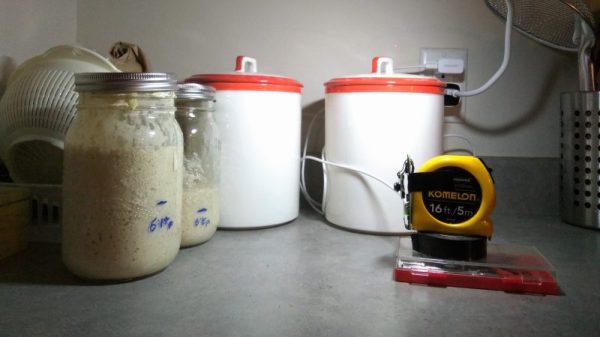
In an effort to demystify his sourdough process, [Justin Lam] has gone digital with this image processing sourdough starter monitor. Sourdough breads are leavened not by the addition of brewers yeast (Saccharomyces cerevisiae), but by the inclusion of a starter,  a vibrant ecosystem of wild yeasts that is carefully nurtured, sometimes for years. Like any other living thing, it needs to be fed, a task that should happen at the point of maximum fermentation. Rather than guess when this might be, [Justin] used a Raspberry Pi Zero and PiCam to capture a time-lapse video of the starter as the beasties within give off their CO₂, thus expanding it up inside its container. A little Python does the work of thresholding and finding the top of the starter as it rises, allowing [Justin] to plot height of the starter over time. He found that peak height, and therefore peak fermentation, occurs about six hours after feeding. He has used his data to better inform his feeding schedule and to learn how best to revive neglected starters.

Surprisingly, this isn’t the first time we’ve discussed sourdough here. It seems that someone uses Git for iterative sourdough recipe development, and we once featured a foundry made from a pyrolyzed loaf of sourdough.

Continue reading “Raspberry Pi Tracks Starter Fermentation For Optimized Sourdough”

No Caffeine, No Problem: A Hand-Soldered Chip-Scale Package

It’s said that the electronic devices we use on a daily basis, particularly cell phones, could be so much smaller than they are if only the humans they’re designed for weren’t so darn big and clumsy. That’s only part of the story — battery technology has a lot to do with overall device size — but it’s true that chips can be made a whole lot smaller than they are currently, and are starting to bump into the limit of being able to handle them without mechanical assistance.

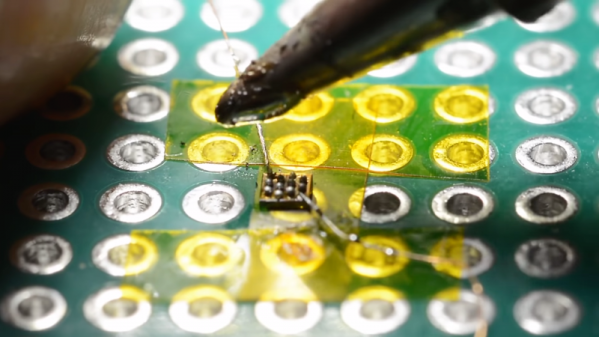
Or perhaps not, if [mitxela]’s hand-soldering of a tiny ball-grid array chip is any guide. While soldering wires directly to a chip is certainly a practical skill and an impressive one at that, this at least dips its toe into the “just showing off” category. And we heartily endorse that. The chip is an ATtiny20 in a WLCSP (wafer-level chip-scale package) that’s a mere 1.5 mm by 1.4 mm. The underside of the chip has twelve tiny solder balls in a staggered 4×6 array with 0.4 mm pitch. [mitxela] tackled the job of soldering this chip to a 2.54-mm pitch breakout board using individual strands from #30 AWG stranded wire and a regular soldering iron, with a little Kapton tape to hold the chip down. Through the microscope, the iron tip looks enormous, and while we know the drop of solder on the tip was probably minuscule we still found ourselves mentally wiping it off as he worked his way across the array. In the end, all twelve connections were brought out to the protoboard, and the chip powers up successfully.

We’re used to seeing [mitxela] work at a much larger scale, like his servo-plucked music box or a portable Jacob’s Ladder. He’s been known to get small before though, too, like with these tiny blinkenlight earrings.

Continue reading “No Caffeine, No Problem: A Hand-Soldered Chip-Scale Package”

Everything You Didn’t Know You Were Missing About Bias Tees

Do you need a bias tee? If you want to put a DC voltage on top of an RF signal, chances are that you do. But what exactly are bias tees, and how do they work?

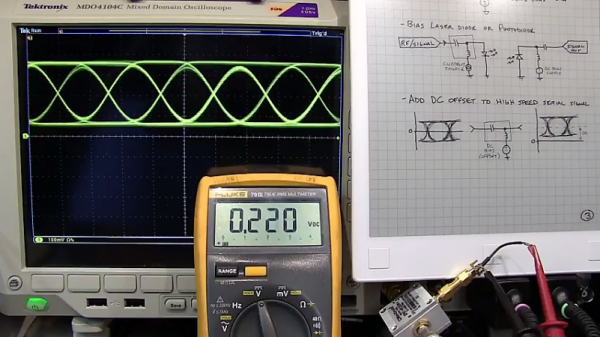
If that’s your question, [W2AEW] has an answer for you with this informative video on the basics of bias tees. A bias tee allows a DC bias to be laid over an RF signal, and while that sounds like a simple job, theory and practice often deviate in the RF world. The simplest bias tee would have a capacitor in series with the RF input and output to pass AC but block DC from getting out the input, and a DC input with a series inductance to prevent RF from getting into the DC circuit. Practical circuits are slightly more complicated, and [W2AEW] covers all you need to know about how real-world bias tees are engineered. He also gives some use cases for bias tees, from sending DC signals up a feed line to control an antenna tuner or rotator to adding a DC bias to a high-speed serial line.

It’s an interesting circuit, and we learned a lot, which is par for the course with [W2AEW]’s videos. Check out some of his other offerings, like a practical guide to the mysteries of Smith charts, or his visualization of how standing waves work.

Continue reading “Everything You Didn’t Know You Were Missing About Bias Tees”

Clock Plays A Game Of Pong With Itself To Pass The Time

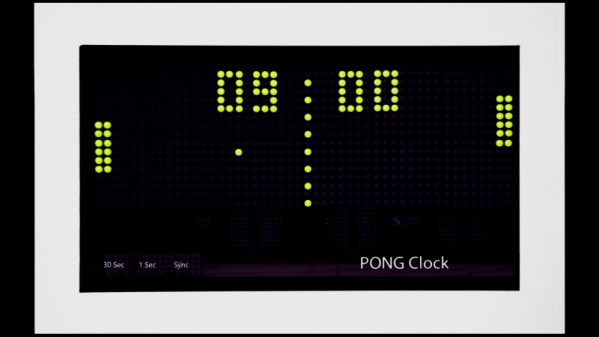
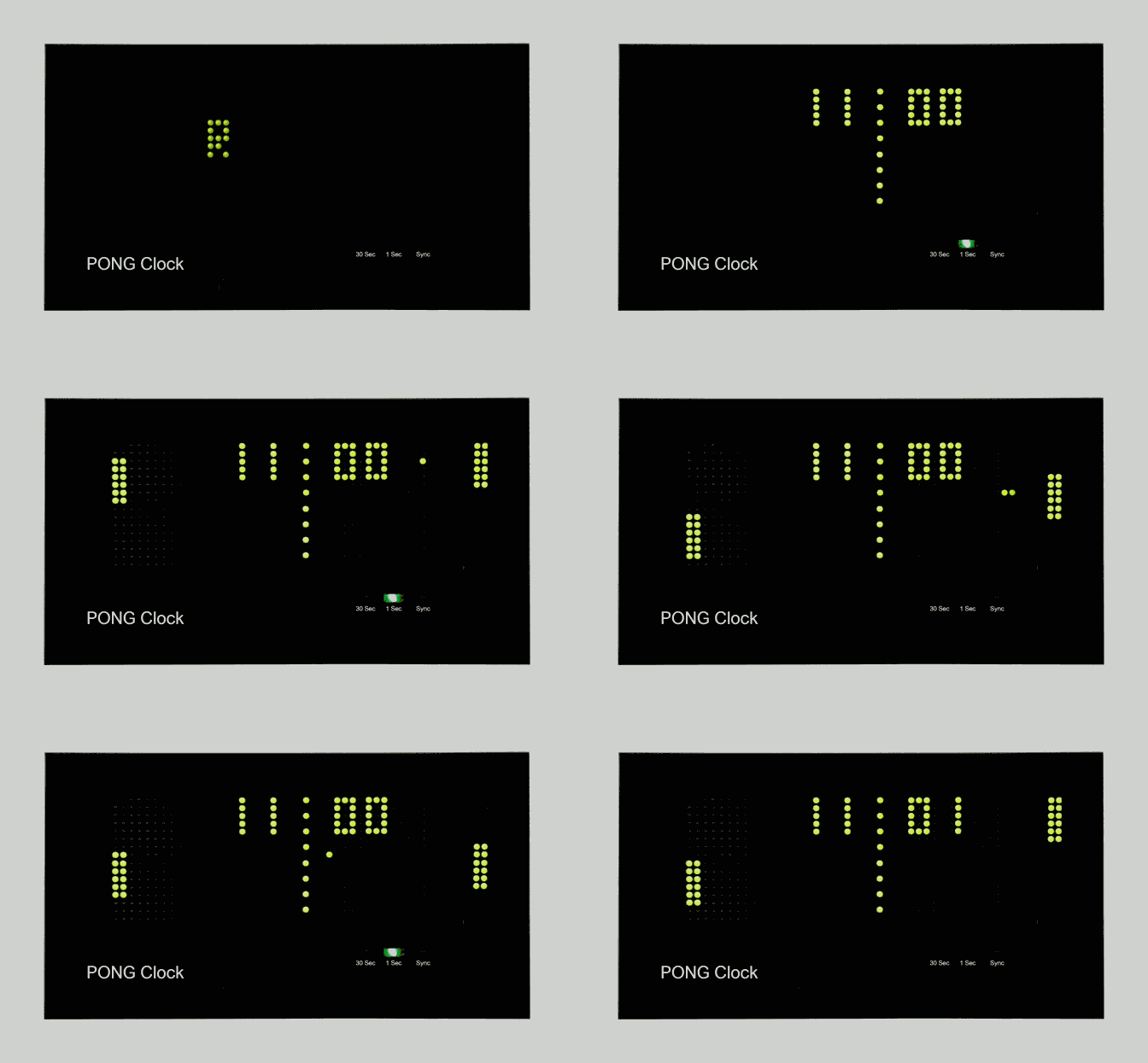
Would you play a game of Pong where each set lasts exactly one minute and the right player is guaranteed to win 60 times more than the left player? Of course not, but if you were designing a clock that displays the time using a Pong motif, then perhaps it would make sense.

There are some neat design tips in [oliverb]’s Pong Clock that are worth taking a look at. Foremost is the case, which is a retasked jewelry box with a glass lid, procured on the cheap from eBay. It’s a good size for a clock meant to be seen from across the room, and already finished to fit into modern decor. The case holds all the goodies, from the 24×16 green LED matrix display to the Uno that runs the show, as well as an RTC module, a sound chip, a temperature sensor, and a PIR module to turn the display off when the room is unoccupied. To prevent disrupting the sleek lines of the case, all the controls are mounted in a remote panel, itself a clean and modern-looking device thanks to the chrome-plated duplex outlet cover used to house it. The clock has several display modes, from normal time and temperature to a word clock, as well as the Pong mode, where the machine plays itself and the score shows the time. It’s fascinating to watch, and we like everything about it, although we think the tick-tock would drive us nuts pretty quickly.

We recently covered the life and times of [Ted Dabney], one of Pong’s fathers and co-founder of Atari. We tend to think he’d like the design of this clock, both as a nod to his game and for its simple but functional design.

Continue reading “Clock Plays A Game Of Pong With Itself To Pass The Time”

An Artsy And Functional LED Filament Lamp

Some projects end up being more objet d’art than objet d’utile, and we’re fine with that — hacks can be beautiful too. Some hacks manage both, though, like this study in silicon and gallium under glass that serves as a bright and beautiful desk lamp.

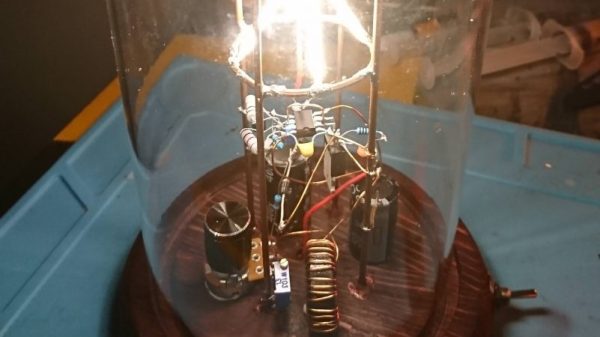
There’s no accounting for taste, of course, but we really like the way [commanderkull]’s LED filament lamp turned out, and it’s obvious that a fair amount of work went into it. Five COB filament strips were suspended from a lacy frame made of wire, which also supports the custom boost converter needed to raise the 12-volt input to the 60 volts needed by the filaments. The boost converter is based on the venerable 555 timer chip, which sits in the middle of the frame suspended by its splayed-out legs and support components. The wooden base sports a few big electrolytics and some hand-wound toroidal inductors, as well as the pot for adjusting the lamp’s brightness. The whole thing sits under a glass bell jar, which catches the light from the filaments and plays with it in a most appealing way.

There’s just something about that dead bug building technique that we love. We’ve seen it before — this potentially dangerous single-tube Nixie clock comes to mind — but we’d love to see it done more.

[via r/electronics]