Casting Tour-De-Force Results In Swashplate For Scale Helicopter

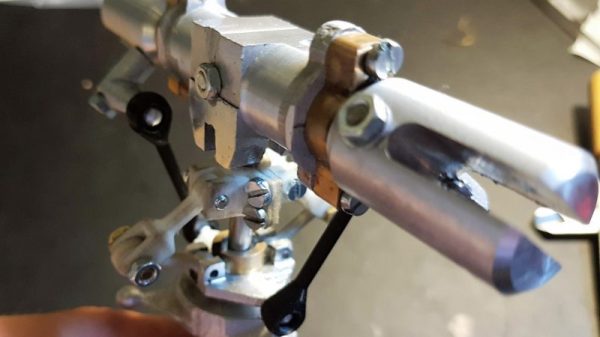
While quadcopters seem to attract all the attention of the moment, spare some love for the rotary-wing aircraft that started it all: the helicopter. Quads may abstract away most of the aerodynamic problems faced by other rotorcraft systems through using software, but the helicopter has to solve those problems mechanically. And they are non-trivial problems, since the pitch of the rotors blades has to be controlled while the whole rotor disk is tilted relative to its axis.

The device that makes this possible is the swashplate, and its engineering is not for the faint of heart. And yet [MonkeyMonkeey] chose not only to build a swashplate from scratch for a high school project, but since the parts were to be cast from aluminum, he had to teach himself the art of metal casting from the ground up. That includes building at least three separate furnaces, one of which was an electric arc furnace based on an arc welder with carbon fiber rods for electrodes (spoiler alert: bad choice). The learning curves were plentiful and steep, including getting the right sand mix for mold making and metallurgy by trial and error.

With some machining help from his school, [MonkeyMonkeey] finally came up with a good design, and we can’t wait to see what the rest of the ‘copter looks like. As he gets there, we’d say he might want to take a look at this series of videos explaining the physics of helicopter flight, but we suspect he’s well-informed on that topic already.

[via r/DIY]
Shooting For The First Time With Help From A Raspberry Pi

Like many people, [Mike] has a list of things he wants to do in life. One of them is “fire a gun with a switch,” and with a little help from some hacker friends, he knocked this item off last weekend.

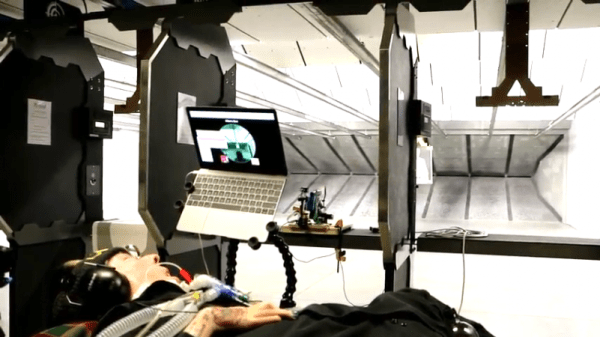
For those wondering why the specificity of the item, the backstory will help explain. [Mike] has spinal muscular atrophy, a disease that was supposed to end his life shortly after it began. Thirty-seven years later, [Mike] is still ticking items off his list, but since he only has voluntary control of his right eyebrow, he faces challenges getting some of them done. Enter [Bill] and the crew at ATMakers. The “AT” stands for “assistive technologies,” and [Bill] took on the task of building a rig to safely fire a Glock 17 upon [Mike]’s command.

Before even beginning the project, [Bill] did his due diligence, going so far as to consult the Bureau of Alcohol, Tobacco, and Firearms (ATF) and arranging for private time at a local indoor gun range. The business end of the rig is a commercially available bench rest designed to control recoil from the pistol, which is fired by a servo connected to the trigger. The interface with [Mike]’s system is via a Raspberry Pi and a Crikit linked together by a custom PCB. A PiCam allowed [Mike] to look down the sights and fire the gun with his eyebrow. The videos below show the development process and the day at the range; to say that [Mike] was pleased is an understatement.

We’re not sure what else is on [Mike]’s list, but we see a lot of assistive tech projects around here — we even had a whole category of the 2017 Hackaday Prize devoted to them. Maybe there’s something else the Hackaday community can help him check off.

Continue reading “Shooting For The First Time With Help From A Raspberry Pi”

An E-Bike Battery Pack Without Spot Welding

In somewhat of a departure from their normal fare of heavy metal mods, [Make It Extreme] is working on a battery pack for an e-bike that has some interesting design features.

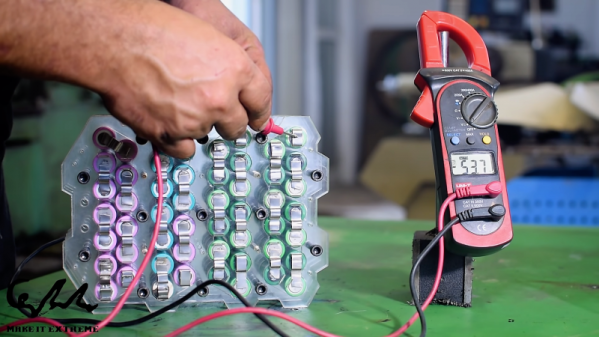
The guts of the pack are pretty much what you’d expect – recovered 18650 lithium-ion cells. They don’t go into details, but we assume the 52 cells were tested and any duds rejected. The arrangement is 13S4P, and the cells are held in place with laser-cut acrylic frames. Rather than spot weld the terminals, [Make It Extreme] used a series of strategically positioned slots to make contacts from folded bits of nickel strip. Solid contact is maintained by cap screws passing between the upper and lower contact frames. A forest of wires connects each cell to one of four BMS boards, and the whole thing is wrapped in a snappy acrylic frame. The build and a simple test are in the video below.

While we like the simplicity of a weld-less design, we wonder how the pack will stand up to vibration with just friction holding the cells in contact. Given their previous electric transportation builds, like this off-road hoverbike, we expect the pack will be put to the test soon, and in extreme fashion.

Continue reading “An E-Bike Battery Pack Without Spot Welding”

Launching Fireworks With Raspberry Pi This Fourth Of July

It’s that time of year again in the United States, and the skies will soon be alight with pyrotechnic displays, both professional and amateur. Amazing fireworks are freely available, sometimes legally, sometimes not. For the enthusiasts that put on homebrew displays, though, the choice between watching your handiwork or paying attention to what you’re doing while running the show is a tough one. This Raspberry Pi fireworks show controller aims to fix that problem.

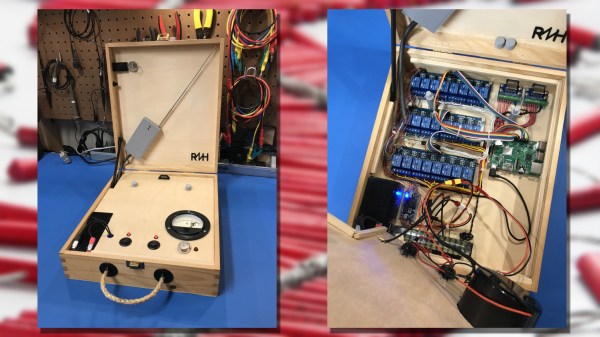
[netmagi] claims his yearly display is a modest affair, but this controller can address 24 channels, which would be a pretty big show in any neighborhood. Living inside an old wine box is a Raspberry Pi 3B+ and three 8-channel relay boards. Half of the relays are connected directly to breakouts on the end of a long wire that connect to the electric matches used to trigger the fireworks, while the rest of the contacts are connected to a wireless controller. The front panel sports a key switch for safety and a retro analog meter for keeping tabs on the sealed lead-acid battery that powers everything. [netmagi] even set the Pi up with WiFi so he can trigger the show from his phone, letting him watch the wonder unfold overhead. A few test shots are shown in the video below.


As much as we appreciate the DIY spirit, it goes without saying that some things are best left to the pros, and pyrotechnics is probably one of those things. Ever wonder how said pros pull it off? Here’s a behind-the-scenes look.

Continue reading “Launching Fireworks With Raspberry Pi This Fourth Of July”

Philo Farnsworth, RCA, And The Battle For Television

The parenthood of any invention of consequence is almost never cut and dried. The natural tendency to want a simple story that’s easy to tell — Edison invented the light bulb, Bell invented the telephone — often belies the more complex tale: that most inventions have uncertain origins, and their back stories are often far more interesting as a result.

Inventing is a rough business. It is said that a patent is just a license to get sued, and it’s true that the determination of priority of invention often falls to the courts. Such battles often pit the little guy against a corporate behemoth, the latter with buckets of money to spend in making the former’s life miserable for months or years. The odds are rarely in the favor of the little guy, but in few cases was the deck so stacked against someone as it was for a young man barely out of high school, Philo Farnsworth, when he went up against one of the largest companies in the United States to settle a simple but critical question: who invented television?

Continue reading “Philo Farnsworth, RCA, And The Battle For Television”

Simple Jig Uses Electromagnet For Clean Angle Grinder Cuts

We like it when hacks are literal hack jobs, put together with what’s on hand to do a specific job. This quick and dirty angle grinder circle cutter certainly fills the bill, and makes decent cuts in sheet metal to boot.

The build starts with an unlikely source for parts – an old automotive AC compressor. The one that [Made in Poland] chose to sacrifice was particularly nasty and greasy, but after popping off the pulley, the treasure within was revealed: the large, ring-shaped clutch electromagnet. Liberated from the compressor, the electromagnet was attached to a small frame holding a pillow block. That acts as an axis for an adjustable-length arm, the other end of which holds a modified angle grinder. In use, the electromagnet is powered up by a small 12-volt power supply, fixing the jig in place on the stock. The angle grinder is traced around and makes a surprisingly clean cut. Check out the build and the tool in use in the video below.

At the time [Made in Poland] recorded the video, he noted that he did not have a plasma cutter. That appears to have changed lately, so perhaps he’ll swap out the angle grinder for plasma. And maybe he’ll motorize it for even smoother cuts.

Continue reading “Simple Jig Uses Electromagnet For Clean Angle Grinder Cuts”

Charging An Electric Supercar With Lemons, Kids, And The Sun

First things first: the tease on this video, that an electric supercar can be charged from a massive lemon battery array, is exactly that – a tease. Despite that, it makes for an interesting story and a great attempt to get kids exposed to science and engineering.

The story goes that [Mark] was approached by Volkswagen to help charge the batteries on their entry for the upcoming Pikes Peak International Hill Climb, the annual “Race to the Clouds” in Colorado. Racers are tortured by a 4,700′ (1,440 m) vertical climb over a 12.42 mile (20 km) course that features 156 switchback turns. Volkswagen’s entry is an electric supercar, and they sent [Mark] a portable battery cart to charge up the best way he saw fit.

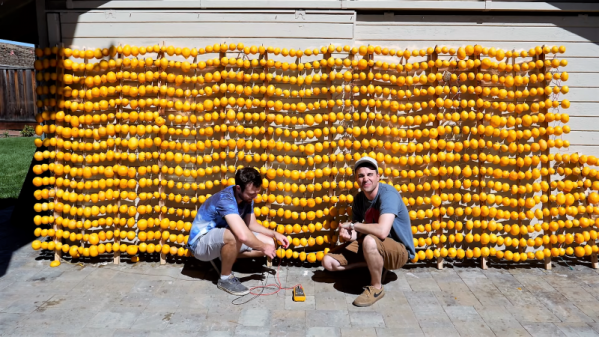
Teaming up with [William Osman], the first attempt was a massive array of lemon cells, made with waterjet-cut strips of zinc and copper held in a plywood frame. Studded with 1,232 lemons, the battery performed just about as well as you’d expect it would. Plan B was cute, and another of [Mark]’s attempts to pad his “Funnest Uncle Ever” score a bit. He devised a zip line with regenerative braking to charge a cordless drill battery, and then indirectly harvested the energy in the battery by turning it into lemonade for a bunch of kids. The sugared-up kids rode the zip line till the battery was charged.

That was still a drop in the bucket, though, so Plan C saw [Mark] install a large solar array on his roof; the tie-in here was that the lemon-powered kids got to design a cleaning system for the solar array. A weak link, to be sure, but the kids had fun, and we can’t deny that the car will at least be partially lemon-powered when it heads up the hill.

Continue reading “Charging An Electric Supercar With Lemons, Kids, And The Sun”