RIP DIP ARM

Every month, semiconductor manufacturers across the globe retire old devices. A product that has been superseded, isn’t selling well, or maybe whose application has declined, is removed from the catalogue and ceases to be manufactured. Usually these moments pass unnoticed, just one old device among many. Who is going to remark upon the demise of a chip for a VGA card for example, or a long-ago-left-behind Flash memory chip?

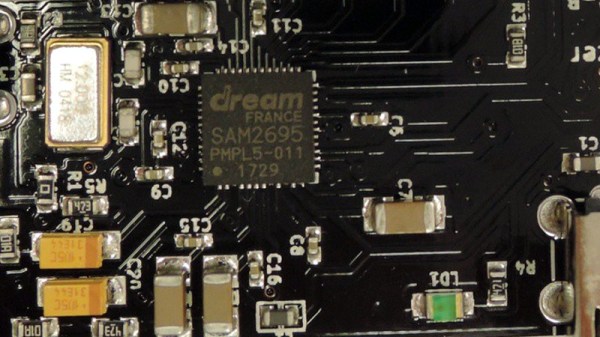
One has come to our attention that is pretty unremarkable, but that could concern some of our readers. NXP have stopped manufacturing the LPC810M021FN8. What on earth is an LPC810M021FN8, you ask, the answer being that it appears to have been the last microcontroller with an ARM core available in a DIP package. Even that in itself is hardly earth-shattering, for if you really must use an ARM core rather than any of the myriad 8, 16, or 32 bit microcontrollers still available you can always get a DIP breakout board for a small surface mount chip.

This turn of events comes as a reminder that, while breadboard-friendly and popular among a section of our community, DIP packages are now particularly old-school. Other once-popular devices such as the LPC1114 have also long-since ceased to be available in this format, and we have to wonder how long we will be able to take advantage of DIP packages for some of the other microcontroller families.

A few years ago this news might have come as something of a disaster, but it now has more of a sense of the passing of a bygone era. It’s normal to use microcontroller dev boards in a larger DIP format for prototyping, so maybe getting used to a bit of surface-mount soldering on a break-out board will be only for the truly hard-core when the last DIP package has been retired. Other than that of course, the 555 is still available in a DIP8, and you can make anything with one of them!

If you didn’t have a chance to take the 810 for a test drive, the usual suppliers still list it in stock, Adafruit have a starter pack for it, and it will no doubt be possible to find it in small quantities for years to come.

[Thanks Tod E. Kurt for the tip]

Hackaday & Tindie UK Tour Adds Milton Keynes

Hackaday and Tindie are on the road in the UK and we want you to grab one of your projects and come hang out! We have three meetups scheduled over the coming week:

Fresh from our Dublin Unconference and following our London meetup which is happening today, Hackaday and Tindie are staying on the road. We’ve already told you about Nottingham on the 18th, and Cambridge on the 19th, to those two we’re adding Milton Keynes on the 23rd.

We’ll be at convening at Milton Keynes Makerspace on the evening of Monday the 23rd, a community hackspace venue with easy access and parking, and a vibrant community of members. It shares an industrial unit with the local Men In Sheds, so look out for their sign. Entry is free but please get a ticket so we know the amount of pizza and soft drinks we need to arrange. Bring along whatever you are working on, we’d love to see one of your projects, whatever it is!

At the end of the month we will also be at Maker Faire UK in Newcastle, Meeting you, our readers, is important to us, and though we can’t reach everywhere we would like to try to get further afield in the future. Please watch this space.

The Raspberry Pi 3B+ As An SDR – Without The SDR!

We’ve become used to software-defined radio as the future of radio experimentation, and many of us will have some form of SDR hardware. From the $10 RTL USB sticks through to all-singing, all-dancing models at eye-watering prices, there is an SDR for everyone.

What about the idea of an SDR without any external hardware? Instead of plugging something into your Raspberry Pi, how about using the Pi itself, unmodified? That’s just what the Nexmon SDR project has achieved, and this has been made possible through clever use of the on-board Broadcom 802.11ac WiFi chip. The result is a TX-capable SDR, albeit one only capable of operating within the 2.4 GHz and 5 GHz spectrum used by WiFi.

The team had previously worked extensively with the chipset in the Nexus 5 phone, and the SDR extension was first available on that platform. Then along came the Raspberry Pi 3 B+ with a similar-enough WiFi chipset that the same hack was portable to that platform, et voilá: WiFi SDR on a Pi 3 B+.

If you’ve not looked at the Pi 3 B+ we’d like to direct you to our review. If you don’t have a Nexus 5 kicking around, and you’d like to do some WiFi-band SDR work, it’s looking like an amazing deal.

Via rtl-sdr.com.

Clive Sinclair, The Other Author

A reasonable selection of the Hackaday readership will have had their first experiences of computing on an 8-bit machine in a black case, with the word “Sinclair” on it. Even if you haven’t work with one of these machines you probably know that the man behind them was the sometimes colourful inventor Clive (now Sir Clive) Sinclair.

The finest in 1950s graphic design, applied to electronics books.

He was the founder of an electronics company that promised big results from its relatively inexpensive electronic products. Radio receivers that could fit in a matchbox, transistorised component stereo systems, miniature televisions, and affordable calculators had all received the Sinclair treatment from the early-1960s onwards. But it was towards the end of the 1970s that one of his companies produced its first microcomputer.

At the end of the 1950s, when the teenage Sinclair was already a prolific producer of electronics and in the early stages of starting his own electronics business, he took the entirely understandable route for a cash-strapped engineer and entrepreneur and began writing for a living. He wrote for electronics and radio magazines, later becoming assistant editor of the trade magazine Instrument Practice, and wrote electronic project books for Bernard’s Radio Manuals, and Bernard Babani Publishing. It is this period of his career that has caught our eye today, not simply for the famous association of the Sinclair name, but for the fascinating window his work gives us into the state of electronics at the time.

Continue reading “Clive Sinclair, The Other Author”

Audio Hacking With The ESP8266

If you study the specifications of the ESP8266 WiFi-enabled microcontroller, you will notice that it features an I2S audio interface. This is a high-speed serial port designed to deliver 16-bit audio data in a standard format, and has its origins in consumer audio products such as CD players. It would be usual to attach a dedicated DAC to an I2S interface to produce audio, but [Jan Ostman]’s synthesiser projects eschew that approach, and instead do the job in software. His I2S interface pushes out a pulse density modulated data stream in the same manner as a 1-bit DAC, meaning that the only external components required to produce audio are a simple low-pass filter. He’s posted a video of the synth in action, which we’ve placed below the break.

The example he gives us is a basic clone of a Roland 909 drum machine, and he takes us through the code with extensive examples including MIDI. He’s using the Wemos D1 Mini board, but the same could be replicated with many other ESP8266 platforms.

We’ve featured [Jan]’s work many times before, from his minimalist Atmel-based devices through to small but perfectly-formed complete instruments.

Continue reading “Audio Hacking With The ESP8266”

Hackaday And Tindie Are Coming To London On Sunday!

Hackaday and Tindie have arrived in London at the weekend, fresh from our Dublin Unconference. Join us this Sunday afternoon, as we convene at the Artillery Arms, a pub on the northeastern edge of the City. It’s a free event, we ask though that you sign up for it via Eventbrite if you’d like to attend.

We’re following our usual Bring-a-Hack style format, so come along and hang out with members of the London Hackaday community, and if you have a project to bring along then don’t be shy as we’d love to see it. And especially if you have a Hackaday Prize entry to show then we’d particularly like to see it. You never cease to amaze us with the work you do, be it the simplest of hacks or the most technically advanced. Just one thing though, if you bring something, make sure it’s handheld or portable enough to easily sit on a pub tabletop, space may be limited.

In attendance will be Tindie’s [Jasmine Brackett] and Hackaday’s [Jenny List], as well as quite a few of our community regulars. What better way could there be to spend a spring Sunday afternoon in London?

But what if you can’t make London, and face the prospect of missing out on us entirely? Fortunately, this one is not the only meetup we have planned, we’re heading to Nottingham and Cambridge on the 18th and 19th of April, respectively, and might even squeeze in another date if we can.

Dublin Unconference Roundup: The Topics That Are Hot Right Now

On Saturday, the Hackaday Community from across Ireland and other parts of Europe poured into the performance hall at Dublin’s Project Arts Centre for a massive collection of talks. From rediscovering century’s old technology, to cutting edge research projects, we heard talks from dozens of attendees on the technology that is interesting them most right now.

Choosing what to share about last weekend’s Uncon has been a particularly taxing process. So many and varied were the projects presented, and such was their high standard, that a writer faces a significant challenge to fit them into a single report. But we’ll give it a try. Read on for highlights of what was a weekend we will remember forever.

[Rachel]'s about to lull us into a false sense of security with talk of fashion, then go for the eyeballs!
[Rachel]’s about to lull us into a false sense of security with talk of fashion, then go for the eyeballs!

From Wearables to Lab-Grown Eyeballs

Dublin by early April has lost some of winter’s chill, but the sun hadn’t regained control enough for the populace to have shed their coats and boots. It was in a slightly damp Temple Bar then that the Hackaday faithful convened at the Project Arts Centre, temporarily forsaking for us its role as one of Ireland’s most cutting-edge contemporary performing arts venues. We’d spent the previous day rounding up what seemed like Ireland’s entire stock of snack food to keep everyone happy, so it was into the upstairs performance hall for the day’s festivities. After putting in a talk topic and stopping by the swag table for goodies from our sponsor, DesignSpark, we all packed into the hall and began the Uncon.

First to brave the floor was [Rachel “Konichiwakitty” Wong], who started by talking about her interest in and flair for wearable electronics applied to fashion. This is not however what she does for a living, and she soon switched from the kawaii to the everyday work of a stem cell research scientist. This section of her talk was entitled “The Future Of Medicine, stem cells, tissue engineering, off-the-shelf pick-n-mix organs”.  Because of the work being done by people like her our hospitals may one day be able to prescribe custom 3D-printed organs for their patients, and her talk was a fascinating overview of that field for those of us who can not grow eyeball tissue on our benches.

There followed the exciting Unconference format, in which attendees were scheduled on-the-fly in four talk sessions throughout the day. Each deliver a seven-minute presentation and although it’s not compulsory to give an Unconference talk, there were definitely more than enough people wanting to give it a go. It’s impossible to mention them all in a single Hackaday piece, but here follows a selection of the many that caught our eye.

Continue reading “Dublin Unconference Roundup: The Topics That Are Hot Right Now”