ISS Astronaut Shows Off SpaceX’s Stylish Spacesuit

Beyond the fact that Hollywood costume designer Jose Fernandez was called in to develop its distinctively superhero look, SpaceX hasn’t released a lot of public information about their high-tech spacesuit. But thanks to Japanese astronaut [Soichi Noguchi], Mission Specialist on the first operational Crew Dragon flight and a current occupant of the International Space Station, we now have a guided tour of the futuristic garment. The fact that it was recorded in space is just an added bonus.

As it was released on his personal YouTube account and isn’t an official NASA production, the video is entirely in Japanese, though most of it can be understood from context. You can try turning on the automatic English translations, but unfortunately they seem to be struggling pretty hard on this video. For example as [Soichi] demonstrates the suit’s helmet, the captions read “A cat that is said to have been designed using a 3D printer.” Thanks, Google.

Still, this video provides us with the most information we’ve ever had about how astronauts store, wear, and operate the suit. [Soichi] starts by showing off the personalized bags that the suits are kept in and then explains how the one-piece suit opens on the bottom so the wearer can pull it on over their head. He also points out the three layers the suit is made of: a Teflon-coated outer shell, a fiber-reinforced core for strength, and an inner airtight garment.

Little details are hidden all over the suit, such as a track built into the heel of the boot that’s used to restrain the astronaut’s feet to the Crew Dragon’s seats. [Soichi] also provides what appears to be the first public view of the umbilical connector on the suit. Hidden under a removable cover, the connector features 14-pins for data and power, a wide port for air circulation, and smaller high-pressure port for nitrox that would presumably be used to inflate the suit should the cabin lose pressure while in flight.

It’s taken an incredible amount of work to get commercial spacecraft such as the Dragon to the point that they can begin ferrying crews to the ISS. This close look at all the details that went into something as seemingly mundane as the suit astronauts wear while riding in their craft is a reminder that nothing about human spaceflight is easy.

Continue reading “ISS Astronaut Shows Off SpaceX’s Stylish Spacesuit”

AI Upscaling And The Future Of Content Delivery

The rumor mill has recently been buzzing about Nintendo’s plans to introduce a new version of their extremely popular Switch console in time for the holidays. A faster CPU, more RAM, and an improved OLED display are all pretty much a given, as you’d expect for a mid-generation refresh. Those upgraded specifications will almost certainly come with an inflated price tag as well, but given the incredible demand for the current Switch, a $50 or even $100 bump is unlikely to dissuade many prospective buyers.

But according to a report from Bloomberg, the new Switch might have a bit more going on under the hood than you’d expect from the technologically conservative Nintendo. Their sources claim the new system will utilize an NVIDIA chipset capable of Deep Learning Super Sampling (DLSS), a feature which is currently only available on high-end GeForce RTX 20 and GeForce RTX 30 series GPUs. The technology, which has already been employed by several notable PC games over the last few years, uses machine learning to upscale rendered images in real-time. So rather than tasking the GPU with producing a native 4K image, the engine can render the game at a lower resolution and have DLSS make up the difference.

The current model Nintendo Switch

The implications of this technology, especially on computationally limited devices, is immense. For the Switch, which doubles as a battery powered handheld when removed from its dock, the use of DLSS could allow it to produce visuals similar to the far larger and more expensive Xbox and PlayStation systems it’s in competition with. If Nintendo and NVIDIA can prove DLSS to be viable on something as small as the Switch, we’ll likely see the technology come to future smartphones and tablets to make up for their relatively limited GPUs.

But why stop there? If artificial intelligence systems like DLSS can scale up a video game, it stands to reason the same techniques could be applied to other forms of content. Rather than saturating your Internet connection with a 16K video stream, will TVs of the future simply make the best of what they have using a machine learning algorithm trained on popular shows and movies?

Continue reading “AI Upscaling And The Future Of Content Delivery”

Smashed Amiga 2000 Gets New Lease On Life

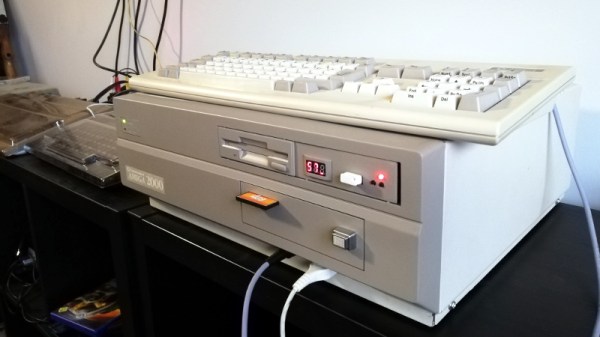
For most people, opening up a package and seeing that the Amiga 2000 you purchased on eBay had been smashed up by the delivery carrier would be a heartbreaking moment. But not [Drygol]. If you live and breathe vintage computer restorations like he does, finding your latest acquisition is in need of more repairs and upgrades than you originally anticipated is actually a bonus.

The first issue that needed sorting out was the broken case. This Amiga must have had one wild ride, as there were several nasty cracks in the front panel and whole chunks had been broken off. We’ve seen [Drygol] repair broken computer cases before, but it seems like each time he comes up with some new tricks to bring these massacred pieces of plastic back to like-new condition. In this case plastic welding is used to hold the parts together and fill in the gaps, and then brass mesh is added to the backside for strength. The joints are then sanded, filled in with polyester putty, and finally sprayed with custom color matched paint. While he was in the area, he also filled in a hole the previous owner had made for a toggle switch.

Then [Drygol] moved onto the internals. Some of the traces on the PCB had been corroded by a popped battery, a socket needed to be replaced, and as you might expect for a machine of this vintage, all of the electrolytic capacitors were suspect and needed to go. Finally, as the system didn’t have a power supply, he wired in a picoPSU. That got the 34 year old computer back up and running, and at this point, the machine was almost like new again. So naturally, it was time to start with the upgrades and modifications.

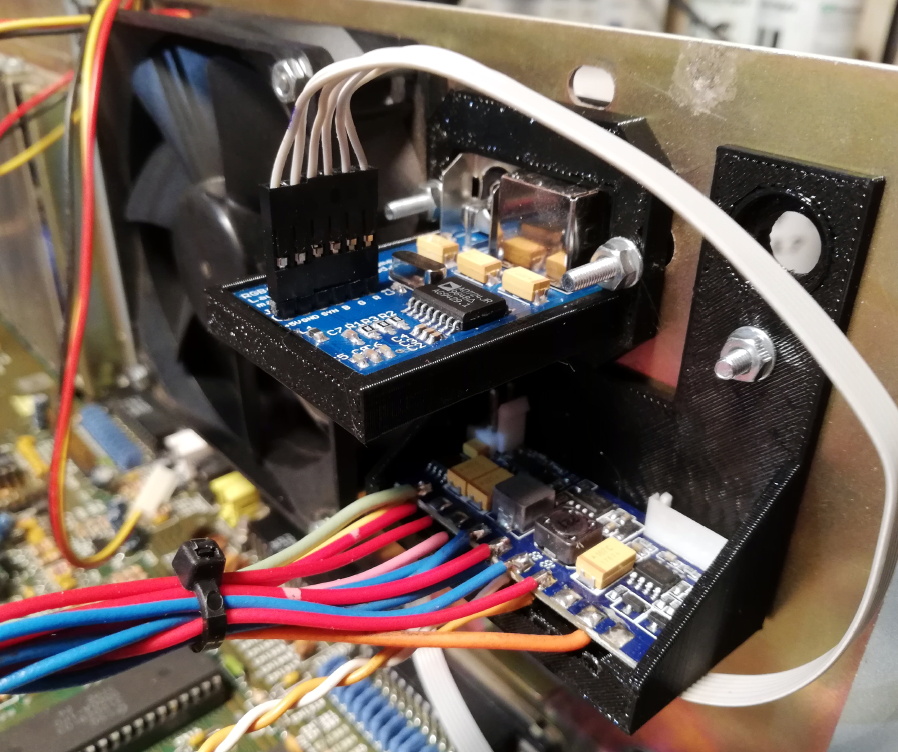
Case fan, video adapter, and picoPSU.

[Drygol] added an IDE interface and connected a CompactFlash adapter as the computer’s primary drive. For the secondary, he installed a GoTek floppy drive emulator that lets you replace a mountain of physical disks with a USB flash drive full of images. Between the two, all of the computer’s storage needs are met with nary a moving part.

The emulator was given its own 3D printed front panel to fit with the Amiga’s visual style, and he also printed out a holder for the RGB4ALL S-Video/Composite adapter installed on the rear of the machine. To help keep all this new gear cool, he finished things off with a new case fan.

Some will no doubt complain about the addition of the extra gadgetry, but to those people, we suggest you just focus on the phenomenal case restoration work. While you might not agree with all of the modifications [Drygol] makes, there’s no question that you can learn something by going through his considerable body of work.

Spinning Up A Water Cooled 3D Printed Stirling Engine

The Stirling external combustion engine has fascinated gear heads since its inception, and while the technology has never enjoyed widespread commercialization, there’s a vibrant community of tinkerers who build and test their own takes on the idea. [Leo Fernekes] has been working on a small Stirling engine made from 3D printed parts and common hardware components, and in his latest video he walks viewers through the design and testing process.

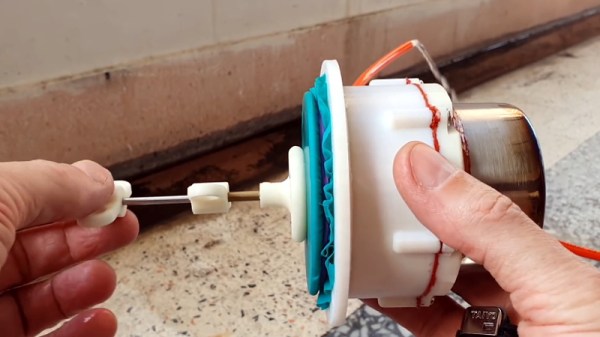
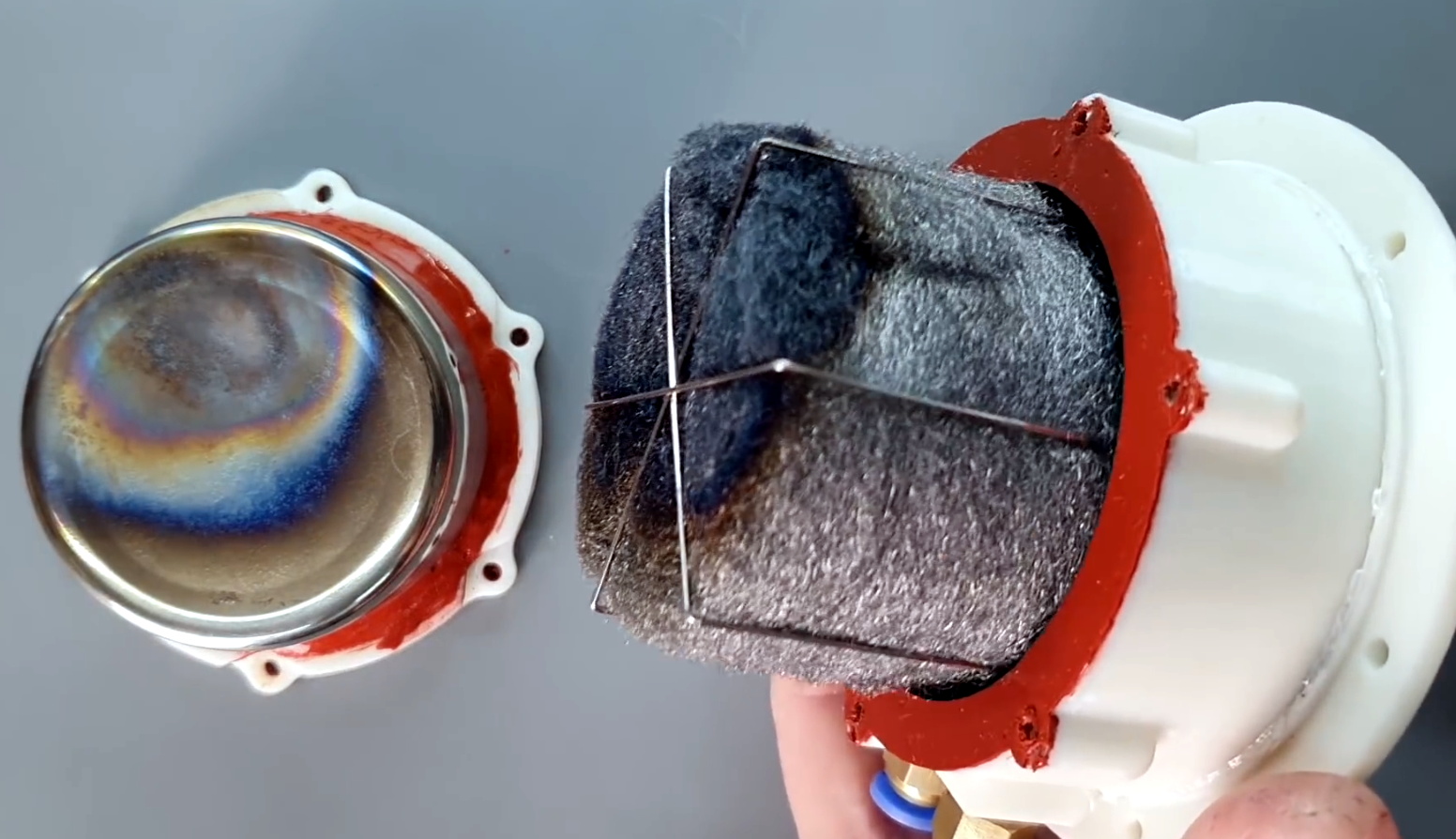
We’ve seen Stirling engines with 3D printed parts before, but in most cases, they are just structural components. This time, [Leo] really wanted to push what could be done with plastic parts, so everything from the water jacket for the cold side of the cylinder to the gears and connecting rods of the rhombic drive has been printed. Beyond the bearings and rods, the most notable non-printed component is the stainless steel spice shaker that’s being used as the cylinder.

The piston is made of constrained steel wool.

Mating the hot metal cylinder to the 3D printed parts naturally introduced some problems. The solution [Leo] came up with was to design a toothed collar to hold the cylinder, which reduces the surface area that’s in direct contact. He then used a piece of empty SMD component feed tape as a insulator between the two components, and covered the whole joint in high-temperature silicone.

Like many homebrew Stirling engines, this one isn’t perfect. It vibrates too much, some of the internal components have a tendency to melt during extended runs, and in general, it needs some fine tuning. But it runs, and in the end, that’s really the most important thing with a project like this. Improvements will come with time, especially once [Leo] finishes building the dynamometer he hopes will give him some solid data on how the engine’s overall performance is impacted as he makes changes.

If you’ve got a glass test tube laying around, putting together a basic Stirling engine demonstration is probably a lot easier than you might think. Commercial kits are also available if you’re looking for something more substantial, but even those can benefit from some aftermarket modifications. With a little effort, you’ll have a power plant ready for the surface of Mars in no time.

Continue reading “Spinning Up A Water Cooled 3D Printed Stirling Engine”

Web Tool Cranks Up The Power On DJI’s FPV Drone

Apparently, if the GPS on your shiny new DJI FPV Drone detects that it’s not in the United States, it will turn down its transmitter power so as not to run afoul of the more restrictive radio limits elsewhere around the globe. So while all the countries that have put boots on the Moon get to enjoy the full 1,412 mW of power the hardware is capable of, the drone’s software limits everyone else to a paltry 25 mW. As you can imagine, that leads to a considerable performance penalty in terms of range.

But not anymore. A web-based tool called B3YOND promises to reinstate the full power of your DJI FPV Drone no matter where you live by tricking it into believing it’s in the USA. Developed by the team at [D3VL], the unlocking tool uses the new Web Serial API to send the appropriate “FCC Mode” command to the drone’s FPV goggles over USB. Everything is automated, so this hack is available to anyone who’s running a recent version of Chrome or Edge and can click a button a few times.

There’s no source code available yet, though the page does mention they will be putting up a GitHub repository soon. In the meantime, [D3VL] have documented the command packet that needs to be sent to the drone over its MODBUS-like serial protocol for others who might want to roll their own solution. There’s currently an offline Windows-only tool up for download as well, and it sounds like stand-alone versions for Mac and Android are also in the works.

It should probably go without saying that if you need to use this tool, you’ll potentially be violating some laws. In many European countries, 25 mW is the maximum unlicensed transmitter power allowed for UAVs, so that’s certainly something to keep in mind before you flip the switch. Hackaday isn’t in the business of dispensing legal advice, but that said, we wouldn’t want to be caught transmitting at nearly 60 times the legal limit.

Even if you’re not interested in fiddling with drone radios, it’s interesting to see another practical application of the Web Serial API. From impromptu oscilloscopes to communicating with development boards and conference badges, clever developers are already finding ways to make hardware hacking easier with this new capability.

[Thanks to Jules for the tip.]

Custom Built 12-Port A/V Switch Keeps CRT Well Fed

Classic gaming aficionados who prefer to play on real hardware know the struggle of getting their decades-old consoles connected to a modern TV. Which is why many gamers chose to keep a contemporary CRT TV around for when they want to take a walk down memory lane. Unfortunately those old TVs usually didn’t offer more than a few A/V ports on the back, so you’ll probably need to invest in a A/V switch to keep them all hooked up at once.

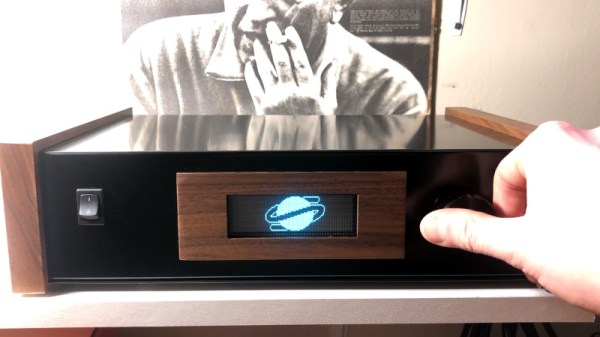
That’s the situation [Thomas Sowell] found himself in, except he couldn’t find one with enough ports. Rather than chain switches together, he decided to build his own custom 12-port console selector. With an integrated amplifier to keep everything looking sharp, a handsome walnut and metal enclosure, and a slick graphical interface that shows the logo of the currently selected console on a Vacuum Fluorescent Display (VFD), the final product is a classic gamer’s dream come true.

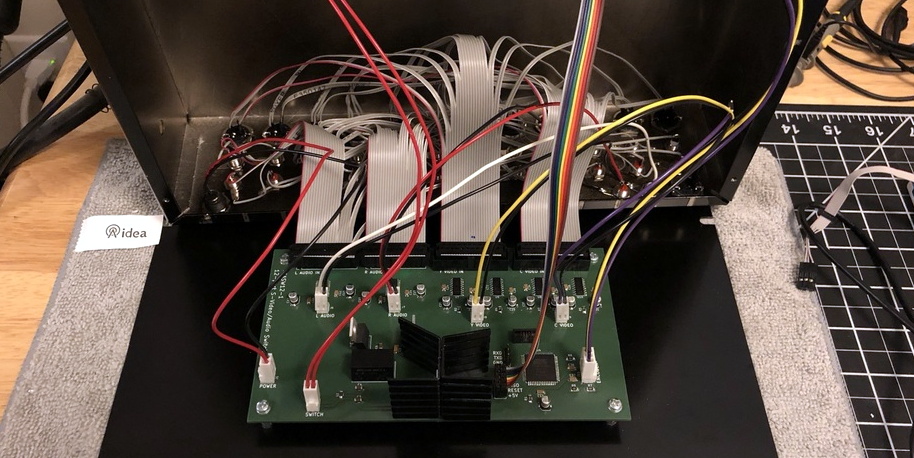
A peek under the hood.

To switch the audio [Thomas] is using a pair of ADG1606 16-channel analog multiplexers, while video is shuffled around with four MAX4315 8-channel video multiplexer-amplifiers. The math might seem a bit off at first, but he’s using one ADG1606 for each stereo channel and since the switch is for S-Video, each device has a luminance and color signal that needs to be handled separately. The multiplexers are flipped with a ATmega2561 microcontroller, which is also responsible for reading user input from a rotary encoder on the front of the case and displaying the appropriate console logo on the 140×32 Noritake VFD.

You may be surprised to find that [Thomas] considered himself an electronics beginner when he started this project, and that this is only the second PCB he’s ever designed. Was this a bold second project? Sure. But it also speaks to how far DIY electronics has come over the last years. Powerful open source tools, modular components, and of course a community of creative folks willing to share their knowledge and designs, has gone a long way towards redefining whats possible for the individual hacker and maker.

Continue reading “Custom Built 12-Port A/V Switch Keeps CRT Well Fed”

Google Calls It Quits With VR, But Cardboard Lives On

Google giving up on one of their projects and leaving its established userbase twisting in the wind hardly counts as news anymore. In fact, it’s become something of a meme. The search giant is notorious for tossing out ideas just to see what sticks, and while that’s occasionally earned them some huge successes, it’s also lead to plenty of heartache for anyone unlucky enough to still be using one of the stragglers when the axe falls.

So when the search giant acknowledged in early March that they would no longer be selling their Cardboard virtual reality viewer, it wasn’t exactly a shock. The exceptionally low-cost VR googles, literally made from folded cardboard, were a massive hit when they were unveiled back in 2014. But despite Google’s best efforts to introduce premium Cardboard-compatible hardware with their Daydream View headset two years later, it failed to evolve into a profitable business.

Google Cardboard

Of course if you knew where to look, the writing had been on the wall for some time. While the Daydream hardware got a second revision in 2017, and Google even introduced a certification program to ensure phones would work properly with the $100 USD headset, the device was discontinued in 2019. On the software side, Android 7 “Nougat” got baked-in VR support in 2016, but it was quietly removed by the time Android 11 was released in the fall of 2020.

With Cardboard no longer available for purchase, Google has simply made official what was already abundantly clear: they are no longer interested in phone-based virtual reality. Under normal circumstances, anyone still using the service would be forced to give it up. Just ask those who were still active on Google+ or Allo before the plug was pulled.

But this time, things are a little different. Between Google’s decision to spin it off into an open source project and the legions of third party viewers on the market, Cardboard isn’t going down without a fight. The path ahead might be different from what Google originally envisioned, but the story certainly isn’t over.

Continue reading “Google Calls It Quits With VR, But Cardboard Lives On”