Original Xbox Gets The Steam Overhaul

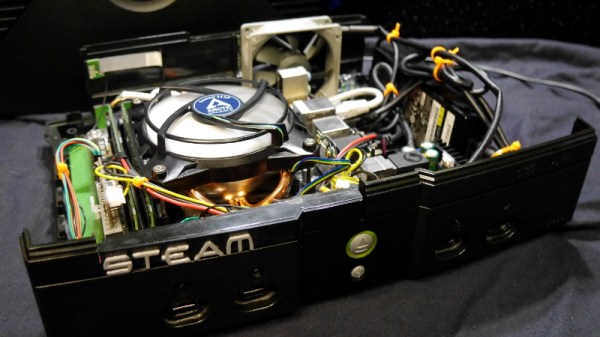
When Microsoft released the original Xbox, it deviated from the design of traditional game consoles in that it used several off-the-shelf computer components. The fact that Microsoft would want their game console to resemble a PC isn’t particularly surprising in hindsight, but we doubt anyone at Redmond ever imagined folks like [Ryan Walmsley] would be cramming in full-fledged computers nearly 20 years later.

[Ryan] tells us he was looking for a way to play some older games from the early 2000s, and thought it was a good opportunity to put together a quiet set-top computer. The final hardware is more than capable of running older titles, and can even be used with Steam Link to stream newer content from his primary gaming computer.

Even with a diminutive Gigabyte GA-H81N Mini ITX motherboard, things are pretty tight inside the Xbox. Fairly tight wire management was required to prevent any airflow obstructions, especially since [Ryan] decided to put the system’s 80 watt laptop-style power supply inside the case. While this made the build a bit more complicated, it does make the final product a lot cleaner and makes it feel just that much more like a proper game console.

Benchmarks show the machine has decent performance, all things considered. [Ryan] says there are some potential upgrades down the line, but as with most gaming PC builds, cost is the limiting factor. Until he’s ready to spend the cash on revamping the internals, he says that streaming newer games over the the network has been working great.

For those looking for a slightly more modern alternative to this project, we’ve also seen a gaming PC shoehorned into an Xbox 360 with similarly impressive results.
Arduino Drums Bring The Noise, No MIDI Required

When looking through existing Arduino drum kit projects, [joekutz] noticed that most of them just used the microcontroller as an input for an existing MIDI device. That’s fine if you’re just looking to build your own hardware interface, but he wondered if it would be possible to forgo the MIDI device completely and actually generate the audio internally.

To be sure, this is a lot to ask of an 8-bit microcontroller, which is probably why nobody does it this way. But [joekutz] wasn’t giving up without a fight. One of the trickiest aspects was storing the samples: the 8-bit, 11.025 KHz mono WAV files ultimately had to be converted into C data arrays with a custom Python script.

Unfortunately, since the samples are essentially part of the drum’s source code, he says distributing the firmware is something of a problem. Though it sounds as though there might be a solution to this soon for those who want to play along at home.

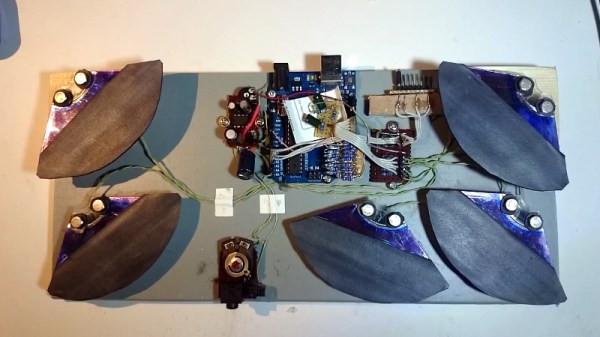
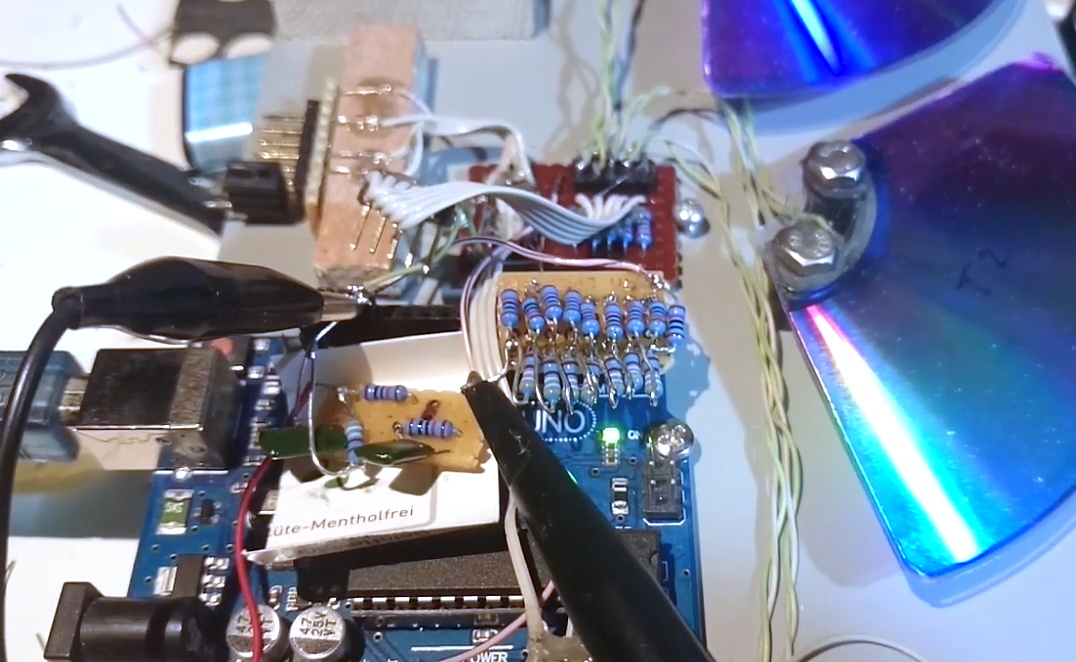
But don’t get the impression that this project is just software. Check out the custom impact sensors lovingly crafted from popsicle sticks and metal cut from soda cans, which have been mated with sections cut out of old DVD-Rs. Actually getting the beats out of the Arduino required the addition of a R2R DAC circuit and a TDA2822 amplifier. In the video after the break, you can hear the results for yourself.

[joekutz] is no stranger to homebrew electronic instruments. When we last heard from him, he was turning a very pink keyboard into his own personal circuit bending playground.

Continue reading “Arduino Drums Bring The Noise, No MIDI Required”

The Easiest Way To Put Your Doorbell On The Internet

Thanks to low-cost WiFi enabled microcontrollers such as the ESP8266 and ESP32, it’s never been a better time to roll your own smart home system. But that doesn’t mean it isn’t daunting for new players. If you’re looking for an easy first project, putting your old school doorbell on the Internet of Things is a great start, but even here there’s some debate about how to proceed.

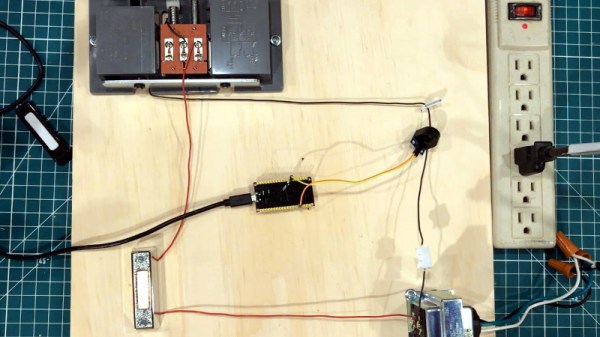
Most people stumble when they get to the point where they have to connect their low-voltage microcontroller up to the relatively beefy transformer that drives a standard doorbell. We’ve seen a number of clever methods to make this connection safely, but this tip from [AnotherMaker] is probably the easiest and safest way you’re likely to come across.

His solution only requires an inductive current sensor, which can be had for less than $1 from the usual overseas suppliers. One leg of the doorbell circuit is passed through the center of this sensor, and the sensor itself is connected up to your microcontroller of choice (here, and ESP32). The rest is software, which [AnotherMaker] explains in the video after the break. With the addition of a little debounce code, your microcontroller can reliably determine when somebody is out there jabbing the bell button; what you do with this information after that is up to you.

If you’re worried this method is too easy you could always try it with an optocoupler, or maybe convert the low-voltage AC to something your microcontroller can handle.

Continue reading “The Easiest Way To Put Your Doorbell On The Internet”

NASA’s Long-Delayed Return To Human Spaceflight

With the launch of the SpaceX Demo-2 mission, the United States has achieved something it hasn’t done in nearly a decade: put a human into low Earth orbit with a domestic booster and vehicle. It was a lapse in capability that stretched on far longer than anyone inside or outside of NASA could have imagined. Through a series of delays and program cancellations, the same agency that put boot prints on the Moon and built the iconic Space Shuttle had been forced to rely on Russia to carry its astronauts into space since 2011.

NASA would still be waiting to launch its own astronauts had they relied on America’s traditional aerospace giants to get the job done. The inaugural flight of the Boeing CST-100 ā€œStarlinerā€ to the International Space Station in December was an embarrassing failure that came perilously close to losing the unmanned capsule. A later investigation found that sloppy software development and inconsistent testing had caused at least two major failures during the mission, which ultimately had to be cut short as the vehicle couldn’t even reach the altitude of the ISS, to say nothing of making a docking attempt. NASA and Boeing have since agreed to attempt another test of the CST-100 sometime before the end of the year, though a delay into 2021 seems almost inevitable due to the global pandemic.

But America’s slow return to human spaceflight can’t be blamed on the CST-100, or even Boeing, for that matter. Since the retirement of the Space Shuttle, NASA has been hindered by politics and indecisiveness. With a constantly evolving mandate from the White House, the agency’s human spaceflight program has struggled to make significant progress towards any one goal.

Continue reading “NASA’s Long-Delayed Return To Human Spaceflight”

Hackaday Prize And Conservation X Labs Issue Design Challenges To Address Extinction Crisis

When most people think of extinct species, they likely imagine prehistoric creatures such as dinosaurs or woolly mammoths. Extinction is something you read about in history books, nature’s way of removing contestants in the great game of life. It’s a product of a cruel and savage world, and outside of a few remaining fringe cases, something that humanity’s advanced technology has put a stop to.

Unfortunately, the truth is far more complicated than that. The planet is currently going through its sixth major extinction event, and this time, it’s our fault. Humanity might not be willfully destroying the natural habitats of the plants, fish, birds, and other lifeforms that have been eradicated, but we’re responsible for it just the same. Humans are an apex predator unlike any the world has ever seen before, and the only force that can stop us is ourselves.

Founded in 2015, Conservation X Labs is devoted to doing everything it can to end this sixth wave of extinction. Unsatisfied with the pace of traditional conservation, they leverage technology and open innovation to develop unique new ways of combating the damage our species has done to life on this planet. After all, it’s the only one we’ve got.

We’ve partnered with this organization to help develop solutions to some of these problems. This includes an open call challenge that anyone can enter, and a Dream Team program that you can get involved with if you act quickly. Let’s take a look at what Conservation X Labs is all about, and what is involved with the challenges at hand.

Continue reading “Hackaday Prize And Conservation X Labs Issue Design Challenges To Address Extinction Crisis”

X-37B Spaceplane To Test Power Beaming Technology

Since 2010, the United States military has been operating a pair of small reusable spaceplanes that conduct secretive long-duration flights in low Earth orbit. Now officially operating under the auspices of the newly formed Space Force, the X-37Bs allow the military to conduct in-house research on new hardware and technology with limited involvement from outside agencies. The spaceplane still needs to hitch a ride to space on a commercial rocket like the Atlas V or the Falcon 9, but once it’s separated from the booster, the remainder of the X-37B’s mission is a military affair.

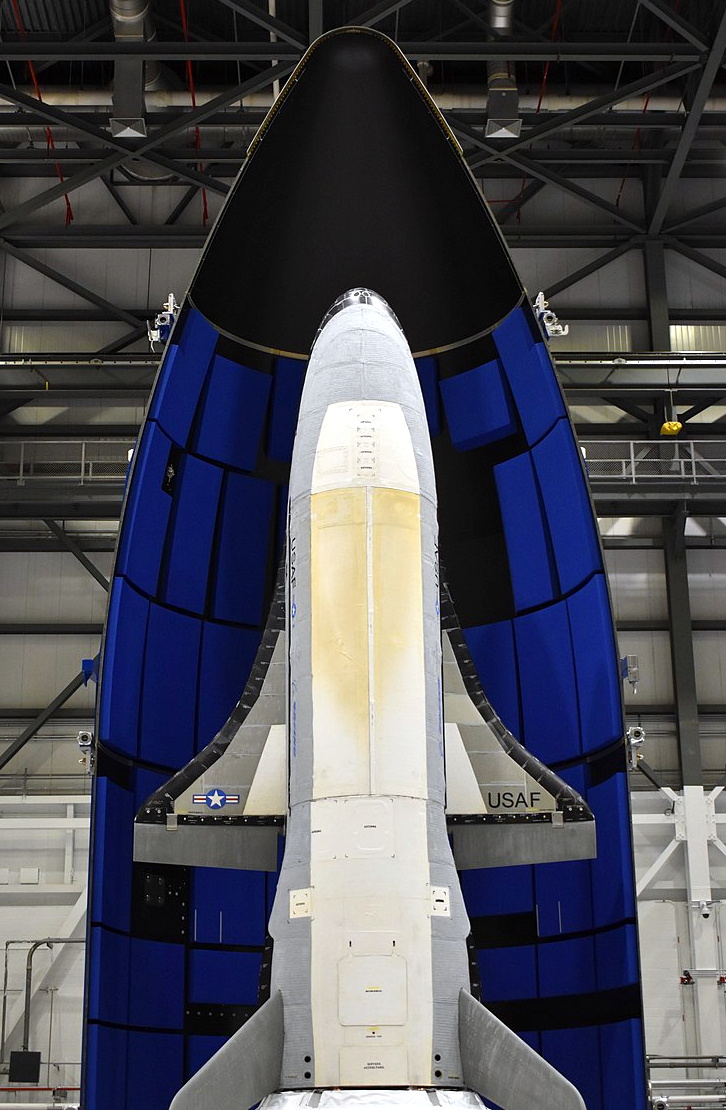
An X-37B being prepared for launch.

So naturally, there’s a lot we don’t know about the USSF-7 mission that launched from Cape Canaveral Air Force Station on May 17th. The duration of the mission and a complete manifest of the experiments aboard are classified, so nobody outside the Department of Defense truly knows what the robotic spacecraft is up to. But from previous missions we know the craft will likely remain in orbit for a minimum of two years, and there’s enough public information to piece together at least some of the investigations it will be conducting.

Certainly one the most interesting among them is an experiment from the U.S. Naval Research Laboratory (NRL) that will study converting solar power into a narrow microwave beam; a concept that has long been considered the key to unlocking the nearly unlimited energy potential offered by an orbital solar array. Even on a smaller scale, a safe and reliable way to transmit power over the air would have many possible applications. For example it could be used to keep unmanned aerial vehicles airborne indefinitely, or provide additional power for electric aircraft as they take-off.

Performing an orbital test of this technology is a serious commitment, and shows that all involved parties must have a fairly high confidence level in the hardware. Unfortunately, there isn’t much public information available about the power beaming experiment currently aboard the X-37B. There’s not even an indication of when it will be performed, much less when we should expect to see any kind of report on how it went. But we can make some educated guesses based on the work that the Naval Research Laboratory has already done in this field.

Continue reading “X-37B Spaceplane To Test Power Beaming Technology”

Improving 3D Printed Supports With A Marker

Anyone who’s spent some quality time with a desktop 3D printer is familiar with the concept of supports. If you’re working with a complex model that has overhanging features, printing a “scaffolding” of support material around it is often required. Unfortunately, supports can be a pain to remove and often leave marks on the finished print that need to be addressed.

Looking to improve the situation, [Tumblebeer] has come up with a very unique modification to the traditional approach that we think is certainly worthy of closer examination. It doesn’t remove theĀ need for support material, but it does make it much easier to remove. The method is cheap, relatively simple to implement, and doesn’t require multiple extruders or filament switching as is the case with something like water-soluble supports.

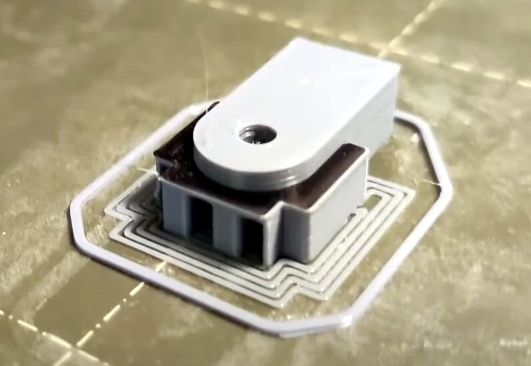
The trick is to use a permanent marker as a release agent between the top of the support and the area of the print it’s actually touching. The coating of marker prevents the two surfaces from fusing, while still providing the physical support necessary to keep the model from sagging or collapsing.

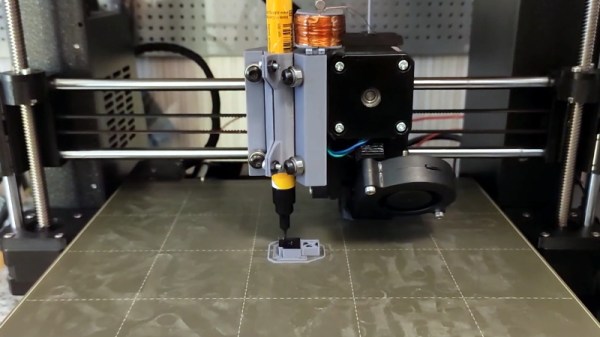
To test this concept, [Tumblebeer] has outfitted a Prusa i3 MK3S with a solenoid actuated marker holder that hangs off the side of the extruder assembly. The coil is driven from the GPIO pins of a Raspberry Pi running OctoPrint, and is engaged by a custom command in the G-code file. It keeps the marker out of the way during normal printing, and lowers it when its time to lay down the interface coating.

[Tumblebeer] says there’s still a bit of hand-coding involved in this method, and that some automated G-code scripts or a custom slicer plugin could streamline the process considerably. We’re very interested in seeing further community development of this concept, as it seems to hold considerable promise. Having a marker strapped to the side of the extruder might seem complex, but it’s nothing compared to switching out filaments on the fly.

Continue reading “Improving 3D Printed Supports With A Marker”