Bus Sniffing Leads To New Display For Vintage Casio

Despite his best efforts to repair the LCD on his Casio FX-702P, it soon became clear to [Andrew Menadue] that it was a dead-end. Rather than toss this relatively valuable device in the trash, he wondered if would be possible to replace the LCD with a more modern display. Knowing that reverse engineering the LCD panel itself would be quite a challenge, he decided instead to focus his efforts on decoding the communications between the calculator’s processor and display controller.

With his logic analyzer connected to the Casio’s four bit bus [Andrew] was able to capture a sequence of bytes during startup that looked promising, although it didn’t quite make sense at first. He had to reverse the order of each nibble, pair them back up into bytes, and then consult the FX-702P’s character map as the device doesn’t use ASCII. This allowed him to decode the message “READY”, and proved the concept was viable.
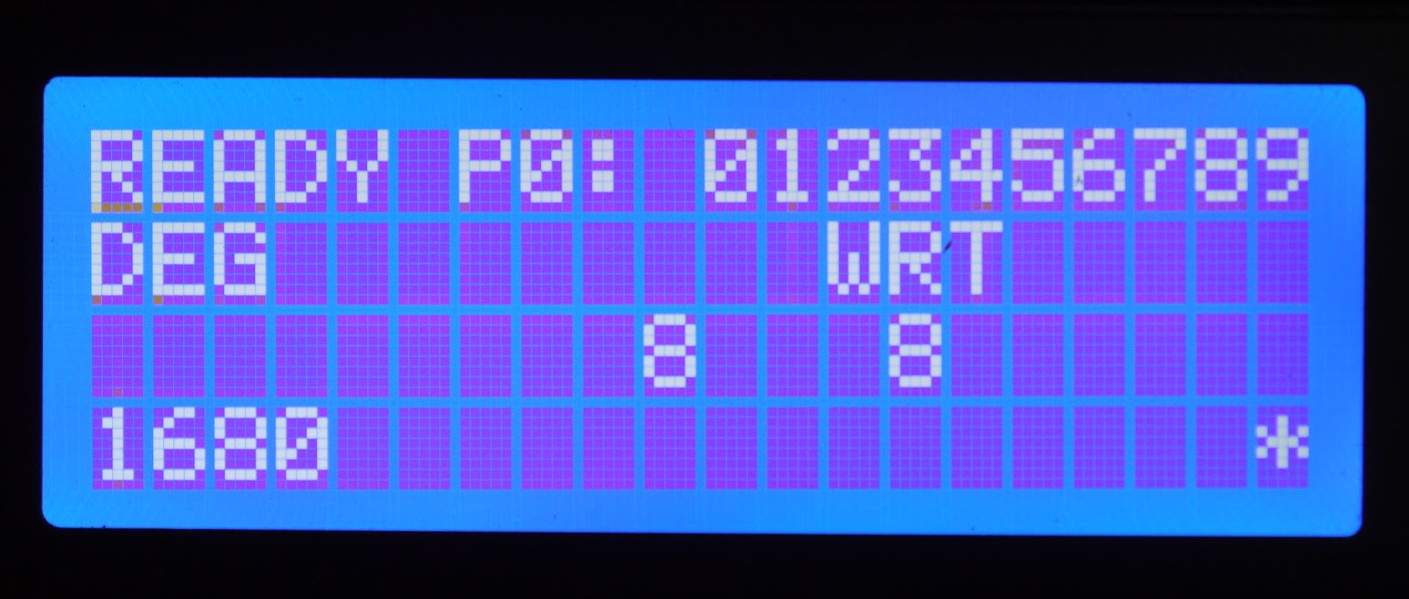
Of course a calculator with a logic analyzer permanently attached to it isn’t exactly ideal, so he started work on something a bit more compact. Armed with plenty of display controller data dumps, [Andrew] wrote some code for a STM32 “Blue Pill” ARM Cortex M3 microcontroller that would sniff and decode the data in near real-time. In the video after the break you can see there’s a slight delay between when he pushes a button and when the corresponding character comes up on the LCD below, but it’s certainly usable.

Unfortunately, the hardware he’s created for this hack is just slightly too large to fit inside the calculator proper. The new LCD is also nowhere near the size and shape that would be required to replace the original one. But none of that really matters. While [Andrew] says he could certainly make the electronics smaller, the goal was never to restore the calculator to like-new condition. Sometimes it’s more about the journey than the destination.

Continue reading “Bus Sniffing Leads To New Display For Vintage Casio”
ESP8266 Adds Web Control To Old Home Theater

There was a time when you could hold onto a TV or A/V receiver for the better part of the decade and not feel as though you were missing out on the latest and greatest features. But today you’re lucky to get three years out of a “smart” TV before it’s either supplanted by a vastly improved version, or falls victim to some weird issue that (surprise, surprise) means you need to buy a new one.

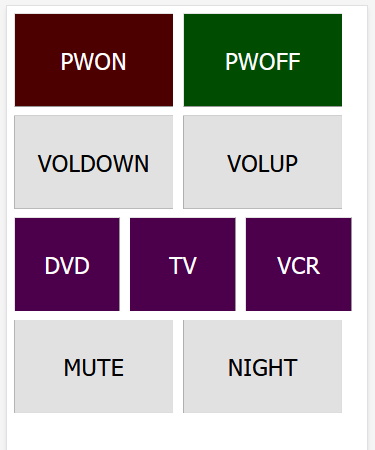
A simple touch interface hosted on the ESP8266

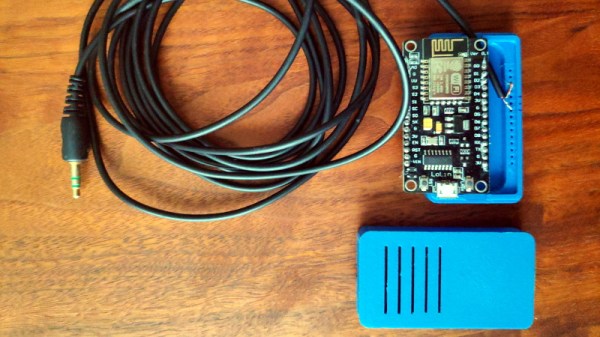
Not content with the status quo of planned obsolescence, [aamarioneta] recently set out to add a sprinkling of modern convenience to a circa 2008 Denon AVR 2308 home theater receiver. Like any good A/V receiver, the AVR 2308 features a dizzying array of ports on the back panel, one of which happens to be for an external infrared receiver. This turned out to be the perfect place to jack in an ESP8266, earning this 12 year old receiver an honorary membership into the Internet of Things.

The interesting thing about this hack is that there’s actually no IR involved. Sure, the code could be used to drive an IR LED attached to the ESP8266’s GPIO pins, and the AVR 2308 would respond as if the original remote was being used; but where’s the fun in that? Thanks to the receiver port, they’re able to inject the IR codes directly into the device. It’s the same protocol, just without the photons.

With a simple web-interface running on the ESP8266, they can control the AVR 2308 from a smartphone’s browser anywhere in the house. From here it would only take a few more lines of code to tie it into an existing home automation system or add in support for Alexa voice control.

We love seeing projects that add modern features to older hardware, as that’s one less piece of gear sent to an early grave because its owner felt they were behind the curve. It’s getting a bit unfriendly out there for consumers, and anything that puts the power back into the owner’s hands is a step in the right direction.

Mini RC Helicopter Becomes Even Smaller Submarine

We often think of submarines as fairly complex pieces of machinery, and for good reason. Keeping the electronics watertight can naturally be quite difficult, and maintaining neutral buoyancy while traveling underwater is a considerable engineering challenge. But it turns out that if you’re willing to skip out on those fairly key elements of submarine design, the whole thing suddenly becomes a lot easier. Big surprise, right?

That’s precisely how [Peter Sripol] approached his latest project, which he’s claiming is the world’s smallest remote control submarine. We’re not qualified to say if that’s true or not, but we were certainly interested in seeing how he built the diminutive submersible. Thanks to the fact that it started life as one of those cheap infrared helicopters, it’s actually a fairly approachable project if you’re looking to make one yourself.

The larger prototype version is also very cool.

After testing that the IR communication would actually work as expected underwater, [Peter] liberated the motors and electronics from the helicopter. The motor’s wires were shortened, and the receiver PCB got a slathering of epoxy to try and keep the worst of the water out, but otherwise they were unmodified.

If you’re wondering how the ballast system works, there isn’t one. The 3D printed body angles the motors slightly downwards, so when the submarine is moving forward it’s also being pulled deeper into the water. There aren’t any control surfaces either, differential thrust between the two motors is used to turn left and right. This doesn’t make for a particularly nimble craft, but in the video after the break it certainly looks like they’re having fun with it.

Looking for a slightly more complex 3D printed submersible vehicle? Don’t worry, we’ve got you covered.

Continue reading “Mini RC Helicopter Becomes Even Smaller Submarine”

Dumpster Finds Combined Into 4K Desktop Monitor

Dumpster diving is a time honored tradition in the hacking community. You can find all sorts of interesting hardware in the trash, and sometimes it’s even fully functional. But even the broken gadgets are worth taking back to your lair to strip for parts. If you’re as lucky as [Jamz], you might be able to mash a few devices together and turn them into something usable.

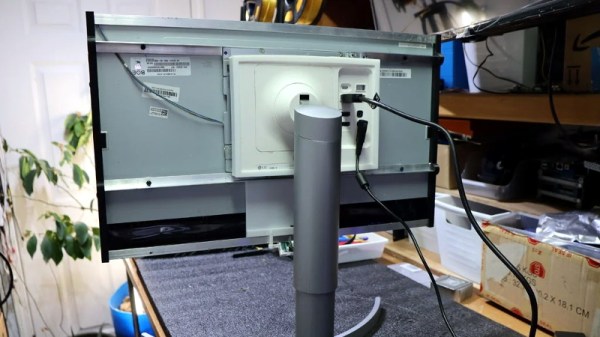
In this case, [Jamz] scored a LG 27UK650 monitor with a cracked display and a Dell OptiPlex 7440 “All-in-One” computer that was DOA. Separately these two pieces of gear were little more than a pile of spare parts waiting to be liberated. But if the control board could be salvaged from the monitor, and the working LCD pulled from the Dell…

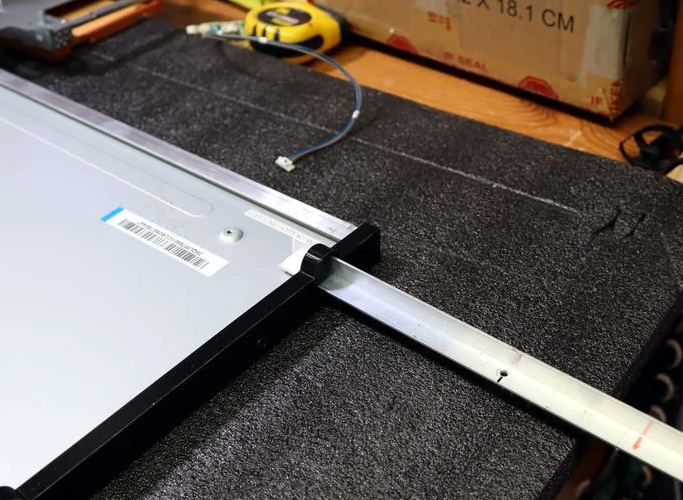
After taking everything apart, [Jamz] made a frame for this new Frankenstein monitor using pieces of aluminum channel from the hardware store and 3D printed side panels. With the Dell LCD mounted in the skeletal frame, the control board from the LG monitor was bolted to the back and wired in. Finally the center section of the LG monitor’s back panel was cut out and mounted to the new hybrid display with a 3D printed frame.

Admittedly, these were some pretty solid finds as far as trash goes. You won’t always be so lucky. But if you can keep an open mind, the curb is littered with possibilities. How about some impressive home lighting that started life as a cracked flat screen TV?

US Navy Looking To Retire Futuristic Prototype Ships

From the Age of Sail through to the Second World War, naval combat was done primarily in close quarters and with cannons. Naturally the technology improved quite a bit in those intervening centuries, but the idea was more or less the same: the ship with the most guns and most armor was usually the one that emerged victorious. Over the years warships became larger and heavier, a trend that culminated in the 1940s with the massive Bismarck, Iowa, and Yamato class battleships.

But by the close of WWII, the nature of naval combat had begun to change. Airplanes and submarines, vastly improved over their WWI counterparts, presented threats from above and below. A few years later, the advent of practical long-range guided missiles meant that adversaries no longer had to be within visual range to launch their attack. Going into the Cold War it became clear that to remain relevant, warships of the future would need to be smaller, faster, and smarter.

The aft flight deck of a modular LCS

It was this line of thinking that lead the US Navy to embark on the Littoral Combat Ship (LCS) program in the early 2000s. These ships would be more nimble than older warships, able to quickly dash through shallow coastal waters where adversaries couldn’t follow. Their primary armament would consist of guided missiles, with fast firing small-caliber guns being relegated to defensive duty. But most importantly, the core goal of the LCS program was to produce a modular warship.

Rather than being built for a single task, the LCS would be able to perform multiple roles thanks to so-called “mission modules” which could be quickly swapped out as needed. Instead of having to return to home port for a lengthy refit, an LCS could be reconfigured for various tasks at a commercial port closer to the combat area in a matter of hours.

A fleet of ships that could be switched between combat roles based on demand promised to make for a more dynamic Navy. If the changing geopolitical climate meant they needed more electronic reconnaissance vessels and fewer minesweepers, the Navy wouldn’t have to wait the better part of a decade to reshuffle their assets; the changeover could happen in a matter of weeks.

Unfortunately, the Littoral Combat Ships have been plagued with technical problems. Citing the expensive refits that would be required to keep them operational, the Navy is now looking at retiring the first four ships in the fleet, the newest of which is just six years old.

Continue reading “US Navy Looking To Retire Futuristic Prototype Ships”

Visualizing Energy Fields With A Neon Bulb Array

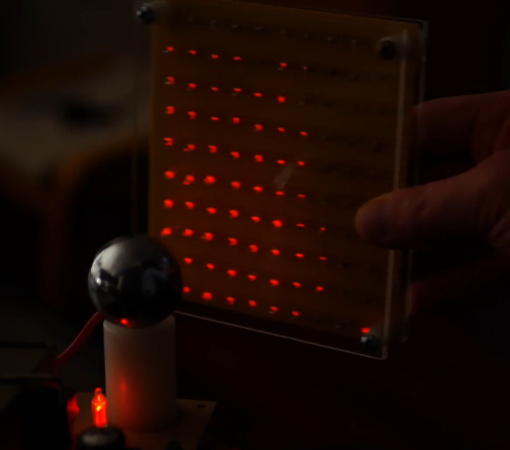
Everyone knows that one of the coolest things to do with a Tesla coil is to light up neon or fluorescent tubes at a distance. It’s an easy and very visual way to conceptualize how much energy is being pumped out, making it a favorite trick at science museums all over the world. But what would it look like if you took that same concept and increased the resolution? Replace that single large tube with an array of smaller ones. That’s exactly what [Jay Bowles] did in his latest video, and the results are impressive to say the least.

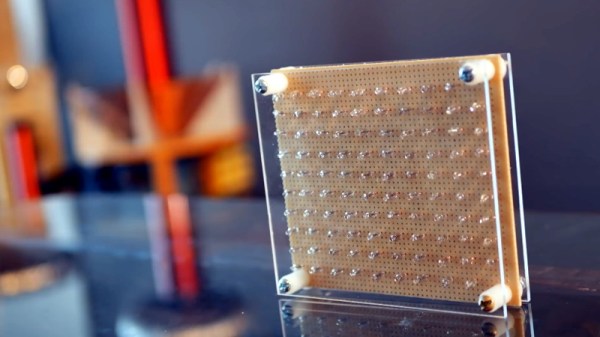
From a hardware standpoint, it doesn’t get much simpler. [Jay] knew from experience that if you bring a small neon indicator close to a Tesla coil, it will start to glow when approximately 80 volts is going through it. The higher the voltage, the brighter the glow. So he took 100 of these little neon bulbs and arranged them in a 10×10 grid on a piece of perfboard. There’s nothing fancy around the backside either, just all the legs wired up in parallel.

When [Jay] brings the device close to his various high-voltage toys, the neon bulbs still glow like they did before. But the trick is, they don’t all glow at the same brightness or time. As the panel is moved around, the user can actually see the shape and relative strength of the field by looking at the “picture” created by the neon bulbs.

The device isn’t just a cool visual either, it has legitimate applications. In the video, [Jay] explains how it allowed him to observe an anomalous energy field that collapsed when he touched the base of his recently completed Tesla coil; an indication that there was a grounding issue. He’s also observed some dead spots while using what he’s come to call his “High-Voltage Lite-Bright” and is interested in hearing possible explanations for what he’s seeing.

We’ve been fans of [Jay] and the impressively produced videos he makes about his high-voltage projects for years now, and we’re always excited when he’s got something new. Most hardware hackers start getting sweaty palms once the meter starts indicating more than about 24 VDC, so we’ve got a lot of respect for anyone who can build this kind of hardware and effectively communicate how it works to others.

Continue reading “Visualizing Energy Fields With A Neon Bulb Array”

Wire Wrapping Skills Put To Use For Sign Making

We don’t see many wire wrapped circuits these days, and you could be forgiven for thinking it was nearly a lost art at this point. But that doesn’t mean the technique can’t be applied elsewhere. [MiHu-Works] recently wrote in to share a sign they recently made for a client’s restaurant that looks an awful lot like the back panel of a homebrew computer to us.

Before you get a chance to scroll down and complain about it in the comments, we admit this one is fairly deep into the crafts side of the spectrum. But it’s also a gorgeous piece that we’d be happy to hang up in the hackerspace, so we don’t care. There might not be any angry pixies zipping around through all that lovingly wrapped copper wire, but it certainly feels like you’re looking at the internals of some complex machine.

To make it, [MiHu-Works] first printed out the lettering on paper and put it on the wood to serve as a guide. Roofing nails were then driven into the wood to create the outline of the text. A simple tool made from a forked piece of wood was placed under the head of each nail as it was hammered in to make sure the depth was consistent. It also made sure there was adequate room underneath to wrap the copper wires through them. Then it was time for the wrapping…so much wrapping. (Who is going to come through with the robot to do this?)

A few years back we asked the Hackaday readers if they thought the days of wire wrapped circuits were over. It generated a lot of discussion and interesting ideas, but looking at projects like this, perhaps we were asking the wrong question.

Continue reading “Wire Wrapping Skills Put To Use For Sign Making”