24 Hours Of Temperature Data At A Glance

In an era where we can see the current temperature with just a glance at our smartphones, the classic “Time and Temp” gadget sitting on the desk doesn’t have quite the same appeal. The modern weather fanatic demands more data, which is where this gorgeous full-day temperature display from [Richard] comes in.

The display, built inside of a picture frame, shows the temperature recorded for every hour of the day. If the LED next to the corresponding hour is lit that means the value displayed is from the current day, otherwise it’s a holdover from the previous day’s recordings. This not only makes sure all 24 LED displays have something to show, but gives you an idea of where the temperature might be trending for the rest of the day. Naturally there’s also a display of the instantaneous temperature (indoor and outdoor), plus [Richard] even threw in the current wind speed for good measure.

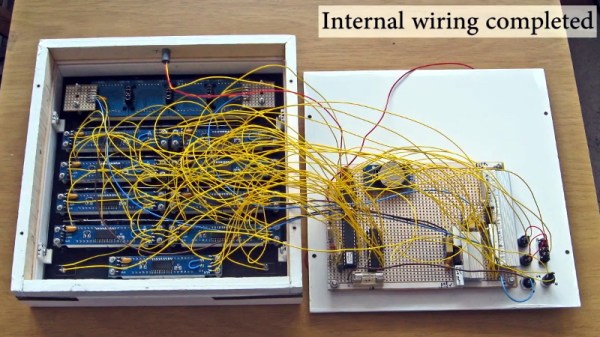
In the video after the break, [Richard] briefly walks us through the construction of his “Thermo Logger”, which reveals among other things that the beautiful panel art is nothing more exotic than a printed piece of A4 paper. The video also features a 3D model of the inside of the device which appears to have been created through photogrammetry; perhaps one of the coolest pieces of project documentation we’ve ever seen. We’ll just throw this out there: if you want to ensure that your latest build makes the front page of Hackaday, pop off that back panel and make some decent quality 3D scans.

Given the final result, it should come as no surprise to find that this isn’t the first incredible weather display that [Richard] has built. We previously covered another weather monitoring creation of his that needed two seperate display devices to adequately display all the data it was collecting.
Continue reading “24 Hours Of Temperature Data At A Glance”

ESP8266 Unlocks Hidden Features In Sound Bar

It’s no secret that the hardware devices we buy are often more capable than their manufacturer leads on. Features hidden behind firmware locks are a common trick, as it allows companies to sell the same piece of gear as a different model by turning off certain capabilities. Luckily for us, these types of arbitrary limitations are often easy to circumvent.

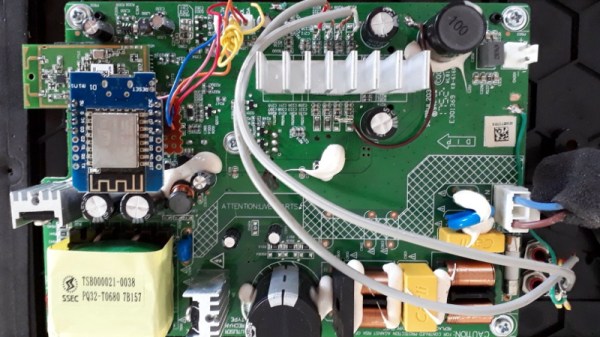
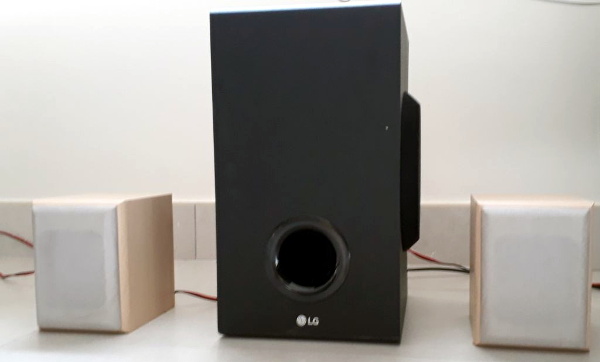
As a perfect example, [Acuario] recently discovered that the LG SJ2 sound bar has quite a few features that aren’t advertised on the box. Whether it’s due to greed or just laziness, it turns out LG isn’t using many of the capabilities offered by the ESMT AD83586B IC inside the amplifier. The chip gets its configuration via I2C, so thanks to the addition of an ESP8266, the expanded capabilities can now be easily enabled through a web interface.

[Acuario] has already found out how to turn on things like simulated surround sound, or per-channel volume controls; all functions which aren’t even exposed through the normal controls on the sound bar. But it goes deeper than that. The LG SJ2 is a 2.1 channel system, with a wireless speaker providing the right and left channels. But the AD83586B inside the subwoofer is actually capable of driving two locally connected speakers, though you obviously need to do a little rewiring.

There are still even more capabilities to unlock, though [Acuario] is currently struggling with some incomplete documentation. The datasheet says there’s support for user-defined equalizer settings, but no examples are given for how to actually do it. If anyone’s got a particular affinity for these sort of amplifier chips, now could be your time to shine.

For hackers, there’s perhaps no better example of feature-locked products than Rigol’s line of oscilloscopes. From the 2000 series of scopes in 2013 up to their higher-end MSO5000 just last year, there’s a long history of unlocking hidden features on these popular tools.

Build This Handy Leak Detector For $1.02

You’ve probably noticed that modern life has become rather complicated, and the projects we cover here on Hackaday have not been immune to the march of progress. We certainly aren’t complaining, but we’ll admit to the occasional wistful daydream of returning to the days when the front page of Hackaday looked more MacGyver than Microsoft.

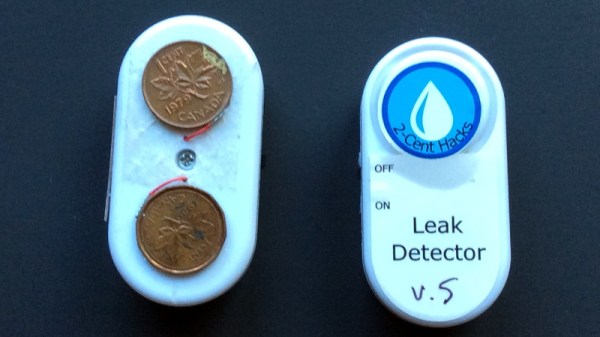
Which is precisely why this hacked together water alarm from [dB] is so appealing. Dubbed the “SqueakyLeaks”, this gadget started its life as a simple wireless intruder alarm from the Dollar Tree. When the magnet got far enough from the battery-powered base, a 90 dB warble would kick in and let you know somebody had opened a window or a door they shouldn’t have.

But with a little rewiring and two Canadian pennies serving as contacts, the alarm has been converted to a water detector that can be placed around potential leaky appliances like the water heater or in areas where you want to be alerted to water accumulation such as sumps. They’re basically “set and forget”, as [dB] says the three LR44 batteries used in the alarms should last about two years. Though with a BOM of $1.02 CAD, it’s probably cheaper to just make multiples and throw them out when the batteries die. Continue reading “Build This Handy Leak Detector For $1.02”

The Future’s So Bright, I Gotta Wear LCDs

Whether it was rays from the Sun that made a 150 million kilometer trip just to ruin your day or somebody’s unreasonably bright aftermarket headlights, at some point or another we’ve all experienced the discomfort of bright spots in our eyes. But short of wearing welder’s goggles all the time, what can we do? Luckily for us, [Nick Bild] has come up with a solution. Sort of.

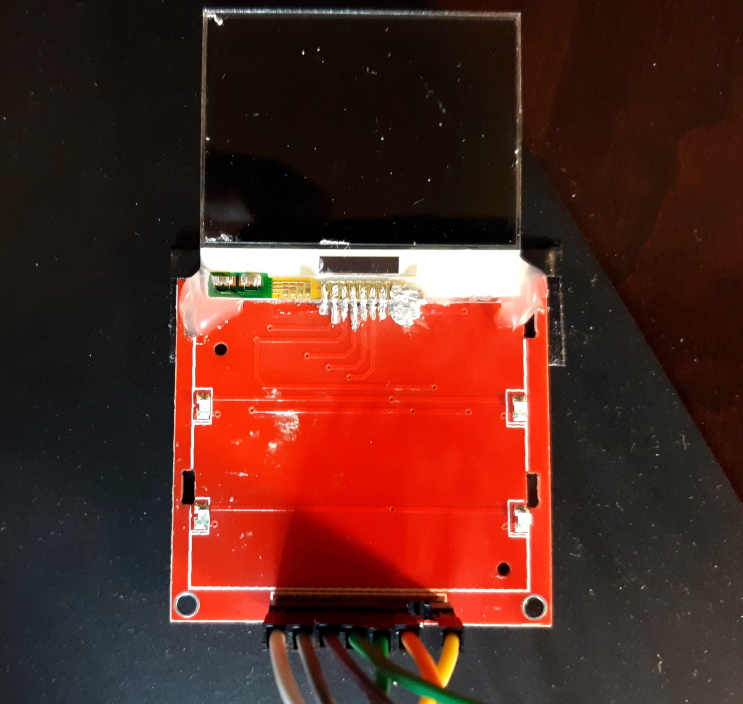
Modifying the LCD so it can be seen through.

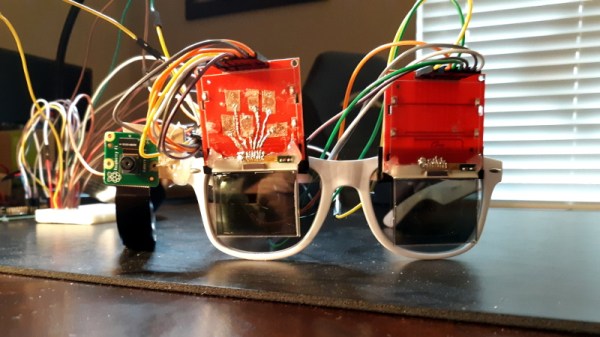
By adding LCDs to a pair of standard sunglasses, [Nick] has created something he’s calling “Light Brakes”. The idea is that the LCDs, having their backings removed, can essentially be used as programmable shutters to block out a specific part of the image that’s passing through them. With the addition of a Raspberry Pi and a camera, the Light Brakes can identify an unusually bright source of light and block it from the wearer’s vision by drawing a sufficiently large blob on the LCDs.

At least, that’s the idea. As you can see in the video after the break, the LCDs ability to block out a moving source of light is somewhat debatable. It’s also unclear what, if any, effect the “blocking” would have on UV, so you definitely shouldn’t try looking at the sun with a pair of these.

That said, a refined version of the concept could have some very interesting applications. For instance, imagine a pair of glasses that could actively block out advertisements or other unpleasant images from your field of vision. If this all sounds a bit like something out of an episode of Black Mirror, that’s because it is.

Attentive readers may have noticed that this isn’t the first time these fashionable frames have graced the pages of Hackaday. Over the summer they were used in a very interesting field of view home automation project that [Nick] was working on. This also isn’t the first time he’s stuck a pair of small LCDs in front of his eyes in the name of progress. We’re starting to identify something of a trend here, though we certainly aren’t complaining.

Continue reading “The Future’s So Bright, I Gotta Wear LCDs”

Advertise Your Conference Schedule Via SSID

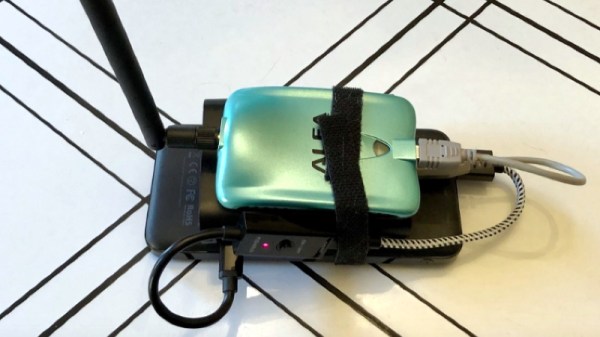
Whether it’s been a Python script running on a Linux box or an ESP8266, abusing using WiFi SSIDs to convey messages is hardly a new trick. But for DerbyCon 2019, [vgrsec] wanted to do put together something a little unique. Dare we say, even useful. Rather than broadcast out SSID obscenities or memes, this Raspberry Pi created fake WiFi networks that told everyone what talks were coming up.

The concept here is fairly simple: there’s a text file in /boot that contains the truncated names of all the talks and workshops in the schedule, one per line, and each line starts with the time that particular event is scheduled for. The script that [vgrsec] wrote opens this text file, searches for the lines beginning with the current time, and generates the appropriate SSIDs. With the number of tracks being run at DerbyCon, that meant there could be as many as five SSIDs generated at once.

Now in theory that would be enough to pull off this particular hack, but there’s a problem. The lack of an RTC on the Raspberry Pi means it can’t keep time very well, and the fact that the WiFi adapter would be busy pumping out SSIDs meant the chances of it being able to connect to the Internet and pull down the current time over NTP weren’t very good.

As the system was worthless without a reliable way of keeping time, [vgrsec] added an Adafruit PiRTC module to the mix. Once the time has been synchronized, the system could then run untethered via a USB battery bank. We might have put it into an enclosure so it looks a little less suspect, but then again, there were certainly far more unusual devices than this to be seen at DerbyCon.

Of course, if you’re OK with just dumping the entire schedule out at once and letting the user sift through the mountain of bogus SSIDs themselves, that’s even easier to accomplish.

A Miniature Radio Telescope In Every Backyard

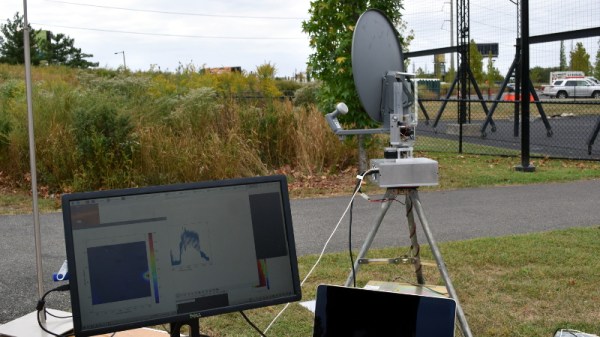
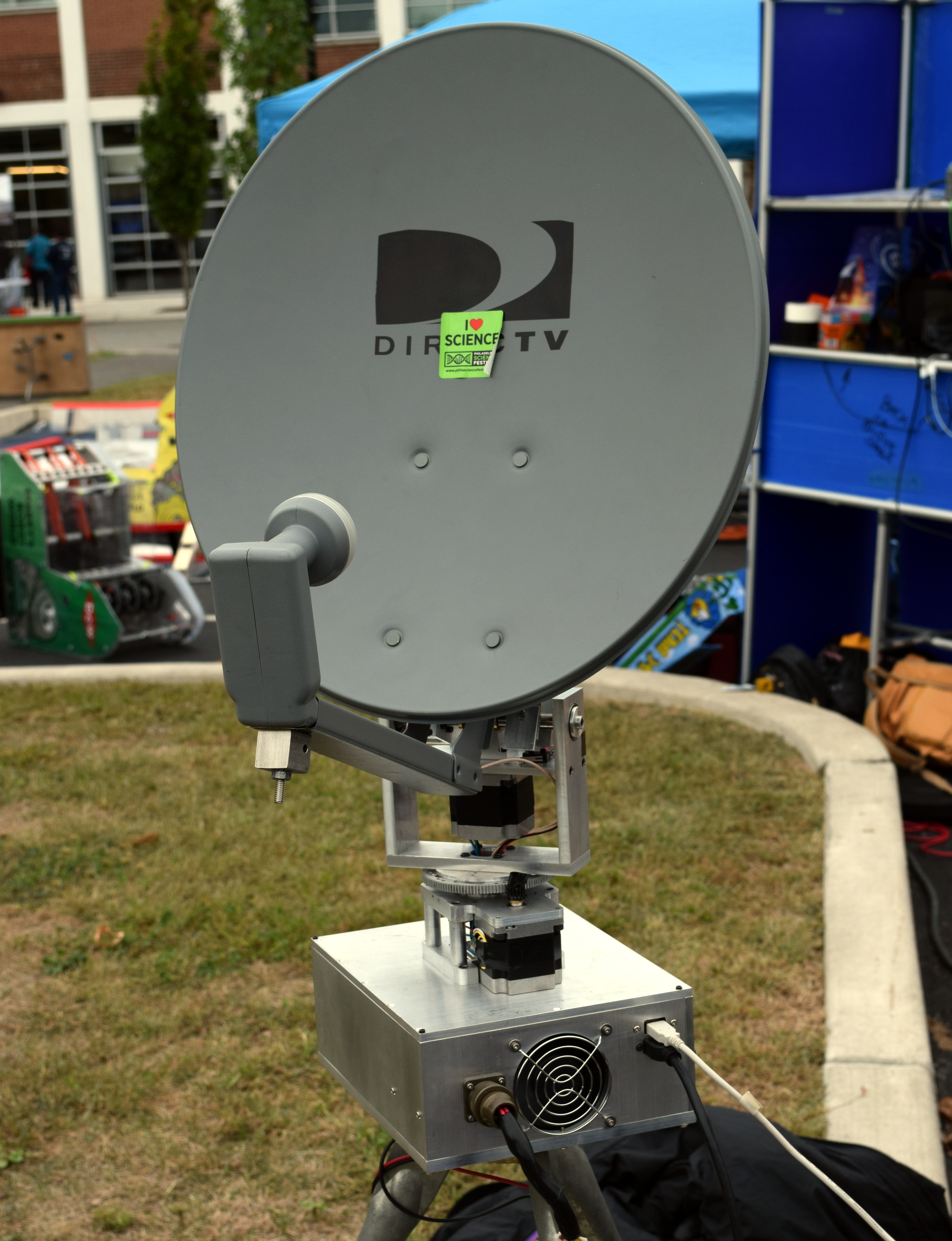
You probably wouldn’t expect to see somebody making astronomical observations during a cloudy day in the center of a dense urban area, but that’s exactly what was happening at the recent 2019 Philadelphia Mini Maker Faire. Professor James Aguirre of the University of Pennsylvania was there demonstrating the particularly compact Mini Radio Telescope (MRT) project built around an old DirecTV satellite dish and a smattering of low-cost components, giving visitors a view of the sky in a way most had never seen before.

Thanks to the project’s extensive online documentation, anyone with a spare satellite dish and a couple hundred dollars in support hardware can build their very own personal radio telescope that’s capable of observing objects in the sky no matter what the time of day or weather conditions are. Even if you’re not interested in peering into deep space from the comfort of your own home, the MRT offers a framework for building an automatic pan-and-tilt directional antenna platform that could be used for picking up signals from orbiting satellites.

With the slow collapse of satellite television in the United States these dishes are often free for the taking, and a fairly common sight on the sidewalk come garbage day. Perhaps there’s even one (or three) sitting on your own roof as you read this, waiting for a new lease on life in the Netflix Era.

Whether it’s to satisfy your own curiosity or because you want to follow in Professor Aguirre’s footsteps and use it as a tool for STEM outreach, projects like MRT make it easier than ever to build a functional DIY radio telescope.

Continue reading “A Miniature Radio Telescope In Every Backyard”

Developing Guidelines For Sustainable Spaceflight

In the early days of spaceflight, when only the governments of the United States and the Soviet Union had the ability to put an object into orbit, even the most fanciful of futurists would have had a hard time believing that commercial entities would one day be launching sixty satellites at a time. What once seemed like an infinite expanse above our heads is now starting to look quite a bit smaller, and it’s only going to get more crowded as time goes on. SpaceX is gearing up to launch nearly 12,000 individual satellites for their Starlink network by the mid-2020s, and that’s just one of the “mega constellations” currently in the works.

Just some of the objects in orbit around the Earth

It might seem like overcrowding of Earth orbit is a concern for the distant future, but one needs only look at recent events to see the first hints of trouble. On September 2nd, the European Space Agency announced that one of its research spacecraft had to perform an evasive maneuver due to a higher than acceptable risk of colliding with one of the first-generation Starlink satellites. Just two weeks later, Bigelow Aerospace were informed by the United States Air Force that there was a 1 in 20 chance that a defunct Russian Cosmos 1300 satellite would strike their Genesis II space station prototype.

A collision between two satellites in orbit is almost certain to be catastrophic, ending with both spacecraft either completely destroyed or severely damaged. But in the worst case, the relative velocity between the vehicles can be so great that the impact generates thousands of individual fragments. The resulting cloud of shrapnel can circle the Earth for years or even decades, threatening to tear apart any spacecraft unlucky enough to pass by.

Fortunately avoiding these collisions shouldn’t be difficult, assuming everyone can get on the same page before it’s too late. The recently formed Space Safety Coalition (SSC) is made up of more than twenty aerospace companies that realize the importance of taking proactive steps to ensure humanity retains the unfettered access to outer space by establishing some common “Rules of the Road” for future spacecraft.

Continue reading “Developing Guidelines For Sustainable Spaceflight”