C64 Finally Gets The SRAM Corporate Wouldn’t Pay For

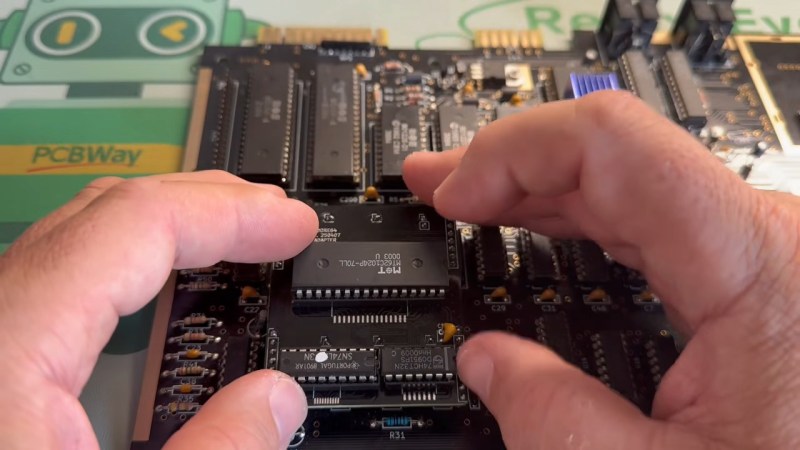
If you think RAM is expensive now, try putting yourselves in the shoes of a Commodore engineer, circa 1981. RAM was eye-wateringly expensive by modern standards, and Jack Tramiel wanted 64K of the stuff for the next computer — hence the name, Commodore 64 — but he didn’t want to pay for it. The solution was to use cheaper dynamic RAM over the more expensive static RAM that later took over the market in the kilobyte range. That’s a small problem for retrocomputer hobbyists, because while we’re complaining about the price of gigabytes of the stuff, you can’t buy new DRAM chips that fit a Commodore at any price. That’s why [Fabio Battaglia] aka [hkzlab] came up with an adapter board to fit easily-available SRAM chips onto aging C64s. 

Nothing lasts forever: not cold September rain, and not DRAM chips. Heat damage? Internal corrosion? There are probably multiple failure modes, but someday the old stock of chips will run out and the retrocomputer community is going to be ready for it. [Keith Olson] sent us a tip on a video by [The Retro Shack] about this very problem that serves as a good demo of what you get when you put SRAM into a C64. (Thanks [Keith]!) That said, the adapter board on offer is only good for C64s with the 250407 motherboard. If yours is different, you may have to modify the board. But hey, it’s open source, so go ye and do that thing. Let us know via the tips line if you do.

Continue reading “C64 Finally Gets The SRAM Corporate Wouldn’t Pay For” →

Pi 5 Becomes ALSA-Compatible TOSLINK Sound Card

This is one of those hacks that makes you stop in your tracks and say, “wait, you can do that!?” — before realizing, oh, yes, of course you can do that. With enough computational power, you can do a lot of things, and the Raspberry Pi 5 is a far cry from the single-board computer’s humble beginnings. In this case, the “you can do that!?” is both that [Oliver] was able to get the digital audio TOSLINK working via an LED tied to one GPIO pin on the Pi, but also the larger project that is embedded in: using the Pi as a full featured 8-channel USB sound card called Camilla DSP.

For the first one: the old TOSLink standard is very simple, and all you need to do is blink an LED quickly enough. Considering the clock frequency of the Pi 5 is in the GHz range and the TOSLINK is the same 3.1 Mbit/s S/PDIF signal you could pull off your CD-ROM drive to your Sound Blaster, there’s no problem there. Except, wouldn’t the operating system get in the way? Well, not when you have enough clock cycles to throw at the problem. Using a Pi 5 doesn’t hurt: the RP1 I/O chip included on the board is keeping things smooth with its included PIO while Linux mucks about in the background. There’s a reason we called it the most important product Raspberry Pi ever made.

As for making a USB sound card from an SBC — well, we’re not sure why that got the “you can do that” reaction. The Raspberry Pi family had ‘gadget mode’ for over a decade now, allowing you to present the computer as a USB device, so why not a sound card? That’s a valid class of USB device.

It’s Full Steam Ahead For This Motorized Canoe

In some parts of Canada, you’ll rarely hear someone use the phrase “whatever paddles your canoe” instead of the more usual “whatever floats your boat”– and apparently, at least for one Swede, that’s steam power. The video, linked and embedded below, is a detailed tour of a canoe equipped with a small boiler and an outboard motor that has been converted to run using steam pressure by [Kenneth Karlsson].

The canoe itself appears to be a Grumman of the “prospector” type, wide in body to hold all the gear you’d need for extended wilderness trips– or, in this case, a small boiler. Amidships is the ideal place, as it won’t affect the balance of the boat. Amidships is an odd place to put an outboard– in the North American homeland of the canoe, if you aren’t moving under your own power, it is more common to cut off the curved stern of the canoe and mount the outboard to the newly-made transom. [Karlsson]’s choice to put the outboard off one side will be less maneuverable than a stern mount, but saves the need to modify the canoe and makes for much shorter steam lines. Shorter steam lines means less hose to potentially leak and scald the occupants, as well as fewer losses, so we can’t really argue with the tradeoffs.

The engine is an old two-stroke outboard that has a single steam cylinder retrofitted to it, along with a heat exchanger to warm up lake water with exhaust steam before it heads the boiler. The water is filtered first, of course, but we do hope the new owner– who posts on YouTube with channel “Steam Canoe” is diligent about cleaning the boiler. It doesn’t look like super high pressure steam, but the vapour phase of water is always something to be respected.

If the potential of scalding steam leaks and boiler explosions put you off, but you still won’t pick up a paddle, canoes can be rigged with sails— or you can just hand the paddle to a robot arm. Though given this is Hackaday, maybe you’d rather skip the canoe and climb aboard the good ship Benchy instead. Continue reading “It’s Full Steam Ahead For This Motorized Canoe” →

SB Mini II Is A Homebrew Apple II Clone

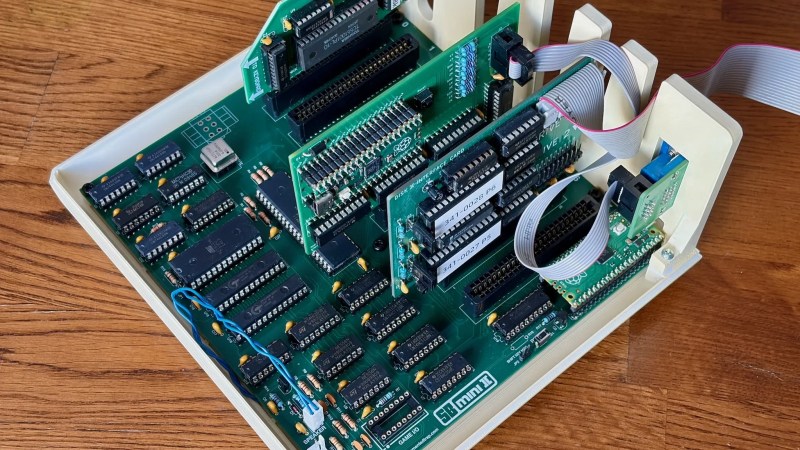
On the one hand, the original Apple II has been copied over and over again since at least the early 80s, so maybe this hack is old hat to the greybeards around here. On the other hand, this is the year 2026. When Apple released it back in 1977, who could have predicted people would still be building these things nearly five decades later?

In that sense, a homebrew Apple II in the current year is pretty remarkable. It’s a really well done project by [simonboak], nicely open sourced with a case to match, so is worth looking at on its own merits.

It doesn’t run DOOM, but neither did the original. Oregon Trail is more this unit’s speed.

Unlike the later models, the original Apple II only used commercially available ICs, making it an easy target for recreation. No FPGAs required, just good old-fashioned DIPs. OK, these are modern CMOS versions of the chips, but other than that, the biggest concession to modernity is space on the board for a Raspberry Pi Pico to allow for connecting a USB keyboard.

The accompanying blog post lists some other differences from 1977’s favorite home computer: SRAM vs DRAM — because you know the Woz would have used it if he could — and omitting the composite video circuitry in favor a late-model VGA card. There’s no need for the composite output since he’s eschewing the period-appropriate CRT for a retro-styled LCD monitor, which is also 3D printed and available on Printables. It’s crazy to think that the Apple II family lived long enough not only to see the dawn of VGA but also well into its sunset.

If a homebuilt Apple ][ doesn’t impress, what about a PC-compatible circa 1995?

The gun on its bipod.

Belt Fed Potato Cannon Spits Spuds

Spud guns are a staple of summertime fun for the maker set, especially on the Eagleland side of the pond, combining as they do two of our favorite things: firearms and calories. Nine out of ten Canadians agree that there’s nothing quite like a high-speed poutine — but judging by accent [Current Concept] is an American and so his potato cannon needed a little something extra that even the second amendment doesn’t protect: fully automatic firing, with a belt feed.

Like many spud guns, this one is powered by compressed air and uses PVC for both the barrel and air reservoir; unlike most spud guns, it has a steel frame holding it together, and a 3D-printed belt-feed mechanism to bring the spuds into position, with a beefy stepper motor pulling the potatoes. Of course just sticking an extra length of pipe between reservoir and barrel would just result in 80 PSI potato-scented flatulence as the air escaped betwixt the gap, so a pair of piston-actuated, 3D printed fittings slides over the plastic casings in the belt that hold the spuds. It’s not a perfect seal, but video evidence suggests it’s tight enough to get the tubers flying.

Now, there are some caveats — the air reservoir is only good for one shot, so it needs to stay hooked to an air compressor to take advantage of the repeated firings. Since it has to recharge, it’s also only firing a spud every six seconds, so while the mechanism could do “full auto”, it’s actually semiautomatic in practice as nobody’s going to sit and hold the trigger that long. Finally, we must warn you that the YouTuber behind this is trying to be funny for much of the video. Some may find his delivery leaves them in stitches; others will be left cold. There is, of course, no accounting for taste.

Oddly enough, this isn’t the first automatic air gun to grace these pages. It’s also one of the weaker potato propellers, especially compared to this MAPP-gas powered monster. Hopefully [Current Concept] doesn’t see that and get any ideas for the promised revision of his belt-fed tuber tosser, or he may get a visit from the ATF — that’s the US Bureau of Alcohol, Tobacco, and Firearms, who are way less fun to deal with than the name might imply.

Continue reading “Belt Fed Potato Cannon Spits Spuds” →

The Bit79 Was A Famicom Clone That Took The “Family Computer” Name Seriously

While the original name of what much of the world knows as the NES was the Nintendo Family Computer, or Famicom for short, it was very rarely used as a family computer. Sure, there was a basic cartridge and an add-on keyboard sold in Japan, but it was always a sideshow to the games.

Nintendo recognized that when they brought their Entertainment System overseas. Most of the various famiclones — which date back to the mid-80s — are the same. BIT in Taiwan had a different idea: their Bit 79 would be a full home computer. Picture a C=64 that plays Nintendo games, and you might not be too far off. [Inkbox] tells the full story in his latest YouTube video, and it’s a must-watch for anyone interested in the history of 8-bit machines that are totally unknown in the West.

Continue reading “The Bit79 Was A Famicom Clone That Took The “Family Computer” Name Seriously” →

Extract Fumes In Midcentury Style With Nixie Tubes And Military Surplus

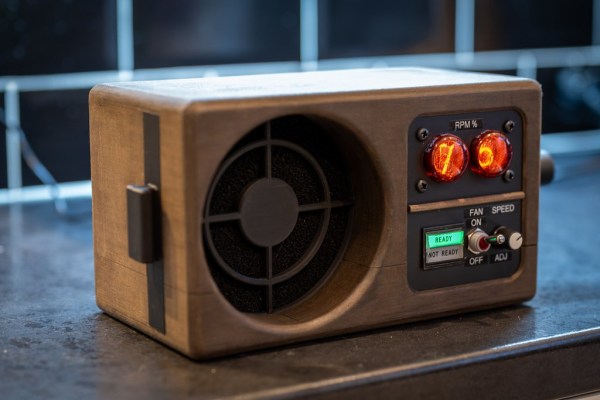
Nobody wants to breathe solder fumes; that’s a given. For most of us, an industrial-looking fan-and-filter made in China and picked up cheap feels like more than enough to keep our lungs clear. Other people, people like [George Conneely], have more refined tastes. Why have a fume extractor when you can have a work of art?

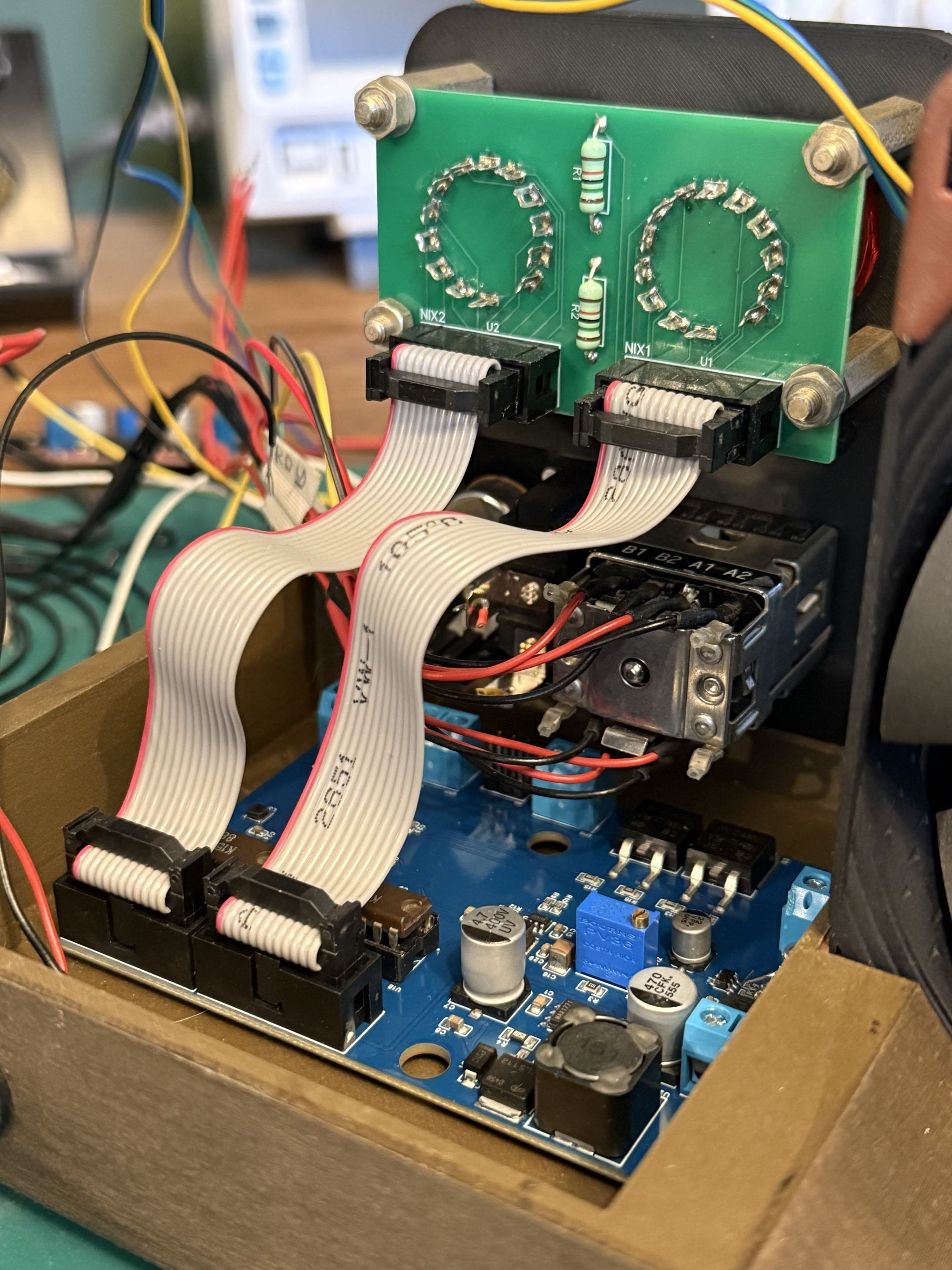
The insides aren’t quite as pretty as the outside, but it’s a clean build.

This is one of those projects where the images really speak for themselves, because the whole point is to be beautiful. Sure, the wooden case is lovingly sculpted by a—wait, it’s 3D-printed!? Yes, with the right stain and care applying it, it seems Wood PLA can fool the eye, or at least the camera. Inside that PLA case there’s a custom PCB with an ATMega microcontroller and some MOSFETS to drive the Nixie tubes. The two digits represent the fan’s set RPM as a percentage of maximum, as is clearly labeled. Using a READY/NOT READY indicator pulled from a Panvia Tornado to show whether the fan has actually spun up to its set speed is an amazing touch.

The only problem with this build is that it is too nice. We’d almost rather see it on Don Draper’s desk than risk dirtying it on a lab bench. Evidently, [George] ascribes to the philosophy that one should surround oneself with beauty whenever possible. Your tastes may differ, but to many, nixie tubes certainly qualify– whether on a desk clock or in a car’s dashboard, there’s just something about that incandescent glow.

Thanks to [George] for the tip.