
Streaming Games Means The Nintendo DSi Will Never Be Obsolete

There comes a point where you have to acknowledge that your beloved console is out of date and– barring the odd homebrew title– won’t be playing new games ever again. You’d think that Nintendo’s 2008 DSi handheld would be in this category, but [gavff64] has a workaround. What if the odd homebrew title streamed games over the network?

At its core the RNDS-Stream is just decoding an MJPEG stream from a server on a Linux PC, giving you the content of an X11 or xWayland window with relatively low latency at around 15-20FPS. So while you won’t be entering any e-sports tournaments, you can enjoy more relaxed, casual games like Counterstrike. Well, at least there’s no audio streaming yet, so you won’t have to hear the other team’s trash talk. That ought to make it more relaxed.

Sound may come; the project is very much a work in progress, and also a showcase of RubyNDS, [gavff64]’s Ruby-based homebrew framework for the DSi. Why Ruby? Why the DSi? For no other reason than [gavff64] likes both of those things.You can observe it in action after 4:48 in the video embedded below– just be warned, it’s editing is tuned to a TikTok-using audience and won’t be to everyone’s taste. Don’t let videography get in the way, though, because the hack is the thing and it’s up on GitHub for all and sundry under an MIT license.

The DSi is no stranger to hackers, having gotten its first flash cart the year of its release. In spite of that, we’ve seen surprisingly little homebrew for the dual-screen device, this augmented reality app being an exception.

Continue reading “Streaming Games Means The Nintendo DSi Will Never Be Obsolete” →
Don’t Try This At Home, Transcranial Magnetic Stimulation Edition

Transcranial magnetic stimulation is one of those things that seems too wacky to be true. Depression not responding to treatment? Let’s smack you upside the head with strong magnetic fields! As odd as it sounds, it’s actually very well studied and works often enough that it has been approved by regulatory agencies as real evidence based medicine.

It’s also now open source, thanks to the OpenTMS project by [Zach McGinty]. Though since its not approved by the FDA or your local authority, be very aware of [Zach]’s disclaimer that this is not a medical device and if you do build something based on the extensive data on his GitHub, you do so at your own risk.

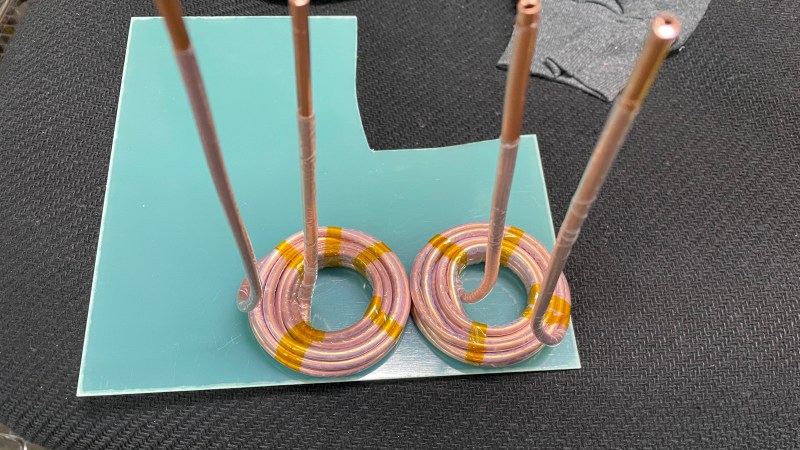
He’s got plans for the coils that go next to your head — made of hollow copper pipe to carry coolant, just like the pros do it — and the power supply to pulse them with mind-altering amounts of electricity. That might be literal in this case, but it’s also a hefty power supply: a pair of microwave oven transformers, switched through IGBTs in a flyback configuration. We’re talking kiloamps here, so make sure you know what you’re about before you try putting that kind of power right next to your skull.

[Zach] did, and he’s still here. Though to be fair, we’re not sure if he’s a very good engineer or just very lucky. Given he’s isolated the IGBT gate controls with fiber optics, and seems to follow other best practices, we’re going to guess the former, but it might still be both.

Either way, this one is going firmly into the “don’t try this at home” bucket. Even so we’re happy to see more medicine go open source, be it assistive sip-and-puff pointing devices, or ESP32 electroencephalograms. If nothing else, it keeps the big boys on their toes, and that’s what hacking is all about.

[Avery] standing inside the inflating envelope of his airship

Don’t Worry, This R/C Airship Is Supposed To Be On Fire

We’ve had a lot of flying hacks here over the years, and that includes just about any way to get airborne you can think of — but very few of those have been airships. Fewer still have been 27-foot thermal airships, like the one [Avery Flies] designed and put together recently.

A thermal airship, in case the name doesn’t give it away, is a dirigible hot air balloon. Like a hot air balloon, it gets its lift from the density difference between hot air and the regular atmosphere. Unlike a hot air balloon, it has control surfaces and an engine so it goes where you tell it to. The craft uses good-old-fashioned radio control, and except for the nylon envelope he spends the first 15 minutes of the video below designing and sewing up, the technology mostly comes from be from the world of R/C aircraft.

The big exception is of course the a propane burner used to generate heat, said propane being supplied by a pair of small green tanks such as you might use on a portable barbecue. Everything that moves is electric, though: there’s a 70 mm (about 2¾“) electric ducted fan acting to push the air up into the balloon so it keeps shape, and a great big brushless DC motor pushing an 18” (about 457 mm) prop for thrust. The steering servo is actually a repurposed winch servo from an R/C sailboat, rather than anything from the world of model aircraft. But it makes sense, as the meter-scale fabric rudder is more like a sail than the control surfaces of most R/C aircraft.

You might expect a blimp to be the biggest flying machine we’ve featured on Hackaday, but some truly giant-scale R/C aircraft have come our way in the past. We’ve also seen some pretty teeny blimps.

Continue reading “Don’t Worry, This R/C Airship Is Supposed To Be On Fire” →

DIY Algae Biodiesel Is Harder Than You Think

There’s one thing [Silent H] wants you to know before you watch his video about making biodiesel, embedded below: he started this project before he’d even heard of the Strait of Hormuz. No, he’s just independent-minded and wanted to try making his own fuel when diesel was– in retrospect– cheap as chips. That’s probably a good thing, because while [Silent] gets his pint of fuel at the end of the video, it’s not from algae; it’s from a backup crop of sunflowers.

As it turns out, he picked what was the perfect algae and the absolute worst algae for making biodiesel from: Chlorella Vulgaris. It’s perfect because it’s easy to grow, and easy to extract from the growth medium, as it sinks when it is ‘ripe’, and has a very high oil content. Of course [Silent] didn’t want to toss algae cakes into a steam powered canoe, he wanted diesel fuel for his vehicle. That’s where the project broke down: Chlorella Vulgaris cells are exceptionally tough, and if you can’t rupture the cell wall, you can’t can’t get out any appreciable oil. A few grams by solvent extraction is all he manages before switching to more tractable feedstock.

That feedstock is sunflowers, which give up their oil through the application of violent pressure. That is to say, he crushes the seeds in an oil press. Oil acquired, he goes on to transesterfy the stuff, extracting glycerine to produce biodiesel– a process ripe for hacking that you’d think we’d cover more often.

We have covered the algae growth side of things before, but that algae seemed to be destined for other uses than fuel.

Continue reading “DIY Algae Biodiesel Is Harder Than You Think” →

Ambition, Thy Name Is A 3D Printed Transonic R/C Jet

Building anything that flies from scratch is an ambitious undertaking, even if it’s ‘just’ radio-controlled. 3D printing the aircraft isn’t that odd these days, but putting a hot jet engine into a plastic airframe is another ambitous reach. Getting said 3D printed airframe up to the transonic speed of Mach 0.8? Ambition, thy name is Kingchaser. Or at least, that’s the name [The Mach Initiative] give to their very ambitious aircraft, the video about which is embedded below.

The airframe is largely 3D printed from PETG– that’s all the orange bits– but there are carbon fiber rods and an aluminum frame to help take up the strain. The black section around the motor is printed from PPS-CF– that’s Polyphenylene sulfide with carbon fibre–wrapped in carbon fiber to take the heat. This all builds off a smaller PLA version that’s already flown called Kingfisher, which claimed the title of the first 3D printed jet. That flight is on their YouTube channel, if you’re interested.

Now with a bigger aircraft and a much bigger engine– 300 N or 68 lbf of thrust– they’re going for the speed record. If they get even close to the design goal of mach 0.8, they’re absolutely going to leave the world’s fastest drone– a 626 km/h quadcopter we’ve written about— in the dust.

The switch to PETG from PLA, for the record, was to deal with the expected aerodynamic heating at that speed, about 990 km/h or 615 mph. An interesting detail many don’t bother with when it comes to 3D printed airplanes is that the skin has all been polished smooth, since skin drag is dominant at that speed regime. The video is just chock full of those little details that it takes to defeat drag and get to the record speed, and there’s more to come from [The Mach Initiative].

Speaking of remote controlled speed records, we covered another batch of brits take home the land speed record a few years back. May [The Mach Initiative] see such success!

Continue reading “Ambition, Thy Name Is A 3D Printed Transonic R/C Jet” →

Conveyor Belt GBoard Brings The Keys To You

It must be April in October again, because Google Japan has a new, hilariously impractical reimagining of the keyboard: a conveyor belt. This time it’s on GitHub with firmware, STLs, and a full build guide if you, too, want to wait a full cycle to get the ‘backspace’ key whenever you make a typo, or to write such fun words as “ooid” or “princesship”.

You can watch it in action in the video embedded below, but just the photo probably gives you the idea: the four staggered rows of keys are each 3D-printed chains holding mechanical key switches, driven from a motor in the base. Each row also has a flexible PCB to keep everything wired together, though it’s unclear how those electrical impulses from the key presses get off the conveyor belt and into your computer. That part of the build guide is “TBD” and the source code doesn’t appear to be complete.

Those details may be forthcoming, or it might never be revealed because this is obviously a joke, but now that they’ve gone to the effort of providing STLs, we’re now invested in figuring out how to actually make it work. A BLE-equipped microcontroller in each belt? RFID tags on each key, with readers in the base? SMD LEDs on the flex PCB that flash out the ASCII code of each pressed key as they whiz past a sensor? In theory, any of those should work, but which should we use? You decide!

We like Google Japan and their weird keyboards, and we have to say that compared to the hat from a few years ago, this one is almost practical, though the rotary-phone one wins on style points. In some ways, it occurs to us that this is the exact inverse of the chain printers of yesteryear.

Thanks to [CityZen] for the tip! If October for you is more “spooky” than “silly”, we still want to know about it. Or if you build any of the Gboards. Either way, let us know on the tips line what you’re up to.

Continue reading “Conveyor Belt GBoard Brings The Keys To You” →

It’s GW-BASIC, Jim, But Not As We Know It

Back in the old days the IBM-PC, like most of its contemporary computers, shipped with BASIC in ROM. Even after it stopped living in ROM, IBM-Compatibles shipped with GW-BASIC, and now we have a project that asks: what if they still did? Thoreau BASIC is GW-BASIC, but updated for the 21st century.

It’s meant to be code-compatible with all old GW-BASIC code — which means, yes, line numbers and GOTOs abound — but it can boot from a modern x86 PC’s UEFI or run under Windows and take full advantage of modern hardware with 64-bit memory and multithreading support. Graphics are 24-bit at any resolution your monitor can handle, and there are a number of handy built-in commands to handle file management, graphics — including sprites — mouse and keyboard input, 32-channel sound, and more. It is also not strictly an interpreted language. Programs can be compiled to run under Windows or bare-metal on UEFI x86 machines.

It’s not open source, but the project is “pay what you want” over on Itch.io, where you can also see a number of examples.

We’ve seen other attempts to revive BASIC over the years, like MoonBASIC or BASIC-256, but we have to admit it’s never going to be the dominant force it once was, regardless of how nostalgic we might get. That’s probably for the best, but it’s still nice to know you can boot to BASIC if you really, really want to. Do you think it would work with our preprocessor?