Organic Chemistry Circuits Are Flexible And Work Wet

As circuits find their way into more and more real-world environments, the old standard circuitry isn’t always up to the task. It wasn’t that long ago that a computer needed special power, cooling, and a large room. Now those computers wouldn’t cut it for the top-of-the-line smartphone. However, most modern circuits don’t bend well and don’t like getting wet.

An international team of researchers is developing chemical-based circuitry that uses gold nanoparticles and electrically charged organic molecules to build circuit elements that behave like semiconductor diode junctions. It’s simple to make flexible circuits that don’t mind being wet using this chemical soup.

In an interview with IEEE Spectrum, the developers mentioned that other circuit elements similar to transistors and light sensors should be possible. The circuits aren’t perfect, however. The switching speed needs improvement. Also, while conventional circuits don’t like to get wet, these chemical circuits have difficulties if things get dry. Still, like all technology, things will probably improve over time.

This technology needs a good bit of engineering refinement before it is practical. If you need flexible photosensitive circuits in the near term, you might try here. Meanwhile, waterproof circuitry just needs the right kind of enclosure.

Photo Credit: UNIST/Nature Nanotechnology

Anti-Hack: Free Automated SSL Certificates

You want to put your credit card number into a web site. You know to look for a secure web site. But what does that really prove? And now that so many electronic projects have Web servers (ok, I’ll say it… the Internet of Things), do you need to secure your web server?

There was a time when getting a secure certificate (at least one that was meaningful) cost a pretty penny. However, a new initiative backed by some major players (like Cisco, Google, Mozilla, and many others) wants to give you a free SSL certificate. One reason they can afford to do this is they have automated the verification process so the cost to provide a certificate is very low.

Continue reading “Anti-Hack: Free Automated SSL Certificates”

Crawl, Walk, Run: Planning Your First CPU Design

I’ve worked with a lot of students who want to program computers. In particular, a lot of them want to program games. However, when they find out that after a few weeks of work they won’t be able to create the next version of Skyrim or Halo, they often get disillusioned and move on to other things. When I was a kid, if you could get a text-based Hi-Lo game running, you were a wizard, but clearly the bar is a lot higher than it used to be. Think of the “Karate Kid”–he had to do “wax on, wax off” before he could get to the cool stuff. Same goes for a lot of technical projects, programming or otherwise.

I talk to a lot of people who are interested in CPU design, and I think there’s quite a bit of the same problem here, as well. Today’s commercial CPUs are huge beasts, with sophisticated memory subsystems, instruction interpreters, and superscalar execution. That’s the Skyrim of CPU design. Maybe you should start with something simpler. Sure, you probably want to start learning Verilog or VHDL with even simpler projects. But the gulf between an FPGA PWM generator and a full-blown CPU is pretty daunting.

Continue reading “Crawl, Walk, Run: Planning Your First CPU Design”

ARM Board Transmits FM

There is more than a casual link between computer people and musicians. Computers have created music since 1961 when an IBM7094 sang the song Daisy Bell (later inspiring another computer, the HAL 9000, to do the same).

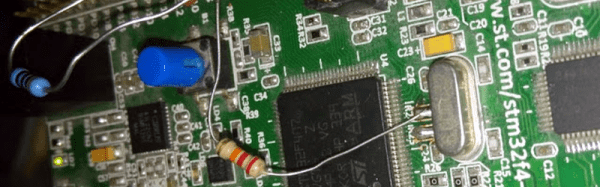
[Vinod.S] wanted to create music on an STM32F407 Discovery board, but he also wanted it to play on his FM radio. He did it, and his technique was surprising and straightforward. The key is that the ARM processor on the Discovery board uses an 8MHz crystal, but internally (using a phase-locked loop, or PLL) it produces a 100MHz system clock. This happens to be right in the middle of the FM radio band. Bringing that signal back out of the chip on a spare output pin gives you the FM carrier.

That’s simple, but a carrier all by itself isn’t sufficient. You need to FM modulate the carrier. [Vinod.S] did the music playback in the usual way and fed the analog signal via a resistor to the crystal. With some experimentation, he found a value that would pull the crystal frequency enough that when multiplied up to 100MHz, it would produce the desired amount of FM deviation. You can see a video of the whole thing in action, below.

Continue reading “ARM Board Transmits FM”

SDRAM Logic Analyzer Uses An AVR And A Dirty Trick

We often see “logic analyzer” projects which are little more than microcontrollers reading data as fast as they can, sending it to a PC, and then plotting the results. Depending on how fast the microcontroller is, these projects range from adequate to not very useful.

At first glance, [esot.eric’s] logic analyzer project has an AVR in it, so it ought to be on the low end of the scale. Then you look at the specs: 32 channels at 30 megasamples per second. How does that work with an AVR in it?

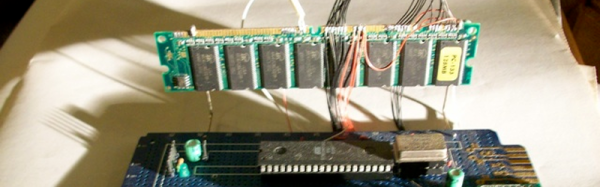
The answer lies in the selection of components. The analyzer uses a 128MB SDRAM DIMM (like an older PC might use for main memory). That makes sense; the Arduino can’t store much data internally. However, it isn’t the storage capacity that makes this choice critical. It seems [esot.eric] has a way to make the RAM “free run”.

The idea is to use the Arduino (or other host microcontroller) to set up the memory. Some of the memory’s output bits feedback to the address and data lines. Then the microcontroller steps aside and the SDRAM clocks samples into its memory by itself at the prevailing clock rate for the memory.

Continue reading “SDRAM Logic Analyzer Uses An AVR And A Dirty Trick”

Solder At Room Temperature

Have you ever seen the science experiment (or magic trick?) where you get water supercooled to where it isn’t frozen, but then it freezes when you touch it, pour it, or otherwise disturb it? Apparently, ice crystals form around impurities or disturbances in the liquid and then “spread.” A similar effect can occur in metals where the molten metal cools in such a way that it stays melted even below the temperature that would usually cause it to melt.

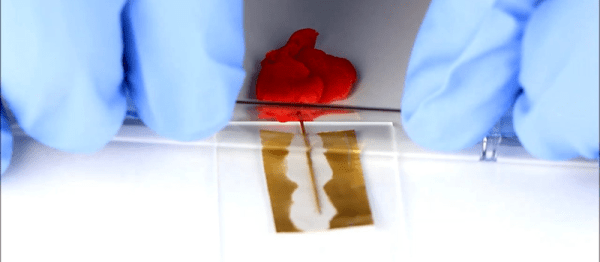
[Martin Thuo] at Iowa University used this property to make solder joints at room temperature using Field’s metal (a combination of bismuth, indium, and tin). The key is a process that coats the molten metal with several nanolayers that protect it from solidifying until something disturbs the protective layer.

Continue reading “Solder At Room Temperature”

Thanks For The Memories: Touring The Awesome Random Access Of Old

I was buying a new laptop the other day and had to make a choice between 4GB of memory and 8. I can remember how big a deal it was when a TRS-80 went from 4K (that’s .000004 GB, if you are counting) to 48K. Today just about all RAM (at least in PCs) is dynamic–it relies on tiny capacitors to hold a charge. The downside to that is that the RAM is unavailable sometimes while the capacitors get refreshed. The upside is you can inexpensively pack lots of bits into a small area. All of the common memory you plug into a PC motherboard–DDR, DDR2, SDRAM, RDRAM, and so on–are types of dynamic memory.

The other kind of common RAM you see is static. This is more or less an array of flip flops. They don’t require refreshing, but a static RAM cell is much larger than an equivalent bit of dynamic memory, so static memory is much less dense than dynamic. Static RAM lives in your PC, too, as cache memory where speed is important.

For now, at least, these two types of RAM technology dominate the market for fast random access read/write memory. Sure, there are a few new technologies that could gain wider usage. There’s also things like flash memory that are useful, but can’t displace regular RAM because of speed, durability, or complex write cycles. However, computers didn’t always use static and dynamic RAM. In fact, they are relatively newcomers to the scene. What did early computers use for fast read/write storage?

Continue reading “Thanks For The Memories: Touring The Awesome Random Access Of Old”