What if you could unlock a door with your shirtsleeve, or code a secret message into your tie? This could soon be a thing, because researchers at the University of Washington have created a fabric that can store data without any electronics whatsoever. The fabric can be washed, dried, and even ironed without losing data. Oh, and it’s way cheaper than RFID.
By harnessing the ferromagnetic properties of conductive thread, [Justin Chen] and [Shyam Gollakota] have proved the ability to store bit strings and 2D images through magnetization. The team used an embroidery machine to lay down thread in dense strips and patches, and then coded in ones and zeros by rubbing the threads with N and S neodymium magnets.
They didn’t use anything special, either, just this conductive thread, some magnets, and a Nexus 5 to read the data. Any phone with a magnetometer (so, most of them) could decode this type of binary data. The threads stay reliably magnetized for about a week and then begin to weaken. However, their tests proved that the threads can be re-magnetized over and over.
The team also created 2D images with magnets on a 9-patch made of conductive fabric. The images can be decoded piecemeal by a single magnetometer, or all at once by an array of them. Finally, the team made a glove with a magnetized patch of thread on the fingertip. They were able to get the phone to recognize six unique gestures with 90% accuracy, even with the phone tucked away in a pocket. See it in action in their demo video after the break.
Magnetic memory is certainly not a new concept. But for the wearable technology frontier, it’s a novel one.
Continue reading “Your Next Wearable May Not Need Electricity”

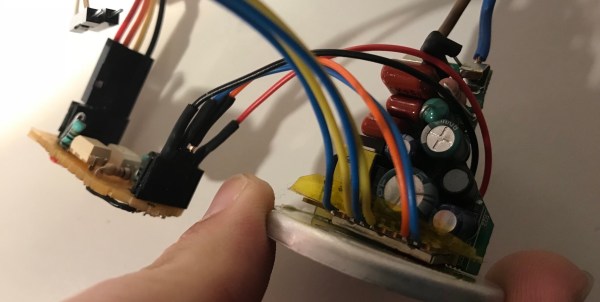

 He starts off by building a custom electro-mechanical clock movement, and since he’s planning as he progresses, meccano, breadboard and jumper wires were the way to go. Hot glue helps preserve sanity by keeping all the jumper wires in place. To interface with all of the peripherals in the clock, he decided to use a bank of shift registers driven from a regular Arduino Uno. The more expensive DS3231 RTC module ensures better accuracy compared to the cheaper DS1307 or similar clones. A bank of RGB LEDs acts as an annunciator panel inside the clock to help provide various status indications. The mechanical movement itself went through several iterations to get the time display working with a smooth movement of the hands. Besides displaying time, [David] also added a moon phase indicator dial. A five-rod chime is struck using a stepper motor driven cam and a separate solenoid is used to pull and release three chime hammers simultaneously to generate the loud gong sounds.