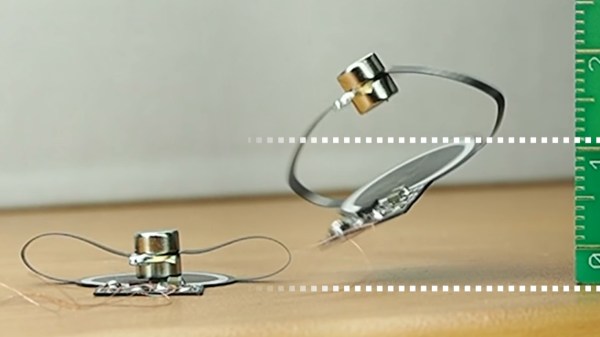
Just because something doesn’t seem to have an apparent purpose, that doesn’t mean we shouldn’t try making it anyway. As flexible PCBs become cheaper and easier to order from low-scale fab houses, we’re seeing hobbyists experiment with new uses for them such as [Carl Bugeja]’s jumping circuit.
The circuit is based a coil printed on the flexible PCB itself acting as an electromagnet, but unlike other designs which use the same trick, in this one the coil is made to be the static side of an actuator. Attached to the circuit with folding arms is a stack of two permanent magnets, which work as the moving part. Since the magnets make up most of the mass of the circuit, as they’re pushed down and sprung back up, it causes the whole thing to leap around just under one centimeter off the table like a little electric grasshopper.
This is far from [Carl]’s first appearance here on Hackaday, and he’s been clearly busy exploring new uses for flexible PCBs with their properties as electromagnets, from making POV displays with them to small robots that move around through vibration. We’re excited to see what else he can come up with, and you can see this one in action after the break.
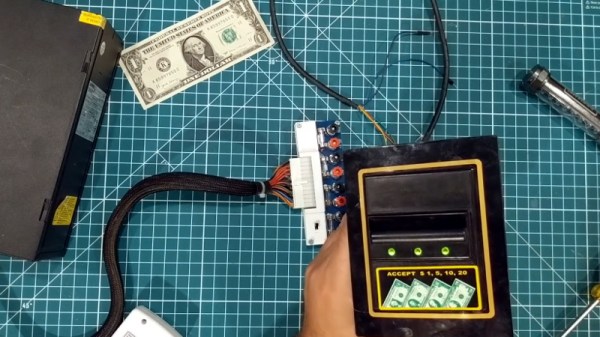
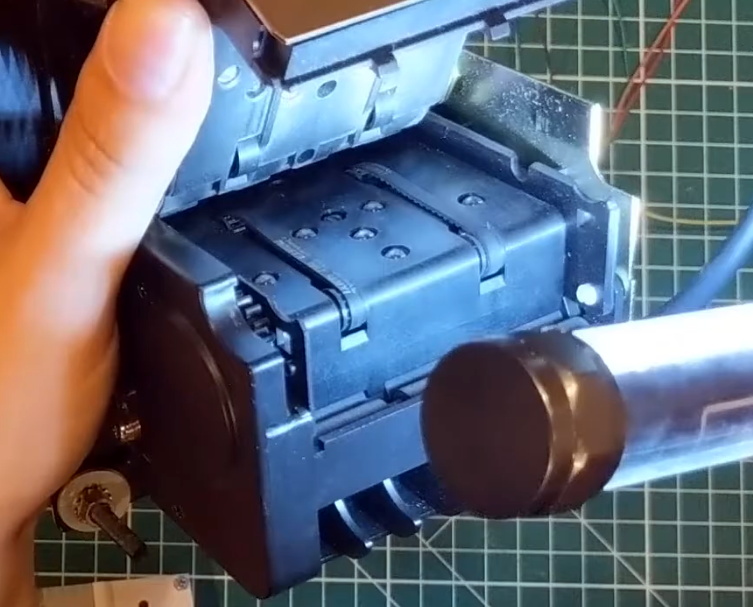
We’ve all seen, and occasionally wrestled with, bill acceptors like the one [Another Maker] recently liberated from an arcade machine. But have you ever had one apart to see how it works? If not, the video after the break is an interesting peak into how this ubiquitous piece of hardware tells the difference between a real bill and a piece of paper.
But [Another Maker] goes a bit farther than just showing the internals of the device. He also went through the trouble of figuring out how to talk to it with an Arduino, which makes all sorts of money-grabbing projects possible. Even if collecting paper money isn’t your kind of thing, it’s still interesting to see how this gadget works on a hardware and software level.
As explained in the video, a set of belts are used to pull the bill past an array of IR LEDs. The hardware uses these to scan the bill and perform some dark magic to determine if it’s a genuine piece of currency. [Another Maker] notes that these readers actually need to receive occasional firmware updates to take into account new bill designs. In fact, the particular unit he has is so out of date that it won’t accept modern $5 bills; which may explain how he got it for free in the first place.
The coaster is built around an Arduino Micro, which uses a microphone to detect audio levels in the room. When it detects an extended silence, it then fires off a sound clip using a SparkFun audio breakout board. The questions vary from plain to politically sensitive, so there’s a good chance you could get some spicy conversation as a result. Any talking device runs a risk of being more annoying than helpful, and there’s certainly a risk that Chatty Coaster could fall into this category. Choosing the right content seems key here.
Overall, while this may not be the ultimate solution to boring company, it could get a laugh or two and serves as a good way to learn how to work with audio on microcontrollers. Video after the break.
We’ll admit, when we were reading this one, we thought we had déjà vu. But this one’s a lot less blamey.
One of the strangest things about human nature is our tendency toward inertia. We take so much uncontrollable change in stride, but when our man-made constructs stop making sense, we’re suddenly stuck in our ways — for instance, the way we measure things in the US, or define daytime throughout the year. Inertia seems to be the only explanation for continuing to do things the old way, even when new and scientifically superior ways come along. But this isn’t about the metric system — it’s about something much more personal. If you use a keyboard with any degree of regularity, this affects you physically.
Many, many people are content to live their entire lives typing on QWERTY keyboards. They never give a thought to the unfortunate layout choices of common letters, nor do they pick up even a whisper of the heated debates about the effectiveness of QWERTY vs. other layouts. We would bet that most of our readers have at least heard of the Dvorak layout, and assume that a decent percentage of you have converted to it.
Hardly anyone in the history of typewriting has cared so much about subverting QWERTY as August Dvorak. Once he began to study the the QWERTY layout and all its associated problems, he devoted the rest of his life to the plight of the typist. Although the Dvorak keyboard layout never gained widespread adoption, plenty of people swear by it, and it continues to inspire more finger-friendly layouts to this day.
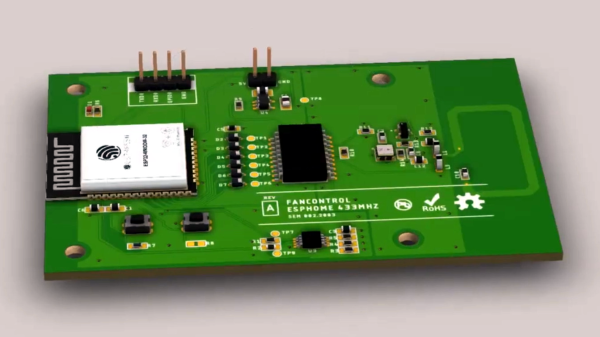
In the quest to automate everything in your home, you no doubt have things that aren’t made with home automation in mind. Perhaps your window AC unit, or the dimmer in your dining room. [Seb] has several ceiling fans that are controlled by remotes and wanted to connect them to his home automation system. In doing so, [Seb] gives a good overview of how to tackle this problem and how to design a PCB so he doesn’t have a breadboard lying around connected to the guts of his remote control.
There are several things [Seb] needs to figure out in order to connect his fans to Home Assistant, the home automation system he uses: He needs to determine if the circuit in the remote can be powered by 5 or 3.3 V, he needs to connect the circuit to an ESP32 board, and he needs to figure out if he can create a custom PCB that combines the circuit and the ESP32 into one. The video goes through each of these steps and shows the development of each along the way.
There’s a lot of info in the video, so it might need to be slowed down a bit to see all the details. There are some other reverse engineering of home automation gear on the site, here, or, you might want to build your own remote to control your automated devices.
A great big Thank You to everyone who answered the call to participate in Folding@Home, helping to understand proteins interactions of SARS-CoV-2 virus that causes COVID-19. Some members of the FAH research team hosted an AMA (Ask Me Anything) session on Reddit to provide us with behind-the-scenes details. Unsurprisingly, the top two topics are “Why isn’t my computer doing anything?” and “What does this actually accomplish?”
The first is easier to answer. Thanks to people spreading the word — like the amazing growth of Team Hackaday — there has been a huge infusion of new participants. We could see this happening on the leader boards, but in this AMA we have numbers direct from the source. Before this month there were roughly thirty thousand regular contributors. Since then, several hundredthousands more started pitching in. This has overwhelmed their server infrastructure and resulted in what’s been termed a friendly-fire DDoS attack.
Here’s a summary of current Folding@Home situation :
* We know about the work unit shortage
* It’s happening because of an approximately 20x increase in demand
* We are working on it and hope to have a solution very soon.
* Keep your machines running, they will eventually fold on their own.
* Every time we double our server resources, the number of Donors trying to help goes up by a factor of 4, outstripping whatever we do.
Why don’t they just buy more servers?
The answer can be found on Folding@Home donation FAQ. Most of their research grants have restrictions on how that funding is spent. These restrictions typically exclude capital equipment and infrastructure spending, meaning researchers can’t “just” buy more servers. Fortunately they are optimistic this recent fame has also attracted attention from enough donors with the right resources to help. As of this writing, their backend infrastructure has grown though not yet caught up to the flood. They’re still working on it, hang tight!
Computing hardware aside, there are human limitations on both input and output sides of this distributed supercomputer. Folding@Home need field experts to put together work units to be sent out to our computers, and such expertise is also required to review and interpret our submitted results. The good news is that our contribution has sped up their iteration cycle tremendously. Results that used to take weeks or months now return in days, informing where the next set of work units should investigate.
If you’ve seen both a fused filament fabrication (FFF) printer and a wire welder, you may have noticed that they work on a similar basic principle. Feedstock is supplied in filament form — aka wire — and melted to deposit on the work piece in order to build up either welds in the case of the welder, or 3D objects in the case of the printer. Of course, there are a number of difficulties that prevent you from simply substituting metal wire for your thermoplastic filament. But, it turns out these difficulties can be overcome with some serious effort. [Dominik Meffert] has done exactly this with his wire 3D printer project.
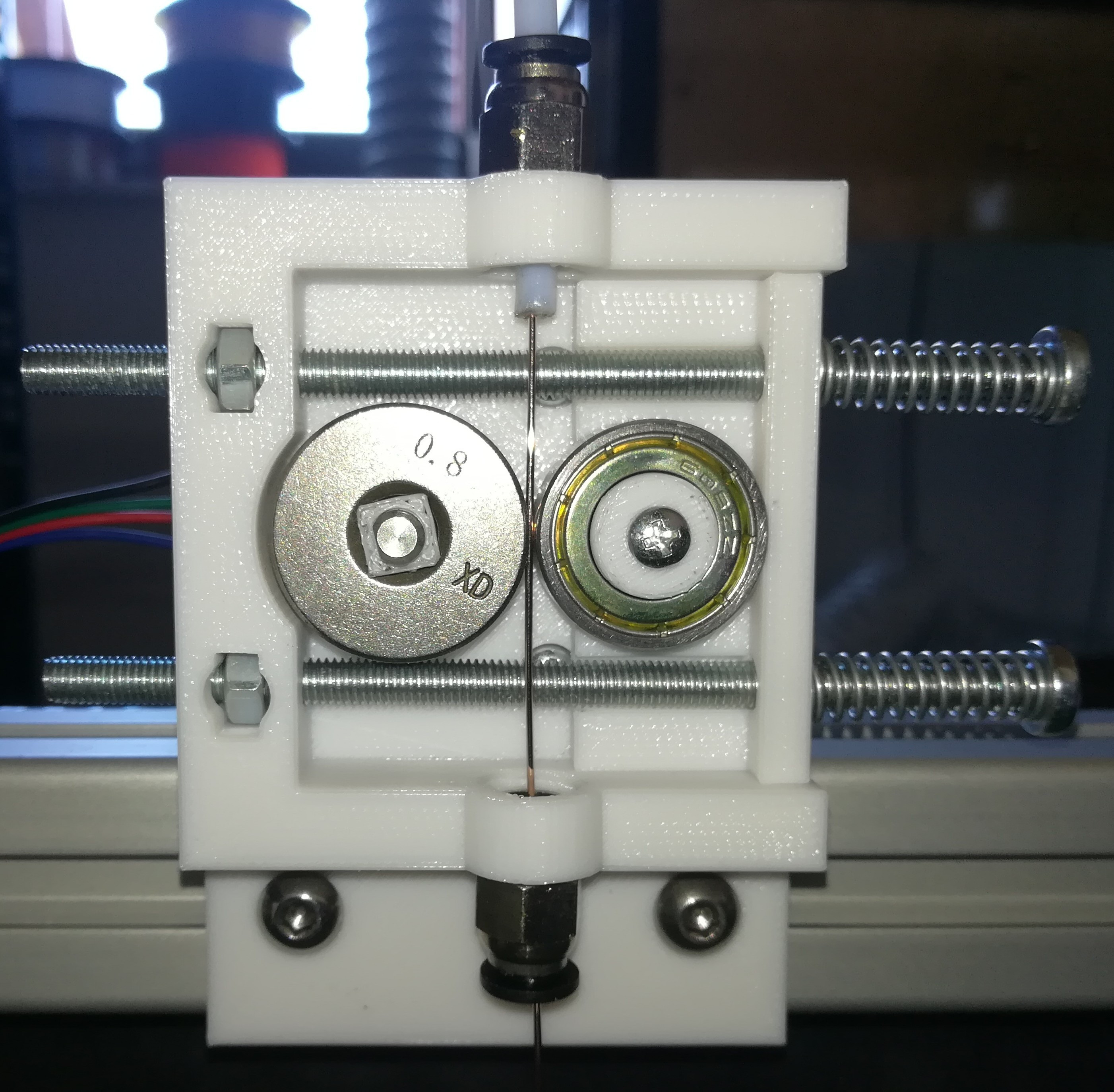
Extruder cold end using a standard feeder roller
For his filament, [Dominik] chose standard welding wire, and has also experimented with stainless steel and flux-cored wires. Initially, he used a normal toothed gear as the mechanism in the stepper-driven cold end of his Bowden-tube extrusion mechanism, but found a standard wire feeder wheel from a welder worked better. This pinch-drive feeds the wire through a Bowden tube to the hot end.
In thermoplastic 3D printers, the material is melted in a chamber inside the hotend, then extruded through a nozzle to be deposited. Instead of trying to duplicate this arrangement for the metal wire, [Dominik] used a modified microwave oven transformer (MOT) to generate the low-voltage/high-amperage required to heat the wire restively. The heating is controlled through a phase-fired rectifier power controller that modulates the power on the input of the transformer. Conveniently, this controller is connected to the cooling fan output of the 3D printer board, allowing any standard slicer software to generate g-code for the metal printer.
To allow the wire to heat and melt, there must be a complete circuit from the transformer secondary. A standard welding nozzle matching the wire diameter is used as the electrode on the hot end, while a metal build plate serves as the other electrode. As you can imagine, getting the build plate — and the first layer — right is quite tricky, even more so than with plastic printers. In this case, added complications involve the fact that the printed object must maintain good electrical continuity with the plate, must not end up solidly welded down, and the fact that the 1450 °C molten steel tends to warp the plate.
Considering all the issues that have to be solved to make this all work, we are very impressed with [Dominik’s] progress so far! Similar issues were solved years ago for the case of thermoplastic printers by a group of highly-motivated experimenters, and it’s great to see a similar thing starting to happen with metal printing, especially using simple, readily-available materials.