Speakers Taking The Stage At Supercon Plus A Hint Of The Hacking To Come

Four weeks from today the Hackaday Superconference comes alive for the fifth year. From engineering in challenging environments to elevating the art form of electronics, here are nine more talks that will make this a year to remember.

In addition to the slate of speakers below there are three other announcements, plus workshops. Jeroen Domburg (aka Sprite_TM) is designing this year’s badge based around a beefy FPGA running a RISC-V core and using open source synthesis tools. We’ll have more on that soon, but if you just can’t wait, check out the expansion board spec he just published, and join the conference chat room for the inside track. Badge hacking is sure to be the liveliest we’ve ever seen.

Tickets are sold out but you can still get on the waiting list and hope that one becomes available. If you are holding onto one of these hot commodities but are unable to use it, please return your ticket so that we can get it to someone waiting with their fingers crossed.

The Talks (Part Four of Many)


  • Laurel Cummings

    When it Rains, It Pours

    Over the last two years my work has been beyond ordinary, building and prototyping in strange locations like being stranded on a sailboat in the Atlantic Ocean, teaching US Marines in Kuwait, and building fuel gauge sensors for generators for vital systems in North Carolina post hurricane Florence. Some of the big lessons I’ve learned are about how to source materials and supplies in weird places, like finding potentiometers in the backwoods of North Carolina when Amazon cannot physically deliver across flooded highways, how to find welding gas in Kuwait City (and how a local chef could possibly be your best bet), or how far you can get with an O’Reilly’s Auto Parts store near the city docks. These situations help you really see the “engineer creep” that can happen to a project. I’ve learned that when you’re in high-risk situations, you really should stop caring about whether the edges of your 3D print are chamfered. In fact, version 1 of the hurricane fuel gauge sensor was demonstrated while being housed inside an elegant, tasteful sandwich baggie.


  • Angela Sheehan

    Building Whimsical Wearables: Leveling Up Through Playful Prototyping

    Whether it’s for a theme party, Halloween, cosplay, or That Thing in The Desert, designing wearables for whimsical self expression presents a great opportunity to challenge yourself as a maker, wearer, and collaborator. As an artist and designer who crash landed into a career in tech, I’ve found that imposter syndrome can often place limits on what feels personally achievable from an electronics and programming standpoint. Recontextualizing a project to shift the focus from ‘wearable tech hardware endeavor’ to ‘quirky mixed media experiment in personal styling’, I’ve created a safe space to play and try new things just outside my skill set and produced some of my most technically complex and polished personal work. Take a journey with me through the process of conceptualizing and building my Color Stealing Fairy project, an exercise in iterative design and upgrading an interactive wearable project over the course of two years and counting.


  • Michael Ossmann and Kate Temkin

    Software-Defined Everything

    The popularity of Software-Defined Radio (SDR) has led to the emergence of powerful open source software tools such as GNU Radio that enable rapid development of real-time Digital Signal Processing (DSP) techniques. We’ve used these tools for both radio and non-radio applications such as audio and infrared, and now we are finding them tremendously useful for diverse sensors and actuators that can benefit from DSP. In this talk we’ll show how we use the open source GreatFET platform to rapidly develop an SDR-like approach to just about anything.
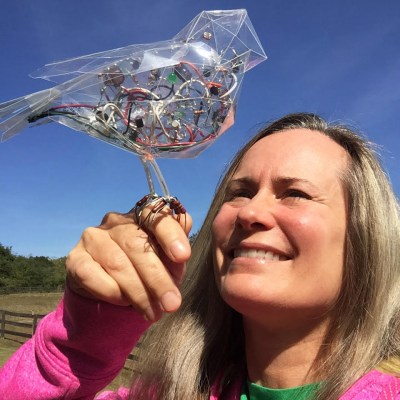

  • Kelly Heaton

    “Hacking Nature’s Musicians” (or, “The Art of Electronic Naturalism”)

    The general lack of acceptance of electronic art results from a scarcity of critics, curators, collectors, and grantors who understand electronic media, compounded by a cultural gap between the artistic and engineering communities. In order to solve this problem, we must stretch our comfort zone and vocabularies to have a respectful, enlightening conversation with people with different educational backgrounds. In this talk I’ll discuss my wonderment at the simple, analog circuit designs that mimic life-like behavior such as chirping crickets and singing birds. This will include discussion of various schematics and demonstrations of a small. along with an abbreviated survey of my work to-date.


  • Jasmine Brackett

    Setting your Electronics Free

    In this panel we’ll discuss the key ways to get your projects from your workshop into the hands of the first few users, and what you can do to scale up from there. We’ll talk about common pitfalls, and also what are the best resources to draw upon.


  • David Williams

    MicroFPGA – The Coming Revolution in Small Electronics

    Big FPGA’s are awesome. They’re doing what they’ve always done, enabling AI, signal processing, military applications etc. However, there is a new possibility emerging – FPGA’s for small applications – which is quite possibly even more significant. Using open source tools, cheap flexible development boards, and new libraries, designers have a whole new set of options, creating incredibly high performance, flexible, low power projects and products.


  • Nick Poole

    Boggling the Boardhouse: Designing 3D Structures, Circuits, and Sensors from PCBs

    The presentation will be a series of design features or techniques with a few minutes of exploration into the ‘gotchas’ of each, as well as example layouts in EAGLE and physical examples. I’d like to cover as many different techniques as I can cram into 30 minutes, including bringing weird shapes into EDA, the inside corner problem caused by tab and slot, fillet soldering, stacking boards, imitating model sprues with mouse bites, manipulating the mask layer for custom displays, bendy tab buttons, working rotary encoder, and ergonomic design for handheld PCBs.


  • Ted Yapo

    Towards an Open-Source Multi-GHz Sampling Oscilloscope

    Tektronix designed a 14.5 GHz sampling oscilloscope in 1968. With the easy multi-layer PCB designs, tiny surface-mount parts, blazingly fast semiconductors, and computer horsepower available to the individual designer today, can a similar sampling head be re-created inexpensively with common, off-the-shelf components? Should be easy, right? It’s not. In this talk, I’ll discuss progress towards an open-source GHz+ sampling oscilloscope, including a lot of dead ends, plus some very promising leads.


  • Jeroen Domburg

    Building the Hackaday Superconference Badge

    The tradition of the Hackaday Supercon badge is to build something unlike any Supercon badge that came before. This year’s badge has an FPGA as its central component, and this comes with some extra challenges: the FPGA only comes in a BGA package with a whopping 381 pads to solder, and instead of just referring to the datasheet of the SoC to write the badge software, the SoC itself had to be written first.  I will discuss the development process of the badge, as well as the many challenges encountered along the way.


Keep Your Eye on Hackaday for the Livestream

The speakers you’ll see at Supercon have an amazing wealth of experience and we can’t wait to see their talks. But even if you couldn’t get a ticket, that doesn’t mean you have to miss out. Keep your eye on Hackaday for a link to the livestream which will begin on Saturday, November 16th.

Hackaday Podcast 040: 3D Printed Everything, Strength V Toughness, Blades Of Fiber, And What Can’t Coffee Do?

Hackaday Editors Mike Szczys and Elliot Williams opine on the coolest hacks we saw this week. This episode is heavy with 3D printing as Prusa released a new, smaller printer, printed gearboxes continue to impress us with their power and design, hoverboards are turned into tanks, and researchers suggest you pour used coffee grounds into your prints. Don’t throw out those “toy” computers, they may be hiding vintage processors. And we have a pair of fantastic articles that cover the rise and fall of forest fire watchtowers, and raise the question of where all those wind turbine blades will go when we’re done with them.

Take a look at the links below if you want to follow along, and as always tell us what you think about this episode in the comments!

Take a look at the links below if you want to follow along, and as always, tell us what you think about this episode in the comments!

Direct download (60 MB or so.)

Continue reading “Hackaday Podcast 040: 3D Printed Everything, Strength V Toughness, Blades Of Fiber, And What Can’t Coffee Do?”

The True Cost Of Multimeters

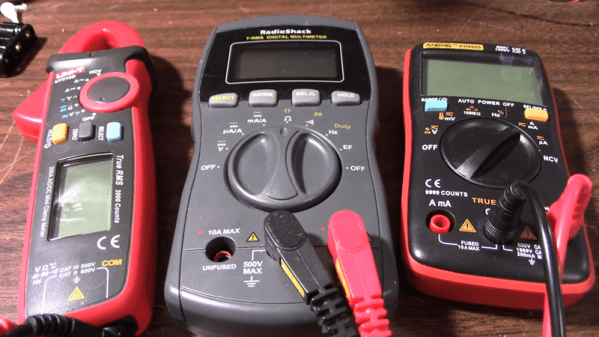
If you are building a home shop, it is common to try to get the cheapest gear you can possibly get. However, professionals often look at TCO or total cost of ownership. Buying a cheap car, for example, can cost more in the long run compared to buying an expensive car that requires less maintenance. Most consumers will nod sagely and think of ink jet printers. That $20 printer with the $80 cartridges might not be such a deal after all. [JohnAudioTech] bought a few cheap multimeters and now has problems with each of them. Maybe that $120 meter isn’t such a bad deal, after all.

The problems he’s seen are the same ones we’ve all seen: noisy selector switches, suspect display readings, and worn off lettering. You can see the whole story in the video below.

Continue reading “The True Cost Of Multimeters”

This Week In Security: A Digital Café Américain, The Linux Bugs That Weren’t, The Great Nation, And More

A government is going after a human rights activists in Morocco. It sounds familiar, but I don’t think Humphrey Bogart is running the gin joint this time around.

Questionable Casablanca references aside, Amnesty International has reported another attack against human rights workers. In this case, a pair of Moroccan activists were targeted with what appears to be NSO’s Pegasus malware suite. Researchers identified text message phishing that led to malicious web pages, as well as HTTP man in the middle attacks against their mobile devices. Once the target was successfully directed to the malicious site, A collection of zero-day vulnerabilities were used to compromise the phone with the NSO malware.

NSO is an Israeli company that specializes in building malware and other cybersecurity tools for governments. As you can imagine, this specialization has earned NSO the scorn of quite a few organizations. NSO claims to have a policy framework in place that allows them to evaluate and terminate the use of their software when it is deemed illegal or abusive, but due to the nature of their contracts, that process is anything but transparent. Continue reading “This Week In Security: A Digital Café Américain, The Linux Bugs That Weren’t, The Great Nation, And More”

Lessons Learned Building A DIY Rebreather

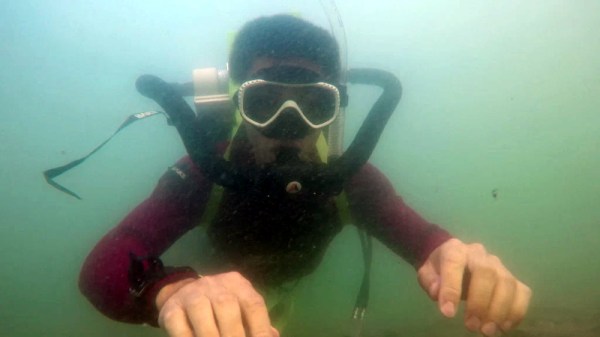
While the homebrew rebreather the [AyLo] describes on his blog looks exceptionally well engineered and is documented to a level we don’t often see, he still makes it very clear that he’s not suggesting you actually build one yourself. He’s very upfront about the fact that he has no formal training, and notes that he’s already identified several critical mistakes. That being said, he’s taken his rebreather out for a few dives and has (quite literally) lived to tell the tale, so he figured others might be interested in reading about his experiments.

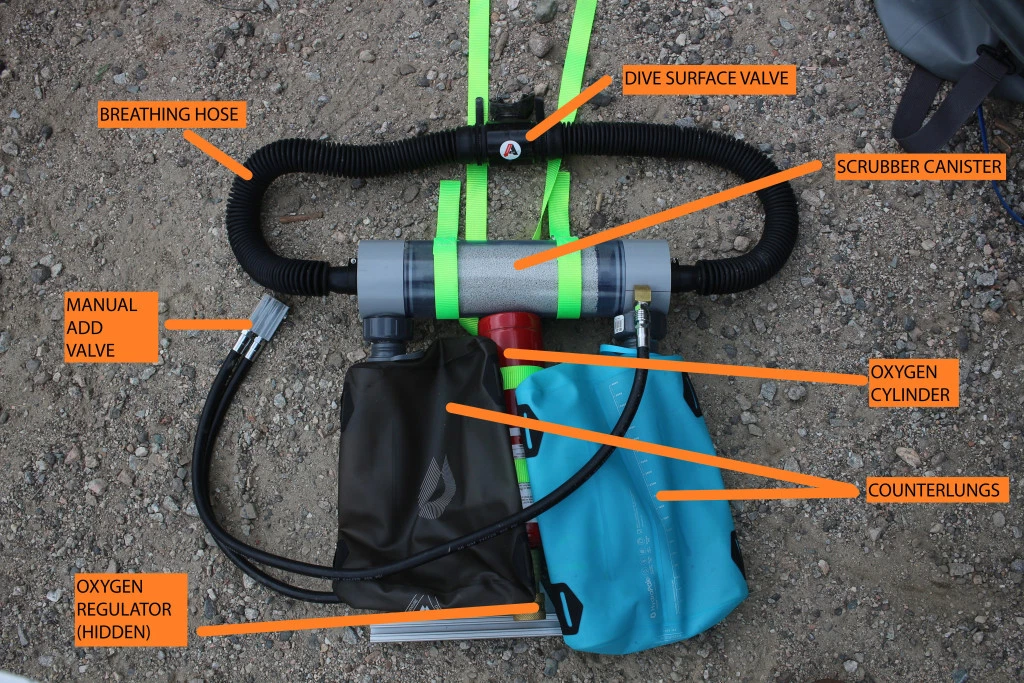
For the landlubbers in the audience, a rebreather removes the CO2 from exhaled air and recirculates the remaining O2 for another pass through the lungs. Compared to open circuit systems, a rebreather can substantially increase the amount of time a diver can remain submerged for a given volume of gas. Rebreathers aren’t just for diving either, the same basic concept was used in the Apollo PLSS to increase the amount of time the astronauts could spend on the surface of the Moon.

The science behind it seemed simple enough, so [AyLo] did his research and starting designing a bare-minimum rebreather system in CAD. Rather than completely hack something together with zip ties, he wanted to take the time to make sure that he could at least mate his hardware with legitimate commercial scuba components wherever possible to minimize his points of failure. It meant more time designing and machining his parts, but the higher safety factor seems well worth the effort.

[AyLo] has limited the durations of his dives to ten minutes or less out of caution, but so far reports no problems with the setup. As with our coverage of the 3D printed pressure regulator or the Arduino nitrox analyser, we acknowledge there’s a higher than usual danger factor in these projects. But with a scientific approach and more conventional gear reserved for backups, these projects prove that hardware hacking is possible in even the most inhospitable conditions.

Next Level Spirit Level Is On The Level

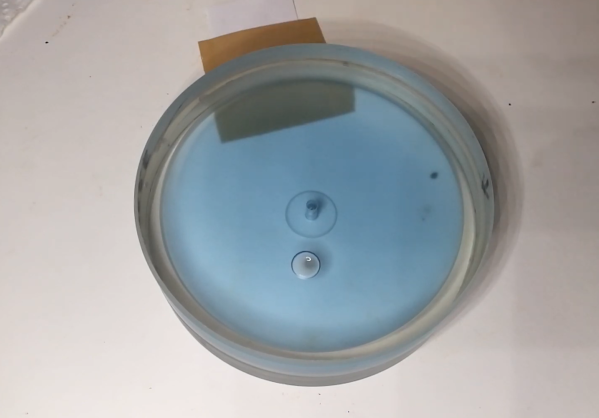
Miss your shot and scratch on the eight ball? It’s natural to blame the table for not being level so you can save face, but in all likelihood, you’re probably right. [Huygens Optics]’s father never misses a billiards shot on his home table, until one day he did. [Huygens Optics] rushed to his aid and built an extremely precise spirit level for the table so it will never happen again.

First and foremost, he had to decide how sensitive the spirit level should be. Obviously, the table should be as level as possible, though other factors like the condition of the felt will come into play as well. In doing some calculations, he found that every degree of leveling error in the table translates to several millimeters of ball unevenness and deviation, so he wanted the level to have .01 degrees of accuracy. How he manages this feat of grinding and polishing in a hobbyist workshop is all captured in the fascinating video after the break.

The level is made from two disks cut from leftover 15mm borosilicate glass. Between the disks is a 4mm cavity for the liquid (ethyl alcohol) and the air bubble to move around. To avoid introducing error with uneven adhesive application, [Huygens Optics] tried to join the disks using optical contact bonding, wherein two surfaces stick together through the magic of intermolecular forces, like the one that keeps geckos attached to vertical things. That worked quite well until he added the liquid, which broke the bond. Instead, he used a thin, UV-curable epoxy.

Getting into optics doesn’t have to cost a lot. Instead of buying or grinding lenses for experimentation, you can laser-cut lens profiles out of acrylic.

Continue reading “Next Level Spirit Level Is On The Level”

Robot Allows Remote Colleagues To Enjoy Office Shenanigans

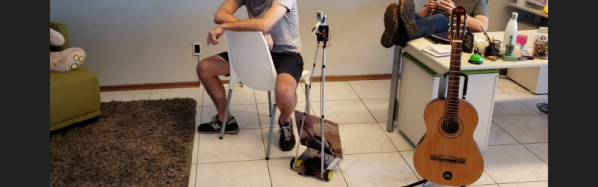
[Esther Rietmann] and colleagues built a Telepresence Robot to allow work at home teammates to have a virtual, but physical presence in the office. A telepresence robot is like a tablet mounted on a Roomba, providing motion capability in addition to an audio/video connection. Built during a 48 hour hackathon, it is a bit crude under the hood and misses out on some features, such as a bidirectional video feed. But overall, it pretty much does what is expected from such a device.

The main structure is build from cheap aluminium profiles and sheets. A Raspberry Pi is at the heart of the electronics hardware, with a servo mounted Pi-camera and speaker-microphone pair taking care of video and audio. The two DC motors are driven by H-bridges controlled from the Pi and an idle swivel caster is attached as the third wheel. The whole thing is powered by a power bank. The one important thing missing is an HDMI display which can show a video feed from the remote laptop camera. That may have been due to time constraints, but this feature should not be too difficult to add as a future upgrade. It’s important for both sides to be able to see each other.

The software is built around WebRTC protocol, with the WebRTC Extension from UV4L doing most of the heavy lifting. The UV4L Streaming Server not only provides its own built-in set of web applications and services, but also embeds a general-purpose web server on another port, allowing the user to run and deploy their own custom web apps. This allowed [Esther Rietmann]’s team to build a basic but functional front-end to transmit data from the remote interface for controlling the robot. The remote computer runs a Python control script, running as a system service, to control the drive motors and camera servo.

The team also played with adding basic object, gesture and action recognition features. This was done using PoseNet – a machine learning model, which allows for real-time human pose estimation in the browser using TensorFlowJS – allowing them to demonstrate some pose detection capability. This could be useful as a “follow me” feature for the robot.

Another missing feature, which most other commercial telepresence robots have, is a sensor suite for collusion avoidance, object detection and awareness such as micro switches, IR / ultrasonic detectors, time of flight cameras or LiDAR’s. It would be relatively easy to add one or several sensors to the robot.

If you’d like to build one for yourself, check out their code repository on Github and the videos below.

Continue reading “Robot Allows Remote Colleagues To Enjoy Office Shenanigans”