Voja Antonic designed this fantastic retrocomputing badge for Hackaday Belgrade in 2018, and it was so much fun that we wanted to bring it stateside to the Supercon essentially unaltered. And that meant that Voja had some free time to devote to a new hardware giveaway: the Cube. So while his talk at Supercon in November was ostensibly about the badge, he just couldn’t help but tell us about his newer love, and some of the extremely clever features hidden within.
It’s funny how the hardware we design can sometimes reflect so much on the creator. Voja designed then-Yugoslavia’s first widely used home computer (and published the DIY plans in a magazine!). Thousands were built from their kits. The Galaksija was a Z80-based design with a custom BASIC that was just barely squeezed into the available 4K of ROM. So you shouldn’t be shocked that the retro-badge has a working keyboard and a nice BASIC on board.
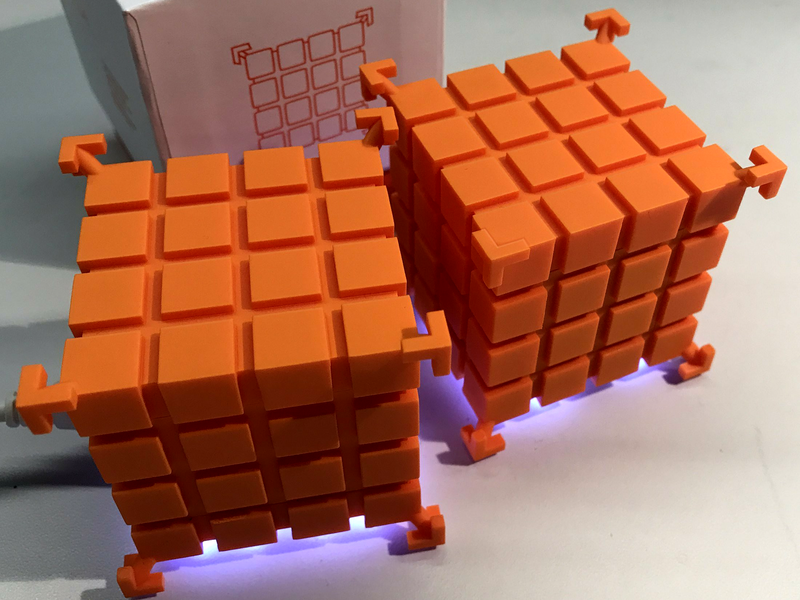
But let’s jump ahead to the Cube, because that’s even more of a passion project. On the outside, they’re very simple devices, with only a USB port and a sweet diffused LED ring visible. Aesthetic? Minimalistic? Beautiful, honestly. Continue reading “Voja Antonic: Designing The Cube”→
Did you know Britain launched its first satellite after the program had already been given the axe? Me neither, until some stories of my dad’s involvement in aerospace efforts came out and I dug a little deeper into the story.
I grew up on a small farm with a workshop next to the house, that housed my dad’s blacksmith business. In front of the workshop was a yard with a greenhouse beyond it, along one edge of which there lay a long gas cylinder about a foot (300mm) in diameter. To us kids it looked like a torpedo, and I remember my dad describing the scene when a similar cylinder fell off the side of a truck and fractured its valve, setting off at speed under the force of ejected liquid across a former WW2 airfield as its pressurised contents escaped.
Everybody’s parents have a past from before their children arrived, and after leaving the RAF my dad had spent a considerable part of the 1950s as a technician, a very small cog in the huge state-financed machine working on the UK’s rocket programme for nuclear and space launches. There were other tales, of long overnight drives to the test range in the north of England, and of narrowly averted industrial accidents that seem horrific from our health-and-safety obsessed viewpoint. Sometimes they came out of the blue, such as the one about a lake of highly dangerous liquid oxidiser-fuel mix ejected from an engine that failed to ignite and which was quietly left to evaporate, which he told me about after dealing with a cylinder spewing liquid propane when somebody reversed a tractor into a grain dryer.
My dad’s tales from his youth came to mind recently with the news that a privately-owned Scottish space launch company is bringing back to the UK the remains of the rocket that made the first British satellite launch from where they had lain in Australia since crashing to earth in 1971. What makes this news special is that not only was it the first successful such launch, it was also the only one. Because here in good old Blighty we hold the dubious honour of being the only country in the world to have developed a space launch capability of our own before promptly abandoning it. Behind that launch lies a fascinating succession of forgotten projects that deserve a run-through of their own, they provide a window into both the technological and geopolitical history of that period of the Cold War.
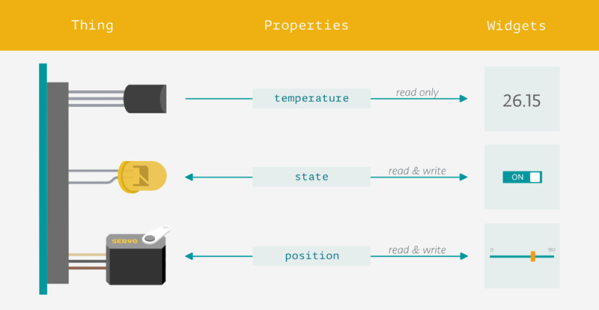
Love it or hate it, for many people embedded systems means Arduino. Now Arduino is leveraging its more powerful MKR boards and introducing a cloud service, the Arduino IoT Cloud. The goal is to make it simple for Arduino programs to record data and control actions from the cloud.
The program is in beta and features a variety of both human and machine interaction styles. At the simple end, you can assemble a dashboard of controls and have the IoT Cloud generate your code and download it to your Arduino itself with no user programming required. More advanced users can use HTTP REST, MQTT, Javascript, Websockets, or a suite of command line tools.
In the early 1990s, I was lucky enough to get some time on a 60 MeV linear accelerator as part of an undergraduate lab course. Having had this experience, I can feel for the scientists at CERN who have had to make do with their current 13 TeV accelerator, which only manages energies some 200,000 times larger. So, I read with great interest when they announced the publication of the initial design concept for the Future Circular Collider (FCC), which promises collisions nearly an order of magnitude more energetic. The plan, which has been in the works since 2014, includes three proposals for accelerators which would succeed CERN’s current big iron, the LHC.
Want to know what’s on the horizon in high-energy physics?
Regular readers will have followed our series of posts looking at the issues surrounding reports of drones in proximity to aircraft, and will have noted that we recently asked our community how they would approach the detection and handling of marauding drones in controlled airspace. We are mere amateurs though by comparison to a team with its roots in Delft University of Technology’s Micro Air Vehicle Laboratory, because they have approached the problem through DroneClash, a spectacle best described as akin to a Robot Wars competition for drones. Their website states that “Anything goes, with one exception: nojamming“, and teams will do battle before an audience for a share in a considerable prize fund.
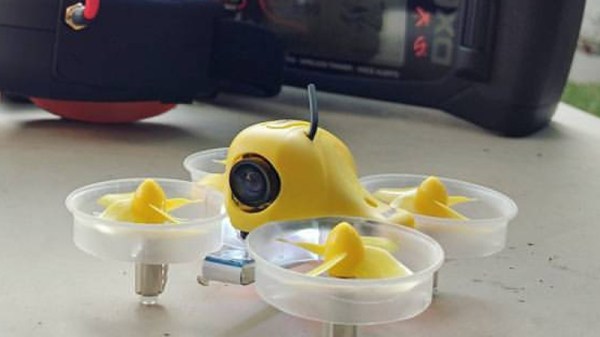
The fun is not however limited to team members. People in the audience will also be able to participate, by being invited to try their luck at bringing down a TinyWhoop that will periodically fly into the arena for a chance at their own prize. The ubiquitous cheap toy drone will be accessible through software, and would-be attackers are invited to register in advance to take a pop at it.
It looks as if DroneClash will be an unmissable event for anyone able to make it to the Netherlands on March 16th. We’ve mentioned it in past years, and we look forward to seeing what comes out of it this year too.
TinyWhoop header image: Dan Lundmark, (CC BY 2.0).
There’s no doubting the wonders that micro-electromechanical systems (MEMS) technology have brought to the world. With MEMS chips, your phone can detect the slightest movement, turning it into a sensitive sensor platform that can almost anticipate what you’re going to do next. Actually, it’s kind of creepy when you think about it.
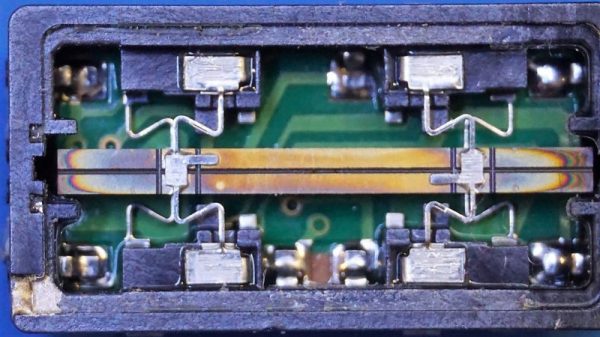
But before nano-scale MEMS inertial sensing came along, lots of products needed to know their ups from their downs, and many turned to products such as this vibrating piezoelectric gyroscope that [Kerry Wong] found in an old camcorder. The video below shows a teardown of the sensor, huge by MEMS standards but still a marvel of micro-engineering. The device is classified as a Coriolis vibratory gyroscope (CVG) which, as the name implies, uses the Coriolis effect to sense rotation. In this device, [Kerry] found that a long, narrow piezoelectric element spans the long axis of the sensor, suspended from what appears to be four flexible arms. [Kerry] probed the innards of the sensor while powered up and discovered a 22 kHz signal on the piezo element; this vibrates the bar in one plane so that when it rotates, it exerts a force on the support arms that can be detected. Indeed, [Kerry] hooked the output of the sensor to a wonderfully old-school VOM whose needle wiggled with the slightest movement of the sensor.
Sadly, MEMS made this kind of sensor obsolete, but we appreciate the look under the hood. And really, MEMS chips are using the same principle to detect motion, just on a much smaller scale. Want the MEMS basics? [Al] has you covered.
Arduinos are a handy tool to have around. They’re versatile, cheap, easy to program, and have a ton of software libraries to build on. They’ve only been around for about a decade and a half though, so if you were living in 1989 and wanted to program a microcontroller you’d probably be stuck with an 8-bit microprocessor with no built-in peripherals to help, reading from a physical book about registers and timing, and probably trying to get a broken ribbon cable to behave so it would actually power up. If you want a less frustrating alternate history to live in, though, check out the latest project from [Marek].
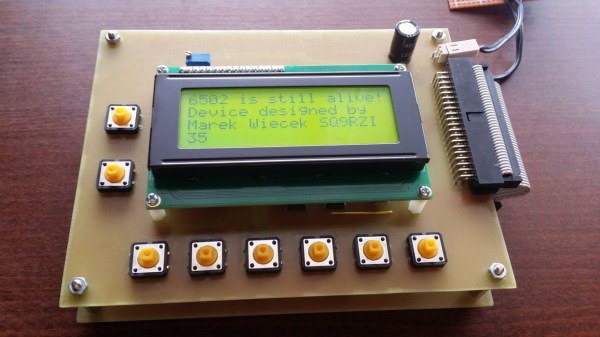
He discovered some 6502 chips (Polish language, Google Translate link) that a Chinese manufacturer was selling, but didn’t really trust that they were legitimate. On a lark he ordered some and upon testing them he found out that they were real 6502s. Building an 8-bit computer is something he’d like to do, but in the meantime he decided to do a project using one of these chips as a general-purpose microcontroller similar to a modern Arduino. The project has similar specs as an Arduino too, including 8kB of RAM memory, 8kB of I/O address space, and various EPROM capabilities. [Marek] went on to build a shield board for it as well, for easy access to some switches and LEDs. It’s a great build that anyone interested in microcontrollers should check out.
Keep in mind that an ATtiny45 has 8 bits like the 6502 but only costs around $1 USD, whereas a 6502 would have cost around $200 in today’s dollars. It’s really only in modern times that we can appreciate the 6502 as a cheap 8-bit microcontroller for that reason alone, but we can also appreciate how it ushered in a computer revolution since competing Intel and Motorola chips cost around six times more before it showed up. They became so popular in fact that people still regularly use them to build retrocomputers of all kinds.


 It’s funny how the hardware we design can sometimes reflect so much on the creator. Voja designed then-Yugoslavia’s first widely used home computer (and published the DIY plans in a magazine!). Thousands were built from their kits. The Galaksija was a Z80-based design with a custom BASIC that was just barely squeezed into the available 4K of ROM. So you shouldn’t be shocked that the retro-badge has a working keyboard and a nice BASIC on board.