Fail Of The Week: How Not To Use Pushbuttons

If you are a regular at creating printed circuit boards, it is likely that somewhere in your shop there will be a discard pile of boards on which you placed a component in the wrong orientation such that it would not work. It’s easily done, and don’t be shy to admit it if it’s happened to you.

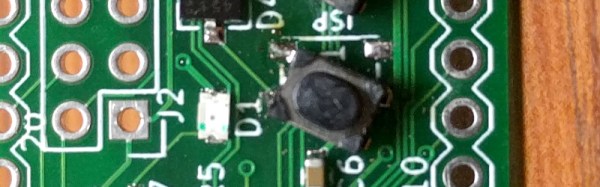
[Bill] was making his own ARM developer board, taking inspiration from the ARM Pro Mini. He produced his PCB design and sent it off to the board house, and in due course received and reflow soldered a batch of beautiful dev boards. On power-up though, something was wrong! No USB device detected on his computer, a disaster. A lot of studying board and schematic led to the discovery that his push-button switches had been placed at 90 degrees to the orientation it should have had, leaving them in a permanently “on” position.

The PCB bug makes this is a Fail Of The Week post, but he transformed into a win with some experimentation with the switch outline in KiCAD before finding a way to mount the switches on the pads at 45 degrees, covering three of the pads. Well done, and well done for admitting the error.

[Editor’s note: been there, done that. One way to prevent the error is to only connect to diagonally opposite pins of the tact switch, so the rotation doesn’t matter.]

Having earlier asked others to come clean with their PCB mistakes, it’s probably appropriate to admit that Hackaday scribes are just as fallible as [Bill] when it comes to PCB layouts. Somewhere there may still be a board on this bench with a QFN microcontroller bodged on at 90 degrees to its original orientation, with cut tracks and tiny wire runs.

Whether you are a seasoned PCB pro or a wet-behind-the-ears rookie, our Creating a PCB In Everything series should be of interest.

KIM-1 To COSMAC Elf Conversion — Sort Of

In the mid-1970s, if you had your own computer, you probably built it. If you had a lot of money and considerable building skill, you could make an Altair 8800 for about $395 — better than the $650 to have it built. However, cheaper alternatives were not far behind.

In 1976, Popular Electronics published plans for a computer called the COSMAC Elf which you could build for under $100, and much less if you had a good junk box. The design was simple enough that you could build it on a piece of perf board or using wire wrap. We featured the online archive of the entire Popular Electronics collection, but hit up page 33 of this PDF if you want to jump right to the article that started it all. The COSMAC Elf is a great little machine built around a 40-pin RCA 1802 processor, and for many was the first computer they owned. I lost my original 1802 computer in a storm and my recent rebuild in another completely different kind of storm. But there is a way to reclaim those glory days without starting from scratch.  I’m going to repurpose another retro-computing recreation; the KIM-1.

I’ll admit it, Rewiring a real KIM-1 to take an 1802 CPU would be difficult and unnecessary and that’s not what this article is about. However, I did have a KIM UNO — [Oscar’s] respin of the classic computer using an Arduino mini pro. Looking at the keyboard, it occurred to me that the Arduino could just as easily simulate an 1802 as it could a 6502. Heck, that’s only two digits different, right?

The result is pretty pleasing. A “real” Elf had 8 toggle switches, but there were several variations that did have keypads, so it isn’t that far off. Most Elf computers had 256 bytes of memory (without an upgrade) but the 1802 UNO (as I’m calling it) has 1K. There’s also a host of other features, including a ROM and a monitor for loading and debugging programs that doesn’t require any space in the emulated 1802.

Continue reading “KIM-1 To COSMAC Elf Conversion — Sort Of”

Monster Mindstorms Delta Bot Delicately Picks Candy

A group of embedded developers from Sioux Embedded Systems in Eindhoven, the Netherlands, wanted to get experience working on Microsoft .Net. To make it fun they made it their project to produce a LEGO train with visitors at LEGO World, the official LEGO convention in the Netherlands. The team developed an application in C# to fully automate the train, with Mindstorms NXT and EV3 bricks as well as LEGO Power Functions motors controlling everything.

The train project carries a simple premise: the visitor chooses one of four colors, and the train goes and picks up a piece of simulated candy with the matching color. Called Sioux.net on Track, the project has produced a new train every year since 2012 with improvement goals in place to add features with every version. Ironically, the least interesting part of the setup is the actual train and track. The team’s creativity comes to the fore in two areas of the project: the method by which the candy color is selected, and the assembly that dispenses the correct color into the train car.

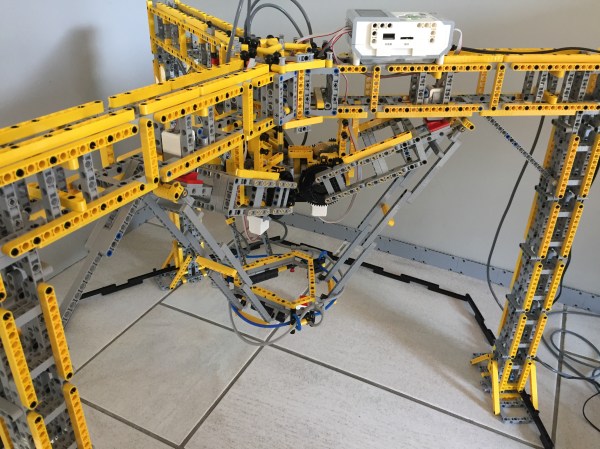
Team member [Hans Odenthal] has built candy-grabbers for various years’ trains. He learned about the ABB FlexPicker and this year decided to build a delta robot for the layout. It consists of huge girders constructed from 5×9 and 5×11 Technic beam frames held together with more Technic beams and hundreds of connector pegs. The three arms each move on a pair of turntables which are geared down to provide as much torque as possible — the fake candy pieces are light, but the arms themselves weigh a lot. [Hans] ended up revamping the gearboxes to up the ratio from 1:5 to 1:25.

Continue reading “Monster Mindstorms Delta Bot Delicately Picks Candy”

Hackaday’s Assistive Technology Challenge Begins Now

This morning marks a new challenge in the Hackaday Prize: we want to see what you can do with Assistive Technology. Twenty entries will win $1000 each, becoming part of the final round for a chance at the top prizes ranging from $5,000 to $50,000.

Assistive Technology means things that help people by improving their quality of life. This can take so many forms but broadly speaking this could make aging easier, turn disabilities into abilities, or enhance the access and delivery of health care.

We’ve seen great things in this area from the Hackaday community. The Grand Prize for the 2015 Hackaday Prize went to an assistive technology that linked motorized wheelchairs to gaze-controlled computers, called Eyedrivomatic. And at the 2016 Hackaday SuperConference we learned how common tools and crowd sourced skills can lead to a new take on physical rehabilitation with a robot-assisted elbow.

The Hackaday Prize challenges us all to Build Something that Matters. It’s hard to argue that there is a better place to take on this challenge than with Assistive Technologies. Enter your project today!

Hackaday Links Column Banner

Hackaday Links: July 23, 2017

Hey, you know what’s happening right now? We’re wrapping up the third round of The Hackaday Prize. This challenge, Wheels, Wings, and Walkers, is dedicated to things that move. If it’s a robot, it qualifies, if it’s a plane, it qualifies, if it passes butter, it qualifies. There’s only a short time for you to get your entry in. Do it now. Superliminal advertising.

Speaking of the Hackaday Prize, this project would be a front-runner if only [Peter] would enter it in the competition. It’s one thing to have a cult; I have a cult and a petition to ‘stop’ me.

We were completely unaware of this project, but a few weeks ago, a cubesat was launched from Baikonur. This cubesat contains a gigantic mylar reflector, and once it’s deployed it will be the second brightest object in the night sky after the moon. I don’t know why we haven’t seen this in the press, but if you have any pictures of sightings, drop those in the comments.

In a mere two years, we’ll be looking at the 50th anniversary of the Apollo 11 landing. The mission control center at Johnson Space Center — where these landings were commanded and controlled — is still around, and it’s not in the best shape. There’s a Kickstarter to restore the Apollo Mission Control Center to its former glory. For the consoles, this means restoring them to Apollo 15 operational configuration.

We’ve seen 3D printed remote control airplanes, and at this point, there’s nothing really exceptional about printing a wing. This user on imgur is going a different direction with 3D printed fiberglass molds. Basically, it’s a fuselage for a Mustang that is printed, glued together, with the inside sanded and coated in wax. Two layers (3 oz and 6 oz) fiberglass is laid down with West Systems epoxy. After a few days, the mold is cracked open and a fuselage appears. This looks great, and further refinements of the process can include vapor smoothing of the inside of the mold, a few tabs to make sure the mold halves don’t break when the part is released, and larger parts in general.

The Darknet’s Casefile will take you to the limit of your existing knowledge. Join them, to go on a quest to improve your technical abilities.

This week is Def Con. That means two things. First, we’re on a hardware hunt. If you’ve been dedicating the last few months to #badgelife or other artisanal electronics, we want to hear about it. Second, [Joe Kim] made a graphic of the Tindie dog wearing a Hackaday hoodie and it’s adorable. There are a limited number of stickers of our hacker dog.

Gigabyte launched a single board computer with an Intel Apollo Lake CPU, discrete memory and storage, and a mini PCIe slot. Of course, this is being incorrectly marketed as a ‘Raspberry Pi competitor’, but whatever.

Linux Fu: Better Bash Scripting

It is easy to dismiss bash — the typical Linux shell program — as just a command prompt that allows scripting. Bash, however, is a full-blown programming language. I wouldn’t presume to tell you that it is as fast as a compiled C program, but that’s not why it exists. While a lot of people use shell scripts as an analog to a batch file in MSDOS, it can do so much more than that. Contrary to what you might think after a casual glance, it is entirely possible to write scripts that are reliable and robust enough to use in many embedded systems on a Raspberry Pi or similar computer.

I say that because sometimes bash gets a bad reputation. For one thing, it emphasizes ease-of-use. So while it has features that can promote making a robust script, you have to know to turn those features on. Another issue is that a lot of the functionality you’ll use in writing a bash script doesn’t come from bash, it comes from Linux commands (or whatever environment you are using; I’m going to assume some Linux distribution). If those programs do bad things, that isn’t a problem specific to bash.

One other limiting issue to bash is that many people (and I’m one of them) tend to write scripts using constructs that are compatible with older shells. Often times bash can do things better or neater, but we still use the older ways. For example:

Continue reading “Linux Fu: Better Bash Scripting”

Friday Hack Chat: Making Electronics For Education

For this week’s Hack Chat on Hackaday.io, we’ll be talking with AnnMarie Thomas about making electronics for education. There’s a huge intersection between electronics and education, and whether you’re designing robots for a FIRST team or designing a geometry curriculum around 3D-printed objects, there’s a lot electronics can teach students.

AnnMarie Thomas is an associate professor at the School of Engineering and the Opus College of Business at the University of St. Thomas. She’s the founder of the Playful Learning Lab, and along with her students she’s created Squishy Circuits. AnnMarie is the author of Making Makers: Kids, Tools, and the Future of Innovation. Basically, if you’re looking for someone who knows how to make an educational product, you can’t do any better.

For this week’s Hack Chat, we’ll be talking about how to define how technology and education can intersect. There are ways to define a concept, build and sell an educational product, and how to find a market for a product. If you’ve ever wanted to know what goes into getting students to dive into electronics, this is the Hack Chat you have to sit in on.

Oh, AnnMarie is also a judge for this year’s Hackaday Prize. Neat.

Also on deck for this week’s Hack Chat will be Tindie. Tindie is Supplyframe’s (Hackaday’s parent company) answer to the question, ‘where should I sell my hardware product’. Think of it as ‘Etsy for electronics’, but with less furniture made out of pallet wood, but paradoxically more products that require a California prop 65 warning. Isn’t electronics fun?

Here’s How To Take Part:

join-hack-chatOur Hack Chats are live community events on the Hackaday.io Hack Chat group messaging. This Hack Chat will take place at noon Pacific time on Friday, July 21st. Confused about where and when ‘noon’ is? Here’s a time and date converter!

Log into Hackaday.io, visit that page, and look for the ‘Join this Project’ Button. Once you’re part of the project, the button will change to ‘Team Messaging’, which takes you directly to the Hack Chat.

You don’t have to wait until Friday; join whenever you want and you can see what the community is talking about.