It is nearly impossible to build any kind of hardware these days without at some point in the process dealing with China — Chinese suppliers, and so by extension Chinese culture. Difficulties can be as simple as the usual inconvenience of everything stopping for weeks up to and after Chinese New Year, or engineers that you know to be otherwise reasonably competent simply choosing not to bring up glaring and obvious problems. Having encountered my share of Western hardware entrepreneurs on the verge of a breakdown, and just as many flummoxed Chinese bosses completely unable to see exactly why they’re so upset, I thought I’d try to offer at least a little insight into one of the many issues that comes up.
Nearly any school child in the world will be able to tell you whom they were taught invented the lightbulb, the telephone, the radio transmitter. Those same children will usually be able to tell you of at least a few Chinese inventions as well — gunpowder, paper, the compass etc. But with one key difference, even the Chinese children are unlikely to be able to credit even a group of people for their invention let alone a single (usually misattributed) individual.
China does not really have an Edison, or Tesla, or Bell — oh we’ve had people as brilliant, but they are not celebrated in quite the same way for cultural reasons. If you were to do an alternate history of China where we went through the Industrial Revolution first, you’d want to split the timeline around Mozi (墨子). The Mohists (followers of Mozi) had advanced siege engine design, schools of logic, mathematics and theory for the physical sciences. much of the same foundation that set the West on its particular trajectory. In the end, Confucian ideals won out and China became a culture that celebrated scholarship over ingenuity (to vastly oversimplify things).
Even our respective terms for engineer reflect this. The word engineer (Latin ingeniator) is derived from the Latin words ingeniare (“to contrive, devise”) and ingenium (“cleverness”). Yet in Chinese 工程师, the first character for engineer in Chinese is the carpenters square 工. He or she is a simple worker (工人 literally “Work Person”). Even now, engineers are not held in anywhere near the same regard in China as they are in the West.
The piston engine has been the king of the transportation industry for well over a century now. It has been manufactured so much that it has become a sort of general-purpose machine that can be used to do quite a bit more than merely move people and cargo from one point to another. Running generators, hydraulic systems, pumps, and heavy machinery are but a few examples of that.
Scale production of this technology also had the effect of driving prices for these engines down, and now virtually everyone in the developed world has cheap and easy access to them. In the transportation world, at least, it looks like its reign might finally be coming to a slow, drawn-out conclusion as electric cars capture more and more market share.
Electric motors aren’t the first technology to try to topple the piston engine from its apex position on top of our modern transportation industry, though. In the 1960s another technology, the gas turbine engine, tried to replace it — and failed.
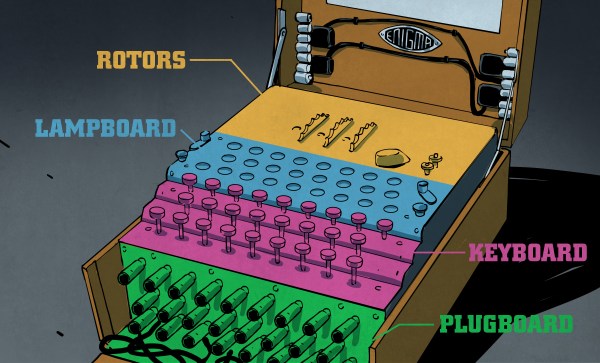
To many, the Enigma machine is an enigma. But it’s really quite simple. The following is a step-by-step explanation of how it works, from the basics to the full machine.
Possibly the greatest dedicated cipher machine in human history the Enigma machine is a typewriter-sized machine, with keyboard included, that the Germans used to encrypt and decrypt messages during World War II. It’s also one of the machines that the Polish Cipher Bureau and those at Britain’s Bletchley Park figured out how to decipher, or break. Most recently the story of how it was broken was the topic of the movie The Imitation Game.
If you sign up for a European hacker camp such as CCC Camp in Germany or SHA Camp in the Netherlands, you’ll see among the items recommended to take with you, a DECT handset. DECT, or Digital Enhanced Cordless Telecommunications, refers to the set of standards that lie behind the digital cordless telephones that are ubiquitous across Europe and some countries elsewhere in the world. These standards cover more than just the simple two-way telephone calls through a base station that most Europeans use them for though, they define a fully functional multi-cell 3G phone and data networking system. This means that an event like SHA Camp can run its own digital phone network without having to implement cell towers.
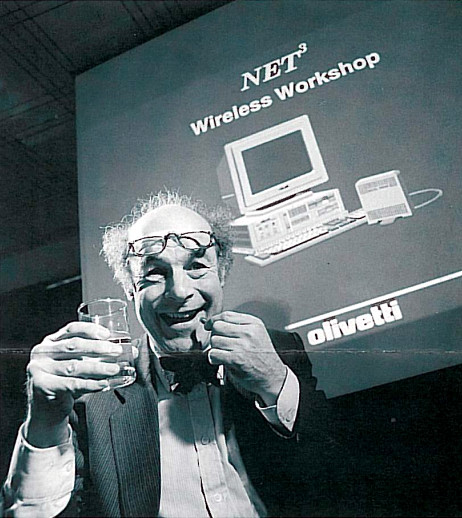
Olivetti promotional Net3 image
Reading the history of DECT, there is the interesting snippet that the first DECT product on the market in 1993 was not a telephone but a networking device, and incidentally the first wireless LAN product on the European market. Olivetti’s Net3 provided 512kB/s wireless networking to a base station with Ethernet or Token Ring interfaces for connection to a LAN. In its original form it was an internal card for a desktop PC coupled to a bulky external box containing radio circuitry and antenna, but its later incarnations included a PCMCIA card with a much smaller antenna box. The half-megabit speed seems tiny by today’s standards, but in the pre-multimedia world of 1993 would have been perfectly adequate for a Novell Netware fileserver and an HP Laserjet 4.
[Heinz Wolff] swallows a condom in another Olivetti promotional image.
Mystery Technology
So DECT is an interesting technology that can do more than just a simple cordless phone, and its first product was unexpectedly somewhat groundbreaking. It then becomes even more interesting to find that Net3 has left very little evidence of itself to find that can be found on the Web, and learning more about it requires a little detective work.
The Wikipedia entry has the bare bones, but it speaks volumes about the obscure nature of the product that the encyclopedia’s only picture of it is a tiny thumbnail-sized promotional image of the PCMCIA variant in a chunky mid-1990s laptop. A further search reveals a 1993 British Olivetti staff newsletter (PDF) carrying another promotional image of the desktop Net3 device featuring the then-well-known TV personality and academic [Heinz Wolff] demonstrating the technology bizarrely by swallowing a DECT medical instrumentation transponder wrapped in a condom. Some press releases remain in the fossilized remnants of the 1990s internet, and a Net3 design team member’s LinkedIn page led us to the patent covering the system, but that’s pretty much it. We can’t even find a high enough resolution image of a Net3 card for our featured image slot.
Wireless Things Before Their Time
It’s obvious that Net3 and DECT networking as a high-end wireless LAN before a need for wireless LANs existed never made it, but what is perhaps more interesting is that it seems to have left no legacy for other more mundane applications. We are in the midst of an explosion of hype around the Internet of Things and it seems new short-range wireless networking technologies appear almost daily, yet the world seems to have overlooked this robust, low power, and mature wireless network with its own dedicated frequency allocation that many of us already have in our homes. It seems particularly surprising that among the many DECT base stations on sale at your local consumer electronics store there are none with an Internet connection, and there is no market for IoT devices that use DECT as their backhaul.
In the open-source community there has been some work on DECT. The OsmocomDECT project for example provides a DECT software stack, and deDECTed.org states an aim to “better understand DECT and its security and to create an Open Source implementation of the DECT standard”. But there seems to have been very little hardware work in our community on the standard, for example there are no DECT-specific projects on Hackaday.io.
Net3 then was a product before its time, a herald of what was to come, from that twilight period when the Web was definitely a thing but had yet to become the world’s universal information repository. Public wireless networking was still several years in the future, so there was no imperative for road warriors to equip themselves with a Net3 card or for computer manufacturers — not even Olivetti themselves! — to incorporate the technology. It thus didn’t take the world by storm, and unusually for such a ground-breaking computer product there remains little legacy for it beyond a rarely-used feature of the protocol Europeans use for their cordless phones.
Did you have a Net3 card? Do you still have one? Let us know in the comments.
While most people who make the trek to the path of totality for the Great American Eclipse next week will fix their gazes skyward as the heavenly spectacle unfolds, we suspect many will attempt to post a duck-face selfie with the eclipsed sun in the background. But at least one man will be feverishly tending to an experiment.
On a lonely hilltop in Wyoming, Dr. Don Bruns will be attempting to replicate a famous experiment. If he succeeds, not only will he have pulled off something that’s only been done twice before, he’ll provide yet more evidence that Einstein was right.
If you ever go to a computer history museum, you’ll be struck by how bland most modern computers look. Prior to 1980 computers had lights and switches, and sometimes dials and meters. Some had switchboard-like wiring panels and some even had oscilloscope-like displays. There’s something about a machine with all those switches and lights and displays that gets your hacker juices flowing. Have you ever wanted to get started in retrocomputing? Is it difficult? Do you need a lot of money? That depends on what your goals are.
There are at least three ways you can go about participating in retrocomputing: You can pony up the money to buy actual antique computers, you can build or buy old computers recreated with anywhere from zero to one hundred percent of period-authentic components, or you can experiment with emulators that run on a modern computer. As a hybrid of the second and third option there are also emulations in FPGAs.
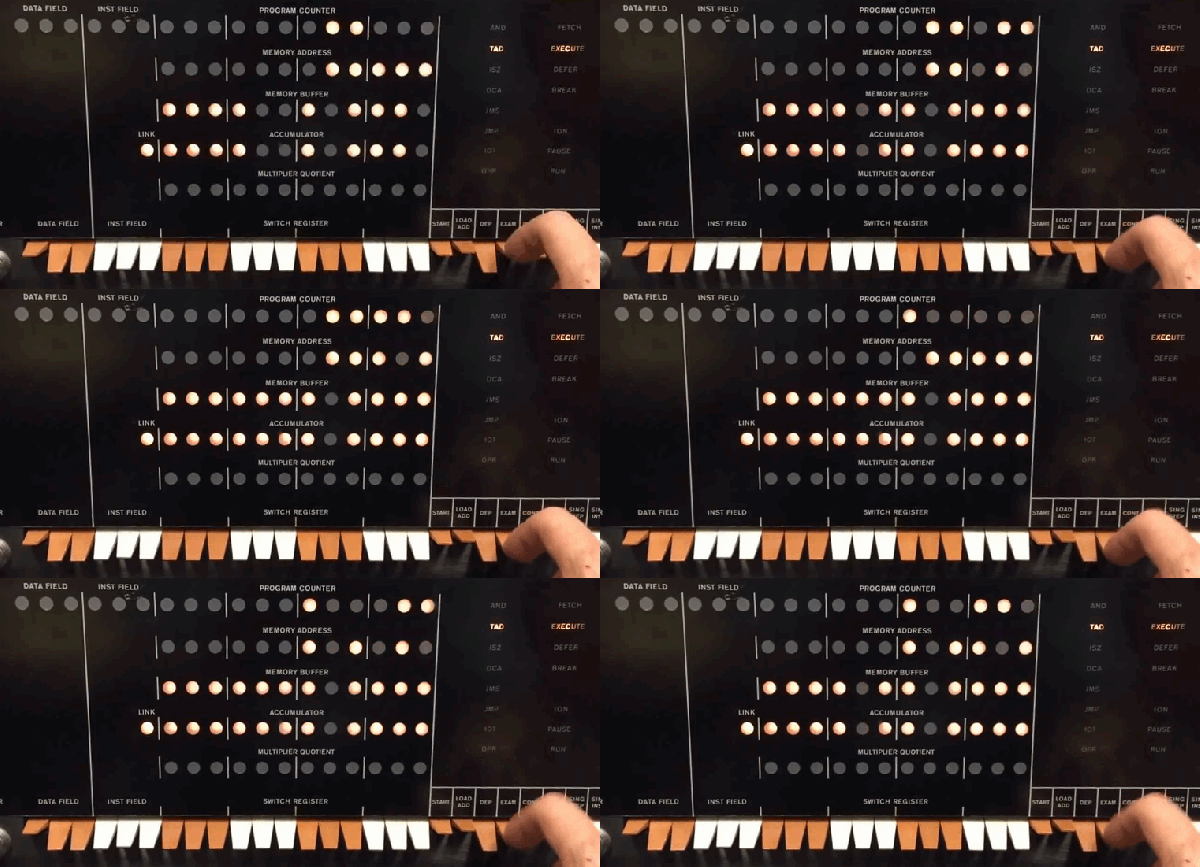
You can see that the first option can be very expensive and you will probably have to develop a lot of repair and restoration skills. Watching [Mattis Lind] twiddle the bits on an actual PDP-8 in the clip above is great, but you’ll need to work up to it. The two techniques which get you going without the original hardware don’t have to break the bank or even cost anything presuming you already have a PC.
Although some sneer at emulation, for some machines it is almost the only way to go. You couldn’t buy the original EDSAC, for example. It is also a good way to get started without a lot of expense or risk. But regardless of how you do it, there’s one thing in common: you have to know how to operate the thing.
In a bout of frustration I recently realized that the roads have all updated — most people have no idea how — and this sometimes hurts the flow of traffic. This realization happened when an unfortunate person stopped in a left turn lane well before the stop line. The vehicle didn’t trigger the sensor, so cycle after cycle went by and the traffic system never gave the left turn lane a green light, thinking the lane was unoccupied. Had the driver known about this the world would have been a better place. The first step in intelligent automation is sensing, and there are a variety of methods used to sense traffic’s flow.