Why Ada Is The Language You Want To Be Programming Your Systems With

The Ada programming language was born in the mid-1970s, when the US Department of Defense (DoD) and the UK’s Ministry Of Defence sought to replace the hundreds of specialized programming languages used for the embedded computer systems that increasingly made up essential parts of military projects.  Instead, Ada was designed to be be a single language, capable of running on all of those embedded systems, that offered the same or better level of performance and reliability.

With the 1995 revision, the language also targeted general purpose systems  and added support for object-oriented programming (OOP) while not losing sight of the core values of reliability, maintainability and efficiency. Today, software written in Ada forms the backbone of not only military hardware, but also commercial projects like avionics and air-traffic control systems. Ada code controls rockets like the Ariane 4 and 5, many satellites, and countless other systems where small glitches can have major consequences.

Ada might also be the right choice for your next embedded project. Continue reading “Why Ada Is The Language You Want To Be Programming Your Systems With”

Norovirus Smartphone: Using Megapixels And Microfluidics To Fight The Other Kind Of Virus Infection

Chances are pretty good that at some time in your life, you’ve crossed paths with a norovirus. And chances are that you remember the encounter vividly, or at least its aftermath. I recall a run-in with the bug one Christmas, when my parents brought over more than just toys for the kids when they visited. Within a day, everyone in the house was sharing the joy. Twas the season; they don’t call it the winter vomiting bug for nothing.

Most of the 685 million norovirus infections each year resolve after a few miserable days, but some require hospitalization and 200,000 of them result in death, mainly from dehydration and mainly children. An easy to use, cheap, and accurate means of detecting the virus in the field would be quite a boon to public health. And soon, smartphones may be able to do just that.

Continue reading “Norovirus Smartphone: Using Megapixels And Microfluidics To Fight The Other Kind Of Virus Infection”

Can You Really Use The Raspberry Pi 4 As A Desktop Machine?

When the Raspberry Pi 4 was released, many looked at the dual micro HDMI ports with disdain. Why would an SBC like the Raspberry Pi need two HDMI ports? The answer was that the Pi 4 is finally fast enough to work as a desktop replacement, and the killer feature (for many of us) for a desktop is multiple monitors.

Now I know what many of you are thinking. There’s no way a $35, or even $55, credit-card-sized computer can replace a $1000+ desktop machine, right? Right? Of course not, but at the same time, yes, yes it can. So I tried to use the Pi as a desktop replacement for a week, and it worked. In fact, this article has been written almost entirely on the Pi 4 with 4 GB of memory, as well as a couple of my recent security columns. I could definitely continue working with the Pi as my daily driver for that purpose.

There are a few points of order to cover first. Initial reviews were based on the June 20th release of Raspbian, which in turn was based on the pre-release Debian Buster. Since then, Buster has released. Fixes that were queued up have landed now that the release freeze has ended. A new Raspbian image was released on July 10, and many of the initial release issues have been fixed.
Continue reading “Can You Really Use The Raspberry Pi 4 As A Desktop Machine?”

Sensor Filters For Coders

Anybody interested in building their own robot, sending spacecraft to the moon, or launching inter-continental ballistic missiles should have at least some basic filter options in their toolkit, otherwise the robot will likely wobble about erratically and the missile will miss it’s target.

What is a filter anyway? In practical terms, the filter should smooth out erratic sensor data with as little time lag, or ‘error lag’ as possible. In the case of the missile, it could travel nice and smoothly through the air, but miss it’s target because the positional data is getting processed ‘too late’. The simplest filter, that many of us will have already used, is to pause our code, take about 10 quick readings from our sensor and then calculate the mean by dividing by 10. Incredibly simple and effective as long as our machine or process is not time sensitive – perfect for a weather station temperature sensor, although wind direction is slightly more complicated. A wind vane is actually an example of a good sensor giving ‘noisy’ readings: not that the sensor itself is noisy, but that wind is inherently gusty and is constantly changing direction.

It’s a really good idea to try and model our data on some kind of computer running software that will print out graphs – I chose the Raspberry Pi and installed Jupyter Notebook running Python 3.

The photo on the left shows my test rig. There’s a PT100 probe with it’s MAX31865 break-out board, a Dallas DS18B20 and a DHT22. The shield on the Pi is a GPS shield which is currently not used. If you don’t want the hassle of setting up these probes there’s a Jupyter Notebook file that can also use the internal temp sensor in the Raspberry Pi. It’s incredibly quick and easy to get up and running.

It’s quite interesting to see the performance of the different sensors, but I quickly ended up completely mangling the data from the DS18B20 by artificially adding randomly generated noise and some very nasty data spikes to really punish the filters as much as possible. Getting the temperature data to change rapidly was effected by putting a small piece of frozen Bockwurst on top of the DS18B20 and then removing it again.

Continue reading “Sensor Filters For Coders”

3D Printering: The Search For Better Search

There’s no question that a desktop 3D printer is at its most useful when it’s producing parts of your own design. After all, if you’ve got a machine that can produce physical objects to your exacting specifications, why not give it some? But even the most diligent CAD maven will occasionally defer to an existing design, as there’s no sense spending the time and effort creating their own model if a perfectly serviceable one is already available under an open source license.

But there’s a problem: finding these open source models is often more difficult than it should be. The fact of the matter is, the ecosystem for sharing 3D printable models is in a very sorry state. Thingiverse, the community’s de facto model repository, is antiquated and plagued with technical issues. Competitors such as Pinshape and YouMagine are certainly improvements on a technical level, but without the sheer number of models and designers that Thingiverse has, they’ve been unable to earn much mindshare. When people are looking to download 3D models, it stands to reason that the site with the most models will be the most popular.

It’s a situation that the community is going to have to address eventually. As it stands, it’s something of a minor miracle that Thingiverse still exists. Owned and operated by Makerbot, the company that once defined the desktop 3D printer but is today all but completely unknown in a market dominated by low-cost printers from the likes of Monoprice and Creality, it seems only a matter of time before the site finally goes dark. They say it’s unwise to put all of your eggs in one basket, and doubly so if the basket happens to be on fire.

So what will it take to get people to consider alternatives to Thingiverse before it’s too late? Obviously, snazzy modern web design isn’t enough to do it. Not if the underlying service operates on the same formula. To really make a dent in this space, you need a killer feature. Something that measurably improves the user experience of finding the 3D model you need in a sea of hundreds of thousands. You need to solve the search problem.

Continue reading “3D Printering: The Search For Better Search”

Hackaday Celebrates 15 Years And Oh How The Hardware Has Changed

Today marks exactly 15 years since Hackaday began featuring one Hack a Day, and we’ve haven’t missed a day since. Over 5,477 days we’ve published 34,057 articles, and the Hackaday community has logged 903,114 comments. It’s an amazing body of work from our writers and editors, a humbling level of involvement from our readers, and an absolutely incredible contribution to open hardware by the project creators who have shared details of their work and given us all something to talk about and to strive for.

What began as a blog is now a global virtual hackerspace. That first 105-word article has grown far beyond project features to include spectacular long-form original content. From our community of readers has grown Hackaday.io, launched in 2014 you’ll now find over 30,000 projects published by 350,000 members. The same year the Hackaday Prize was founded as a global engineering initiative seeking to promote open hardware, offering big prizes for big ideas (and the willingness to share them). Our virtual connections were also given the chance to come alive through the Hackaday Superconference, Hackaday Belgrade, numerous Hackaday Unconferences, and meetups all over the world.

All of this melts together into a huge support structure for anyone who wants to float an interesting idea with a proof of concept where “why” is the wrong question. Together we challenge the limits of what things are meant to do, and collectively we filter through the best ideas and hold them high as building blocks for the next iteration. The Hackaday community is the common link in the collective brain, a validation point for perpetuating great ideas of old, and cataloging the ones of new.

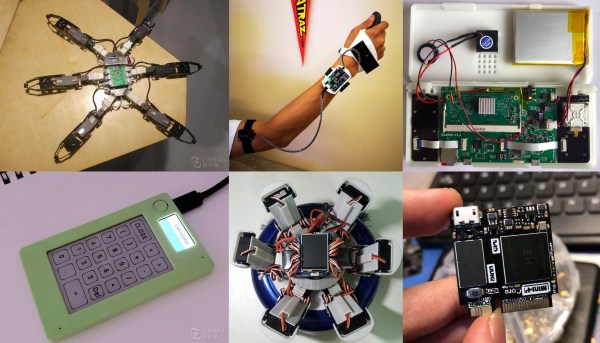
Perhaps the most impressive thing about the last 15 years of Hackaday is how much the technological landscape has changed. Hackaday is still around because all of us have actively changed along with it — always looking for that cutting edge where the clever misuse of something becomes the base for the next transformative change. So we thought we’d take a look back 15 years in tech. Let’s dig into a time when there were no modules for electronics, you couldn’t just whip up a plastic part in an afternoon, designing your own silicon was unheard of, and your parts distributor was the horde of broken electronics in your back room.

Continue reading “Hackaday Celebrates 15 Years And Oh How The Hardware Has Changed”

Are Hydrogen Cars Still Happening?

Potentially coming to a service station near you.

In every comment section, there’s always one. No matter the electric vehicle, no matter how far the technology has come, there’s always one.

“Only 500 miles of range? Electric cars are useless! Me, and everyone I know, drives 502 miles every day at a minimum! Having to spend more than 3 minutes to recharge is completely offensive to my entire way of life. Simply not practical, and never will be.”

Yes, it’s true, electric cars do have limited range and can take a little longer to recharge than a petrol or diesel powered vehicle. Improvements continue at a rapid pace, but it’s not enough for some.

To these diehards, hydrogen fuel cell vehicles may have some attractive benefits. By passing hydrogen gas through a proton-exchange membrane, electricity can be generated cleanly with only water as a byproduct. The technology holds a lot of promise for powering vehicles, but thus far hasn’t quite entered our daily lives yet. So what is the deal with hydrogen as a transport fuel, and when can we expect to see them in numbers on the ground?

Continue reading “Are Hydrogen Cars Still Happening?”