More Power: Powel Crosley And The Cincinnati Flamethrower

We tend to think that there was a time in America when invention was a solo game. The picture of the lone entrepreneur struggling against the odds to invent the next big thing is an enduring theme, if a bit inaccurate and romanticized. Certainly many great inventions came from independent inventors, but the truth is that corporate R&D has been responsible for most of the innovations from the late nineteenth century onward. But sometimes these outfits are not soulless corporate giants. Some are founded by one inventive soul who drives the business to greatness by the power of imagination and marketing. Thomas Edison’s Menlo Park “Invention Factory” comes to mind as an example, but there was another prolific inventor and relentless promoter who contributed vastly to the early consumer electronics industry in the USA: Powel Crosley, Jr.

Continue reading “More Power: Powel Crosley And The Cincinnati Flamethrower”

AI And The Ghost In The Machine

The concept of artificial intelligence dates back far before the advent of modern computers — even as far back as Greek mythology. Hephaestus, the Greek god of craftsmen and blacksmiths, was believed to have created automatons to work for him. Another mythological figure, Pygmalion, carved a statue of a beautiful woman from ivory, who he proceeded to fall in love with. Aphrodite then imbued the statue with life as a gift to Pygmalion, who then married the now living woman.

chateau_de_versailles_salon_des_nobles_pygmalion_priant_venus_danimer_sa_statue_jean-baptiste_regnault
Pygmalion by Jean-Baptiste Regnault, 1786, Musée National du Château et des Trianons

Throughout history, myths and legends of artificial beings that were given intelligence were common. These varied from having simple supernatural origins (such as the Greek myths), to more scientifically-reasoned methods as the idea of alchemy increased in popularity. In fiction, particularly science fiction, artificial intelligence became more and more common beginning in the 19th century.

But, it wasn’t until mathematics, philosophy, and the scientific method advanced enough in the 19th and 20th centuries that artificial intelligence was taken seriously as an actual possibility. It was during this time that mathematicians such as George Boole, Bertrand Russel, and Alfred North Whitehead began presenting theories formalizing logical reasoning. With the development of digital computers in the second half of the 20th century, these concepts were put into practice, and AI research began in earnest.

Over the last 50 years, interest in AI development has waxed and waned with public interest and the successes and failures of the industry. Predictions made by researchers in the field, and by science fiction visionaries, have often fallen short of reality. Generally, this can be chalked up to computing limitations. But, a deeper problem of the understanding of what intelligence actually is has been a source a tremendous debate.

Despite these setbacks, AI research and development has continued. Currently, this research is being conducted by technology corporations who see the economic potential in such advancements, and by academics working at universities around the world. Where does that research currently stand, and what might we expect to see in the future? To answer that, we’ll first need to attempt to define what exactly constitutes artificial intelligence.

Continue reading “AI And The Ghost In The Machine”

Creating A PCB In Everything: Upverter

For the last five months, I’ve been writing a series of posts describing how to build a PCB in every piece of software out there. Every post in this series takes a reference schematic and board, and recreates all the elements in a completely new PCB tool.

There are three reasons why this sort of review is valuable. First, each post in this series is effectively a review of a particular tool. Already we’ve done Fritzing (thumbs down), KiCad (thumbs up), Eagle (thumbs up), and Protel Autotrax (interesting from a historical perspective). Secondly, each post in this series is a quick getting started guide for each PCB tool. Since the reference schematic and board are sufficiently complex for 90% of common PCB design tasks, each of these posts is a quick how-to guide for a specific tool. Thirdly, this series of posts serves as a basis of comparison between different tools. For example, you can do anything you want in KiCad and most of what you want in Eagle. Fritzing is terrible, and Autotrax is the digital version of the rub-on traces you bought at Radio Shack in 1987.

With that introduction out of the way, let’s get cranking on Upverter.

A little bit about Upverter

Upverter was founded in 2010 as an entirely web-based EDA tool aimed at students, hobbyists, and Open Hardware circuit designers. This was one of the first completely web-based circuit design tools and Upverter’s relative success has been a bellwether for other completely web-based EDA tools such as circuits.io and EasyEDA.

I would like to take a second to mention Upverter is a Y Combinator company (W11), which virtually guarantees this post will make it to the top of Hacker News. Go fight for imaginary Internet points amongst yourselves.

Upverter is a business after all, so how are they making money? Most EDA suites offer a free, limited version for personal, hobbyist, and ‘maker’ projects, and Upverter is no exception. The professional tier offers a few more features including CAM export, 3D preview, an API, simulation (coming soon), BOM management, and unlimited private projects for $125 per seat per month, or $1200 per seat per year.

To give you a basis of comparison for that subscription fee, Eagle CAD’s new license scheme gives you everything – 999 schematic sheets, 16 layers, and unlimited board area – for $65 per month, or $500 per year. Altium’s CircuitStudio comes in at $1000 for a one-year license. There are more expensive EDA suites such as Altium Designer and OrCAD, but you have to call a sales guy just to get a price.

Upverter is positioning itself as a professional tool at a professional price. There are better tools out there, of course, but there are thousands of businesses out there designing products with tools that cost $500 to $1000 per seat per year. In any event, this is all academic; the Hackaday crowd gravitates towards the free end of the market, whether that means beer or speech.

A big draw for Upverter is their Parts Concierge service. You’ll never have to create a part from scratch again, so the sales copy says. Apparently, Upverter is using a combination of very slick scripts to pull part layouts off a datasheet and human intervention / sanity check to create these parts. Does it work? We’re going to find out in the review below.

Continue reading “Creating A PCB In Everything: Upverter”

Books You Should Read: Making A Transistor Radio

When a Hackaday article proclaims that its subject is a book you should read, you might imagine that we would be talking of a seminal text known only by its authors’ names. Horowitz and Hill, perhaps, or maybe Kernigan and Ritchie. The kind of book from which you learn your craft, and to which you continuously return to as a work of reference. Those books that you don’t sell on at the end of your university career.

Ladybird books covered a huge range of topics.

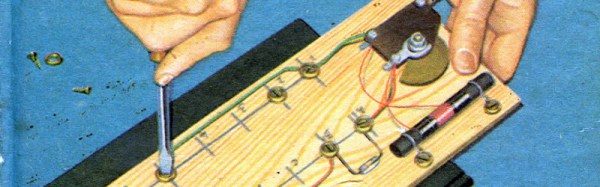
So you might find it a little unexpected then that our subject here is a children’s book. Making A Transistor Radio, by [George Dobbs, G3RJV] is one of the huge series of books published in the UK under the Ladybird imprint that were a staple of British childhoods for a large part of the twentieth century. These slim volumes in a distinctive 7″ by 4.5″ (180 x 115 mm) hard cover format were published on a huge range of subjects, and contained well written and informative text paired with illustrations that often came from the foremost artists of the day. This one was published at the start of the 1970s when Ladybird books were in their heyday, and has the simple objective of taking the reader through the construction of a simple three transistor radio. It’s a book you must read not because it is a seminal work in the vein of Horrowitz and Hill, but because it is the book that will have provided the first introduction to electronics for many people whose path took them from this humble start into taking the subject up as a career. Including me as it happens, I received my copy in about 1979, and never looked back. Continue reading “Books You Should Read: Making A Transistor Radio”

Ask Hackaday: Are Unlockable Features Good For The User?

There are numerous examples of hardware which has latent features waiting to be unlocked by software. Most recently, we saw a Casio calculator which has the same features as its bigger sibling hidden within the firmware, only to be exposed by a buffer overflow bug (or the lead from a pencil if you prefer a hardware hack).

More famously, oscilloscopes have been notorious for having crippled features. The Rigol DS1052E was hugely popular on hacker benches because of it’s very approachable price tag. The model shipped with 50 MHz bandwidth but it was discovered that a simple hack turned it into the DS1102E 100 MHz scope. Tektronix has gotten in on this action as well, shipping modules like I2C, CAN, and LIN analyzation on the scope but requiring a hardware key to unlock (these were discovered to have a horribly insecure unlock method). Similar feature barriers are found on Rigol’s new reigning entry-level scope, the DS1054Z, which ships with protocol analyzation modules (among others) that are enabled only for the first 70 hours of scope operation, requiring an additional payment to unlock them. Most scope manufacturers are in on the game, and of course this is not limited to our tools. WiFi routers are another great example of hardware hosting firmware-unlockable features.

So, the question on my mind which I’d like to ask all of the Hackaday community is this: are unlockable features good for us, the people who use these tools? Let’s take a look at some of the background of these practices and then jump into a discussion in the comments.

Continue reading “Ask Hackaday: Are Unlockable Features Good For The User?”

Hacking The Aether: How Data Crosses The Air-Gap

It is incredibly interesting how many parts of a computer system are capable of leaking data in ways that is hard to imagine. Part of securing highly sensitive locations involves securing the computers and networks used in those facilities in order to prevent this. These IT security policies and practices have been evolving and tightening through the years, as malicious actors increasingly target vital infrastructure.

Sometimes, when implementing strong security measures on a vital computer system, a technique called air-gapping is used. Air-gapping is a measure or set of measures to ensure a secure computer is physically isolated from unsecured networks, such as the public Internet or an unsecured local area network. Sometimes it’s just ensuring the computer is off the Internet. But it may mean completely isolating for the computer: removing WiFi cards, cameras, microphones, speakers, CD-ROM drives, USB ports, or whatever can be used to exchange data. In this article I will dive into air-gapped computers, air-gap covert channels, and how attackers might be able to exfiltrate information from such isolated systems.

Continue reading “Hacking The Aether: How Data Crosses The Air-Gap”

Early Electromechanical Circuits

In the days before semiconductor diodes, transistors, or even vacuum tubes, mechanical means were used for doing many of the same things. But there’s still plenty of fun to be had in using those mechanical means today, as [Manuel] did recently with his relay computer. This post is a walk through some circuits that used those mechanical solutions before the invention of the more electronic and less mechanical means came along.

Continue reading “Early Electromechanical Circuits”