Chemical Formulas 101

It seems like every other day we hear about some hacker, tinkerer, maker, coder or one of the many other Do-It-Yourself engineer types getting their hands into a complex field once reserved to only a select few. Costs have come down, enabling common everyday folks to equip themselves with 3D printers, laser cutters, CNC mills and a host of other once very expensive pieces of equipment. Getting PCB boards made is literally dirt cheap, and there are more inexpensive Linux single board computers than we can keep track of these days. Combining the lowering hardware costs with the ever increasing wealth of knowledge available on the internet creates a perfect environment for DIYers to push into ever more specific scientific fields.

One of these fields is biomedical research. In labs across the world, you’ll find a host of different machines used to study and create biological and chemical compounds. These machines include DNA and protein synthesizers, mass spectrometers, UV spectrometers, lyophilizers, liquid chromatography machines, fraction collectors… I could go on and on.

These machines are prohibitively expensive to the DIYer. But they don’t have to be. We have the ability to make these machines in our garages if we wanted to. So why aren’t we? One of the reasons we see very few biomedical hacks is because the chemistry knowledge needed to make and operate these machines is generally not in the typical DIYers toolbox. This is something that we believe needs to change, and we start today.

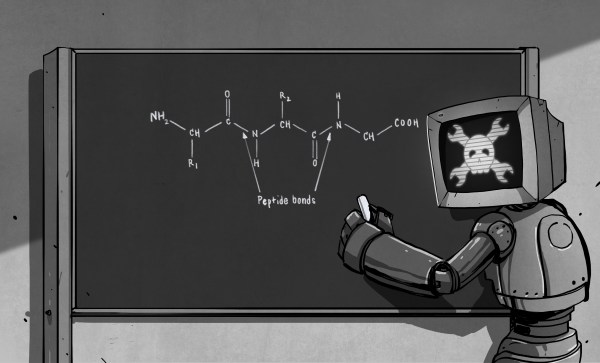
In this article, we’re going to go over how to convert basic chemical formulas, such as C9H804 (aspirin), into its molecular structure, and visa versa. Such knowledge might be elementary, but it is a requirement for anyone who wishes to get started in biomedical hacking, and a great starting point for the curious among us.


Continue reading “Chemical Formulas 101”

Automatic Resistance: Resistors Controlled By The Environment

Resistors are one of the fundamental components used in electronic circuits. They do one thing: resist the flow of electrical current. There is more than one way to skin a cat, and there is more than one way for a resistor to work. In previous articles I talked about fixed value resistors as well as variable resistors.

There is one other major group of variable resistors which I didn’t get into: resistors which change value without human intervention. These change by environmental means: temperature, voltage, light, magnetic fields and physical strain. They’re commonly used for automation and without them our lives would be very different.

Continue reading “Automatic Resistance: Resistors Controlled By The Environment”

The Healthy Maker: Tackling Vapors, Fumes And Heavy Metals

Fearless makers are conquering ever more fields of engineering and science, finding out that curiosity and common sense is all it takes to tackle any DIY project. Great things can be accomplished, and nothing is rocket science. Except for rocket science of course, and we’re not afraid of that either. Soldering, welding, 3D printing, and the fine art of laminating composites are skills that cannot be unlearned once mastered. Unfortunately, neither can the long-term damage caused by fumes, toxic gasses and heavy metals. Take a moment, read the material safety datasheets, and incorporate the following, simple practices and gears into your projects.

Continue reading “The Healthy Maker: Tackling Vapors, Fumes And Heavy Metals”

A Brief History Of ‘Drone’

In the early 1930s, Reginald Denny, an English actor living in Los Angeles, stumbled upon a young boy flying a rubber band-powered airplane. After attempting to help the boy by adjusting the rubber and control surfaces, the plane spun into the ground. Denny promised he would build another plane for the boy, and wrote to a New York model manufacturer for a kit. This first model airplane kit grew into his own hobby shop on Hollywood Boulevard, frequented by Jimmy Stewart and Henry Fonda.

The business blossomed into Radioplane Co. Inc., where Denny designed and built the first remote controlled military aircraft used by the United States. In 1944, Captain Ronald Reagan of the Army Air Forces’ Motion Picture unit wanted some film of these new flying targets and sent photographer David Conover to the Radioplane factory at the Van Nuys airport. There, Conover met Norma Jeane Dougherty and convinced her to go into modeling. She would later be known as Marilyn Monroe. The nexus of all American culture from 1930 to 1960 was a hobby shop that smelled of balsa sawdust and airplane glue. That hobby shop is now a 7-Eleven just off the 101 freeway.

Science historian James Burke had a TV wonderful show in the early 90s – Connections – where the previous paragraphs would be par for the course. Unfortunately, the timbre of public discourse has changed in the last twenty years and the worldwide revolution in communications allowing people to instantaneously exchange ideas has only led to people instantaneously exchanging opinions. The story of how the Dutch East India Company led to the rubber band led to Jimmy Stewart led to remote control led to Ronald Reagan led to Death of a Salesman has a modern fault: I’d have to use the word ‘drone’.

The word ‘propaganda’ only gained its negative connotation the late 1930s – it’s now ‘public relations’. The phrase ‘global warming’ doesn’t work with idiots in winter, so now it’s called ‘climate change’. Likewise, quadcopter pilots don’t want anyone to think their flying machine can rain hellfire missiles down on a neighborhood, so ‘drone’ is verboten. The preferred term is quadcopters, tricopters, multicopters, flying wings, fixed-wing remote-controlled vehicles, unmanned aerial systems, or toys.

I’m slightly annoyed by this and by the reminder I kindly get in my inbox every time I use the dreaded d-word. The etymology of the word ‘drone’ has nothing to do with spying, firing missiles into hospitals, or illegally killing American civilians. People like to argue, though, and I need something to point to when someone complains about my misuse of the word ‘drone’. Instead of an article on Hollywood starlets, the first remote control systems, and model aviation, you get an article on the etymology of a word. You have no one else to blame but yourself, Internet.

Continue reading “A Brief History Of ‘Drone’”

Creating A PCB In Everything: Eagle, Part 2

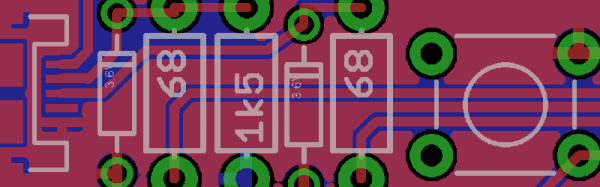
In the last (and first) post in this series, we took a look at Eagle. Specifically, we learned how to create a custom part in Eagle. Our goal isn’t just to make our own parts in Eagle, we want to make schematics, boards, and eventually solder a few PCBs.

The board we’ll be making, like all of the boards made in this Creating A PCB In Everything series, is the Nanite Wesley, a small USB development platform based on the ATtiny85. This board has less than a dozen parts, most of which are through-hole. This is the simplest PCB I can imagine that has sufficient complexity to demonstrate how to make a board.

With that said, let’s get onto the second part of our Eagle tutorial and lay out our circuit board.

Continue reading “Creating A PCB In Everything: Eagle, Part 2”

Web Bluetooth: The New Hotness And Its Dangers

Google’s most recent Chrome browser, version 53, includes trial support for Web Bluetooth, and it’s like the Wild West! JavaScript code, served to your browser, can now connect directly to your Bluetooth LE (BTLE) devices, with a whole bunch of caveats that we’ll make clear below.

On the one hand, this is awesome functionality. The browser is the most ubiquitous cross-platform operating system that the world has ever seen. You can serve a website to users running Windows, Linux, Android, iOS, or MacOS and run code on their machines without having to know if it’s a cellphone, a desktop, or a virtual machine in the Matrix. Combining this ubiquity with the ability to control Bluetooth devices is going to be fun. It’s a missing piece of the IoT puzzle.

On the other hand, it’s a security nightmare. It’s bad enough when malicious websites can extract information from files that reside on your computer, but when they connect directly to your lightbulbs, your FitBits, or your BTLE-enhanced pacemaker, it opens up new possibilities for mischief. The good news is that the developers of Web Bluetooth seem to be aware of the risks and are intent on minimizing them, but there are still real concerns. How does security come out in the balance? Read on.

Continue reading “Web Bluetooth: The New Hotness And Its Dangers”

Creating A PCB In Everything: Eagle, Part 1

For the first in a series of posts describing how to make a PCB, we’re going with Eagle. Eagle CAD has been around since the days of DOS, and has received numerous updates over the years. Until KiCad started getting good a few years ago, Eagle CAD was the de facto standard PCB design software for hobbyist projects. Sparkfun uses it, Adafruit uses it, and Dangerous Prototypes uses it. The reason for Eagle’s dominance in a market where people don’t want to pay for software is the free, non-commercial and educational licenses. These free licenses give you the ability to build a board big enough and complex enough for 90% of hobbyist projects.

Of course, it should be mentioned that Eagle was recently acquired by Autodesk. The free licenses will remain, and right now, it seems obvious Eagle will become Autodesk’s pro-level circuit and board design software.

Personally, I learned PCB design on Eagle. After a few years, I quickly learned how limited even the professional version of Eagle was. At that point, the only option was to learn KiCad. Now that Eagle is in the hands of Autodesk, and I am very confident Eagle is about to get really, really good, I no longer have the desire to learn KiCad.

With the introduction out of the way, let’s get down to making a PCB in Eagle.

Continue reading “Creating A PCB In Everything: Eagle, Part 1”