Sci-Hub: Breaking Down The Paywalls

There’s a battle going on in academia between the scientific journal publishing companies that have long served as the main platform for peer review and spreading information, and scientists themselves who just want to share and have access to the work of their fellows. arxiv.org launched the first salvo, allowing researchers in physics to self-publish their own papers, and has gained some traction in mathematics and computer science. The Public Library of Science journals focus on biology and medicine and offer peer review services. There are many others, and even the big firms have been forced to recognize the importance of open science publication.

But for many, that’s still not enough. The high prestige journals, and most past works, are stuck behind paywalls. Since 2011, Sci-Hub has taken science publishing open by force, illegally obtaining papers and publishing them in violation of copyright, but at the same time facilitating scientific research and providing researchers in poorer countries with access that their rich-world colleagues take for granted. The big publishing firms naturally fought back in court and won, and with roughly $20 million of damages, drove Sci-Hub’s founder underground.

Continue reading “Sci-Hub: Breaking Down The Paywalls”

Shushing Sonic Booms: NASA’s Supersonic X-Plane To Take Flight In 2021

The history of aviation is full of notable X-Planes, a number of which heralded in new generations of flight. The Bell X-1 became the first aircraft to break the speed of sound during level flight in 1947 with the legendary Charles “Chuck” Yeager at the controls. A few years later the X-2 would push man up to Mach 3, refining our understanding of supersonic flight. In the 1960’s, the North American built X-15 would not only take us to the edge of space, but set a world speed record which remains unbroken.

Compared to the heady post-war days when it seemed the sky was quite literally the limit, X-Planes in the modern era have become more utilitarian in nature. They are often proposed but never built, and if they do get built, the trend has been towards unmanned subscale vehicles due to their lower cost and risk. The few full-scale piloted X-Planes of the 21st century have largely been prototypes for new military fighter jets rather than scientific research aircraft.

But thanks to a commitment from NASA, the Lockheed Martin X-59 might finally break that trend and become another historic vehicle worthy of the X-Plane lineage. Construction has already begun on the X-59, and the program has recently passed a rigorous design and timeline overview by NASA officials which confirmed the agency’s intent to financially and logistically support the development of the aircraft through their Low Boom Flight Demonstrator initiative. If successful, the X-59 will not only help refine the technology for the next generation of commercial supersonic aircraft, but potentially help change the laws which have prevented such aircraft from operating over land in the United States since 1973.

Continue reading “Shushing Sonic Booms: NASA’s Supersonic X-Plane To Take Flight In 2021”

Five Year Old Bug Spawns Router Botnet Monster

In the news has been yet another router botnet. [Hui Wang] and [RootKiter] of 360Netlab announced their discovery of what they call the “BCMUPnP_Hunter” rootkit. They estimate this botnet to be running on over 100,000 routers worldwide.

There are two elements of this story that I found particularly baffling. First, this botnet infects routers using a vulnerability that was first reported by Defensecode over five years ago, in 2013! The second oddity is the wide range of devices that are vulnerable and are now part of the botnet. Dozens of brands and at least 116 models have been found to be infected.

One of the details of this story hasn’t been reported entirely accurately. The bug is not built into the Broadcom chipset. Unlike Spectre and Meltdown, it’s not actually a hardware fault. Broadcom distributes a Software Development Kit (SDK) that enables device manufacturers like D-Link, TP-Link, and Linksys to quickly develop firmware for routers using Broadcom chips. The vulnerability lies in this code, rather than part of the hardware itself.

Continue reading “Five Year Old Bug Spawns Router Botnet Monster”

Creating Black Holes: Division By Zero In Practice

Dividing by zero — the fundamental no-can-do of arithmetic. It is somewhat surrounded by mystery, and is a constant source for internet humor, whether it involves exploding microcontrollers, the collapse of the universe, or crashing your own world by having Siri tell you that you have no friends.

It’s also one of the few things gcc will warn you about by default, which caused a rather vivid discussion with interesting insights when I recently wrote about compiler warnings. And if you’re running a modern operating system, it might even send you a signal that something’s gone wrong and let you handle it in your code. Dividing by zero is more than theoretical, and serves as a great introduction to signals, so let’s have a closer look at it.

Chances are, the first time you heard about division itself back in elementary school, it was taught that dividing by zero is strictly forbidden — and obviously you didn’t want your teacher call the cops on you, so you obeyed and refrained from it. But as with many other things in life, the older you get, the less restrictive they become, and dividing by zero eventually turned from forbidden into simply being impossible and yielding an undefined result.

And indeed, if a = b/0, it would mean in reverse that a×0 = b. If b itself was zero, the equation would be true for every single number there is, making it impossible to define a concrete value for a. And if b was any other value, no single value multiplied by zero could result in anything non-zero. Once we move into the realms of calculus, we will learn that infinity appears to be the answer, but that’s in the end just replacing one abstract, mind-boggling concept with another one. And it won’t answer one question: how does all this play out in a processor? Continue reading “Creating Black Holes: Division By Zero In Practice”

Flagging Down Aliens With World’s Biggest Laser Pointer

As you’re no doubt aware, humans are a rather noisy species. Not just audibly, like in the case of somebody talking loudly when you’re in a movie theater, but also electromagnetically. All of our wireless transmissions since Marconi made his first spark gap broadcast in 1895 have radiated out into space, and anyone who’s got a sensitive enough ear pointed into our little corner of the Milky Way should have no trouble hearing us. Even if these extraterrestrial eavesdroppers wouldn’t be able to understand the content of our transmissions, the sheer volume of them would be enough to indicate that whatever is making all that noise on the third rock orbiting Sol can’t be a natural phenomena. In other words, one of the best ways to find intelligent life in the galaxy may just be to sit around and wait for them to hear us.

Of course, there’s some pesky physics involved that makes it a bit more complicated. Signals radiate from the Earth at the speed of light, which is like a brisk walk in interstellar terms. Depending on where these hypothetical listeners are located, the delay between when we broadcast something and when they receive it can be immense. For example, any intelligent beings that might be listening in on us from the closest known star, Proxima Centauri, are only just now being utterly disappointed by the finale for “How I Met Your Mother“. Comparatively, “Dallas” fans from Zeta Reticuli are still on the edge of their seats waiting to find out who shot J.R.

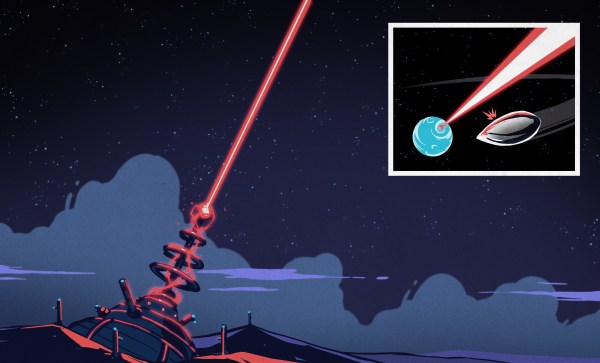
But rather than relying on our normal broadcasts to do the talking for us, a recent paper in The Astrophysical Journal makes the case that we should go one better. Written by James R. Clark and Kerri Cahoy,  “Optical Detection of Lasers with Near-term Technology at Interstellar Distances” makes the case that we could use current or near-term laser technology to broadcast a highly directional beacon to potentially life-harboring star systems. What’s more, it even theorizes it would be possible to establish direct communications with an alien intelligence simply by modulating the beam.

Continue reading “Flagging Down Aliens With World’s Biggest Laser Pointer”

How The Xbox Was Hacked

The millennium: a term that few had any use for before 1999, yet seemingly overnight it was everywhere. The turning of the millenium permeated every facet of pop culture. Unconventional popstars like Moby supplied electronica to the mainstream airwaves while audiences contemplated whether computers were the true enemy after seeing The Matrix. We were torn between anxiety — the impending Y2K bug bringing the end of civilization that Prince prophesied — and anticipation: the forthcoming release of the PlayStation 2.

Sony was poised to take control of the videogame console market once again. They had already sold more units of the original PlayStation than all of their competition combined. Their heavy cloud of influence over gamers meant that the next generation of games wasn’t going to start in until the PS2 was on store shelves. On the tail of Sony announcing the technical specs on their machine, rumors of a new competitor entering the “console wars” began to spread. That new competitor was Microsoft, an American company playing in a Japanese company’s game.
Continue reading “How The Xbox Was Hacked”

Supercon: Designing Your Own Diffractive Optics

Kelly Peng is an electrical and optical engineer, and founder of Kura AR. She’s built a fusion reactor, a Raman spectrometer, a DIY structured light camera, a linear particle accelerator, and emotional classifiers for likes and dislikes. In short, we have someone who can do anything, and she came in to talk about one of the dark arts (pun obviously intended): optics.

The entire idea of Kura AR is to build an immersive augmented reality experience, and when it comes to AR glasses, there are two ways of doing it. You could go the Google Glass route and use a small OLED and lenses, but these displays aren’t very bright. Alternatively, you could use a diffractive waveguide, like the Hololens. This is a lot more difficult to manufacture, but the payoff will be a much larger field of view and a much more immersive experience.

Continue reading “Supercon: Designing Your Own Diffractive Optics”