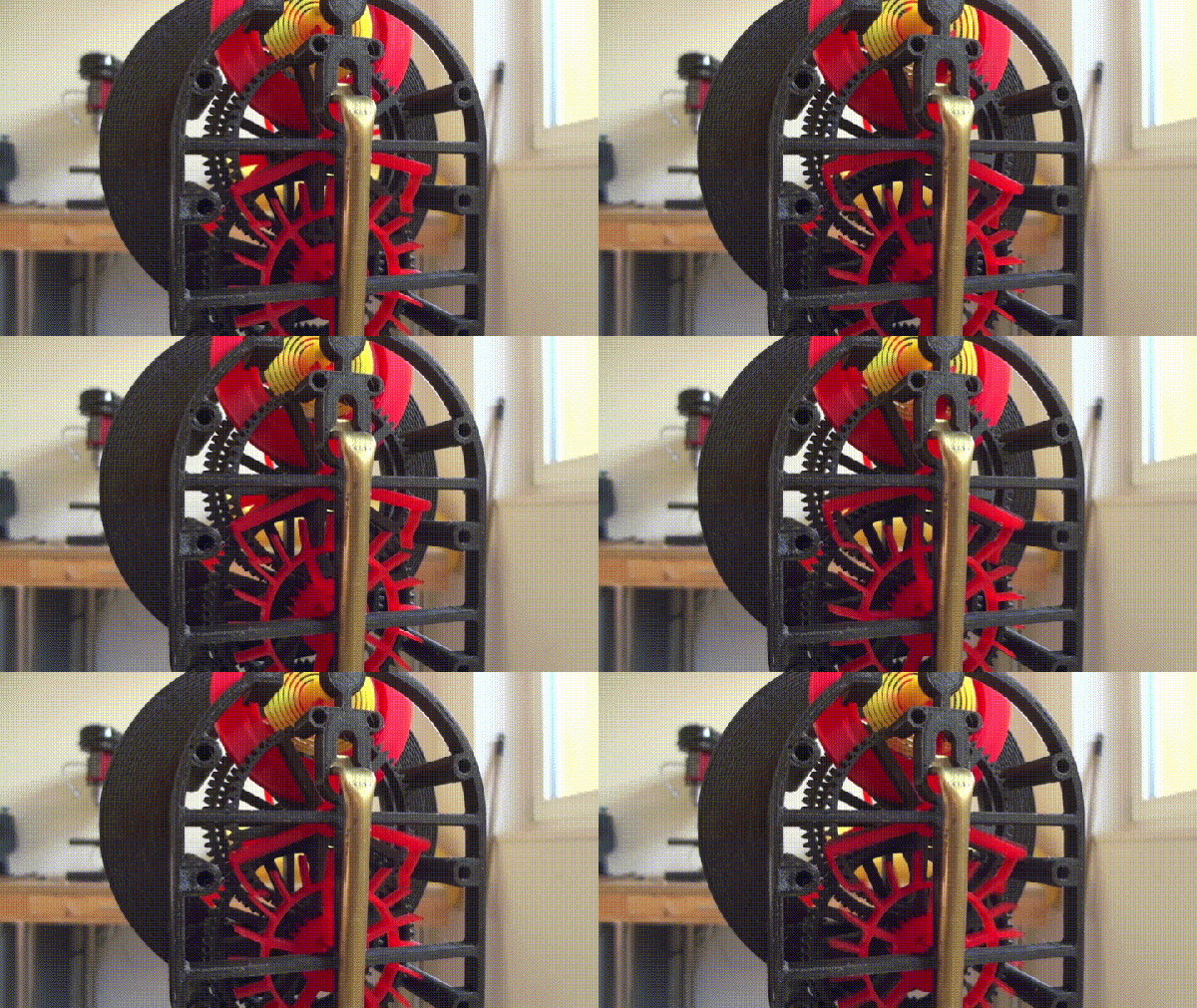
Two-Stage Tentacle Mechanisms Part II: The Cable Controller

A few weeks back, we got a taste for two-stage tentacle mechanisms. It’s a look at how to make a seemily complicated mechanism a lot less mysterious. This week, we’ll take a close look at one (of many) methods for puppeteering these beasts by hand. Best of all, it’s a method you can assemble at home!

Without a control scheme, our homebrew tentacle can only “squirm around” about as much as an overcooked noodle. It’s pretty useless without some sort of control mechanism to keep all the cables in check at proper tension. Since the tentacle’s motion is driven by nothing more than four cable pairs, it’s not too difficult to start imagining a few hobby servos and pulleys doing the job. To get us started, though, I’ve opted for hand controllers just like the puppeteers of the film industry.

Enter Manual Control

Hand controllers? Of all the possibilities offered by electronics, why select such an electronics-devoid caveman approach? Fear not. Hand controllers offer us a unique set of opportunities that aren’t easy to achieve with most alternatives.

Continue reading “Two-Stage Tentacle Mechanisms Part II: The Cable Controller”

Win Loot With The Enlightened Raspberry Pi Contest

Have an awesome Raspberry Pi project in mind (or maybe sitting on your bench right now)? Show it off for the Enlightened Raspberry Pi contest and you can score some excellent loot.

The Raspberry Pi has changed the face of experimental computers. These little $35 Linux powered boards can do incredible things. An active community has sprung up around the Pi. With it have come thousands of projects published on the web, in books, and in magazines. Many of the best Raspberry Pi projects are seen right here on Hackaday and published on Hackaday.io, which boasts over 1000 user created Pi powered projects (yes, we counted). Show us how you pull off those projects and you’ll be eligible to win.

Prizes and Judges

One thing we’d like to see more are really well documented projects — showing off everything anyone with an average skill set needs to perform the cool hack themselves. Do that and you’re well on your way to claiming one of eight great prizes! The grand prize winner gets a Pi-top Raspberry Pi laptop. First prize is the new Pi-top Ceed all in one. Second place is a 32×32 RGB Matrix kit. And the list goes on.

Submit your entry as a project on Hackaday.io and use the “Submit Project To…” option on the left sidebar of your project page to add it to the Enlightened Raspberry Pi contest. When entries close on November 9th, the Hackaday Staff will begin judging, bringing in some help to choose the top winners. This help comes in the form of a few VIP judges!

[Alvaro Prieto] is a Firmware/Electrical engineer who works on electronics for work and for fun. He previously worked at TI, Apple, and Planet. You’ve seen him hacking micro quadcopters, and as a presenter at the 2015 Hackaday SuperCon,

[Matt Richardson] is a Product Evangelist for the Raspberry Pi Foundation and the co-author of Getting Started with Raspberry Pi. We’ve seen [Matt] building heads up displays for bicycles, and removing celebrity gossip from our TV’s.

[Ken Shirriff] writes a popular blog (righto.com) on reverse engineering everything from chargers to microprocessors. Ken was formerly a programmer at Google and has a PhD in computer science from UC Berkeley. We’ve covered his microprocessor work as well as his teardowns of knockoff laptop chargers.

It’s All in the Details:

Entries are open now, show us the details that make great Raspberry Pi projects happen! The full rules can be found on the Enlightened Raspberry Pi Contest page. Fire up your soldering irons, warm up your 3D printers, and load up your favorite code editor. It’s time to start hacking!

enlightenpi

How To Get Started With The ESP32

ESP32 is the hottest new wireless chip out there, offering both WiFi and Bluetooth Low Energy radios rolled up with a dual-core 32-bit processor and packed with peripherals of every kind. We got some review sample dev boards, Adafruit and Seeed Studio had them in stock for a while, and AI-Thinker — the company that makes the most popular ESP8266 modules — is starting up full-scale production on October 1st. This means that some of you have the new hotness in your hands right now, and the rest of you aren’t going to have to wait more than a few more weeks.

As we said in our first-look review of the new chip, many things are in a state of flux on the software side, but the basic process of writing, compiling, and flashing code to the chip is going to remain stable. It’s time to start up some tutorials!

Continue reading “How To Get Started With The ESP32”

Everything You’ll Find At The SuperConference

The 2016 Hackaday SuperConference is the ultimate hardware con. It will take place on November 5+6, 2016 in Pasadena, California. SuperCon is about hardware creation — everything at this conference is geared toward sharing the knowledge, excitement, experience, and motivations that go into building cutting edge electronics.

We offer you 48 hours packed with 21 talks, 5 workshops, lightning talks, 4 meals, the Hackaday Prize party, a hardware badge hacking competition, a crypto challenge, and a most excellent village of hackers to enjoy it with. For one weekend Pasadena will be the hardware center of the universe. Get your ticket to the Hackaday SuperConference now.

Want to know more? The full list of talks, works, and details about everything else is found below. We do anticipate adding to this massive list of talks and workshops as we receive final confirmation from the presenters not yet listed.

Continue reading “Everything You’ll Find At The SuperConference”

The Fastest Rise Time In The West: Making A Truly Quick Pulse Edge

When we are taught about oscillators as newbie engineers, we are shown a variety of waveforms on an oscilloscope or in a textbook. This is a sine wave, they say, this is a sawtooth, this is a square wave, and so on. We’re taught to look at the lines on the screen as idealised, a square wave is truly square, and the transition from low to high voltage and back again is instantaneous.

In most cases this assumption is harmless. If we look into the subject a little deeper we learn that what seemed an instantaneous cliff-face is in fact a very steep slope, but when a circuit does its business in milliseconds there is usually no harm in ignoring a transition time measured in nanoseconds. The glue logic for your Arduino project can take its time.

Sometimes though, the rise time of a logic transition is important. The application that prompted this article was the measurement of oscilloscope bandwidth by looking at how quickly the ‘scope catches up with a pulse that exceeds its bandwidth, for example. When the instrument can happily measure the transition times of all your usual  pulse generators, something out of the ordinary is called for. So it’s worth taking a look at the rise times you’d expect from everyday circuitry, examining a few techniques for generating rise times that are much faster.
Continue reading “The Fastest Rise Time In The West: Making A Truly Quick Pulse Edge”

3D Printering: Trinamic TMC2130 Stepper Motor Drivers

Adjust the phase current, crank up the microstepping, and forget about it — that’s what most people want out of a stepper motor driver IC. Although they power most of our CNC machines and 3D printers, as monolithic solutions to “make it spin”, we don’t often pay much attention to them.

In this article, I’ll be looking at the Trinamic TMC2130 stepper motor driver, one that comes with more bells and whistles than you might ever need. On the one hand, this driver can be configured through its SPI interface to suit virtually any application that employs a stepper motor. On the other hand, you can also write directly to the coil current registers and expand the scope of applicability far beyond motors.

Continue reading “3D Printering: Trinamic TMC2130 Stepper Motor Drivers”

Distributed Censorship Or Extortion? The IoT Vs Brian Krebs

Now it’s official. The particular website that was hit by a record-breaking distributed denial of service (DDOS) attack that we covered a few days ago was that of white-hat security journalist [Brian Krebs]: Krebs on Security.

During the DDOS attack, his site got 600 Gigabits per second of traffic. It didn’t involve amplification or reflection attacks, but rather a distributed network of zombie domestic appliances: routers, IP webcams, and digital video recorders (DVRs). All they did was create HTTP requests for his site, but there were well in excess of 100,000 of these bots.

In the end, [Krebs’] ISP, Akamai, had to drop him. He was getting pro bono service from them to start with, and while they’ve defended him against DDOS attacks in the past, it was costing them too much to continue in this case. An Akamai exec estimates it would have cost them millions to continue defending, and [Brian] doesn’t blame them. But when Akamai dropped the shields, his hosting provider would get slammed. [Krebs] told Akamai to redirect his domain to localhost and then he went dark.

Continue reading “Distributed Censorship Or Extortion? The IoT Vs Brian Krebs”