The SD card first burst onto the scene in 1999, with cards boasting storage capacities up to 64 MB hitting store shelves in the first quarter of 2000. Over the years, sizes slowly crept up as our thirst for more storage continued to grow. Fast forward to today, and the biggest microSD cards pack up to a whopping 1 TB into a package smaller than the average postage stamp.
However, getting to this point has required many subtle changes over the years. This can cause havoc for users trying to use the latest cards in older devices. To find out why, we need to take a look under the hood at how SD cards deal with storage capacity. Continue reading “Size Does Matter When It Comes To SD Cards”→
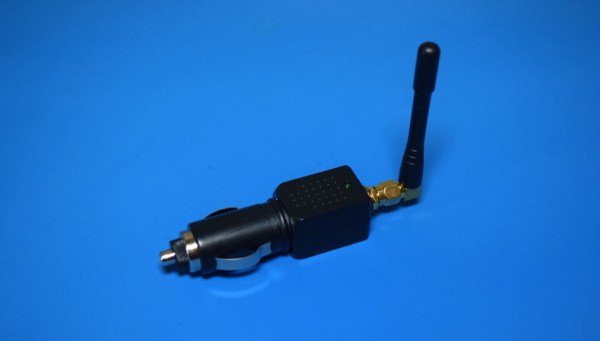
If you spend enough time trolling eBay for interesting electronic devices to take apart, you’re bound to start seeing suggestions for some questionable gadgets. Which is how I recently became aware of these tiny GPS jammers that plug directly into an automotive 12 V outlet. Shipped to your door for under $10 USD, it seemed like a perfect device to rip open in the name of science.
Now, you might be wondering what legitimate uses such a device might have. Well, as far as I’m aware, there aren’t any. The only reason you’d want to jam GPS signals in and around a vehicle is if you’re trying to get away with something you shouldn’t be doing. Maybe you’re out driving a tracked company car and want to enjoy a quick two hour nap in a parking lot, or perhaps you’re looking to disable the integrated GPS on the car you just stole long enough for you to take it to the chop shop. You know, as one does.
But we won’t dwell on the potentially nefarious reasons that this device exists. Hackers have never been too choosy about the devices they investigate and experiment with, and there’s no reason we should start now. Instead, let’s take this piece of gray-area hardware for a test drive and see what makes it tick.
The Earth’s oceans are a vast frontier that brims with possibilities for the future of medicine, ocean conservation, and food production. They remain largely unexplored because of the physical limits of scuba diving. Humans can only dive for a few hours each day, and every minute spent breathing compressed air at depth must be paid for with a slower ascent to the surface. Otherwise, divers could develop decompression sickness from nitrogen expanding in the bloodstream.
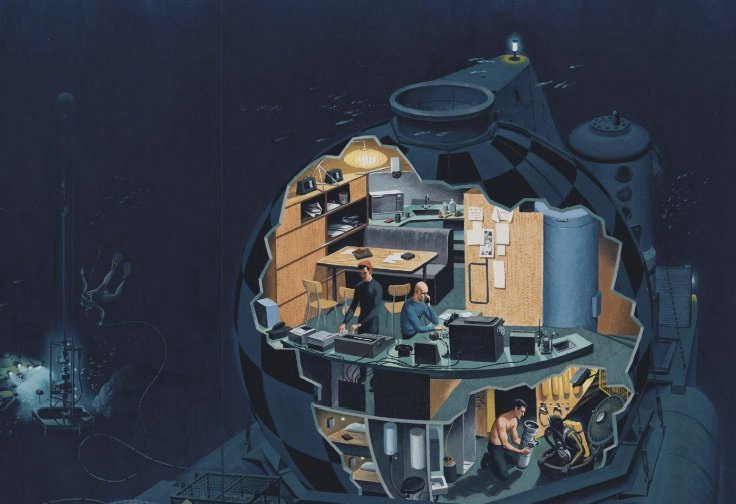
An illustration of the Conshelf 3 habitat. Image via Medium
In the 1960s, world-famous oceanographer Jacques Cousteau built a series of small underwater habitats to extend the time that he and other researchers were able to work. These sea labs were tethered to a support ship with a cable that provided air and power.
Cousteau’s first sea lab, Conshelf 1 (Continental Shelf Station) held two people and was stationed 33 feet deep off the coast of Marseilles, France. Conshelf 2 sheltered six people and spent a total of six weeks under the Red Sea at two different depths.
Conshelf 3 was Cousteau’s most ambitious habitat design, because it was nearly self-sufficient compared to the first two. It accommodated six divers for three weeks at a time and sat 336 feet deep off the coast of France, near Nice. Conshelf 3 was built in partnership with a French petrochemical company to study the viability of stationing humans for underwater oil drilling (before we had robots for that), and included a mock oil rig on the nearby ocean floor for exercises.
Several underwater habitats have come and gone in the years since the Conshelf series, but each has been built for a specific research project or group of tasks. There’s never really been a permanent habitat established for general research into the biochemistry of the ocean.
The news was recently abuzz with stories of how the Mars 2020 mission, which launched from Cape Canaveral at the end of July, had done something that no other spacecraft had done before: it had successfully charged the batteries aboard a tiny helicopter that is hitching a ride in the belly of the Mars 2020 rover, Perseverance.
Although the helicopter, aptly named Ingenuity, is only a technology demonstrator, and flight operations will occupy but a small fraction of the time Mars 2020 is devoting to its science missions, it has still understandably captured the popular imagination. This will be humanity’s first attempt at controlled, powered flight on another planet, after all, and that alone is enough to spur intense interest in what amounts to a side-project for NASA. So here’s a closer look at Ingenuity, and what it takes to build a helicopter that will explore another world.
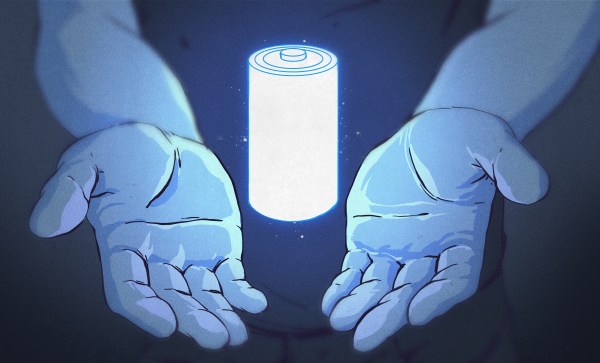
Lithium ion batteries have been a revolutionary technology. Their high energy and power density has made the electric car a practical reality, enabled grid storage for renewable energy, and put powerful computers in the palm of the hand. However, if there’s one thing humanity is known for, it’s always wanting more.
Potential contenders for the title of ultimate battery technology are out there, but it will take a major shift to dethrone lithium-ion from the top of the tree.
A heat wave spreading across a large portion of the west coast of the United States is not surprising for this time of year, but the frequency and severity of these heat waves have been getting worse in recent years as the side effects from climate change become more obvious. In response to this, the grid operators in California have instituted limited rolling blackouts as electricity demand ramps up.
This isn’t California’s first run-in with elective blackouts, either. The electrical grid in California is particularly prone to issues like this, both from engineering issues and from other less obvious problems as well.
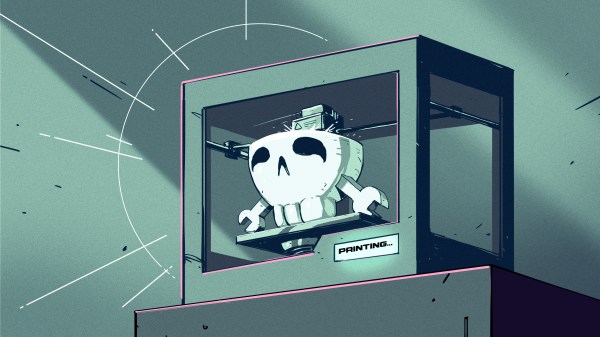
This week our own [Donald Papp] wrote a thought-provoking piece on buying and selling 3D-printer models. His basic point: if you don’t know what you’re getting until you’ve purchased it, and there’s no refund policy, how can you tell if your money is being well spent? It’s a serious problem for these nascent markets, because when customers aren’t satisfied they won’t come back.
It got me thinking about my own experience, albeit with all of the free 3D models out there. They are a supremely mixed bag, and even though you’re not paying for the model, you’re paying in printing time, filament, and effort. It pays to be choosy, and all of [Donald]’s suggestions hold in the “free” market as well.
Only download models that have been printed at least once, have decent documentation about things like layer height, filament type, and support, and to the best of your abilities, be critical about the ability to fabricate the part at all. Fused-deposition printers can only print on top of previous layers, and have a distinct grain, so you need to watch out for overhangs and print orientation. With resin printers, you need to be careful about trapped volumes of uncured resin. You want to be sure that the modeler at least took these considerations into account.
But when your parts have strength requirements, fits, and tolerances, it gets even worse. There’s almost no way a designer can know if you’re overextruding on your first layers or not. Different slicers handle corners differently, making inner surfaces shrink to varying degrees. How can the designer work around your particular situation?
My personal answer is open-source. Whenever possible, I prefer models in OpenSCAD. If you download an STL with ten M8 bolt holes, you could widen them all in a modeling program, but if you’ve got the source code, it’s as easy as changing a single variable. Using the source plays to the customizability of 3D printing, which is perhaps its strongest suit, in my mind. Nobody knows exactly how thick your desk is but you, after all. Making a headphone hook that’s customizable is key.
So even if the markets for 3D prints can solve the reliability problems, through customer reviews or requirements of extensive documentation, they’ll never be able to solve the one-size-fits-nobody issue. Open source fixes this easily. Sell me the source, not the STL!
This article is part of the Hackaday.com newsletter, delivered every seven days for each of the last 200+ weeks. It also includes our favorite articles from the last seven days that you can see on the web version of the newsletter.
Want this type of article to hit your inbox every Friday morning? You should sign up!