Hackaday Links Column Banner

Hackaday Links: July 19, 2020

Care to flex your ethical hacker muscles? The Defense Advanced Research Projects Agency, better known as DARPA, is running its first-ever bug-bounty program. The event is called “Finding Exploits to Thwart Tampering”, or FETT — get it? Bounty hunter? Fett? — and is designed to stress-test security hardware developed through DARPA’s System Security Integration Through Hardware and Firmware, or SSITH. Tortured backronyms and pop culture references aside, FETT will start this month and go through September. This is not an open challenge per se; rather, the Red Team will be coordinated by crowdsourced security research company Synack, who has called for security researchers to sign on.

The Linux kernel development team has decided to join the trend away from insensitive terminology like “master/slave” and “blacklist/whitelist” in coding style. A July 4 proposal by kernel maintainer Dan Williams goes into some detail on the logic of making the change, and it’s quite convincing stuff. It’s hard to argue with the fact that code reviewers can easily be distracted by coding style changes, so replacing terms that have become lightning rods only makes sense. Linus himself has signed off on the changes for all future code; the current terminology will only be allowed for purposes of maintaining older code.

Some stories just leap off the screen when you’re scanning headlines, and a story with the term “narco-antennas” practically begs further investigation. It turns out that the drug cartels in Mexico (and probably elsewhere, but the story focused on Mexico) are quite sophisticated in terms of communications technology. Eschewing cell phones for some of their communication needs for obvious reasons, they still apparently leverage the cell system by installing their own transceivers at cell sites. This can lead to some tense moments for the engineers who maintain legitimate gear at these sites; the story above recounts one hapless tech who powered down a site to make some repairs only to be confronted by armed men upset about the loss of their radios. It’s a fascinating look at the underworld and their technology, and we can’t help but feel for the men and women who have to face down these criminals just to do their jobs.

Way back in January — remember January? — we kicked off the 2020 Hack Chat series with a fellow named Alberto Caballero, principal investigator of the Habitable Exoplanet Hunting Project. At the time, I was blown away by the fact that the tiny changes in intensity caused by planets transiting across their star’s face were detectable on Earth with instruments an amateur astronomer could easily afford. And now, the project’s crowdsourced planet hunters have hit pay dirt, with the discovery of a Saturn-sized exoplanet in orbit within the habitable zone around star GJ 3470, also known as Gliese 3470, a red dwarf about 30 parsecs away in the constellation Cancer. Their paper is still in preprint and hasn’t been peer-reviewed yet, but it’s exciting to see this kind of citizen science being done, and we’d like to congratulate the team on their achievement and wish them continued luck in their search for “Earth 2.0”

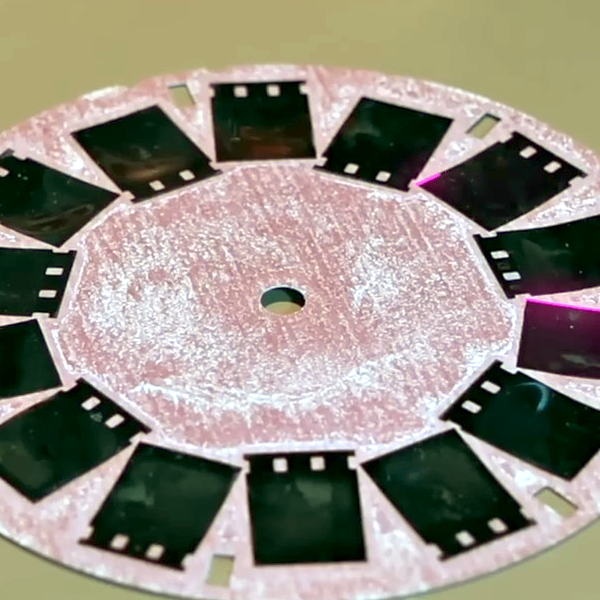
And finally, if you can’t stand the idea that future archaeologists may someday pore over your code in an attempt to understand the digital lives of their long-dead forebears, then you might want to skip this story about how GitHub shipped 21 terabytes of open-source code to cold storage. The destination for the data, contained on reels of archive film and shipped on two pallets, is the world’s long-term memory: the Artic World Archive on the island of Svalbard. Perhaps better known for the Svalbard Seed Vault, where the genetic diversity of the world’s plants is stored, the Artic Code Vault is in a nearby abandoned coal mine and set deep within the permafrost. The rationale for making the effort to preserve code makes for some interesting reading, but we can’t help but feel that like the graffitists of Pompeii, if we’d known someone would be reading this stuff in a thousand years, we might have edited out a few things.


The Sincerest Form Of Flattery

In the art world, it’s often wistfully said that imitation is the sincerest form of flattery. In the open-source hardware world, this flattery takes the shape of finding your open-source project mass produced in China and sold at outrageously low markups. Looking around on my lab, I’ve been the direct beneficiary of this success.

I see an AVR Transistor Tester that I picked up for a few bucks a long time ago. Lacking anything better, it’s my go-to device for measuring inductance and capacitor ESR. For $7, it is worth much more than I paid for it, due to some clever design work by a community of German hackers and the economics of mass production. They’re so cheap that we’ve seen people re-use them just for the displays and with a little modification, turned them into Tetris consoles. That’s too cool. Continue reading “The Sincerest Form Of Flattery”

Modern Radio Receiver Architecture: From Regenerative To Direct Conversion

Modern radio receivers have a distinct advantage over the common early designs which I covered in my previous article. Most of the receivers you will have worked with over the past couple decades are designs by Edwin Armstrong; regenerative, superregenerative, or most commonly superheterodyne. These are distinguished by a few fascinating key traits that bring both benefits and drawbacks.

Today let’s dive into Mr. Armstrong’s receivers. I’ll also talk about DC receivers which, despite the name, are not made to listen to batteries. These are receivers you are much more likely to encounter in modern equipment.

Regenerative and Superregenerative

The regenerative receiver is all about doing more with less. You still see some of these in simple applications like RF remote controls. The idea derives from how an oscillator works. In a simple way of thinking, an oscillator is an amplifier with enough positive feedback that any tiny signal at the right frequency will amplify and then, through feedback, continue to output over and over. If everything were perfect, then, an oscillator would have infinite gain at a given frequency.

Continue reading “Modern Radio Receiver Architecture: From Regenerative To Direct Conversion”

Hackaday Podcast 076: Grinding Compression Screws, Scratching PCBs, And Melting Foam

Hackaday editors Elliot Williams and Mike Szczys are enamored by this week’s fabrication hacks. There’s a PCB mill that isolates traces by scratching rather than cutting. You won’t believe how awesome this angle-cutter jig is at creating tapered augers for injection molding/extruding plastic. And you may not need an interactive way to cut foam, but the art from the cut pieces is more than a mere shadow of excellence. Plus we gab about a clever rotary encoder circuit, which IDE is the least frustrating, and the go-to tools for hard drive recovery.

Take a look at the links below if you want to follow along, and as always, tell us what you think about this episode in the comments!

Take a look at the links below if you want to follow along, and as always, tell us what you think about this episode in the comments!

Direct download (60 MB or so.)

Continue reading “Hackaday Podcast 076: Grinding Compression Screws, Scratching PCBs, And Melting Foam”

This Week In Security: Twitter, Windows DNS, SAP RECON

Twitter just had their biggest security breach in years. Mike warned us about it on Wednesday, but it’s worth revisiting a few of the details. The story is still developing, but it appears that malicious actors used social engineering to access an internal Twitter dashboard. This dashboard, among other interesting things, allows directly changing the email address associated with an account. Once the address is changed to the attacker’s, it’s simple to do a password reset and gain access.

The bitcoin address used in the crypto scam ended up receiving nearly $120,000 USD worth of bitcoin, all of which has been shuffled off into different accounts. It’s an old and simple scam, but was apparently rather believable because the messages were posted by verified Twitter accounts.

Screenshot from Motherboard

A series of screenshots have been posted, claiming to be the internal Twitter dashboard used in the attack. More than a few eyebrows have been raised, as a result of that dashboard. First off, the fact that Twitter employees can directly change an account’s email address is asking for trouble. Even more interesting are the tags that can be added to an account. “Trends Blacklist” and “Search Blacklist” do call to mind the rumors of shadow-banning, but at this point it’s impossible to know the details. Motherboard is reporting that Twitter is removing that screenshot across the board when it’s posted, and even suspending accounts that post it. Of course, they’d do that if it were faked as well, so who knows? Continue reading “This Week In Security: Twitter, Windows DNS, SAP RECON”

Hyundai Makes Push Towards Fuel Cell Trucking

Hyundai has begun shipping fuel-cell based heavy duty trucks to face off against battery-electric trucks in the commercial hauling market.

Battery electric vehicles, more commonly known as electric cars, have finally begun to take on the world in real numbers. However, they’re not the only game in town when it comes to green transportation. Fuel cells that use tanks of hydrogen to generate electricity with H2O as the main byproduct have long promised to take the pollution out of getting around, without the frustrating charge times. Thus far though, they’ve failed to make a major impact. Hyundai still think there’s value in the idea, however, and have developed their XCIENT Fuel Cell truck to further the cause. Continue reading “Hyundai Makes Push Towards Fuel Cell Trucking”

Printed It: Print-in-Place PCB Gripper

The goal of Printed It is to showcase creations that truly embrace the possibilities offered by desktop 3D printing. The most obvious examples are designs that can be printed quickly and cheaply enough that they’re a valid alternative to commercially available products. But as previous entries into the series have shown, there are also technical considerations. Is it simply a duplicate of something that could be produced via traditional means, or does the design really benefit from the unique nature of 3D printing?

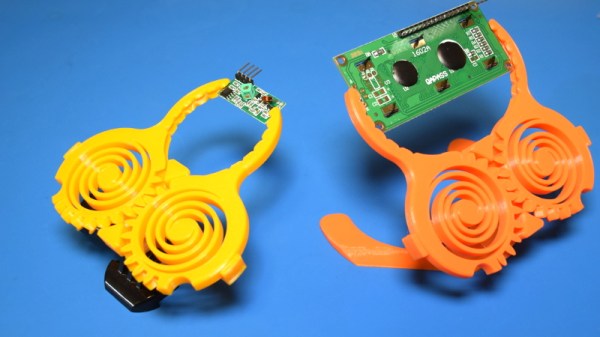
A perfect example is the Print-in-Place PCB Holder/Gripper created by SunShine. This design is able to hold onto PCBs (or really, whatever you wish) without any additional components. Just pull it off the bed, and put it to work. While having to add a rubber band or generic spring would hardly be an inconvenience, there’s always something to be said for a design that’s truly 100% printable.

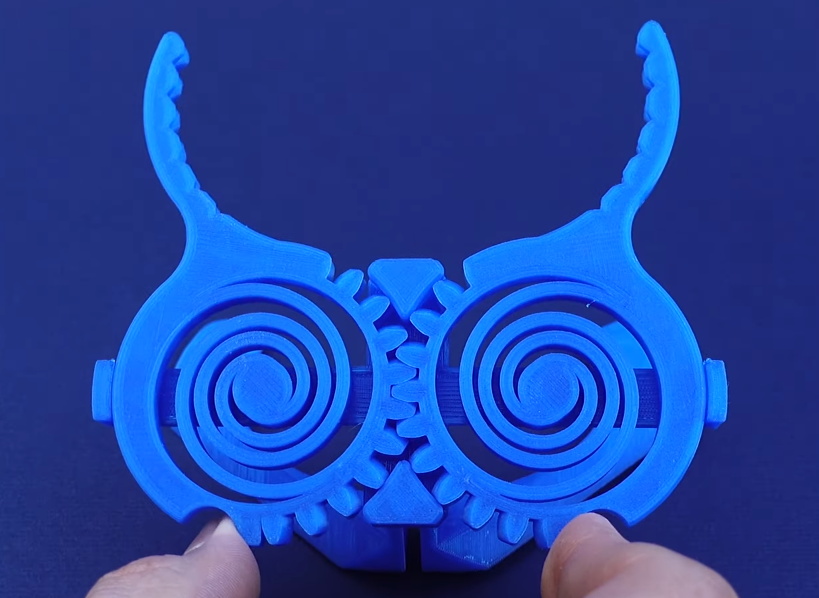
The secret is the dual flat spiral springs integrated into the device’s jaws. While most of the common thermoplastics used in desktop 3D printing are relatively stiff, the springs have been designed in such a way that they can be printed in standard PLA. The backside of the jaws have teeth that mesh together, so the energy of the springs is combined to provide a clamping force. Serrations have been added to the jaws to catch the edge of the PCB and help stabilize it.

Visually, it’s certainly striking. The design largely eschews right angles, giving it an almost biological appearance. Many have compared it to the head of a mantis, or perhaps some piece of alien technology.

There’s no question that the design leverages the strengths of 3D printing either; there’s no other way to produce its intricate interlocking components, especially without the use of any sort of fasteners. In short, this design is an ideal candidate for Printed It. But there’s still one question to answer: does it actually work?

Continue reading “Printed It: Print-in-Place PCB Gripper”