Big Slew Bearings Can Be 3D Printed

Consider the humble ball bearing. Ubiquitous, useful, and presently annoying teachers the world over in the form of fidget spinners. One thing ball bearings aren’t is easily 3D printed. It’s hard to print a good sphere, but that doesn’t mean you can’t print your own slew bearings for fun and profit.

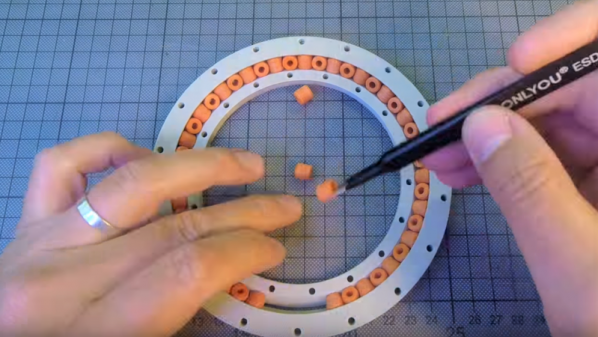
As [Christoph Laimer] explains, slew bearings consist of a series of cylindrical rollers alternately arranged at 90° angles around an inner and outer race, and are therefore more approachable to 3D printing. Slew bearings often find application in large, slowly rotating applications like crane platforms or the bearings between a wind turbine nacelle and tower. In the video below, [Christoph] walks us through his parametric design in Fusion 360; for those of us not well-versed in the app, it looks a little like magic. Thankfully he has provided both the CAD files and a selection of STLs for different size bearings.

[Christoph] is no stranger to complex 3D-printable designs, like his recent brushless DC motor or an older clock build. The clock is cool, but the bearings and motors really get us — we’ll need such designs to get to self-replicating machines.

Continue reading “Big Slew Bearings Can Be 3D Printed”

Electronics That Can Handle The Pressure

Deep-sea exploration is considered as a relatively new area of research and the electronics involved has to be special in order to survive some of the deepest parts of the ocean. Pressure Tolerant Electronics is a new subject and has its own challenges as explained by [Nic Bingham] of the Schmidt Ocean Institute.

[Nic Bingham] was one of the speakers at the Supplyframe office for ‘The Hardware Developers Didactic Galactic’ held April 20th 2017. His talks was based on his experience with ambient-pressure electronics and autonomous solar-diesel power plants at the Antarctic plateau. Due to high pressures at large depths, the selection of components becomes critical. Low density components such as electrolytic capacitors have either air or fluids which are susceptible to compression under water and prone to damage. Since pressure tolerance is not part of most datasheet figures, component selection becomes difficult and subject to prior testing.

There are other challenges as well as [Nic Bingham] explains that revolve around the procurement of special parts as well as spare for older components. In his whitepaper, [Nic Bingham] chalks out everything from the development process to different testing methodologies and even component selection for such applications.

A video of his talk is worth a watch along with the nice writeup by [Chris Gammell] on his first hand experience of the lecture. For those who are looking for something on a budget, the underwater glider project is a good start. Continue reading “Electronics That Can Handle The Pressure”

Helix Display Brings Snake Into Three Dimensions

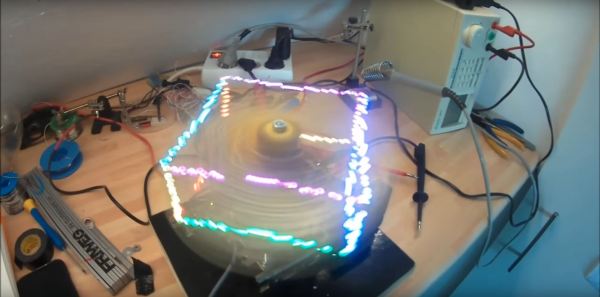
Any time anyone finds a cool way to display in 3D — is there an uncool way? — we’re on board. Instructables user [Gelstronic]’s method involves an array of spinning props to play the game Snake in 3D.

The helix display consists of twelve props, precisely spaced and angled using 3D-printed parts, each with twelve individually addressable LEDs. Four control groups of 36 LEDs are controlled by the P8XBlade2 propeller microcontroller, and the resultant 17280 voxels per rotation are plenty to produce an identifiable image.

In order to power the LEDs, [Gelstronic] used wireless charging coils normally used for cell phones, transferring 10 W of power to the helix array.  A brushless motor keeps things spinning, while an Arduino controls speed and position via an encoder. All the links to the code used are found on the project page, but we have the video of the display in action is after the break.

Continue reading “Helix Display Brings Snake Into Three Dimensions”

Mitosis: Anatomy Of A Custom Keyboard

Ergonomic. Wireless. Low-latency. Minimalist. Efficient. How far do you go when you design your own open-source keyboard? Checking off these boxes and providing the means for others to do so, Redditor [reverse_bias] presents the Mitosis keyboard, and this thing is cool.

The custom, split– as the namesake implies — mechanical keyboard has 23 keys on each 10 cm x 10 cm half, and, naturally, a custom keymapping for optimal personal use.

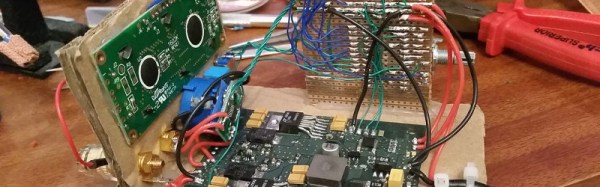
Upper and lower PCBs host the keys and electronic circuits respectively, contributing to the sleek finished look. Key caps and mechanical switches were ripped from sacrificial boards: two Waveshare core51822 Bluetooth modules are used for communication, with a third module paired with a Pro Micro make up the receiver. Continue reading “Mitosis: Anatomy Of A Custom Keyboard”

Impression Products V. Lexmark International: A Victory For Common Sense

A few months ago we reported on a case coming before the United States Supreme Court that concerned recycled printer cartridges. Battling it out were Impression Products, a printer cartridge recycling company, and Lexmark, the printer manufacturer. At issue was a shrinkwrap licence on inkjet cartridges — a legal agreement deemed to have been activated by the customer opening the cartridge packaging — that tied a discounted price to a restriction on the cartridge’s reuse.

It was of concern to us because of the consequences it could have had for the rest of the hardware world, setting a potential precedent such that any piece of hardware could have conditions still attached to it when it has passed through more than one owner, without the original purchaser being aware of agreeing to any legal agreement. This would inevitably have a significant effect on the work of most Hackaday readers, and probably prohibit many of the projects we feature.

We are therefore very pleased to see that a few days ago the Supremes made their decision, and as the EFF reports, it went in favor of Impression Products, and us, the consumer.  In their words, when a patent owner:

…chooses to sell an item, that product is no longer within the limits of the monopoly and instead becomes the private individual property of the purchaser, with the rights and benefits that come along with ownership.

In other words, when you buy a printer cartridge or any other piece of hardware, it is yours to do with as you wish. Continue reading “Impression Products V. Lexmark International: A Victory For Common Sense”

Z80 Based Raspberry Pi Look-alike

Homebrew computers are the ‘in thing’ these days and the Zilog Z80 is the most popular choice for making one on your own. We have seen some pretty awesome builds but [Martin K]’s Z-berry is the smallest on record yet. As the name suggests, the retrocomputer conforms to the Raspberry Pi form factor which includes the GPIO header.

The Z-berry is designed with a Z80 CPU running at 10 MHz (20 MHz possible) and comes with 32 kB ROM
and 512 kB RAM. In addition to the serial interface, the computer boasts an I2C bus, an SPI bus, and a PS/2 keyboard connector to boot. [Martin K] has a video where the finished system is enclosed in a Raspberry Pi case and has an I2C OLED display attached and working.

[Martin K] has posted a lot of details on how to make your own Z-berry which includes the BOM, schematic and preliminary information. We reached out to him to find out more about the software which is stable and available on request along with PCBs and sample code. Additionally, this project promises to draw much less current than the Raspberry Pi and should prove useful for anyone looking to create a retro solution to a modern problem.

It is interesting to see projects that combine modern techniques with retro technologies. One of the best Z80 projects we have seen is the FAP80 and there are some awesome homebrew computer projects on Hackaday.io for you to take a look and get inspiration.
Continue reading “Z80 Based Raspberry Pi Look-alike”

Integrated Circuit Reverse Engineering, 1970s Style

We are used to stories about reverse engineering integrated circuits, in these pages. Some fascinating exposés of classic chips have been produced by people such as the ever-hard-working [Ken Shirriff].

You might think that this practice would be something new, confined only to those interested in the workings of now-obsolete silicon. But the secrets of these chips were closely guarded commercial intelligence back in the day, and there was a small industry of experts whose living came from unlocking them.

Electron micrograph of a wire bond to the Z80 CTC die

Integrated Circuit Engineering Corporation were a Scottsdale, Arizona based company who specialised in semiconductor industry data. They have long since been swallowed up in a series of corporate takeovers, but we have a fascinating window into their activities because their archive is preserved by the Smithsonian Institution. They reverse engineered integrated circuits to produce reports containing detailed information about their mechanical properties as well as their operation, and just such a report is our subject today. Their 1979 examination of the Zilog Z80 CTC (PDF) starts with an examination of the package, in this case the more expensive ceramic variant, then looks in detail at the internal construction of the die itself, and its bonding wires. We are then taken in its typewritten pages through an extensive analysis of the circuitry on the die, with gate-level circuits to explain the operation of each part.

The detail contained in this report is extraordinary, it is clear that a huge amount of work went into its production and it would have been of huge value to certain of Zilog’s customers and competitors. At the time this would have been extremely commercially sensitive information, even if it now seems like a historical curiosity.

The Z80 CTC is a 4-channel counter/timer peripheral chip for the wildly succesful Z80 8-bit microprocessor, in a 28-pin dual-in-line package. We were surprised to find from a quick search that you can still buy this chip from some of the usual suppliers rather than the surplus houses, so it may even still be in production.

If IC reverse engineering takes your fancy, take a look at our archive of [Ken Shirriff] posts.

Thanks [fortytwo] for the tip.