We have many kinds of pills available these days to treat all kinds of different disorders. Of course, the problem with pills is that they don’t work if you don’t take them. Even Worse, for some medicines, missing a dose can cause all kinds of undesirable withdrawl effects and set back a patient’s treatment.
Smart pills aim to fix this problem with a simple monitoring solution that can tell when a patient has taken their medication. They’re now publicly available and authorized for use, so let’s look at how they work.
Looks like there’s trouble out at L2, where the James Webb Space Telescope suffered a mechanical anomaly back in August. The issue, which was just announced this week, involves only one of the six imaging instruments at the heart of the space observatory, known as MIRI, the Mid-Infrared Instrument. MIRI is the instrument on Webb that needs the coldest temperatures to work correctly, down to six Kelvins — we’ve talked about the cryocooler needed to do this in some detail. The problem has to do with unexpectedly high friction during the rotation of a wheel holding different diffraction gratings. These gratings are rotated into the optical path for different measurements, but apparently the motor started drawing excessive current during its move, and was shut down. NASA says that this only affects one of the four observation modes of MIRI, and the rest of the instruments are just fine at this time. So they’ve got some troubleshooting to do before Webb returns to a full program of scientific observations.
There’s an old saying that, “To err is human, but to really screw things up takes a computer.” But in Russia, to really screw things up it takes a computer and a human with a really poor grasp on just how delicately balanced most infrastructure systems are. The story comes from Moscow, where someone allegedly spoofed a massive number of fake orders for taxi rides (story in Russian, Google Translate works pretty well) through the aggregator Yandex.Taxi on the morning of September 1. The taxi drivers all dutifully converged on the designated spot, but instead of finding their fares, they just found a bunch of other taxis milling about and mucking up traffic. Yandex reports it has already added protection against such attacks to its algorithm, so there’s that at least. It’s all fun and games until someone causes a traffic jam.
We know. The title sounds like a bad newsreel from 1942. Turns out, though, that the Nazis were really good at pouring money into military research and developing — or trying to develop — what they called “wunderwaffe” — wonder weapons. While we think of rockets and jets today as reasonably commonplace, they were state-of-the-art when Germany deployed them during WWII. While the rockets were reasonably successful, the jets were too few and too late to matter. However, those were just the tip of the iceberg. The German war industry had plenty of plans ranging from giant construction to secret weapons that seem to be out of the pages of a pulp science fiction magazine.
Size Matters
Part of the plans included huge ships including one aircraft carrier displacing 56,500 tons. Many of these were never completed and, in some cases, were never actually started. In contrast, the Essex-class USS Hornet displaces 31,300 tons and the Lexington was 37,000 tons. The H-class battleships would have had as much as 140,000 tons of displacement dwarfing the Yamato class (73,000 tons) and the Iowa class (53,000 tons).
The true measure of engineering success — or, at least, one of them — is how long something remains in use. A TV set someone designed in 1980 is probably, at best, relegated to a dusty guest room today if not the landfill. But the B-52 — America’s iconic bomber — has been around for more than 70 years and will likely keep flying for another 30 years or more. Think about that. A plane that first flew in 1952 is still in active use. What’s more, according to a love letter to the plane by [Alex Hollings], it was designed over a weekend in a hotel room by a small group of people.
A Successful Design
One of the keys to the plane’s longevity is its flexibility. Just as musicians have to reinvent themselves if they want to have a career spanning decades, what you wanted a bomber to do in the 1960s is different than what you want it to do today. Oddly enough, other newer bombers like the B-1B and B-2 have already been retired while the B-52 keeps on flying.
After decades of delays and false starts, NASA is finally returning to the Moon. The world is eagerly awaiting the launch of Artemis I, the first demonstration flight of both the Space Launch System and Orion Multi-Purpose Crew Vehicle, which combined will send humans out of low Earth orbit for the first time since 1972. But it’s delayed.
While the first official Artemis mission is naturally getting all the attention, the space agency plans to do more than put a new set of boots on the surface — their long-term goals include the “Lunar Gateway” space station that will be the rallying point for the sustained exploration of our nearest celestial neighbor.
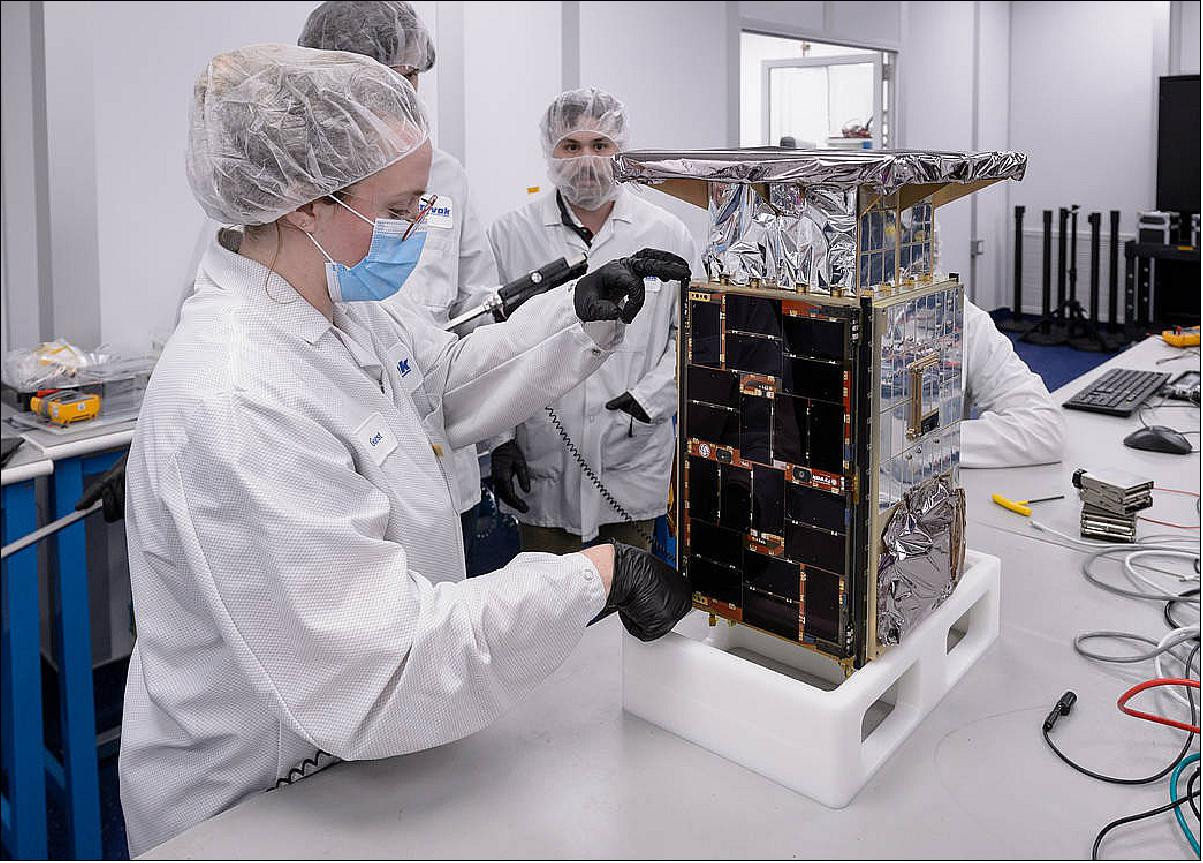
Launched aboard an Electron rocket in June, the large CubeSat will hopefully become the first spacecraft to ever enter into a NRHO. By positioning itself in such a way that the gravity from Earth and the Moon influence it equally, maintaining its orbit should require only periodic position corrections. This would not only lower the maintenance burden of adjusting the Lunar Gateway’s orbit, but reduce the station’s propellant requirement.
CAPSTONE is also set to test out an experimental navigation system that uses the Lunar Reconnaissance Orbiter (LRO) as a reference point instead of ground-based stations. In a future where spacecraft are regularly buzzing around the Moon, it will be important to establish a navigation system that doesn’t rely on Earthly input to operate.
So despite costing a relatively meager $30 million and only being about as large as a microwave oven, CAPSTONE is a very important mission for NASA’s grand lunar aspirations. Unfortunately, things haven’t gone quite to plan so far. Trouble started just days after liftoff, and as of this writing, the outcome of the mission is still very much in jeopardy.
In our occasional series charting audio and Hi-Fi technology we have passed at a technical level the main components of a home audio set-up. In our last outing when we looked at cabling we left you with a promise of covering instrumentation, but now it’s time instead for a short digression into another topic: stereo. It’s a word so tied-in with Hi-Fi that “a stereo” is an alternative word for almost any music system, but what does it really mean? What makes a stereo recording, and how does it arrive at your ears?
As most of you will know, a mono recording uses a single microphone and a single channel while a stereo one uses two microphones recording simultaneously a left and right channel. These are then played back through a pair of speakers, and the result is a sense of spatial field for the listener. Instruments appear to come from their relative positions when recorded, and the sense of being in the performance is enhanced.
Stereo recording as we know it was first perfected as one of the many inventions credited to Alan Blumlein, then working for EMI in London. We have one of his stereo demonstration films in “Trains at Hayes“, filmed from the EMI laboratories overlooking the Great Western Railway, and featuring a series of steam-hauled trains crossing the field of view with a corresponding stereo sound field. His work laid down the fundamentals of stereo recording, including microphone configurations and what would become the standard for stereo audio recording on disk with the channels on the opposite sides of a 45 degree groove. Continue reading “Know Audio: Stereo”→
Floppies may be big in Japan, but nostalgic and/or needful Stateside floppy enthusiasts needn’t fret — just use AOL keyword point that browser toward floppydisk.com. There, you can buy new floppies of all sizes, both new and old, recycle your disks, or send them in to get all that precious vintage stuff transferred off of them.
That delightfully Web 1.0 site is owned by Tom Persky, who fancies himself the ‘last man standing in the floppy disk business’. Who are we to argue? By the way, Tom has owned that address since approximately 1990 — evidently that’s when a cyber-squatter offered up the domain for $1,000, and although Tom scoffed at paying so much as $1 for any URL, his wife got the checkbook out, and he has had her to thank for it ever since.
My business, which used to be 90% CD and DVD duplication, is now 90% selling blank floppy disks. It’s shocking to me. — Tom Persky
Tom also owns diskduper.com, which is where he got his start with floppies — by duplicating them. In the 80s and 90s, being in this business was a bit like cranking out legal tender in the basement. As time wore on and more companies stopped selling floppies or simply went under, the focus of Tom’s company shifted away from duplication and toward sales. Whereas the business was once 90% duplication and 10% floppy sales, in 2022, those percentages have flopped places, if you will.