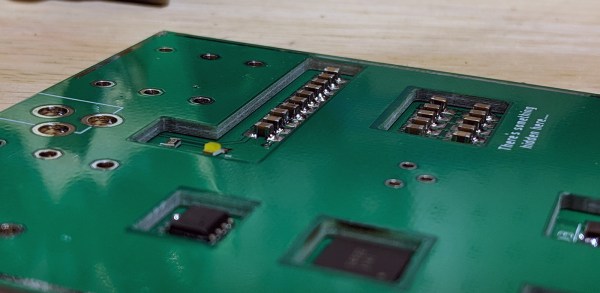
In recent months, the ability to hide components inside a circuit board has become an item of interest. We could trace this to the burgeoning badgelife movement, where engineers create beautiful works of electronic art. We can also attribute this interest to Bloomberg’s Big Hack, where Jordan Robertson and Michael Riley asserted Apple was the target of Chinese spying using components embedded inside a motherboard. The Big Hack story had legs, but so far no evidence of this hack’s existence has come to light, and the companies and governments involved have all issued denials that anything like this exists.
That said, embedding components inside a PCB is an interesting topic of discussion, and thanks to the dropping prices of PCB fabrication (this entire project cost $15 for the circuit boards), it’s now possible for hobbyists to experiment with the technique.
But first, it’s important to define what ‘stuffing components inside a piece of fiberglass’ is actually called. My research keeps coming back to the term ’embedded components’ which is utterly ungooglable, and a truly terrible name because ’embedded’ means something else entirely. You cannot call a PCB fabrication technique ’embedded components’ and expect people to find it on the Internet. For lack of a better term, I’m calling this ‘Oreo construction’, because of my predilection towards ‘stuf’, and because it needs to be called something. We’re all calling it ‘Oreo construction’ now, because the stuf is in the middle. This is how you do it with standard PCB design tools and cheap Chinese board houses.
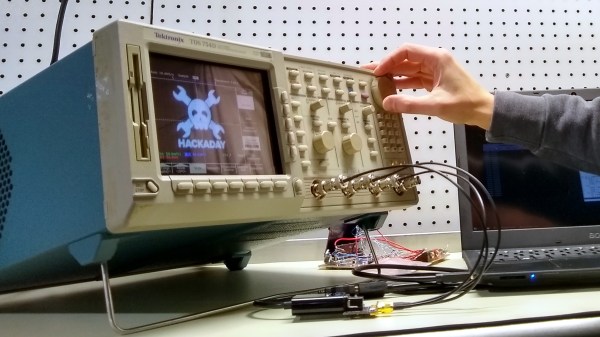
I recently came across the most peculiar way to make a color CRT monitor. More than a few oscilloscopes have found their way on to my bench over the years, but I was particularly struck with a find from eBay. A quick look at the display reveals something a little alien. The sharpness is fantastic: each pixel is a perfect, uniform-colored little dot, a feat unequaled even by today’s best LCDs. The designers seem to have chosen a somewhat odd set of pastels for the UI though, and if you move your head just right, you can catch flashes of pure red, green, and blue. It turns out, this Tektronix TDS-754D sports a very peculiar display technology called NuColor — an evolutionary dead-end that was once touted as a superior alternative to traditional color CRTs.
Join me for a look inside to figure out what’s different from those old, heavy TVs that have gone the way of the dodo.
One of the killer apps of 3D printers is the ability to make custom gears, transmissions, and mechanisms. But there’s a learning curve. If you haven’t 3D printed your own gearbox or automaton, here’s a great reason to take the plunge. This morning Hackaday launched the 3D Printed Gears, Pulleys, and Cams contest, a challenge to make stuff move using 3D-printed mechanisms.
Adding movement to a project brings it to life. Often times we see projects where moving parts are connected directly to a servo or other motor, but you can do a lot more interesting things by adding some mechanical advantage between the source of the work, and the moving parts. We don’t care if it’s motorized or hand cranked, water powered or driven by the wind, we just want to see what neat things you can accomplish by 3D printing some gears, pulleys, or cams!
No mechanism is too small — if you have never printed gears before and manage to get just two meshing with each other, we want to see it! (And of course no gear is literally too small either — who can print the smallest gearbox as their entry?) Automatons, toys, drive trains, string plotters, useless machines, clockworks, and baubles are all fair game. We want to be inspired by the story of how you design your entry, and what it took to get from filament to functional prototype.
When Charles “Chuck” Yeager reached a speed of Mach 1.06 while flying the Bell X-1 Glamorous Glennis in 1947, he became the first man to fly faster than the speed of sound in controlled level flight. Specifying that he reached supersonic speed “in controlled level flight” might seem superfluous, but it’s actually a very important distinction. There had been several unconfirmed claims that aircraft had hit or even exceeded Mach 1 during the Second World War, but it had always been during a steep dive and generally resulted in the loss of the aircraft and its pilot. Yeager’s accomplishment wasn’t just going faster than sound, but doing it in a controlled and sustained flight that ended with a safe landing.
Chuck Yeager and his Bell X-1
In that way, the current status of hypersonic flight is not entirely unlike that of supersonic flight prior to 1947. We have missiles which travel at or above Mach 5, the start of the hypersonic regime, and spacecraft returning from orbit such as the Space Shuttle can attain speeds as high as Mach 25 while diving through the atmosphere. But neither example meets that same requirement of “controlled level flight” that Yeager achieved 72 years ago. Until a vehicle can accelerate up to Mach 5, sustain that speed for a useful period of time, and then land intact (with or without a human occupant), we can’t say that we’ve truly mastered hypersonic flight.
So why, nearly a century after we broke the sound barrier, are we still without practical hypersonic aircraft? One of the biggest issues historically has been the material the vehicle is made out of. The Lockheed SR-71 “Blackbird” struggled with the intense heat generated by flying at Mach 3, which ultimately required it to be constructed from an expensive and temperamental combination of titanium and polymer composites. A craft which flies at Mach 5 or beyond is subjected to even harsher conditions, and it has taken decades for material science to rise to the challenge.
With modern composites and the benefit of advanced computer simulations, we’re closing in on solving the physical aspects of surviving sustained hypersonic flight. With the recent announcement that Russia has put their Avangard hypersonic glider into production, small scale vehicles traveling at high Mach numbers for extended periods of time are now a reality. Saying it’s a solved problem isn’t quite accurate; the American hypersonic glider program has been plagued with issues related to the vehicle coming apart under the stress of Mach 20 flight, which heats the craft’s surface to temperatures in excess of 1,900 C (~3,500 F). But we’re getting closer, and it’s no longer the insurmountable problem it seemed a few decades ago.
Today, the biggest remaining challenge is propelling a hypersonic vehicle in level flight for a useful period of time. The most promising solution is the scramjet, an engine that relies on the speed of the vehicle itself to compress incoming air for combustion. They’re mechanically very simple, and the physics behind it have been known since about the time Yeager was climbing into the cockpit of the X-1. Unfortunately the road towards constructing, much less testing, a full scale hypersonic scramjet aircraft has been a long and hard one.
Circuits are beautiful in their own way, and a circuit sculpture takes that abstract beauty and makes it into a purposeful art form. Can you use the wires of the circuits themselves as the structure of a sculpture, and tell a story with the use and placement of every component? Anyone can exercise their inner artist using this medium and we loved seeing so many people give it a try. Today we announce the top winners and celebrate four score of entries in the Hackaday Circuit Sculpture Contest.
Let’s take a look at twelve outstanding projects that caught (and held) our eye:
I try to keep up with web development trends but it’s hard to keep pace since it’s such a fast evolving field. Barely a week goes by without the release of a new JS framework, elaborate build tool or testing suite — all of them touted as the one to learn. Sorting the hype from the genuinely useful is no mean feat, so my aim in this article is to summarise some of the most interesting happenings that web development saw in the last year, and what trends we expect to see more of in 2019.
A technology or framework doesn’t have to be brand new to be on our list here, it just needs to be growing rapidly or evolving in an interesting way. Let’s take a look!
The holidays bring us many things. Family and friends are a given, as is the grand meal in which we invariably overindulge. It’s a chance for decades old songs and movies to somehow manage to bubble back up to the surface, and occasionally a little goodwill even slips in here or there. But perhaps above all, the holidays are a time for every retailer to stock themselves to the rafters with stuff. Do you need it? No. Do they want it? No. But it’s there on display anyway, and you’re almost certainly going to buy it.
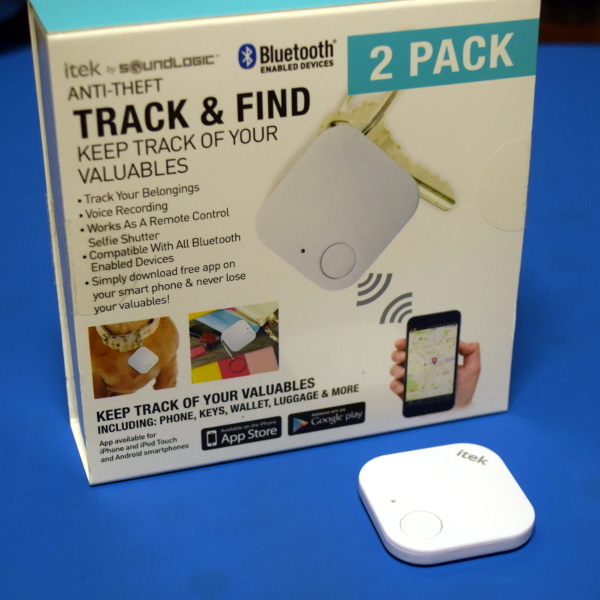
Which is precisely how I came to purchase a two pack of Bluetooth Low Energy (BLE) “trackers” for the princely sum of $10 USD. I didn’t expect much out of them for $5 each, but as this seemed an exceptionally low price for such technology in a brick and mortar store, I couldn’t resist. Plus there was something familiar about the look of the tracker that I couldn’t quite put my finger on while I was still in the store.
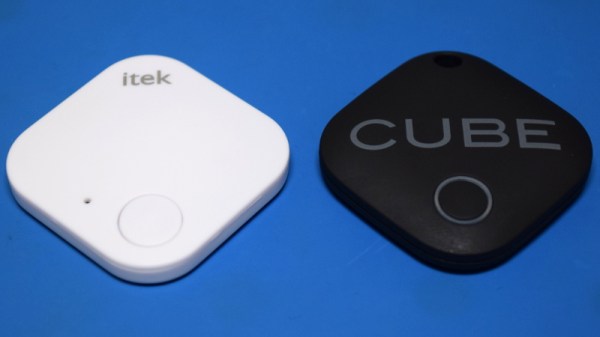
That vague feeling of recollection sent me digging through my parts bin as soon as I got home, convinced that I had seen something among the detritus that reminded me of my latest prize. Sure enough, I found a “Cube” Bluetooth tracker which, ironically, I had received as a Christmas gift some years ago. Putting them side by side, it was clear that the design of these “itek” trackers took more than a little inspiration from the better known (and five times as expensive) product.
The Cube was a bit thicker, but otherwise the shape, size, and even button placement on the itek was nearly identical. Reading through their respective manuals, the capabilities also seemed in perfect parity, down to being able to use the button on the device as a remote camera control for your smartphone. Which got me thinking: just how similar would these two devices be internally? Clearly they looked and functioned the same, but would they be built the same as well? They would have to cut costs somewhere.
Determined to find out how a company can put out what for all the world looks like a mirror image of a competitor’s device while undercutting them by such a large margin, I cracked both trackers open to get a bit more familiar with what makes them tick. What I found on closer inspection of these two similar gadgets is perhaps best summarized by that age old cautionary adage: “Don’t judge a book by its cover.”