Easy Quadrotor Helicopter Instructions

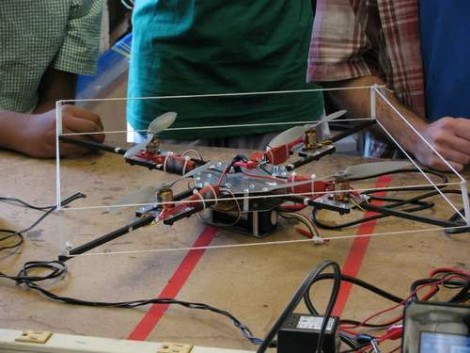
Here’s a great tutorial on building your own quadrotor helicopter. This build isn’t necessarily less expensive than others we’ve seen since quality motors, propellers, and control circuitry aren’t cheap. But the design and assembly is well documented and presents a well-planned building procedure. The carbon-fiber tubes that make up the frame have extensions to protect the motors and propellers in the event of a crash. The Arduino, IMU, and transceiver are all tucked away between two aluminum body plates as well. They only thing missing is a solid methodology for tuning the four motors, a critical procedure that is just touched up at the end of the article.

Equinox Clock

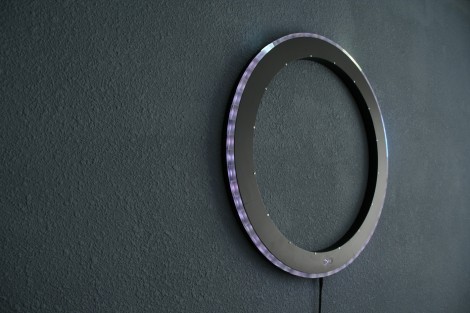
The Equinox clock is made up of simple parts but a combination of fine design and precision make it a gem of a timepiece. The guts are made up of an Arduino, a DS1307 real time clock, twelve LED drivers, and sixty RGB LEDs. These combine with a capacitive touch interface to tell the time using three lit blocks for the hours, one for the minutes, and a fading block for the seconds. See for yourself after the break.

To our delight, [Bram Knaapen] shared the specifics of the case. The black ring that makes up the body was laser cut and spray painted. He uses small blocks of acrylic that have been sandblasted to diffuse the light. This is also a great example of clean circuitry using interconnects between the different circuit boards.

We always enjoy seeing clocks no matter what level of finish is involved, but great design is something that makes us want to hang a project on the wall rather than stow it in a parts bin.

Continue reading “Equinox Clock”

Using An NES Controller On An Android Phone

[Sk3tch] rigged up a way to use an original NES controller with Android. He bought the controller and a breakout board for it at DEFCON. By combining the controller, an Arduino, and a blueSMIRF BlueTooth module the controller can be used as a keyboard on his Android device. In the video after the break he demonstrates pairing the devices and playing Super Mario Bros. 3 in an emulator.

He calls this Alpha quality but it certainly looks like it works well. In the beta version we’d love to see all of the extra electronics inside the controller case like those USB mods.

Continue reading “Using An NES Controller On An Android Phone”

LED Suit Lights Up The Night

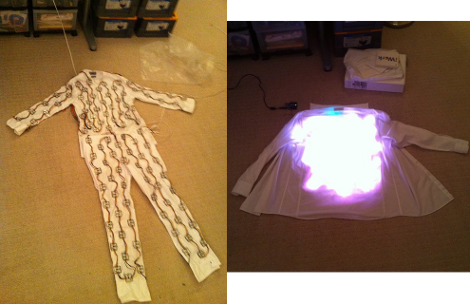
When the tipline popped up with this LED suit, part two, by [Marc DeVidts] we were expecing a simple led version of the previously known EL coat.

Well we were right and wrong in the same instance. Correct in that like predictions, the outcome is stonking great. Wrong in that this suit far outpaces EL in abilities we weren’t expecting. Namely to start off, an iPhone app over WiFi dictates to some 200 Arduino multiplexed RGB LED modules to dance randomly or follow patterns; an accelerometer and microphone are also implanted to further some effects. And finally if the suit isn’t enough to make you giddy, his PCB and enclosure milling surely will. Catch a video of the entire setup after the break.

Continue reading “LED Suit Lights Up The Night”

Controlling An AC Drill Using One PWM Connection

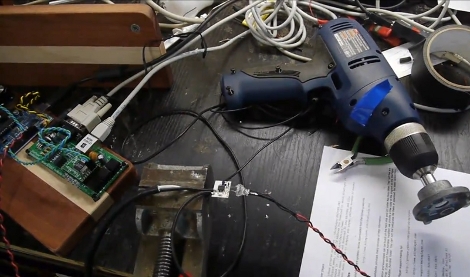
This peculiar setup allows [Ben Krasnow] to control an alternating current device using one pin on a microcontroller. He’s experimenting with a power drill and has relocated the trigger circuitry that makes it spin. On that board he found a variable resistor combined with a capacitor which control a triac, actuating the speed of a drill. [Ben’s] solution works great and isolates the drill from the control circuitry. He replace the variable resistor with a cadmium sulfide photoresistor (basically a variable resistor whose resistance depends on the intensity of light). Pulse-width modulation is used to adjust the brightness of an LED shining on that photoresistor and thereby affect the speed of the drill. This is such as simple alteration to the drill we’d call it MacGyver-esque.

See a demonstration after the break.

Continue reading “Controlling An AC Drill Using One PWM Connection”

Arduino Based Thermal Printer

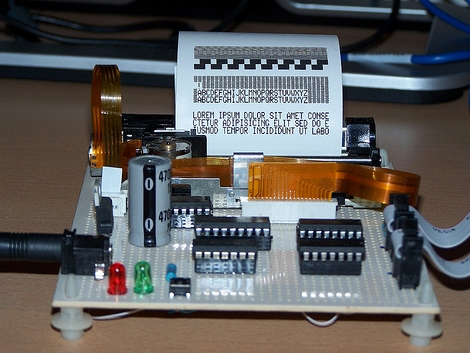
[Manuel] built his own thermal printer based around an Arduino. We’re a bit confused about the parts, his webpage specifies an EFA-1019HW2 print head but the bill of materials on his github shows EPT-1019W2. We can’t find a source for either product number, but we did find similar thermal line printers for as low as $32.00. The controller boards on the other hand look to be around $150 so building your own is a definite win. [Manuel’s] version can print 96 points and has a font set that prints 32 characters per line. Check out the video after the break and let us know if the noise of the print head is a deal killer for you.

Continue reading “Arduino Based Thermal Printer”

DWex Watch Looks For Future Development

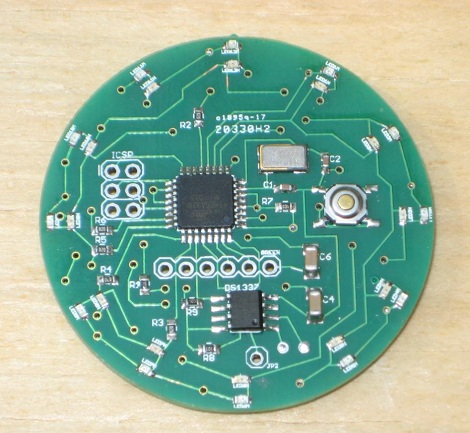
[FlorinC] sent in his DWex Arduino watch, with intentions for it double as an experimenting base. Inspired by the MakerBotWatch, it runs an ATmega328P, DS1337 RTC,and 24 LEDs to display the time. [FlorinC] tells us the (yet to come) case and strap will be similar to Woz’s watch to ensure airport security tackles him. As for experimenting, the PCB contains an ICSP6 and also an FTDI connector for those “other-than-watch purposes”. We’re not all sure what else could be done with a watch; we racked our brains and came up with a compass, but with the source code and Eagle files available maybe you have a better idea?