This Automated Wire Prep Machine Cuts And Strips The Wire

We’ve seen a fair number of automated wire cutting builds before, and with good reason: cutting lots of wires by hand is repetitive and carries the risk of injury. What’s common to all these automated wire cutters is a comment asking, “Yeah, but can you make it strip too?” As it turns out, yes you can.

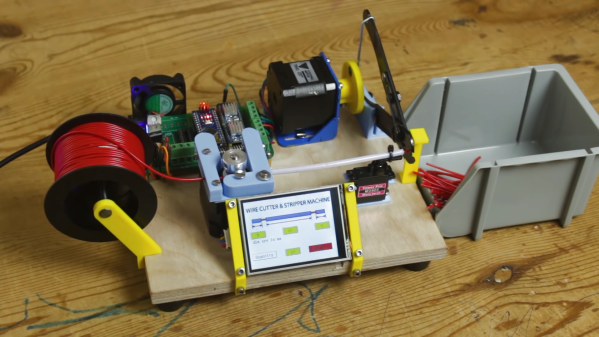
The key to making this automated wire cutter and stripper is [Mr Innovative]’s choice of tooling, and accepting a simple compromise. (Video, embedded below.) Using just about the simplest wire strippers around — the kind with a diamond-shaped opening that adjusts to different wire gauges by how far the jaws are closed — makes it so that the tool can both cut and strip, and adapt to different wire sizes. The wire is fed from a spool to a custom attachment sitting atop a stepper motor, which looks very much like an extruder from a 3D-printer. The wire is fed through a stiff plastic tube into the jaws of the cutter. Choosing between cutting and stripping is a matter of aiming the wire for different areas on the cutter’s jaws, which is done with a hobby servo that bends the guide tube. The throw of the cutter is controlled by a stepper motor — partial closure nicks the insulation, while a full stroke cuts the wire off. The video below shows the build and the finished product in action.

Yes, the insulation bits at the end still need to be pinched off, but it’s a lot better than doing the whole job yourself. [Mr Innovative] has a knack for automating tedious manual tasks like this. Check out his label dispenser, a motor rotor maker, and thread bobbin winder.

Continue reading “This Automated Wire Prep Machine Cuts And Strips The Wire”

Slot Machine Has A Handle On Fun

For some reason, when slot machines went digital, they lost their best feature — the handle. Who wants to push a button on a slot machine, anyway? Might as well just play video poker. [John Bradnam] seems to agree, and has built an open-source three-color matrix slot machine complete with handle.

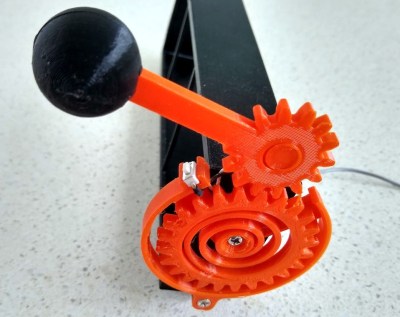
In this case, you’ll be losing all of your nickels to an Arduino Pro Mini. The handle is an upgrade to an earlier slot machine project that uses three 8×8 matrices and a custom driver board. When the spring-loaded handle is pulled, it strikes a micro switch to spins the reels and then snaps back into place. Between each pull, the current score is displayed across the matrix. There’s even a piezo buzzer for victory squawks. We only wish the button under the handle were of the clickier variety, just for the feels. Check out the short demo video after the break.



If you’re not a gambler, you could always turn your slot machine into a clock.

Continue reading “Slot Machine Has A Handle On Fun”

Sierpinski PCB Christmas Tree

It’s holiday time again! And that means it’s time to break out the soldering iron and the RGB LEDs! If you’re going to make a custom PCB to put those LEDs on, you’ll notice that you get few copies of your PCB in your order, so, might as well design it such that you can combine them all together into a single Sierpinski Christmas Tree, just like [Landon Carter] did.

Each PCB “tree” has three connections which can be used as either inputs or outputs by soldering one of two bridge connections on the PCB. The power and signal goes up and down through the tree, rather than across, so the connections go one on the top of the tree and two on the bottom. This way, each tree in the triangle can easily be connected, and each triangle can be easily connected to another. Each individual tree has three WS2812b-mini addressable RGB LEDs and the tree is controlled by an external Arduino.

The first order of 10 PCBs came in, which makes a 9 member tree – next up is a 27 member tree. After that, you’re going to need some pretty high vaulted ceilings in order to put these on the wall. On the upside, though, once the holidays are over, everything can be easily disconnected and packed away with the rest of the decorations. If you, too, are interested in RGB LED decorations, there are a few on the site for your perusal.

FM Radio From Scratch Using An Arduino

Building radio receivers from scratch is still a popular project since it can be done largely with off-the-shelf discrete components and a wire long enough for the bands that the radio will receive. That’s good enough for AM radio, anyway, but you’ll need to try this DIY FM receiver if you want to listen to something more culturally relevant.

Receiving frequency-modulated radio waves is typically more difficult than their amplitude-modulated cousins because the circuitry necessary to demodulate an FM signal needs a frequency-to-voltage conversion that isn’t necessary with AM. For this build, [hesam.moshiri] uses a TEA5767 FM chip because of its ability to communicate over I2C. He also integrated a 3W amplifier into this build, and everything is controlled by an Arduino including a small LCD screen which displays the current tuned frequency. With the addition of a small 5V power supply, it’s a tidy and compact build as well.

While the FM receiver in this project wasn’t built from scratch like some AM receivers we’ve seen, it’s still an interesting build because of the small size, I2C capability, and also because all of the circuit schematics are available for all of the components in the build. For those reasons, it could be a great gateway project into more complex FM builds.

Continue reading “FM Radio From Scratch Using An Arduino”

Flipbook Automation Saves Your Thumb

You’ve probably seen a flipbook. That’s a book with pictures on each page. Each picture is slightly different than the last one so if you flip rapidly through the book you get a little animation. We like the German word, Daumenkino, which translates as “thumb cinema” and that seems appropriate. [Barqunics] put a decidedly new twist on this old technology. His flipbook senses a viewer and automatically flips the pages using a motor. You can see the Arduino-controlled device in the video below.

The presence detection is a ubiquitous sonar sensor. The frame is easy to make since it uses cardboard and hot glue. A DC motor like you find on many toy cars or robots provides the rotation. No 3D printing needed, but we did think it would be easy to 3D-print or laser-cut the pieces.

Continue reading “Flipbook Automation Saves Your Thumb”

He’s The Operator Of His Pocket Arduino

The band Kraftwerk hit the music scene with its unique electronic sound in the 70s in Germany, opening the door for the electronic music revolution of the following decade. If you’re not familiar with the band, they often had songs with a technology theme as well, and thanks to modern microcontroller technology it’s possible to replicate the Kraftwerk sound with microcontrollers as [Steven] aka [Marquis de Geek] demonstrates in his melodic build.

While the music is played on a Stylophone and a Korg synthesizer, it is fed through five separate Arduinos, four of which have various synths and looping samplers installed on them (and presumably represent each of the four members of Kraftwerk). Samplers like this allow pieces of music to be repeated continuously once recorded, which means that [Steven] can play entire songs on his own. The fifth Arduino functions as a controller, handling MIDI and pattern sequencing over I2C, and everything is finally channeled through a homemade mixer.

[Marquis] also dressed in Kraftwerk-appropriate attire for the video demonstration below, which really sells the tribute to the famous and groundbreaking band. While it’s a great build in its own right and is a great recreation of the Kraftwerk sound, we can think of one more way to really put this project over the top — a Kraftwerk-inspired LED tie.

Continue reading “He’s The Operator Of His Pocket Arduino”

Cornhole Boards Play Victory Songs

How do you instantly make any game better? By lighting it up and playing at night. We would normally say ‘drinking’, but we’re pretty sure that drinking is already a prerequisite for cornhole — that’s the game where you toss bean bags at holes in angled boards.

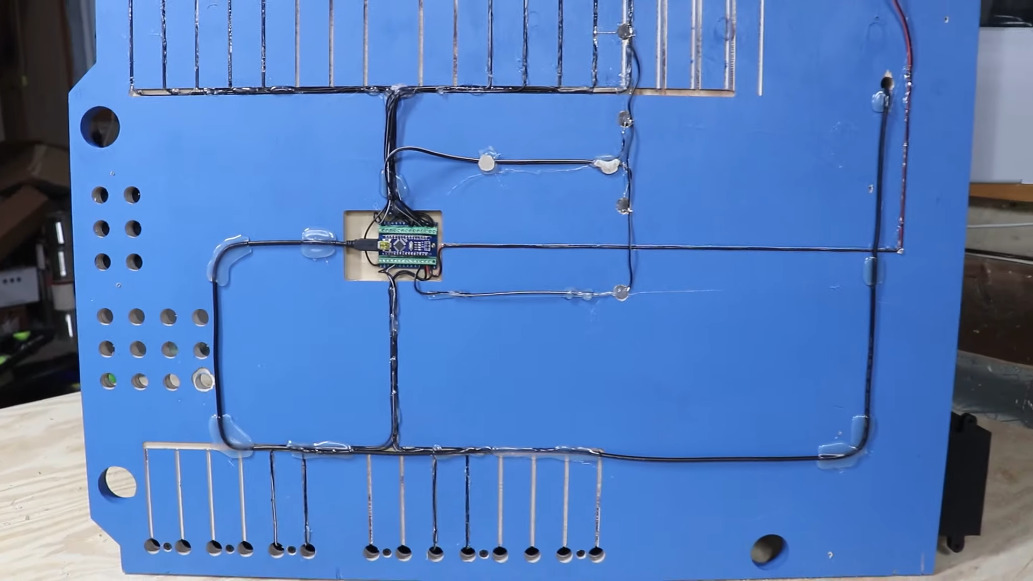
[Hardware Unknown] loves cornhole, and was gifted a set of portable, folding boards that light up around the ring for nighttime action. These turned out to be the perfect basis for reactive boards that light up and play sound whenever points are scored. Both boards have a vibration sensor to detect bags hitting the top, and an IR break-beam sensor pair across the hole. An Arduino Nano reads from the sensors and controls an amplifier and a DF Player for sound.

Players get a point and a song for landing a bag on top of the board, and three points and a different song for making it in the hole. We love the Easter egg — anyone who manages to trip both the vibration sensor and the break-beam detector at the same time will be treated to the sound of a flock of honking geese. Check out the build journey after the break.

No good at cornhole? This one doesn’t let you miss.

Continue reading “Cornhole Boards Play Victory Songs”