Building A Tube-Based Stereo Amp, In Classic Style

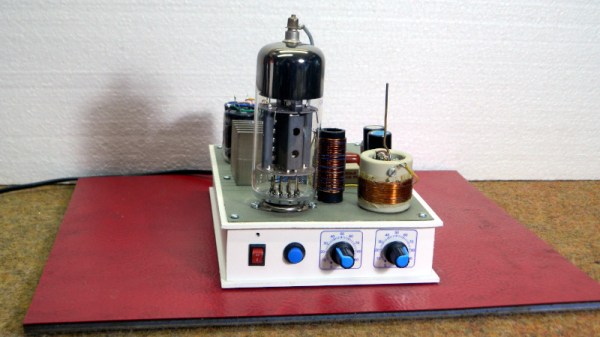
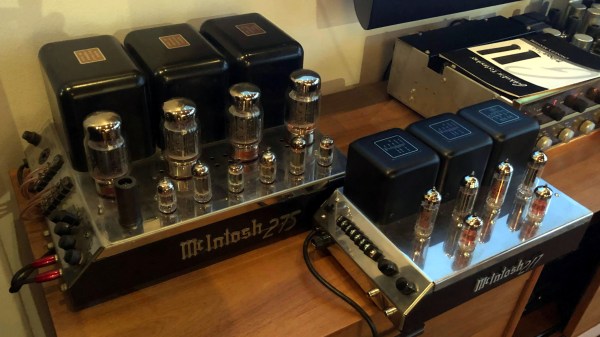
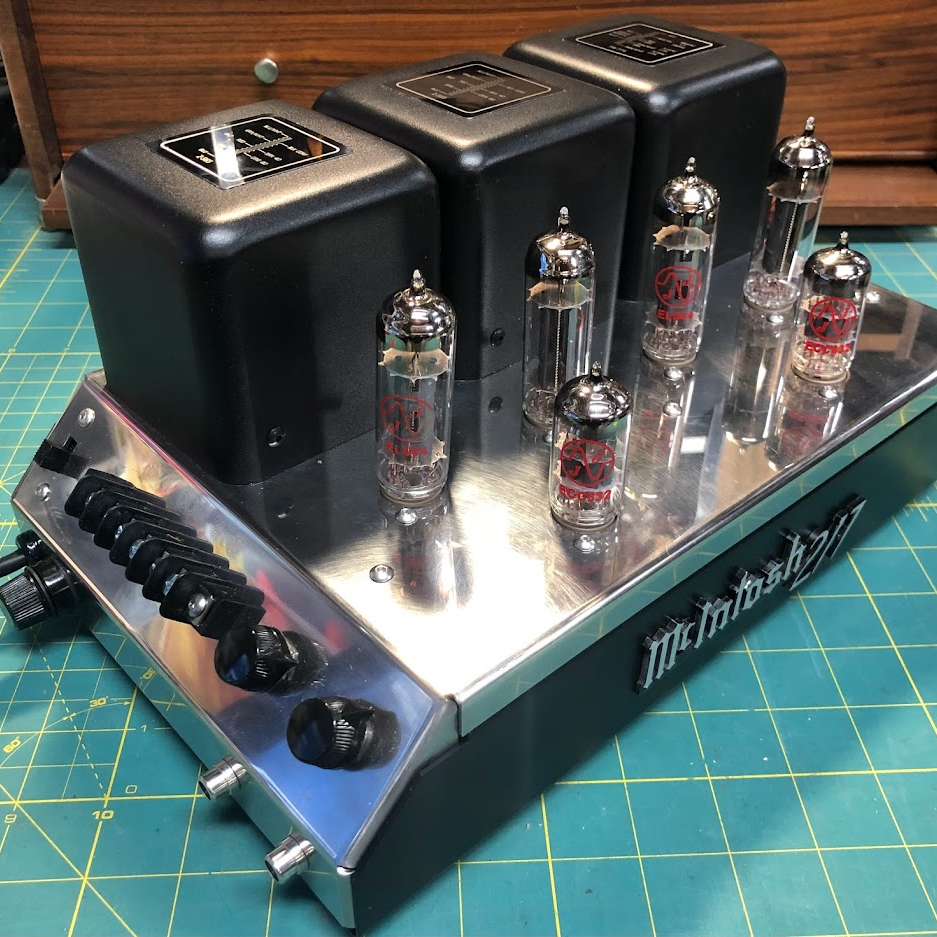
It’s not every day we see the results of someone putting their own spin on a vintage tube amp, but that’s exactly what [lens42] did in creating the McIntosh 217, created as a “mini” version of the McIntosh MC275, a classic piece of audio equipment. Both are pictured next to each other, above.

When it comes to vintage hi-fi stereo amplifiers, two units had particular meaning for [lens42]: the McIntosh MC275 Power Amp, and the Dynaco ST35. The Dynaco was a more budget-friendly amplifier, but looked like a plain box. The McIntosh, however, proudly showed off its tubes and transformers in all their glory. The “McIntosh 217” is design-wise basically a smaller McIntosh MC275, with the innards of a Dynaco ST35.

With so much needing to be designed from the ground up, CAD was invaluable. Component layout, enclosure design, and even wiring and labeling all had to be nailed down as much as possible before so much as heating up the soldering iron. Even so, there were a few hiccups; a vendor had incorrect measurements for a tube socket which meant that the part would not fit. A workaround involved modifying the holes and as luck would have it, the change wasn’t an eyesore. Still, [lens42] reminds us all that whenever you can, have the required parts in-hand for confirmation of dimensions before sending CAD files off for cutting or fabrication.

Many of us can relate to the fact that the whole project was a labor of love and made no real financial sense, but the end result is fantastic, and creating such a thing is something all of us — not just chasers of that elusive “tube sound” — can appreciate.

Simple Universal Modem Helps Save And Load Data From Tape

Back in the early days of the home computer revolution, data was commonly saved on tape. Even better, those tapes would make an almighty racket if you played them on a stereo, because the data was stored in an audio format.  The Simple Universal Modem from [Anders Nielsen] is built to work in a similar way, turning data into audio and vice versa.

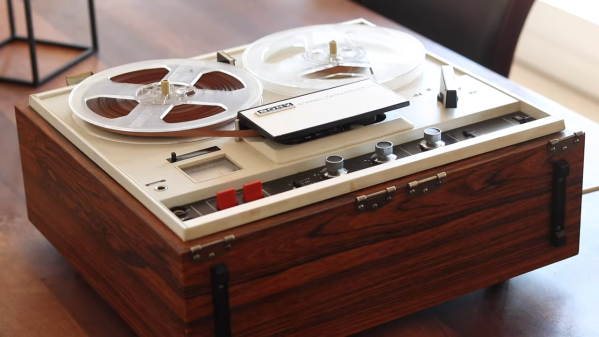
The project consists of a circuit for modulating data into audio, and demodulating audio back into data. It’s “universal” because [Anders] has designed it to be as format-agnostic as possible. It doesn’t matter whether you want to store data on a digital voice recorder, a cassette deck, or an old reel-to-reel. This build should work fairly well on all of them!

On the modulation side of things, it’s designed to be as analog-friendly as possible. Rather than just spitting out rough square waves, it modulates them into nice smooth sine waves with fewer harmonics. On the demodulation side, it’s got an LM393 comparator which can read data on tape and spit out a clean square wave for easy decoding by digital circuitry.

If you find yourself trying to recover old data off tapes, or writing to them for a retrocomputing project, this build might be just what you need. [Anders] even goes as far as demonstrating its use with an old reel-to-reel deck in a helpful YouTube video.

There really were some weird ways of storing data way back when. Just ask IBM. Video after the break.

Continue reading “Simple Universal Modem Helps Save And Load Data From Tape”

Carver M-400 Amplifier Repair Keeps The 1980’s Alive

Carver is a famous name in audio equipment although they have been known to use odd names for things. For example, the 1980’s vintage M-400 magnetic field power amplifier that [JohnAudioTech] is repairing (see the two videos below). That sounds like something off a bad Star Trek remake, but, apparently, we weren’t alone in thinking that, judging by this 1982 review of the unit from a UK magazine.

Still, it is an interesting high-power amplifier and we love seeing gear of this age torn apart. The beast is rated at 201 watts — you have to wonder if the extra watt is another marketing ploy.

There were actually two units and they looked pretty good for four-decade-old boxes. One sounded pretty good outside of some noticeable buzzing. The other had something shorted inside. If you enjoy watching repair videos, you’ll appreciate this two-parter.

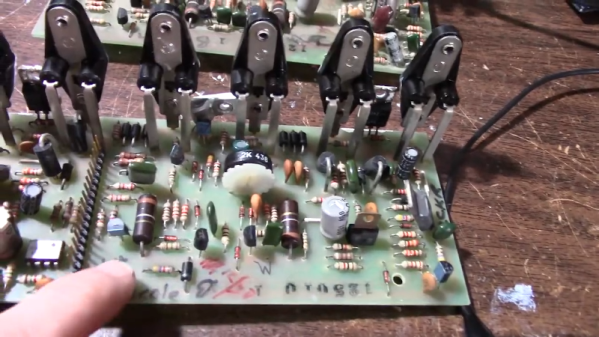
We have to admit — and it may be a personal bias — there is something more pleasing about seeing a PCB populated with a bunch of interesting-looking through-hole components. Modern boards with a sea of surface mount parts tend to look a little bland, aesthetically speaking. Of course, when it comes time to make our own boards, we are happy to use SMD and forego all that hole drilling!

We like watching computer repair videos, in particular. Or sometimes, something really exotic.

Continue reading “Carver M-400 Amplifier Repair Keeps The 1980’s Alive”

Pocket Radio Powered By Tiny Microcontroller

Before the days of MP3 players and smartphones, and even before portable CD players, those of us of a certain age remember that our cassette players were about the only way to take music on-the-go. If we were lucky, they also had a built-in radio for when the single tape exhausted both of its sides. Compared to then, it’s much easier to build a portable radio even though cassettes are largely forgotten, as [wagiminator] shows us with this radio design based on an ATtiny.

The build is about as compact as possible, with the aforementioned ATtiny 402/412 as its core, it also makes use of an integrated circuit FM tuner,  an integrated audio amplifier with its own single speaker, and a small OLED display. The unit also boasts its own lithium-polymer battery charger and its user interface consists of only three buttons, plenty for browsing radio stations and controlling volume.

The entire build fits easily in the palm of a hand and is quite capable for a mobile radio, plus all of the schematics and code is available on the project page. While it doesn’t include AM capability, just the fact that FM is this accessible nowadays when a few decades ago it was cutting-edge technology is quite remarkable. If you’re looking for an even smaller FM receiver without some of the bells and whistles of this one, take a look at this project too.

GGWave Sings The Songs Of Your Data

We’re suckers for alternative data transmission methods, and [Georgi Gerganov]’s ggwave made us smile. At its core, it’s doing what the phone modems of old used to do – sending data encoded as different audio tones. But GGwave does this with sophistication!

It splits the data into four-bit chunks, and uses 16 different frequency offsets to represent each possible value. But for each chunk, these offsets are added to one of six different base frequencies, which allows the receiving computer to tell which chunk it’s in. It’s like a simple framing concept, and it makes the resulting data sound charmingly like R2-D2. (It also uses begin and end markers to be double-sure of the framing.) The data is also sent with error correction, so small hiccups can get repaired automatically.

What really makes ggwave shine is that it’s ported to every platform you care about: ESP32, Arduino, Linux, Mac, Windows, Android, iOS, and anything that’ll run Python or JavaScript. So it’ll run in a browser. There’s even a GUI for playing around with alternative modulation schemes. Pshwew! This makes it easy for a minimalist microcontroller-based beeper button to control your desktop, or vice-versa. An ESP32 makes for an IoT-style WiFi-to-audio bridge. Write code on your cell phone, and you can broadcast it to any listening microcontroller. Whatever your use case, it’s probably covered.

Now the downside. The data rate is slow, around 64-160 bits per second, and the transmission is necessarily beepy-booopy, unless you pitch it up in to the ultrasound or use the radio-frequency HackRF demo. But maybe you want to hear when your devices are talking to each other? Or maybe you just think it’s cute? We do, but we wouldn’t want to have to transmit megabytes this way. But for a simple notification, a few bytes of data, a URL, or some configuration parameters, we can see this being a great software addition to any device that has a speaker and/or microphone.

Oh my god, check out this link from pre-history: a bootloader for the Arduino that runs on the line-in.

Continue reading “GGWave Sings The Songs Of Your Data”

Teensy Spectrum Analyzer Has 170 Channels

While high-fidelity audio has come a long way in the past several decades, a lot of modern stereo equipment is still missing out on some of the old analog meters that were common on amplifiers and receivers of the 60s through the 80s. Things like VU meters don’t tend to be common anymore, but it is possible to build them back in to your sound system with the help of some microcontrollers. [Mark] shows us exactly how to reclaim some of the old-school functionality with this twin audio visualizer display.

Not only does this build include two displays, but the microcontroller is keeping up with 170 channels in real-time in order to drive the display. What’s more impressive is that it’s being done all on a Teensy 4.1. To help manage all of the data and keep the speed as fast as possible it uses external RAM soldered to the board, and a second Teensy audio board is used to do the real time FFT analysis. Most of the channels are sent to the display hosting the spectrum analyzer but two are reserved for left and right stereo VU meters on the second display.

The project from [Mark] is originally based on this software from [DIYLAB] so everything is open-source. While it was originally built for a specific piece of hardware, [Mark] has it set up with a line in and line out plus a microphone input so it can be used for virtually any audio hardware now. For another take on the classic VU meter, take a look at this design based on an Arudino instead.

Continue reading “Teensy Spectrum Analyzer Has 170 Channels”

Abacus Synthesizer Really Adds Up

The abacus has been around since antiquity, and takes similar forms over the hundreds of cultures that have embraced it. It may be one of the first devices to be considered as having a “user interface” in the modern context — at least for simple arithmetic calculations. But using an abacus as the UI for a music synthesizer seems like something entirely new.

Part art concept project and part musical instrument, the “Abacusynth” by [Elias Jarzombek] is a way to bring a more visual and tactile experience to controlling a synth, as opposed to the usual knobs and switches. The control portion of the synth consists of four horizontal rods spanning two plywood uprights. Each rod corresponds to a voice of the polyphonic synth, and holds a lozenge-shaped spinner mounted on a low-friction bearing. Each spinner can be moved left and right on its rod, which controls the presence of that voice; spinning the slotted knob controls the modulation of the channel via photosensors in the uprights. Each rod has a knob on one side that activates an encoder to control each voice’s waveform and its harmonics.

In use, the synthesizer is a nice blend of electronic music and kinetic sculpture. The knobs seem to spin forever, so Abacusynth combines a little of the fidget spinner experience with the exploration of new sounds from the built-in speaker. The synth also has a MIDI interface, so it works and plays well with other instruments. The video below shows the hardware version of Abacusynth in action; there’s also a web-based emulation to try before you build.

Continue reading “Abacus Synthesizer Really Adds Up”