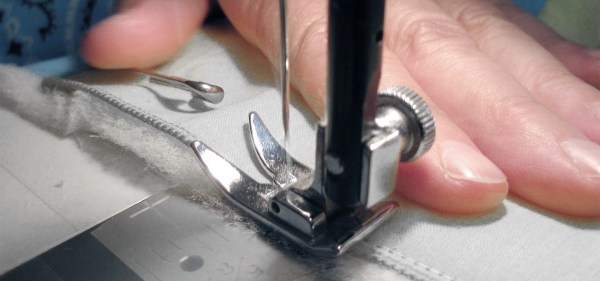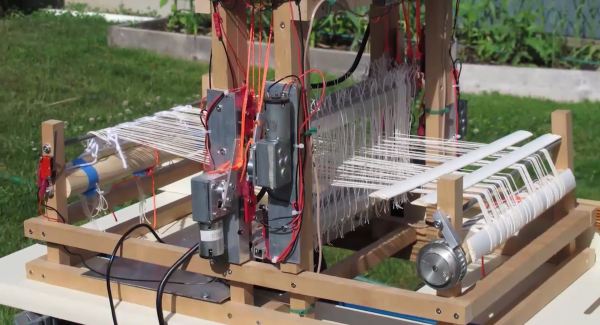
The once successful Kickstarter and National Science Foundation (NSF) research grant winner Electroloom is saying “Thanks and Farewell” to its backers, supporters, and sponsors. The startup ran out of funding while developing printer-like machine that uses electrospinning to automatedly produce ready-to-use garments.
Electroloom has been an ambitious project to explore if electrospinning could be made viable for garment manufacturing. The process that uses a high voltage to transform a resinous liquid into non-woven fabric was originally invented for textile fabrication, although its low throughput has always been a limiting factor. The method was mostly used in laboratory and medical applications. In 2014, Electroloom began developing a process that would bring the technology back to its fibrous roots, building an amazing prototype machine that could print an entire shirt in one piece. Electroloom’s Kickstarter campaign was funded in 2015, and earlier this year, an NSF research grant was awarded to the startup.
Anyone who owns their own pool knows it’s not as simple as filling it up with water and jumping in whenever you want. There’s pool covers to deal with, regular cleaning with the pool vacuum and skimmers, and of course, all of the chemicals that have to be added to keep the water safe. While there are automatic vacuums, there aren’t a whole lot of options for automating the pool chemicals. [Clément] decided to tackle this problem, eliminating one more task from the maintenance of his home. (Google Translate from French.)
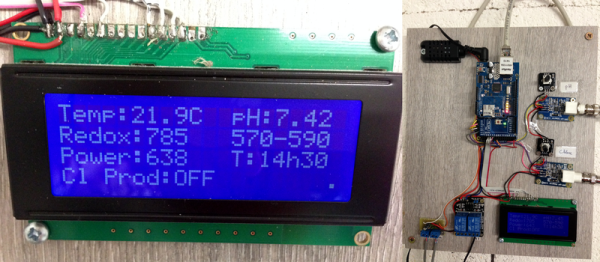
The problem isn’t as simple as adding a set amount of chemicals at a predetermined time. The amount of chemicals that a pool owner has to add are dependent on the properties of the water, and the amount of time that’s elapsed since the previous chemical treatment, and the number of people who have been using the water, and whether or not the pool cover is in use. To manage all of this, [Clément] used an ORP/Redox probe and a pH probe, and installed both in the filtration system. The two probes are wired to an Arduino with an ethernet shield. The Arduino controls electrically actuated chemical delivery systems that apply the required amount of chemicals to the pool, keeping it at a nice, healthy balance. Continue reading “Home Pool Added To Home Automation”→
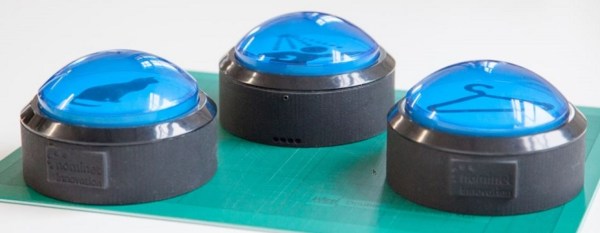
Sometimes you start a project with every intention of using it in a specific way, or maybe your plan is to have a very well-defined set of features. Often, though, our projects go in a completely different direction than we might have intended. That seems to be the case with [Dave] and his Pips. These tiny devices were originally intended to be used by people with disabilities, but it turns out that they’re a perfect platform for this “Internet of Things” thing that we’ve been hearing so much about.
Built around the Bright Blue Bean microcontroller platform to take advantage of its low energy requirements, the Pips were originally intended to be placed around the house where they would light up to remind the user to perform some task. Once the button was pushed, the next Pip in the sequence would activate. While they are quite useful for people with cognitive or sensory impairments, they can also be used in a similar way to the Amazon Dash button or any other simple internet-enabled device. Especially when used in conjunction with a home automation setup, this device could be used in novel ways, such as automating your morning routine without having to add a weight sensor to your bed.
We are also pleased to see that all of the project files are available on GitHub for anyone looking to try this out. Its interesting when something that was originally intended to help out anyone with a disability finds a use somewhere else that it might not have originally been intended for. After all, though, the principle of using things in novel ways is kind of the entire basis of this community.
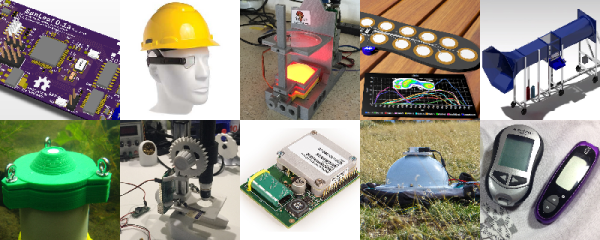
We live in a time of unparalleled access to technology and this has the power to make life better for everyone. Today we are excited to announce twenty spectacular builds that use access to technology to move scientific exploration within the reach of all. These are the winners of the Citizen Scientist challenge of the 2016 Hackaday Prize. Themes tackled in this round include blood glucose monitoring, insole sensing for analyzing your footfalls, lab equipment like automated microscopy, sensors to measure the world around us, and more.
The winners for the Citizen Scientist portion of the Hackaday Prize are, in no particular order:
The Hackaday Prize is the greatest hardware competition on earth. We want to see the next great Open Hardware project benefit everyone. We’re working toward that by recognizing people who build, make, and design the coolest and most useful devices around.
These twenty projects just won $1000 and will now move on to the final phase of The Hackaday Prize, to be judged by our fourteen celebrity judges. Awesome! Now get to work: there’s a lot the hackers behind these projects need to do before the final judging in October where they’ll compete for the grand prize of $150,000 and four other top prizes.
If your project didn’t make the cut, there’s still an opportunity for you to build the next great piece of hardware for The Hackaday Prize. The Automation Challenge is currently under way. It encourages everyone to build devices that make your life easier.

Automate your life; build a device that makes your breakfast, a robot to mow your lawn, or software that does your taxes. Build a device that automatically tracks laundry detergent, automates washing the dishes, or a robot that obeys every command.
Like the Design Your Concept, Anything Goes, and Citizen Science rounds of The Hackaday Prize, the top twenty projects will each win $1000, and move on to the Hackaday Prize finals for a chance to win $150,000 and a residency at the Supplyframe DesignLab in Pasadena.
If you don’t have a project up on Hackaday.io, you can start one right now and submit it to The Hackaday Prize. If you’re already working on the next great piece of hardware design, add it to the Automation challenge using the dropdown menu on the sidebar of your project page.
The title of ‘maker’ is conventionally applied to the young-adult age group. In the case of 84 year-old Ralph Affleck, a lifelong sawmiller, ‘maker’ perhaps undersells the accomplishment of building a fully functioning sawmill that can be operated by a single individual.
Starting in the trade at the age of 16 under his father’s tutelage, fifty years of working in sawmills saw him still loving what he did as retirement loomed. So, with pen, paper, and a simple school ruler he designed the entire shop from scratch. Decades of expertise working with wood allowed him to design the machines to account for warping and abnormalities in the timber resulting in incredibly accurate cuts.
With no other examples to guide his design — aside from perhaps old style steam-powered sawmills, and newer portable ones that he feels are inadequate for the job — much of the shop is built from scratch with scavenged parts. And, that list is impressive: four hydraulic cylinders from a Canberra bomber, levers from an old locomotive, differentials and gearboxes from a MAC and 1912 Republic trucks, a Leyland engine that operated for 13 years without the need for maintenance, and an assortment of old military and air force vehicle parts. This is complimented by his log skidder — also custom — that would look at home in a post-apocalyptic wasteland. Built from two tractors, it combines three gearboxes for 12 forward and 8 reverse gears(what!?), and can hit 42mph in reverse!
Perhaps the buzziest among buzzwords when it comes to electronics is Home Automation. This is a branch of IoT where you can actually go to the home store and come out with bags filled with products. The current Hackaday Prize round challenges you to automate your life and setting your sights on the home seems like an area open to everyone. But we’re having trouble putting our finger on what exactly makes a home automated, and more importantly, the best ways to benefit those who live beside that technology. So we want to know what you think.
Do you have a great idea for what makes an automated home more than a buzz word? Perhaps you are already sold and have been building your own; tell us about it! We want to know how (and when) you think this will turn from a buzzword to something most people want running their house. We’ll round up the best from this discussion for a future post. As a thank you, we’ll select some of the best comments and send you a T-shirt from the Hackaday store.
Who doesn’t love an automatic ice maker?
You can go back fifty years to the cartoons of the 1960’s and see that home automation was just around the corner. The Flintstones had dinosaurs to handle the mundane, and The Jetsons had a robot maid reigning over a cadre of whimsical gadgets in the home. At that point in time the home was already moving into the automation realm with thermostatically controlled air conditioning and water heaters. This was around the same time that automatic ice makers started to appear in a home’s freezer and remote garage door openers came into use.
Beginning in the 1970’s and 80’s it became common to find a dishwasher under the counter in the kitchen. The porch light option of dusk-until-dawn sensors came into use and were followed later by motion detecting lights which used PIR sensors. Automatic lawn sprinklers started to appear in the yards surrounding the home, and security systems that monitor doors, windows, and often motion (using PIR sensors again) became a thing.
These are great examples of home automation which is often overlooked. Even smarter thermostats are all the rage today, and security system add-ons that let you monitor cameras and locks over the Internet.
Which brings us back to the question. Where is this all going? What kind of automation will be developed now in our time, and looked back in 50 years as obvious technology wanted in every home? Do we already have the automated hardware in place and just need something to stitch it all together? Let us know what you think below, and if you’re already working on your own automation project don’t forget to enter it in the Hackaday Prize.
Today marks the beginning of the Automation Challenge round for the 2016 Hackaday Prize. We want to see what you can create that automates life. It’s a terrifically fun jumping off point for a project, and done just right, it can score you some amazing prizes.
Technology can make life better and automation is one place that is about to see huge expansion. This is a chance to put your mark on the future by envisioning, prototyping, and explaining your ideas. The animated image at the top of this post is a perfect example of how fun automation builds can be. It’s the part of the Sunday Morning Breakfast Machine which steeps the tea. We covered this Rube-Goldberg like device a few weeks ago. About 1,000 hours went into building a completely automated breakfast machine.
Building something whimsical is fine for entering this round — a lot of discovery happens when having fun with interesting ideas. But there is plenty of room for serious builds as well. Technological development has always included iterating on automation; asking and answering the question of how can we do more with less effort.
For instance, you can boil coffee in a pot but then you have to use some filtering technique to sequester the grounds. You can use a French press but that this hasn’t saved you much effort. So someone invented the percolator but you still must watch that you don’t burn your brew. From there we have espresso machines and drip brewers that both regulate how much water is used and at what temperature (in addition to keeping the grounds separate). And now we’re seeing single-unit machines like Nespresso and Keurig which make everything a one-step process, if you’re happy with the pods they sell you. I like to refill my own pods, which lets me choose my own grind. I’d love to see someone automate this entire process of cleaning, grinding, filling and presenting a reusable pod. That would make a great entry and help move more people away from disposable plastic/metal.
All I see when I look around me are ways that life should be more automated, and I bet you have the same proclivity. Now you have a reason to take on the challenge. Automate something and enter it in the Hackaday Prize. Twenty of those entries will be awarded $1,000 and move on to vie for the grand prize of $150,000 and a residency at the Supplyframe Design Lab in Pasadena, plus four other huge top prizes.