Reviving A $25 Generator

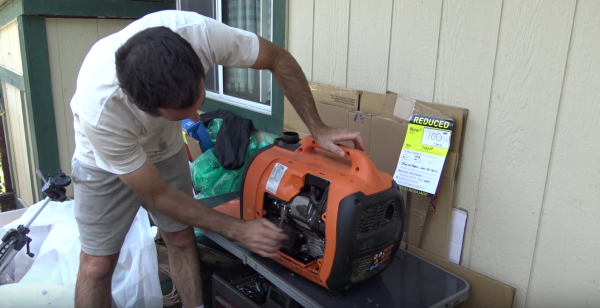
[Jennies Garage] found a used and abused inverter based generator in the clearance section of his local home improvement store. The generator had been returned on a warranty claim and was deemed uneconomical to fix. Originally $799, [Jennies Garage] picked it up for just $25. He documented his quest to get the device running with a trio of videos.

The generator had spark, but didn’t want to fire. The only obvious problem was the fact that the machine had been overfilled with oil. There was little or no compression, but that is not uncommon with modern small engines – many of them have a compression release mechanism which makes them easier to start.

With all the obvious problems eliminated, the only thing left to do was tear into the engine and figure out what was wrong. Sure enough, it was a compression issue. The overfull oil condition had forced engine oil up around the piston rings, causing them to stick, and snapping one of the rings. The cylinder bore was still in good shape though, so all the engine needed was a new set of rings.

That’s when the problems started. At first, the manufacturer couldn’t find the rings in their computer system. Then they found them but the rings would take two weeks to ship. [Jennies Garage] isn’t the patient type though. He looked up the piston manufacturer in China. They would be happy to ship him complete pistons – but the minimum order quantity was 5000. Then he started cross-referencing pistons from other engines and found a close match from a 1960’s era 90cc motorcycle. Ironically, it’s easier to obtain piston rings for an old motorcycle than it is to find them for a late model generator.

The Honda rings weren’t perfect – the two compression rings needed to be ground down about 1/2 a millimeter. The oil ring was a bit too thick, but thankfully the original oil ring was still in good shape.

Once the frankenpiston was assembled, it was time to put the repair to the test. [Jennies Garage] reassembled the generator, guessing at the torque specs he didn’t have. The surgery was a complete success. The generator ran perfectly, and lit up the night at the [Jennies Garage] cabin.

If you’re low on gas, no problem. Did you know you can run a generator on soda? Want to keep an eye on your remote generator? Check out this generator monitor project.

Continue reading “Reviving A $25 Generator”

A Jet Engine On A Bike. What’s The Worst That Could Happen?

On today’s edition of ‘don’t try this at home,’ we’re transported to Russia to see [Igor Negoda]’s working jet bicycle.

This standard mountain bike comes equipped with a jet engine capable of 18kg of thrust, fixed to the frame under the seat with an adjustable bracket to change it’s angle as needed. A cell phone is zip-tied to the frame and acts as a speedometer — if it works, it’s not stupid — and an engine controller displays thrust, rpm and temperature.  A LiPo battery is the engine’s power source with a separate, smaller battery for the electronics. The bike is virtually overgrown with wires and tubes that feed the engine, including an auxiliary fuel tank where a water bottle normally resides. Where’s the main fuel tank? In [Negoda]’s backpack, of course.

It certainly kicks up a mean dust cloud and makes a heck of a racket but the real question is: how fast does it go? From the looks of the smartphone, 72 km/h, 45 mph, or 18 rods to the hogshead.

Continue reading “A Jet Engine On A Bike. What’s The Worst That Could Happen?”

If You’re Going To Make A Model Engine, You Might As Well Make It A Merlin

It has been remarked before in more than one Hackaday post, that here are many communities like our own that exist in isolation and contain within them an astonishing level of hardware and engineering ability. We simply don’t see all the work done by the more engineering-driven and less accessory-driven end of the car modification scene, for example, because by and large we do not move in the same circles as them.

One such community in which projects displaying incredible levels of skill are the norm is the model making world. We may all have glued together a plastic kit of a Spitfire or a Mustang in our youth, but at the opposite end of the dial when it comes to models you will find craftsmanship that goes well beyond that you’d find in many high-end machine shops.

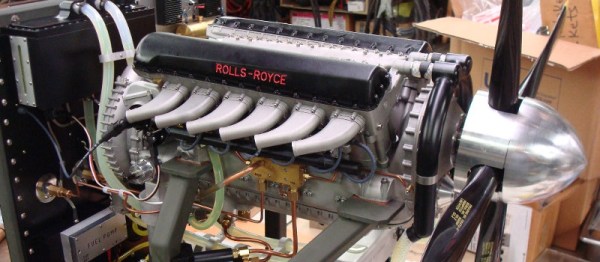
A project that demonstrates this in spades is [mayhugh1]’s quarter-scale model of a vintage Rolls-Royce Merlin V12 piston aero engine. This was the power plant that you would have found in many iconic Allied aircraft of the WW2 era, including the real-life Spitfires and all but the earliest of those Mustangs. And what makes the quarter-scale Merlin just that little bit more special, is that it runs. Just add fuel.

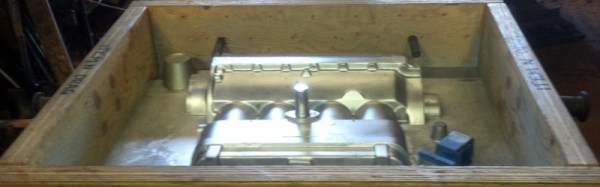
The build took place over a few years and many pages of a forum thread, and includes multiple blow-by-blow accounts, photos, and videos. It started with a set of commercial castings for the engine block, but their finishing and the manufacture of all other engine parts is done in the shop. In the final page or so we see the video we’ve placed below the break, of the finished engine in a test frame being run up on the bench, with a somewhat frightening unguarded airscrew attached to its front and waiting to decapitate an unwary cameraman. Sit down with a cup of your favourite beverage, and read the build from start to finish. We don’t think you’ll be disappointed.

Continue reading “If You’re Going To Make A Model Engine, You Might As Well Make It A Merlin”

Re-Engineering The Ford Model A Engine

Over the nearly a quarter century since the Web has been in existence, there have been various websites and projects in the field covered by Hackaday that have done the rounds and captured our attention for a while. Some have turned into major projects and products, others have collapsed spectacularly, while many have faded away and been forgotten.

It was one of those “I wonder what happened to… ” moments that prompted a search for just such a project that did the rounds a little at the start of this decade. Re-Engineering the Model A Engine is [Terry Burtz]’s project to take the Ford Model A engine from the 1920s and re-engineer it with the benefit of some upgrades to increase its longevity and reliability. The new engine would look identical to the original unit, but would feature modern metallurgy, a re-engineered crankshaft with up-to-date bearings, a pressurised lubrication system, and some cooling system modifications.

The web site has a fascinating technical description and history of the Model A engine, along with a detailed examination of the proposed upgrades. There is a long list of project updates, but sadly work stalled in 2015 due to difficulties finding an iron foundry that could cast the blocks at an affordable price. It’s a shame to see a promising project get so far and fall at this late hurdle, is it too much to hope that among the Hackaday readership there might be people in the foundry business who could advise? It’s quite likely that there would be a queue of Model A owners who would be extremely grateful.

If you think you’ve seen some veteran Ford action here before, you’d be right, but only to a point. Meanwhile where this is being written a similar project for a 1950s Standard Triumph engine would be most welcome.

Fridge Compressor To 2-Stroke Engine: JB Weld For The Win

We like this one because it has a real Junkyard Wars feel to it: turning a cast-off fridge compressor into a two-stroke internal combustion engine. [Makerj101] is doing this with tooling no more complicated than a hacksaw and a hand drill. And JB Weld — lots and lots of JB Weld.

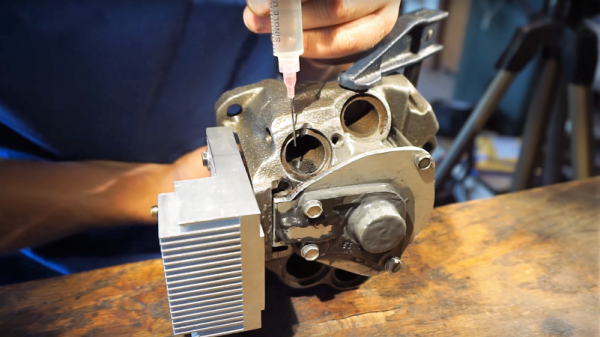
[Makerj101]’s video series takes us through his entire conversion process. Despite the outward similarity between compressors and engines, there are enough crucial differences to make the conversion challenging. A scheme for controlling intake and exhaust had to be implemented, the crankcase needed to be sealed, and a cylinder head with a spark plug needed to be fabricated. All of these steps would have been trivial in a machine shop with mill and lathe, but [Makerj101] chose the hard way. An old CPU heat sink serves as a cylinder head, copper wire forms a head gasket and spacer to decrease the compression ratio, and the old motor rotor serves as a flywheel. JB Weld is slathered everywhere, and to good effect as the test run in the video below shows.

Think you recognize [Makerj101]? You probably do, since we featured his previous machine shop-less engine build. This guy sure gets his money’s worth out of a tube of JB Weld.

Continue reading “Fridge Compressor To 2-Stroke Engine: JB Weld For The Win”

A Live ECU Simulator For OBD2 Projects

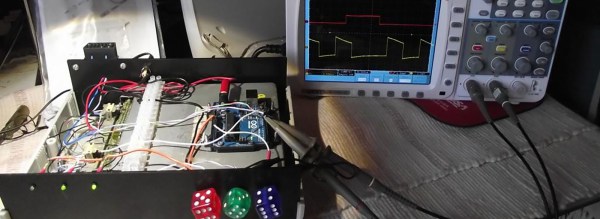
If you are working with OBD2 hardware or software, it’s easy enough to access test data, simply plug into a motor vehicle with an OBD2 socket. If, however, you wish to test OBD2 software under all possible fault conditions likely to be experienced by an engine, you are faced with a problem in that it becomes difficult to simulate all faults on a running engine without breaking it. This led [Fixkick] to create an OBD2 simulator using a secondhand Ford ECU supplied with fake sensor data from an Arduino to persuade it that a real engine was connected.

The write-up is quite a dense block of text to wade through, but if you are new to the world of ECU hacking it offers up some interesting nuggets of information. In it there is described how the crankshaft and camshaft sensors were simulated, as well as the mass airflow sensor, throttle position, and speedometer sensors. Some ECU inputs require a zero-crossing signal, something achieved with the use of small isolating transformers. The result is a boxed up unit containing ECU and Arduino, with potentiometers on its front panel to vary the respective sensor inputs.

We’ve brought you quite a few OBD2 projects over the years, for example, there was this LED tachometer, and a way into GM’s OnStar.

Thanks [darkspr1te] for the tip.

3D Printed Jet Engine

In specific applications, jet engines are often the most efficient internal combustion engines available. Not just for airplanes, but for anything that needs to run on a wide variety of fuels, operate at a consistent high RPM, or run for an extended amount of time. Of course, most people don’t have an extra $4,000 lying around to buy a small hobby engine, but now there’s a 3D-printed axial compressor available from [noob_sauce].

As an aero propulsion engineer, [noob_sauce] is anything but a novice in the world of jet engines. This design is on its fourth iteration with a working model set to be tested by the end of the month. Additionally, [noob_sauce] created his own software that was necessary for the design of such a small, efficient jet engine which has all been made available on Git. So far the only part that has been completed has been the compressor stage of the engine, but it’s still a very impressive build that we don’t see too often due to the complexity and cost of axial compressor jet engines.

Of course, there are some less-complex jet engines that are available to anyone with access to a hardware store and a welder which don’t require hardly any precision at all. While they’re fun and noisy and relatively easy to build, though, they don’t have near the efficiency of a jet engine like this one. The build is impressive on its own, and also great that [noob_sauce] plans to release all the plans so that anyone can build one of these as well.