Designing A PCB GPS Antenna From Scratch

These days, when it comes to GPS devices the antenna is typically part of the package. But what better opportunity for [Pepijn] to learn how to make a GPS antenna from scratch for a badge add-on?

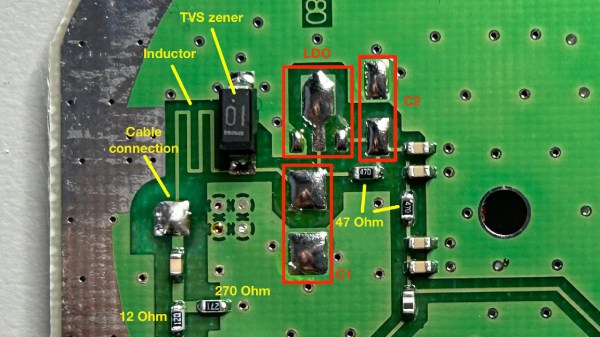
A patch antenna is an antenna of a flat design, which [Pepijn] was going to put directly on a PCB. However, there was added complexity due to GPS being a circularly polarized signal, and that meant doing some research.

Sadly, nowhere did [Pepijn] encounter a straightforward reference design or examples, but in the end success came from going with a truncated corner patch antenna design and using simulation software to figure out exactly what dimensions were needed. (The openEMS free simulation software didn’t bring success, but the non-free Sonnet with a trial license did the trick.) The resulting PCB may not look particularly complex, but every detail matters in such designs.

KiCad handled the PCB CAD design but the prototype came from cutting the PCB on a CNC machine instead of having it fabricated and shipped; a much cheaper and faster option for those with access to the right tools. A bit more testing had the prototype looking good, but the real proof came when it successfully received GPS signals and spewed valid NMEA messages. The design files are on GitHub but as [Pepijn] says, the project was about the journey more than anything else.

PCMCIA Flash Card Gives Up Its Secrets Thanks To Retro Gear

There are two ways to recover data from an obsolete storage medium. One way is to pull out all the tools in the hacker’s kit — with logic analyzers, oscilloscopes, and bit-banged software in a desperate attempt to reverse engineer the original protocol. The other way is to have a really, really deep junk bin that just happens to contain exactly the right pieces that would have been used decades ago.

For recovering data from a 25-year-old PCMCIA memory card, [Dave] from Vintage Apparatus chose the latter method. But to be fair, characterizing the stash of gear he had to select from as a “junk bin” is pretty insulting. It’s more like a museum of retro technology, which just so happened to hold  Toshiba Libretto, a subnotebook computer hailing from the late 1990s. The machine sports a pair of PCMCIA slots and was just the thing to read the data from the old 32 MB SanDisk flash card, which once lived in a backpack-mounted GPS system for surveyors.

If this hack sounds as easy as plugging things into an old computer, you’d be right — if you just happen to have a stack of floppies containing the Windows 98 drivers for said things. So [Dave]’s task became a game of finding the right combination of cards that already had the drivers installed and would provide the connectivity needed to get the data off the flash card. Between a suspiciously crunchy-sounding floppy drive and an Ethernet card dongle badly in need of some contact cleaner, cobbling together the right hardware was a bit of a chore. After that, a lot of the hack was [Dave] just remembering how we used to do things back in the day, with the eventual solution being transferring over the files to an FTP server on a Raspberry Pi.

The video below tells the whole saga, but the real treat might just be the Vintage Apparatus collection of gear. Incidentally, we really like [Dave]’s idea for storing associated bits and bobs.

Continue reading “PCMCIA Flash Card Gives Up Its Secrets Thanks To Retro Gear”

The Voice Of GPS

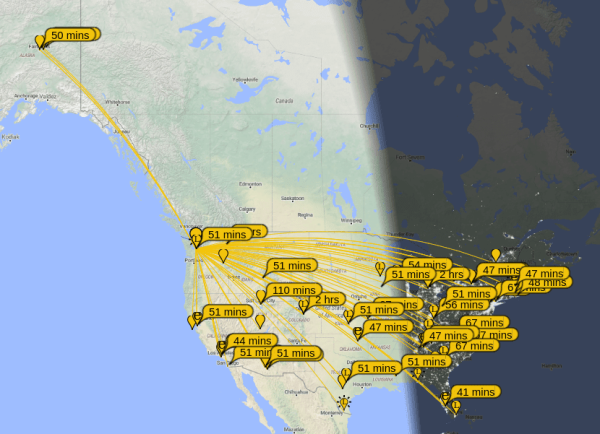
Tuning into a GPS satellite is nothing new. Your phone and your car probably do that multiple times a day. But [dereksgc] has been listening to GPS voice traffic. The traffic originates from COSPAS-SARSAT, which is a decades-old international cooperative of 45 nations and agencies that operates a worldwide search and rescue program. You can watch a video about it below.

Nominally, a person in trouble activates a 406 MHz beacon, and any of the 66 satellites that host COSPAS-SARSAT receivers can pick it up and relay information to the appropriate authorities. These beacons are often attached to aircraft or ships, but there are an increasing number of personal beacons used by campers, hikers, and others who might be in danger and out of reach of a cell phone. The first rescue from this system was in 1982. By 2021, 3,632 people were rescued thanks to the system.

The satellites that listen to the beacon frequencies don’t process the signals. They use a transponder that re-transmits anything it hears on a much higher downlink frequency. These transponders are always payloads on other satellites like navigation or weather satellites. But because the transponder doesn’t care what it hears, it sometimes rebroadcasts signals from things other than beacons. We were unclear if these were rogue radios or radios with spurious emissions in the translator’s input range.

The video has practical tips on how to tune in several of the satellites that carry these transponders. Might be a fun weekend project with a software-defined radio.

We’ve seen homebrew satellite devices, but none for an emergency beacon — we aren’t sure what the legal aspects of that would be. There are other satellites that unknowingly host pirate radio stations, too.

Continue reading “The Voice Of GPS”

Cosmic Ray Navigation

GPS is a handy modern gadget — until you go inside, underground, or underwater. Japanese researchers want to build a GPS-like system with a twist. It uses cosmic ray muons, which can easily penetrate buildings to create high-precision navigation systems. You can read about it in their recent paper. The technology goes by MUWNS or wireless muometric navigation system — quite a mouthful.

With GPS, satellites with well-known positions beam a signal that allows location determination. However, those signals are relatively weak radio waves. In this new technique, the reference points are also placed in well-understood positions, but instead of sending a signal, they detect cosmic rays and relay information about what it detects to receivers.

The receivers also pick up cosmic rays, and by determining the differences in detection, very precise navigation is possible. Like GPS, you need a well-synchronized clock and a way for the reference receivers to communicate with the receiver.

Muons penetrate deeper than other particles because of their greater mass. Cosmic rays form secondary muons in the atmosphere. About 10,000 muons reach every square meter of our planet at any minute. In reality, the cosmic ray impacts atoms in the atmosphere and creates pions which decay rapidly into muons. The muon lifetime is short, but time dilation means that a short life traveling at 99% of the speed of light seems much longer on Earth and this allows them to reach deep underground before they expire.

Detecting muons might not be as hard as you think. Even a Raspberry Pi can do it.

Adding Variometer Functionality To A GPS

Flying a glider, or similarly piloting a paraglider or hang glider, can all be pathways into aviation with a lower barrier of entry than powered flight. Sacrificing one’s engine does generate a few complexities, but can be rewarding as the pilot searches for various means of increasing altitude like ridge soaring or thermaling. You’ll need a special instrument called a variometer to know just how much altitude you’re gaining though, like this one which is built into commercially-available handheld GPS units.

These GPS units are normally intended for use on terra firma only, but [Oganisyan] has figured out a clever way to add this flight instrumentation to these units to help when operating a paraglider. An ATmega328 paired with a pressure sensor is added to the inside of the GPS units and communicates with an available serial interface within the units. To complete the modification, a patched firmware must be installed which adds the variometer function to the display. This upgrade is compatible with a handful of GPS units as well such as the BikePilot2+ or Falk Tiger.

For those who already own one of these GPS units, this could be a cost-effective way of obtaining a variometer, especially since commercially-available variometers tailored for this sort of application can cost around $200 to $500. It is an activity sensitive to cost, though, as it offers a much more affordable option for taking to the skies than any powered craft could, with an exception made for this powered paraglider which offers the ability for powered take off and flight extension using electric-powered props.

Thanks to [MartinO] for the tip!

Developing An Open Source Bike Computer

While bicycles appear to have standardized around a relatively common shape and size, parts for these bikes are another story entirely. It seems as though most reputable bike manufacturers are currently racing against each other to see who can include the most planned obsolescence and force their customers to upgrade even when their old bikes might otherwise be perfectly fine. Luckily, the magic of open source components could solve some of this issue, and this open-source bike computer is something you’ll never have to worry about being forced to upgrade.

The build is based around a Raspberry Pi Zero in order to keep it compact, and it uses a small 2.7 inch LCD screen to display some common information about the current bike ride, including location, speed, and power input from the pedals. It also includes some I2C sensors including pressure and temperature as well as an accelerometer. The system can also be configured to display a map of the current ride as well thanks to the GPS equipment housed inside. It keeps a log in a .fit file format as well so that all rides can be archived.

When compared against a commercial offering it seems to hold up pretty well, and we especially like that it’s not behind a walled garden like other products which could, at any point, decide to charge for map upgrades (or not offer them at all). It’s a little more work to set up, of course, but worth it in the end. It might also be a good idea to pair it with other open source bicycle components as well.

Thanks to [Richard] for the tip!

Garmin HUD Got Discontinued, But Not Trashed

The Garmin HUD+ was a small Bluetooth device intended for the dashboard of a car, meant to be used as a GPS heads-up display for data from Garmin smartphone apps. It used a bright VFD (vacuum fluorescent display) which was viewed through a clear reflector, and displayed GPS information and directions. It was discontinued in 2015, but [Doz] was fond of his and used it happily until a phone upgrade meant it no longer worked. Was it destined for a landfill? Not if he had anything to say about it!

The first thing [Doz] tried was using an alternate Android app, but since it also didn’t work, it was time to sit back and reflect on the scope of the issue. In [Doz]’s case, he really only wanted some basic meaningful data displayed, and decided he could do away with the phone altogether if he had the right hardware. Continue reading “Garmin HUD Got Discontinued, But Not Trashed”