USB VU-meter

[youtube http://www.youtube.com/watch?v=jsg24MGNpRc&feature=player_embedded%5D

WaitingForFriday’s [Simon Inns] is quite possibly the USB interface and PIC master. This week he let us know about his VU-meter repurposed as a computer performance monitor using a PIC18F2550 and his open source USB Generic HID communication class. With PWM the meter’s needles and RGB LED can be accurately set and even dampened for CPU usage, network usage, HDD utilization, and even memory usage. Oddly enough, in his software we didn’t find the ability to use the device as a VU-meter – go figure.

Punching Accelerometers

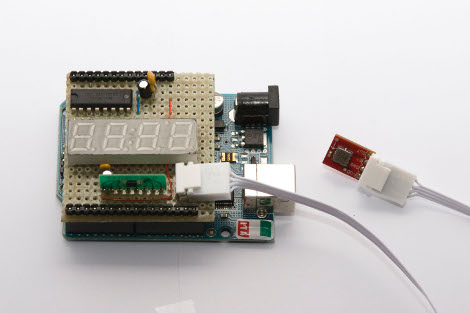
Shortly after finishing his Makiwara punching bag, [Abieneman] wired and programmed an Arduino to an accelerometer to find out just how much acceleration (and with some math, force) is behind his punches. The project is simple and would be quick to reproduce for your own measuring and experiments: all that he used included an Arduino, accelerometer (with A/D converter), LED displays (and shift register). We were a little disappointed to learn of how much static the accelerometer produced, so measuring things such as impulse, energy, and pretty much anything not kinematic is nullified. But it makes us wonder, how much static would be in say, a Wii Remote punching bag?

What Kind Of LED Matrix Does Your Vodka Come With?

Medea Vodka comes with a bottle that includes a blue scrolling LED Marquee. OK, great? It’s an interesting marketing ploy but kind of a waste don’t you think? Friends, it’s up to us to repurpose this  hardware. It can’t be that difficult to hack into the programmable display and make it do your bidding. Our friend Google tells us that you can get your hands on this 750 milliliter bottle for about $40. That’s around $25 more than a passable grade of Vodka sells for, a mere pittance for the challenge of cracking open the hardware for fun and profit. Don’t forget to document your work and tip us off once you’ve accomplished something. See Medea’s programming instructional video after the break. Oh yeah, remember to hack first and drink later… cheap soldering irons get hot!

Continue reading “What Kind Of LED Matrix Does Your Vodka Come With?”

Intruder Alarm McDonald’s Toy Hacking

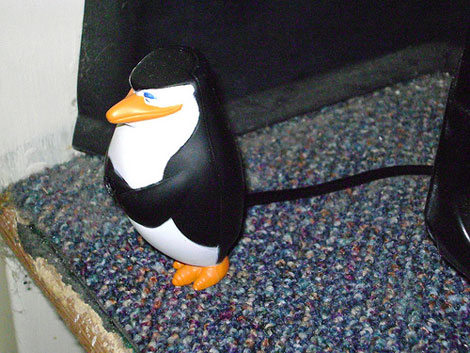
[malikaii] needed to set up some kind of tripwire style alarm system for his office. His bosses kept sneaking in to find him slacking. So, like any loyal hacker, instead of just working harder he built an alarm system. After a failed attempt to recreate an IR alarm circuit he found on the web and built from old appliance parts, he found the Hack a Day article about harvesting McDonald’s toys. The end result was a fully functional IR detecting alarm for the office doorway. This is pretty simple really, the best kind of hack.

Flash Animations On Peggy2.0

[vimeo=http://vimeo.com/10453715]

The LED display toy known as the Peggy2.0 just keeps getting cooler and cooler.  [Leonard] is now sharing with us how we can stream flash animations to one. It requires some Java and an Arduino, but the final effect is quite fluid and responsive. We’ve seen the Peggy grow from basically an electronic litebright to doing video and even being chained together to make larger displays.

[via EMSL]

LED Lighting, A Learning Experience

[Joel] has a very specific color temperature of lighting he wants in his home. So specific, he’s decided to build his own LED lighting to get it. Actually, he’s still searching for that perfect shade of white, but doing so has learned a lot.  He initially made some very pretty PCBs, but then found that hand soldering them made quite a mess. What better time to delve into reflowing? He shares his positive initiation to the skillet method in his latest update. The search still continues for that nice warm glow he’s desiring. We’ve actually seen [Joel] before, he likes smoked meat.

Woot How-to: Let There Be Light! (for Your Rovio)

Before we get into the how-to, we felt it would be appropriate to explain a little bit about how this came to be. As many of you may remember, a couple of months ago we attended CES 2010. While there, we also attended the It Won’t Stay in Vegas Blogger party and ended up meeting the guys from Woot. After all of us spent a little bit of time appreciating the open bar, a group of us stood ended up standing around and talking shop for a while. All of a sudden, a member of our group, Jeremy Grosser, proposed the idea that Hackaday and Woot form a partnership. Basically, they would give us a heads up on what they are going to sell and we would write up a how-to on how to do something cool or useful with that product. Then, when the day came for Woot to sell the product, we would post our how-to. What you are reading right now just so happens to be that idea in action, the first official partnership between Hackaday and Woot. In this how-to, we’ll be taking apart the Wowwee Rovio mobile webcam robot, adding some super-bright LEDs for better see-in-the-dark action, and see how some software called RoboRealm can give it a little bit of artificial intelligence.

Continue reading “Woot How-to: Let There Be Light! (for Your Rovio)”