Custom LED Signage From Household Items

We’ll admit it: sometimes we overthink things. We imagine some of you are the same way; there seems to be something in the hacker mentality that drives us to occasionally over-engineer ideas to the point of unrecognizability. There’s nothing inherently wrong with this, but sometimes it does keep us from seeing easier solutions.

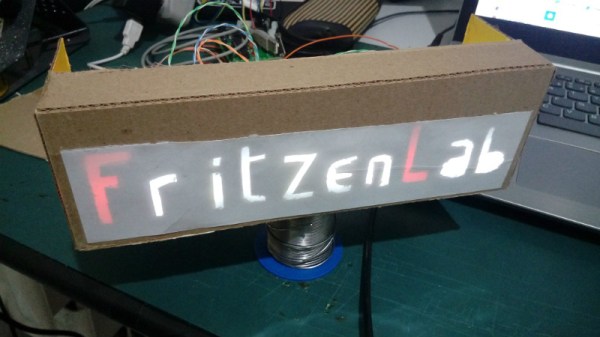
For example, the very slick looking personalized LED sign (Google Translate) that [Clovis Fritzen] recently wrote in to share with us. If we were tasked with creating something like this there would certainly have been a 3D printer and likely a CNC involved before all was said and done, and a few days later we’d still be working out the bugs in our OpenSCAD code. But his approach is very different. Fantastically simple and constructed largely from household items, this is a good project to keep the Junior Hackers entertained on a rainy weekend.

The first step of the process is to draw out the characters you want onto a piece of cardboard, and then carefully cut it out. If you’re worried that you’re not particularly artistic, this step will go a bit better if you print out the design and tape the paper over the cardboard to serve as a template. Once you’ve got your design cut out, you glue or tape a piece of standard printer paper over it. This is the face of the display; it just needs to be lit from behind.

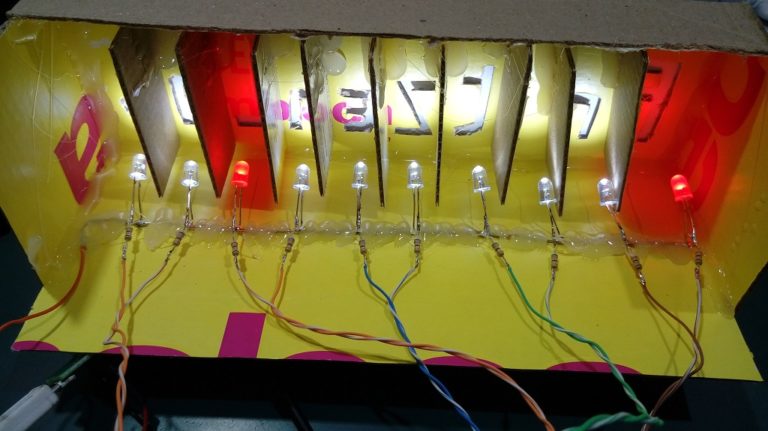
If you wanted to make a sign that was just a single color and didn’t have individually addressable elements, then it would be enough to illuminate the whole cutout with a single light source. But where’s the appeal in that? As [Clovis] shows, you can get much better results by constructing a segmented box, with one LED in each cell. By wiring each LED to a pin on an Arduino or other microcontroller, you’ll have control over the color and brightness of each section of the sign.

Of course, if you’re not big on the whole cardboard aesthetic, you could even recreate this design with the aforementioned CNC and 3D printer. [Clovis] shows how the basic concept works, and that it can be scaled pretty easily depending on the kind of materials you have access to.

Ghost Rider Costume Is Smoking Hot

It’s that spooky time of year once again, with pumpkins and cobwebs as far as the eye can see. This year, [Mikeasaurus] has put together something really special – a Ghost Rider costume with some amazing effects.

The costume starts with the skull mask, which started with a model from Thingiverse. Conveniently, the model was already set up to be 3D printed in separate pieces. [Mike] further modified the design by cutting out the middle to make it wearable. The mask was printed in low resolution and then assembled. [Mike] didn’t worry too much about making things perfect early on, as the final finish involved plenty of sanding and putty to get the surface just right. To complete the spooky look, the skull got a lick of ivory paint and a distressed finish with some diluted black acrylic.

With the visual components complete, [Mike] turned his attention to the effects. Light is courtesy of a series of self-blinking LEDs, fitted inside the mask to give the eye sockets a menacing orange glow. However, the pièce de résistance is the smoke effect, courtesy of a powerful e-cigarette device and an aquarium pump. At 225W, and filled with vegetable glycerine, this combination produces thick clouds of smoke which emanate from the back of the wearer’s jacket and within the skull itself. Truly stunning.

[Mike] reports that the costume is scary enough that he has been banned from answering the door as Ghost Rider. We think it’s bound to be a hit, regardless. For another epic mask build, check out the Borderlands Psycho. Video after the break. Continue reading “Ghost Rider Costume Is Smoking Hot”

Shedding A Bit Of Light On Some Logic

When it comes to logic technologies, we like to think we’ve seen them all here at Hackaday. But our community never ceases to surprise us with its variety and ingenuity, so it should be a surprise that [Dr Cockroach] has delivered one we’ve not seen before. Light logic doesn’t use the conventional active devices you’d expect such as transistors, tubes, or even relays. Instead, it uses LEDs and CdS cells to make rudimentary switches. So far there is a NAND, a NOR, and a set-reset latch that appears in the video below the break, and it is not inconceivable that much more complex devices could be crafted.

The CdS cell switch is not too far different in operation to a transistor, with the CdS cell forming half of a potential divider as a rough equivalent of a collector-emitter circuit, and the LED feeding its light to the cell and forming a rough equivalent of a base circuit. It would probably not form a very good analog of a transistor and it seems likely that is will not be the fastest of devices, but we applaud the ingenuity in coming up with it.

CdS cells are a component that seems almost to come from another era, redolent of childhood electronic kits from days of yore. It’s no surprise we don’t see them too often, though, they pop up in the occasional automatic sunglasses.

Continue reading “Shedding A Bit Of Light On Some Logic”

Trashed TV Gets RGB LED Backlight

It might not be obvious unless you’ve taken one apart, but most of the TVs and monitors listed as “LED” are simply LCD panels that use a bank of LEDs to illuminate them from behind. Similarly, what are generally referred to as “LCDs” are LCD panels that use fluorescent tubes for illumination. To get a true LED display with no separate backlight, you need OLED. Confused? Welcome to the world of consumer technology.

With those distinctions in mind, the hack that [Zenodilodon] recently performed on a broken “LED TV” is really rather brilliant. By removing the dead white LED backlights and replacing them with RGB LED strips, he not only got the TV working again, but also imbued it with color changing abilities. Perfect for displaying music visualizations, or kicking your next film night into high gear with a really trippy showing of Seven Samurai.

In the video after the break, [Zenodilodon] starts his RGB transplant by stripping the TV down to its principal parts. The original LEDs were toasted, so they might as well go straight in the bin alongside their driver electronics. But the LCD panel itself was working fine (tested by shining a laser pointer through it to see if there was an image), and the plastic sheets which diffuse the LED backlight were easily salvaged.

With the old LEDs removed, [Zenodilodon] laid out his new strips and soldered them up to the external controller. He was careful to use all white wires, as he was worried colored wires might reflect the white light and be noticeable on the display. After buttoning the TV back up, he went through a few demonstrations to show how the image looked with the white LEDs on, as well as some interesting effects that could be seen when the LEDs are cycling through colors.

The RGB strips don’t light up the display as well as the original backlight did, as there are some obvious dark spots and you can see some horizontal lines where the strips are. But [Zenodilodon] says the effect isn’t too bad in real-life, and considering it was a cheap TV the image quality was probably never that great to begin with.

On the flip side, if you find an LED TV or monitor in the trash with a cracked screen, it might be worth taking it home to salvage its super-bright white LEDs for your lighting projects.

Continue reading “Trashed TV Gets RGB LED Backlight”

Gaze Upon This Daft Punk Helmet’s Rows Of Utterly Perfect Hand-Soldered LEDs

The iconic robot helmets of Daft Punk feature prominently as challenging DIY hardware projects in their own right, and the results never disappoint. But [Nathaniel Stepp]’s photo gallery of his own version really sets the bar in both quality and attention to detail. The helmet uses a Teensy 3.2 as the main processor, and the visor consists of 328 hand soldered through-hole APA106 addressable RGB LEDs. A laser cut panel serves as the frame for the LEDs, and it was heat-formed to curve around the helmet and mate into the surrounding frame. Each LED is meticulously hand-soldered, complete with its own surface mount decoupling cap; there’s no wasted space or excess wire anywhere to be seen. It looks as if a small 3D printed jig was used to align and solder the LEDs one or two columns at a time, which were then transferred to the visor for final connections with the power bus and its neighboring LEDs.

After the whole array was assembled and working, the back of each LED appears to have then been carefully coated in what looks like Plasti-Dip in order to block light, probably to minimize the blinding of the wearer. A small amount of space between each LED allows the eyeballs inside the helmet to see past the light show in the visor.

The perfectly done array of LEDs in the visor is just one of the design elements showing the incredible workmanship and detail in [Nathaniel]’s helmet. His website promises more build details are coming, but in the meantime you can drink in the details shown in the aforementioned photo gallery.

With Halloween approaching, you might be interested in rolling your own Daft Punk inspired helmet. Not ready to do everything from scratch? No problem, because it’s never been easier to make your own with the help of a 3D printer and some LED strips.

[via SparkFun Blog]

DIY Studio Lights To Improve Your Videos

It’s 2018, a full thirteen years since YouTube was founded. With an online sharing service up and running, and high-resolution cameras in just about every mobile phone, the production of video has been democratized. Sadly, for those citizens with eyes, the production of good video is not so widespread. What’s one thing you need for good video? Good lighting – and you can build it yourself.

This build from [DIY Perks] relies upon readily available components and uses simple build techniques accessible to the average maker. Using cheap LED strips (albeit photography-grade ones), along with off-the-shelf plastics and dimmer modules, it’s possible to build a light that preserves colour integrity while being lightweight, compact, and easy to use. The final product is remarkably elegant – at a glance it could be a commercial product. Nifty tricks like daisy chaining the power supplies and combining different spectrum LEDs for better control add to the functionality.

Overall, it’s a build that does take some time, but it could easily be completed in a weekend and the results are top notch. It’s not the first lightbox build we’ve seen here, either. Video after the break.

[Thanks to Keith O for the tip!]

Continue reading “DIY Studio Lights To Improve Your Videos”

World’s Smallest LED Blinky

[Mike Harrison] is known for incredibly tiny soldering. Now he’s claiming a “world’s smallest” in the form of a stand-alone LED blinker, and we think he’s got the record.

He brought it along with him to Friday’s Beagleboard Bring-a-Hack, and we got a close look at the diminutive assembly. The project was dreamed up when [Mike] saw an announcement from Seiko about a new supercapacitor in a tiny package (likely the CPH3225A giving the blinky a footprint of 3.2 x 2.5 mm). With that in hand he added a PIC 10f322 microcontroller in a SOT23 package, an 0603 smoothing capacitor, and an SMD LED.

With such a tiny package, the trickiest part is figuring out how to charge that supercap. [Mike] used a drill and hand files to make a square hole in a CR2032 battery holder to serve as a jig. The bottom of the supercap rests against the battery as a pogo pin makes the second connection to a terminal on the side of his assembly. It charges quickly and will happily blink away for about six minutes after charging.

Mike set out to make two of these, but dropped the second supercap when at his workbench to be forever lost in the detritus common to every electronics workshop. When he first pulled it out at the meetup we were on a rooftop terrace and we were more than a bit concerned that this would just blow away. How do you begin to fabricate such a tiny assembly? He used UV cured epoxy to glue them together first, then somehow completed the soldering by hand!

Continue reading “World’s Smallest LED Blinky”