Friday Hack Chat: All About LED Design

There are three great enabling technologies of the last twenty years. The first is lithium batteries that hold a lot of juice. Quadcopters wouldn’t exist without them, and the Tesla Model S wouldn’t either. The second is crazy powerful brushless motors. Here, again, quads wouldn’t exist without them, but we’re also getting smaller, torquier, and more powerful motion platforms.

The third great enabling technology in recent memory is LEDs. Remember when the PlayStation 2 came out, and everyone was amazed by the blue LED? That blue LED won a Nobel Prize. Now, we have LED light bulbs, LEDs in any color of the rainbow, powerful UV LEDs, and bazillion candela flashlights. LEDs are awesome.

For this week’s Hack Chat, we’re going to be talking all about LEDs. Everything from strips to rings, discrete to waterproof, COBs, weird colors, and everything in between. If you’re looking to replace your workshop lighting with LEDs, this is the Hack Chat for you. If you’ve ever wondered about the quality of LEDs, and the price-performance ratio, this is for you. This is all about blinky bling.

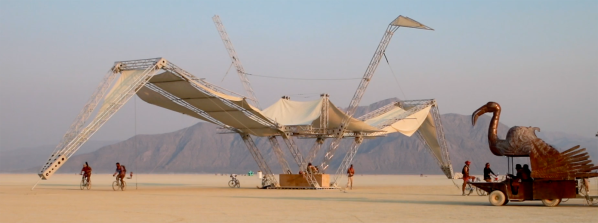
Our guest for this week’s Hack Chat will be [Metalnat], founder of the Burbank MakerSpace, a recent resident of the Supplyframe DesignLab where he designed a VR controller, and worked on Crane, a flapping automaton that glided over the playa at this year’s Burning Man. During this Hack Chat, we’ll be talking about LEDs, including installation methods, types of LEDs, suppliers, and LED manufacturing methods.

This is a Hack Chat, so we’re taking questions from the audience. Here’s a spreadsheet we’ll be using to guide the discussion.

Here’s How To Take Part:

join-hack-chatOur Hack Chats are live community events on the Hackaday.io Hack Chat group messaging. This Hack Chat will be going down noon, Pacific time on Friday, September 29th. Sidereal and solar getting you down? Wondering when noon is this month? Not a problem: here’s a handy countdown timer!

Click that speech bubble to the right, and you’ll be taken directly to the Hack Chat group on Hackaday.io.

You don’t have to wait until Friday; join whenever you want and you can see what the community is talking about.

An Enchanted Rose For A Beauty

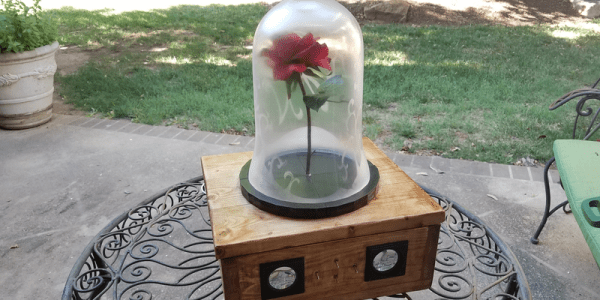
Being a maker opens up so many doors in terms of ways to romance one’s partner through passion projects. If their passion is Disney films, then you may handily make them the enchanted rose from Beauty and the Beast for their birthday. Easy-peasy.

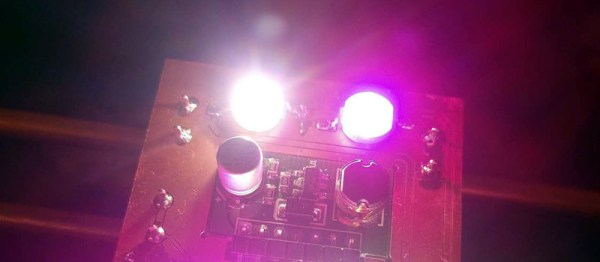
In addition to the love and care that went into this build, redditor [Vonblackhawk2811] has included a set of LEDs, salvaged from cheap flashlights and electronic candles, which are controlled by four toggle switches and offer multiple lighting selections — candlelight, soft white, colour cycling, and bright white — to appropriately set the mood. As if that wasn’t enough to romance his sweetheart, he’s also included an aux cord input and a pair of speakers so they may be serenaded by a tune or two as they dance the night away.

Liberal use of hot glue and duct tape are keeping the electronics secured, preventing any shorts. After all — what would it say if this gift went up in flames? An inspired stencil design — hand drawn and cut out — was used to apply a spray-on frosted glass finish to the cloche, and a romantic phrase was burned into the base, completing this heartfelt gift. The only quibble we have is that now we all have to step up our game in the courtship department.

That is, unless one is sporting the Romance Pants.

[via /r/DIY]

Hackaday Prize Entry: Modular Rail Lighting

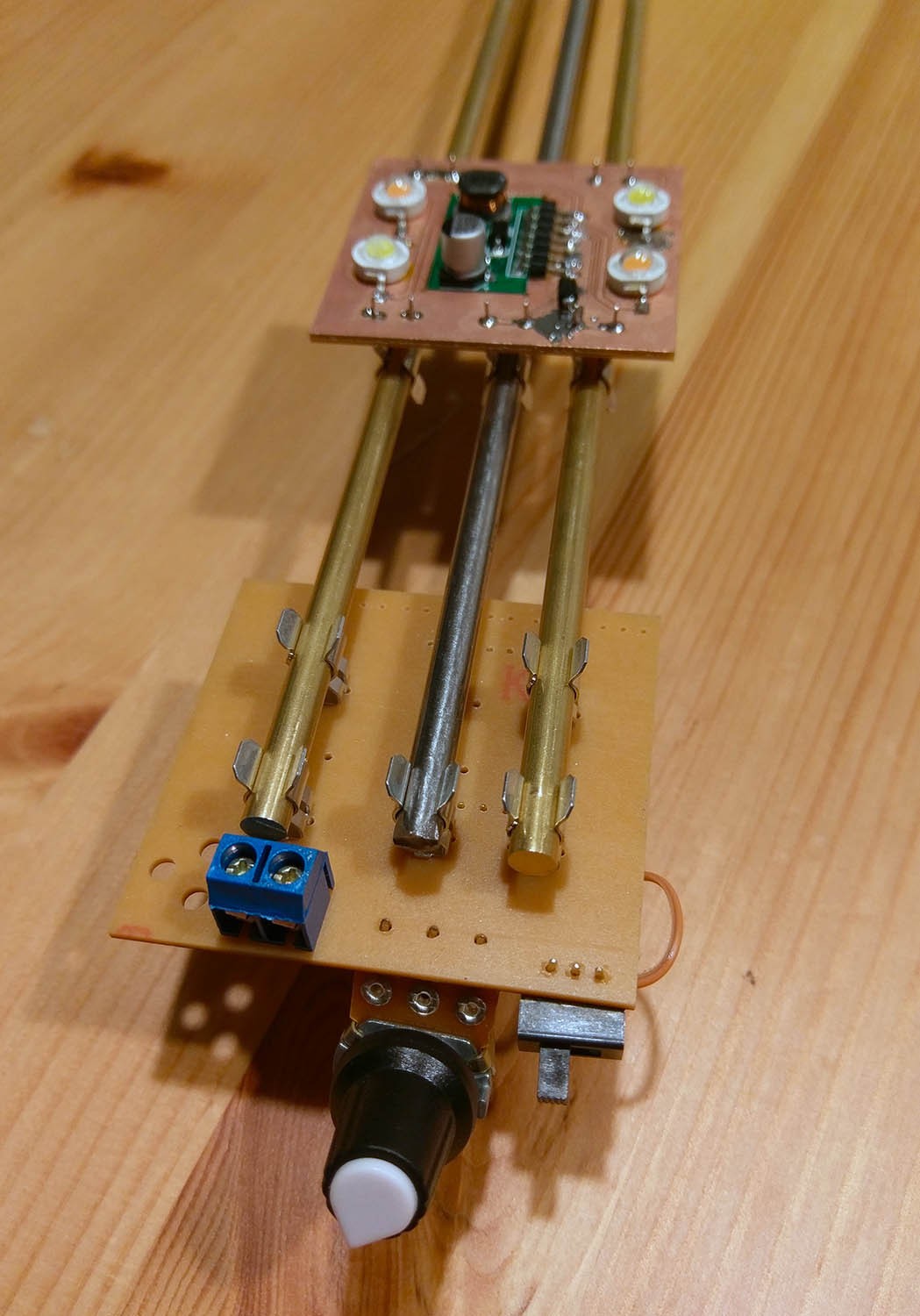
When operating any kind of hydroponic farming, there are a number of lighting solutions — few of them inexpensive. Originally looking for an alternative to the lighting of IKEA’s expensive hydroponics system, [Professor Fartsparkle] and their colleague prototyped a rail system that allows clip-on LED boards for variable lighting options.

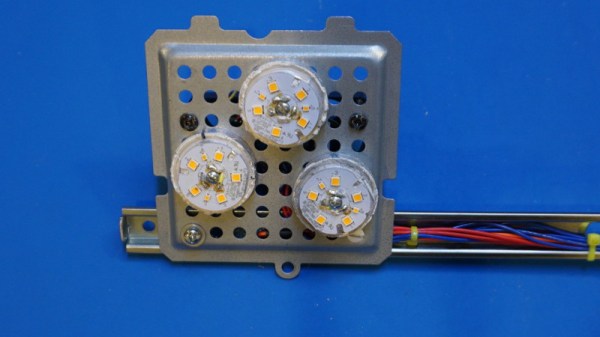
Taking inspiration from wire and track lighting systems, the key was the 5mm fuse holders mounted on the bottom of the LED boards. Snipping off their stopping clip makes them easy to install and remove from the mounting rails. The rails themselves double as power conduits for the LED boards, but keeping them out of the way is easily done with the variety of 3D printed hangers [Professor Fartsparkle] has devised. Lighting is controlled by a potentiometer on the power injection board, as well as any home automation control via an ESP8266.

[Professor Fartsparkle] asserts that the boards can be slid along the rails without any noticeable flickering, but they do suffer from heat dissipation issues. That aside, the prototype works well enough that the 3W LEDs can be run at half power.

This is an ingenious — and cheap — workaround for when sunlight isn’t an option, but you are still looking for a solution capable of automation.

Servo-Controlled IoT Light Switches

The Internet of Things is fun to play with; there’s all manner of devices to automate and control remotely. It can be sketchy, though — make a mistake when coding your automatic plant watering system and you could flood your house. Make a mistake with a space heater and you could burn it down. Combine these risks with the fact that many people live in rental properties, and it can be a difficult proposition to bring the Internet of Things to your home.

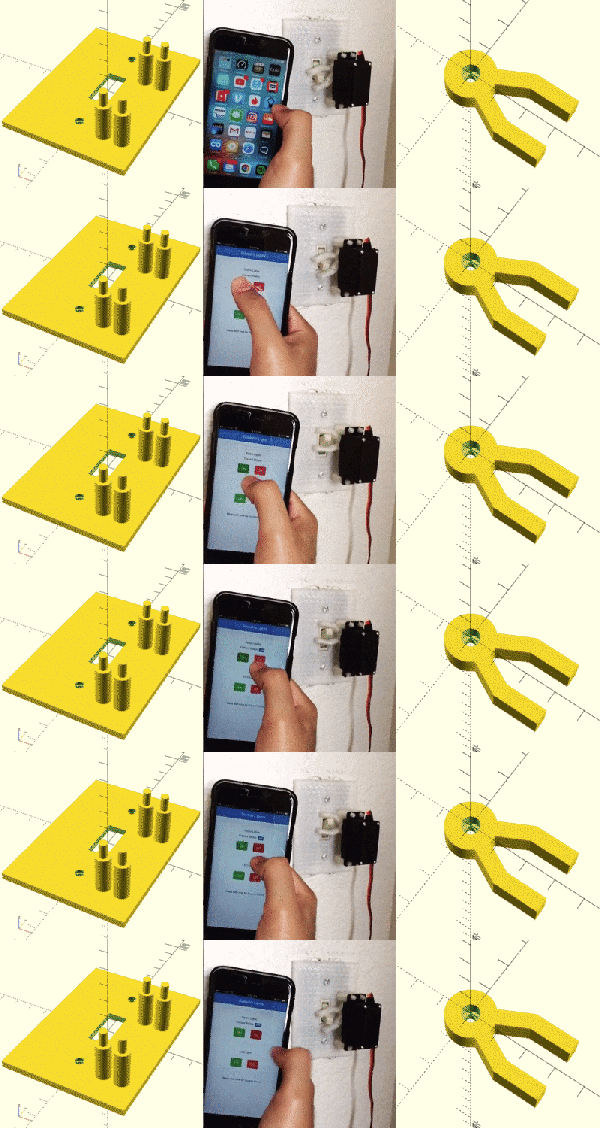
[Suyash] came up with a way around this by building 3D printed light switch covers that add servo control. It’s a great solution that it doesn’t require the modification of any mains wiring, and interfaces with the standard switches in the normal way. It makes it a lot safer this way — there are municipal wiring codes for a reason. This is a great example of what you can do with a 3D printer, above and beyond printing out Yoda heads and keychains.

The backend of things is handled by the venerable ESP8266, with [Suyash]’s custom IoT library known as conduit doing the heavy lifting. The library is a way to quickly build IoT devices with web interfaces, and [Suyash] claims it’s possible to be blinking an LED from the cloud within 5 minutes using the tool.

For another take on an IoT light switch, check out this Hackaday Prize entry from 2016.

Pulley Lamp Stands Up With You

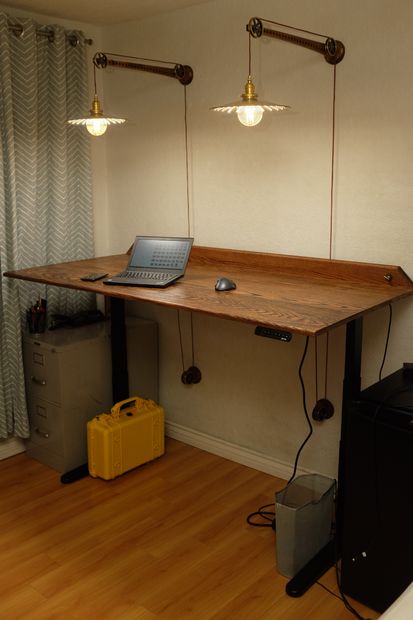
Standing desks are either the best thing since sliced bread, or the fastest way to make your legs tired and get you ridiculed by your coworkers in the bargain. This leads some folks to compromise and make standing desks that can be re-lowered to sitting height when you need to take a break. But now the distance from your desktop to the light source that illuminates it has changed. We can’t have that!

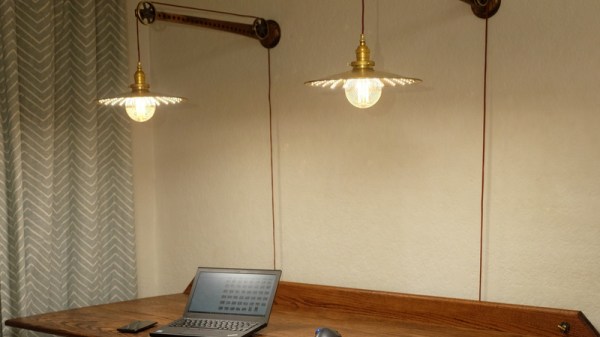
fo6i703itw44bt1-medium[John Culbertson] came up with a very elegant solution to the “problem”. He made lights that are suspended on pulleys that raise and lower with the desk itself. We’re not sure that you’re in the same situation he is, but we’re sure that you’ll agree that he did a nice job.

Besides the pulley mechanism, the light shades are a work of art. [John] clearly wanted a retro feel, so he used low-voltage lightbulbs, but augmented them with LED strips to pump out the lumens. All in all, there’s a tremendous attention to detail in the project, and it shows.

Disclaimer: your humble author is writing you this missive from a standing desk. Ours is just a regular desk put up on bricks — a temporary solution that’s become permanent. We’re always keeping our eyes out for mechanisms to make the desk convertible, but everything that we’ve seen is either overkill or ridiculously overpriced or both. It’s hard to beat 24 bricks at $0.35 apiece. Anyone have any suggestions?

Of course, with an adjustable desk come the problems of moving your lighting along with it, but [John] has solved that one for us.

LED Bulb-shade Cityscapes

Cost-effective LED lighting for your home has opened up many doors for more efficient living, but also some more creative illumination for your living space. If you want to bring the dazzle of city lights right into your home, [David Grass] has two projects to sate this desire in perhaps the most literal way possible: Huddle and Stalaclights.

These clever, 3D printed bulbshades are possible since LEDs emit very little heat, and can be printed in a variety of designs. Huddle is named for — and illustrates — humanity’s coalescing into cities as the centre of modern life from which most of our information and technology emits. Stalaclights offers an inverted perspective on the straining heights of skyscrapers and is inspired by the Art Deco era and the expansion of cities like New York and Chicago.

Continue reading “LED Bulb-shade Cityscapes”

Landscape Lighting That Also Texts

Your local hardware store or garden supply center probably has everything you need to install landscape lighting all around your property. What’s a little less likely is coming out of that situation with fewer holes in your wallet than in your yard. And even then, it’s pretty much guaranteed that any off-the-shelf equipment won’t send you a text message when your landscape lighting isn’t working properly. [Mark]’s landscape lighting system does, though!

Powered by a Raspberry Pi, this landscape lighting system has every feature imaginable. It can turn the lighting on at sunset and turn it off at a set or random time later in the evening. There’s a web interface served from the Pi that allows further user control. The Raspberry Pi also monitors the lighting and can sense when one of the lights burns out. When one does, the Pi uses Twillo to send a text message notification.

There’s not many more features we can imagine packing into a setup like this. Of course, if you don’t have a spare Pi around you can probably manage to get the job done with an ESP8266, or even an old-fashioned Arduino.