Expensive Batteries Hide Cheap Tricks

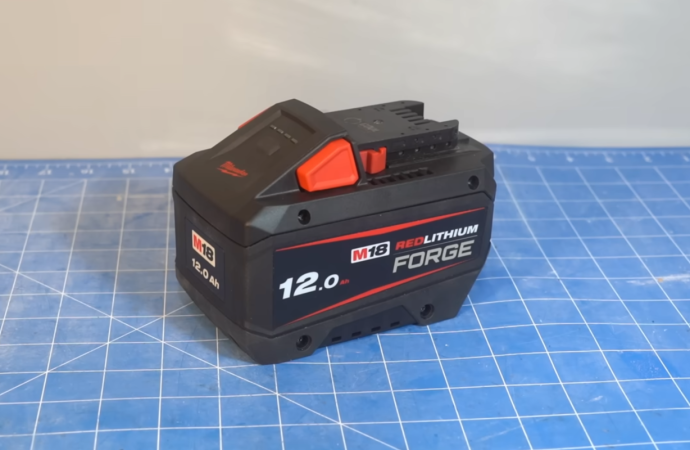
In our modern world full of planned obsolescence helping to fuel cycles of consumerism, the thing that really lets companies dial this up to the max is locked-down electronics and software. We all know the key players in this game whether it’s an automotive manufacturer, video game console producer, smart phone developer, or fruit-based computer company of choice, but there are some lesser known players desperately trying to make names for themselves in this arena too. Many power tool manufacturers like Milwaukee build sub-par battery packs that will wear out prematurely as [Tool Scientist] shows in this video.

Determining that these packs don’t actually balance their cells isn’t as straightforward as looking for leads going to the positive terminal of each. The microcontrollers running the electronics in these packs are hooked up, but it seems like it’s only to communicate status information about the batteries and not perform any balancing. [Tool Scientist] tested this hypothesis through a number of tests after purposefully adding an imbalance to a battery pack, first by monitoring i2c communications, measuring across a resistor expected to show a voltage drop during balancing, let a battery sit 21 days on a charger, and then performing a number of charge and discharge cycles. After all of that the imbalance was still there, leading to a conclusion that Milwaukee still doesn’t balance their battery packs.

Giving them the benefit of the doubt, it could be that most packs will be just fine after years without balancing, so the added cost of this feature isn’t worth it. This video was put out nearly a year ago, so it’s possible Milwaukee has made improvements since then. But a more realistic take, especially in a world dominated by subscription services and other methods of value extraction, is that Milwaukee is doing this so that users will end up having to buy more batteries. They already make user serviceability fairly difficult, so this would be in line with other actions they’ve taken. Or it could be chalked up to laziness, similar to the Nissan Leaf and its lack of active thermal management in its battery systems.

Thanks to [Polykit] for the tip!
Continue reading “Expensive Batteries Hide Cheap Tricks”

Force Feedback Steering Wheel Made From Power Drill

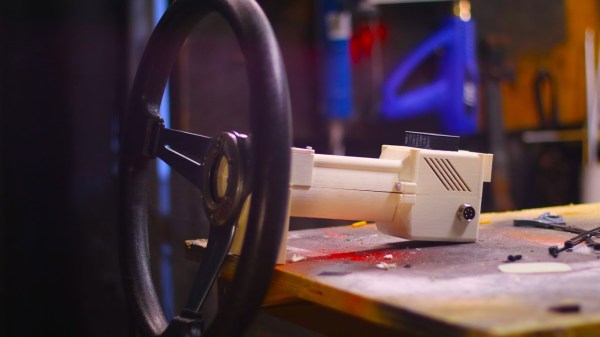
When it comes to controllers for racing games, there is perhaps no better option than a force feedback steering wheel. With a built-in motor to push against the wheel at exactly the right times, they can realistically mimic the behavior of a steering wheel from a real car. The only major downside is cost, with controllers often reaching many hundreds of dollars. [Jason] thought it shouldn’t be that hard to build one from a few spare parts though and went about building this prototype force feedback steering wheel for himself.

Sourcing the motor for the steering wheel wasn’t as straightforward as he thought originally. The first place he looked was an old printer, but the DC motor he scavenged from it didn’t have enough torque to make the controller behave realistically, so he turned to a high-torque motor from a battery-powered impact driver. This also has the benefit of coming along with a planetary gearbox as well, keeping the size down, as well as including its own high-current circuitry. The printer turned out to not be a total loss either, as the encoder from the printer was used to send position data about the steering wheel back to the racing game. Controlling the device is an Arduino, which performs double duty sending controller information from the steering wheel as well as receiving force feedback instructions from the game to drive the motor in the steering wheel. Continue reading “Force Feedback Steering Wheel Made From Power Drill”

The Flight Of The Dremel

A few months ago we featured a model aircraft whose power plant came courtesy of an angle grinder. It was the work of [Peter Sripol], and it seems he was beseiged by suggestions afterwards that he might follow it up with a helicopter built using a Dremel rotary tool. Which he duly did, and the results can be seen in the video below the break.

The Dremel itself requires a gearing to drive the balsa-bladed rotor, and a tail rotor is mounted with its own motor at the end of a boom. The video has many entertaining failures which see him arrive at a set of balancing arms and a tailplane for stability. The result is a helicopter that flies after a fashion, and is even able to stay aloft for a few seconds rather than crashing to earth.

The machine lacks the full rotor pitch control of its commercial bretheren, indeed the only control is directional via the tail rotor. Still it deserves top marks for entertainment alone, and we wouldn’t mind a go ourselves. The original angle grinder craft can be seen here.

Continue reading “The Flight Of The Dremel”

This Custom Workbench Will Make You Flip

In a recent video, [SomeSkillStudio] created a tidy tool storage system for their slim garage workbench. We have seen the “five knuckle” 270 degree hinges used here before and knew they’d enable some cool hacks. Here you’ll see how he puts this unique type of hardware to work building a densely packed work surface. For anyone who’s set up shop in a garage that’s somehow also supposed to still regularly host vehicles, you’ll know how important it is to have a place to put everything away and make it easy to do so.

The video has several great tips on making sure everything fits together, something key for anyone reproducing this with their own tool collection. If you have even less space, we have some great past workshop builds from portable, to tiny, to elaborate. Even if you’ve already established a place to work, we have tips on organizing your shop, giving each tool a home in a shadow board or across an infinite grid. Clearly, making a work space is one of our favorite kinds of projects.

Continue reading “This Custom Workbench Will Make You Flip”

Balancing A Motor With An Oscilloscope

With all things in life, one must seek to achieve balance. That may sound a little like New Age woo-woo, but if you think it’s not literally true, just try tolerating a washing machine with a single comforter on spin cycle, or driving a few miles on unbalanced tires.

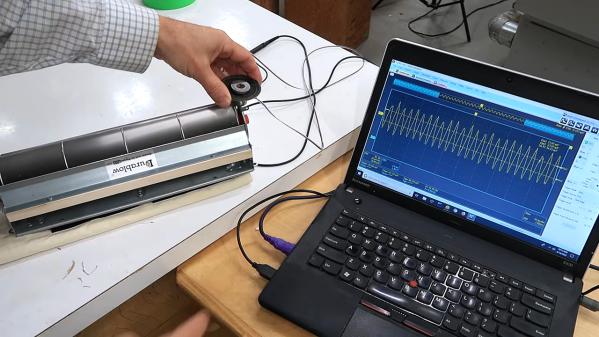
Anything that rotates can quickly spin itself into shrapnel if it’s not properly balanced, and the DIY power tools in [Matthias Wandel]’s shop are no exception. Recent upgrades to his jointer have left the tool a bit noisy, so he’s exploring machine vibrations with this simple but clever setup. Using nothing but a cheap loudspeaker and an oscilloscope, [Matthias] was able to characterize vibrations in a small squirrel-cage blower — he wisely chose to start small to validate his method before diving into the potentially dangerous jointer. There was quite a lot to be learned from the complex waveforms coming back from the transducer, analysis of which was greatly helped by the scope’s spectrum analyzer function. The video below shows the process of probing various parts of the blower, differentiating spectral peaks due to electrical noise rather than vibration, and actually using the setup to dynamically balance the fan.

We’d rate this as yet another handy shop tip from [Matthias], and we’ll be looking out for the analysis of his jointer. Want to do the same but you don’t have an oscilloscope? No problem — an earbud and Audacity might be all you need.

Continue reading “Balancing A Motor With An Oscilloscope”

DeWalt Literal Hack Upgrades Battery

There are several important decisions you make in your life: Coke or Pepsi; vi or emacs; PC or Mac. But, lately, you need to pick a battery ecosystem for your tools. DeWalt? Black & Decker? Or just cheapies from Harbor Freight? But what happens when your vendor of choice changes their batteries? That’s the situation [jleslie48] found when a DeWalt 14.4V battery died. All the new tools require 18V batteries, so buying an old battery for one tool didn’t make sense. Time to literally hack the old tool to accept the new battery.

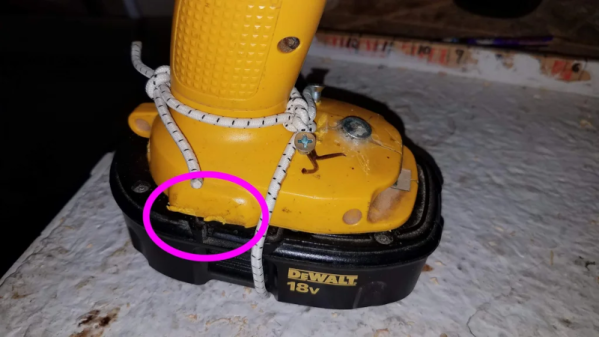
Presumably, nothing in the drill will mind the higher voltage. It is all a matter of mechanics and nothing a Dremel tool won’t fix. Since the tool was old and the 18V batteries relatively new, [jleslie48] decided to limit modifications to the tool only leaving the batteries intact for use with the newer tools.

The only problem once you remove the pins and clips that interfere with the battery fit, it won’t actually stay on the drill. We might have turned to duct tape or zip ties, but bungee cord works, too, as you can see in the finished product.

Honestly, though, the bungee is good because you can stretch it to remove the battery for charging. We might have just cannibalized the drill for its motor, but next time you have a tool with no battery, it might be worth looking to see if you could modify the tool.

Bungees are great for robots, too. Or, you can lay siege on your neighbors.

Designing Printed Adapters For Power Tool Batteries

Unless you’re particularly fond of having multiple types of batteries and chargers, you’d do well to make sure all your portable power tools are made by the same company. But what do you do if there’s a tool you really need, but your brand of choice doesn’t offer their own version of it? Rather than having to buy into a whole new tool ecosystem, you might be able to design your own battery adapter.

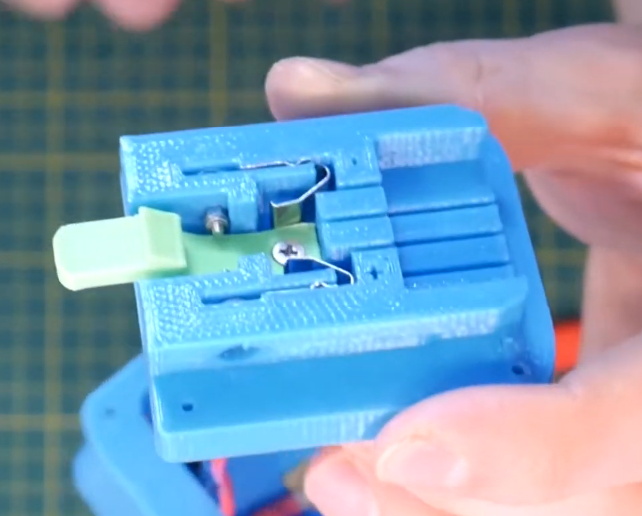
Note the locking tab that’s been printed separately.

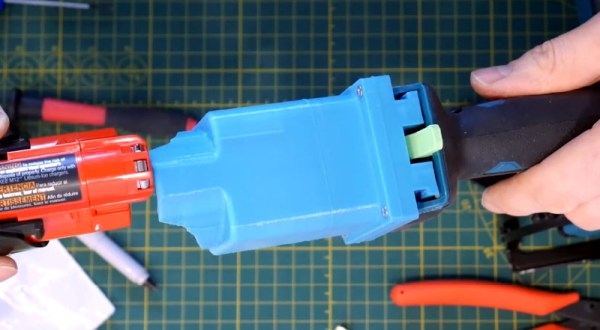
As [Chris Chimienti] explains in the video after the break, the first thing you’ve got to do (beyond making sure the voltages match) is take some careful measurements of the connectors on your batteries and tools. His goal was to adapt a Milwaukee M12 battery to Makita CXT tool, so if you happen to have that same combination of hardware you can just use his STLs. Otherwise, you’ll be spending some quality time with a pair of calipers and a notepad.

Once the interfaces have been designed and printed, they are wired together and mounted to opposite ends of the center support column. In theory you’d be done at this point, but as [Chris] points out, there’s a bit more to it than just wiring up the positive and negative terminals. Many tools use thermistors in the batteries for thermal protection purposes, and when the tool doesn’t get a reading from the sensor, it will likely refuse to work.

His solution to the problem is to “hotwire” the thermistor lead on the battery connector with a standard resistor of the appropriate value. This will get the tool spinning, but obviously there’s no more thermal protection. For most homeowner DIY projects this probably won’t cause a problem, but if you’re a pro who’s really pushing their tools to the limit, this project might not be for you.

Of course, this isn’t the first time we’ve seen somebody adapt batteries from different brands to work on their tools. It’s a common enough problem once you start building up a workshop, although you could always avoid it by building all your own tools.

Continue reading “Designing Printed Adapters For Power Tool Batteries”