Poor Man’s Laser Scanner Probably Won’t Shoot Your Eye Out, Kid

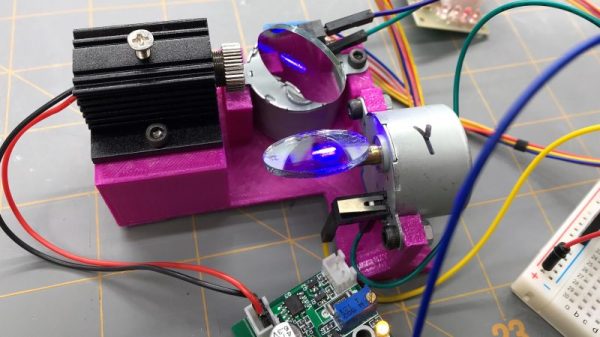
Yes, laser cutters that come off the slow boat from China are more affordable than ever, and with some tweaks and hacks they can turn out some decent results. But if you just want a laser lightshow that’ll draw boxes on your living room ceiling, this simple X-Y laser scanner might be a good platform to build.

Let’s say right up front that there are more than a few safety issues with [ThingEngineer]’s 3D-printed two-axis scanner. He’s well aware of these potential retina-cooking issues and duly notes that a good pair of laser safety goggles is a must and that the cheap anti-lawsuit glasses that laser module manufacturers often include with their products don’t count.

[Editor’s Note: Glasses are really only intended for alignment operations. Pros enclose lasers beyond a certain power to prevent anyone going blind. Know where your beam terminates, kids.]

With that in mind, there’s a lot to be said for this poor man’s scanner build. Yes, it would be faster with real galvos and low-mass mirrors, but time is money, and the steppers and craft store mirror discs do the job, albeit slowly. We like that everything is so simple, even the method for turning a regular mirror into a front-surface mirror.

[ThingEngineer] proves you don’t need galvanometers to have some simple laser fun. And if steppers don’t do it for you, you can try little brushed DC hobby motors or even 3D-printed cams.

Continue reading “Poor Man’s Laser Scanner Probably Won’t Shoot Your Eye Out, Kid”

Spoof A Skimmer For Peace Of Mind

It’s a sad commentary on the state of the world when it becomes a good practice to closely inspect the card reader on every ATM and gas pump for the presence of a skimmer. The trouble is, even physically yanking on the reader may not be enough, as more sophisticated skimmers now reside safely inside the device, sipping on the serial comms output of the reader and caching it for later pickup via Bluetooth. Devilishly clever stuff.

Luckily, there’s an app to detect these devices, and the prudent consumer might take solace when a quick scan of the area reveals no skimmers in operation. But is that enough? After all, how do you know the smartphone app is working? This skimmer scammer scanner — or is that a skimmer scanner scammer? — should help you prove you’re being as safe as possible.

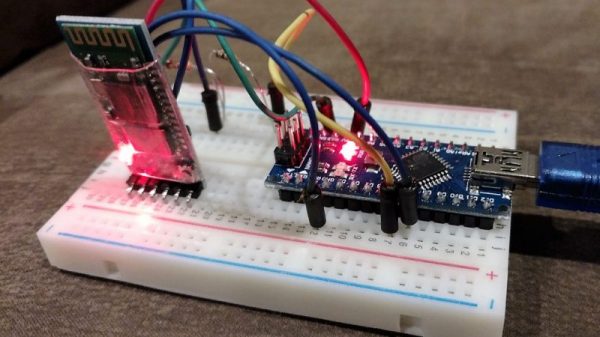
The basic problem that [Ben Kolin] is trying to solve here is: how do you prove a negative? In other words, one could easily write an app with a hard-coded “This Area Certified Zebra-Free” message and market it as a “Zebra Detector,” and 99.999% of the time, it’ll give you the right results. [Ben]’s build provides the zebra, as it were, by posing as an active skimmer to convince the scanner app that a malicious Bluetooth site is nearby. It’s a quick and dirty build with a Nano and a Bluetooth module and a half-dozen lines of code. But it does the trick.

Need a primer on the nefarious world of skimming? Here’s an overview of how easy skimming has become, and a teardown of a skimmer captured in the wild.

Interference Scanner With Clear Instructions

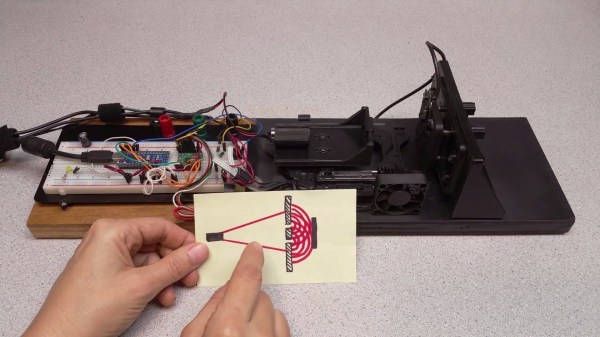
Meticulous. Thorough. Exacting. These are all words we’d use to describe this video by [BrendaEM] about her Homemade 3D Optical Interference Scanner which can be seen after the break. The scanner uses 3D-printed parts and repurposed materials you might find lying around in your spare parts bin. An old optical drive tray acts to move the laser-wielding sled while a stripped-out webcam is an optical sensor. Links to relevant files such as 3D models and Arduino sketches will be found in the video’s author section.

The principle of operation is demonstrated with a water analog in the video at 2:00 with waves in a plastic container. By creating two small apertures between a light source and a sensor, it’s possible to measure the light waves which make it through. [BrendaEM] uses some powerful visualization software to convert her samples into 3D models which look really cool and simultaneously demonstrate the wave nature of light.

On the left side of her device are the control electronics which don’t need any special coatings since light won’t pass over this area. For the right side, where coherent light is measured, to borrow a Rolling Stones lyric: no colors anymore, I want them to turn black. Even the brass strips with apertures are chemically darkened.

Most of the laser hacks here use lasers rather than measure them, like this Laser Clock and a Laser Projector.

Continue reading “Interference Scanner With Clear Instructions”

Old Chart Recorder Becomes Single-Pixel Scanner

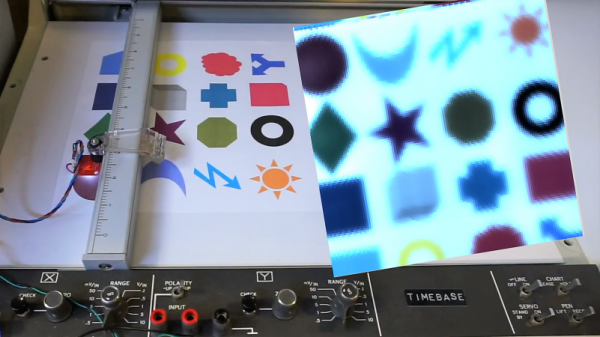
With so many ways to capture images from paper, do we really need another one? Especially one that takes 15 minutes to capture a 128×128 pixel image? Probably not, but building a single-pixel RGB scanner is pretty instructive, and good clean fun to boot.

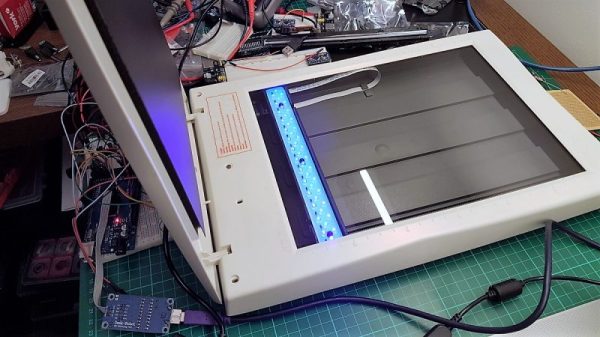
We have to admit that when [Kerry Wong] scored an ancient Hewlett-Packard X-Y chart recorder a while back, we wondered if it would lead to anything useful. One may quibble with the claim that the Lorenz attractor plotter he built with it is useful, and this single pixel scanner is equally suspect, but we like the idea. Using an Arduino to drive the X- and X-axis of the recorder through a raster pattern over the bed and replacing the pen with an RGB sensor board, [Kerry] was able to collect the color data for each pixel and reconstruct the image. It wouldn’t be too hard to replicate this if you don’t have an analog X-Y recorder, which just goes to show that not everything needs to be steppers and digital to get something useful done. Or at least semi-useful.

As for the RGB sensor used, they’ve made appearances here many times before, mostly in M&M sorters but with the occasional synesthesia simulator.

Continue reading “Old Chart Recorder Becomes Single-Pixel Scanner”

Amazing 3D-Scanner Teardown And Rebuild

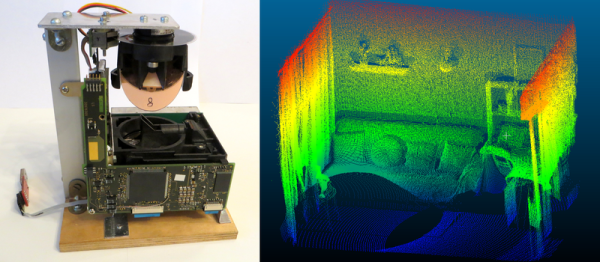
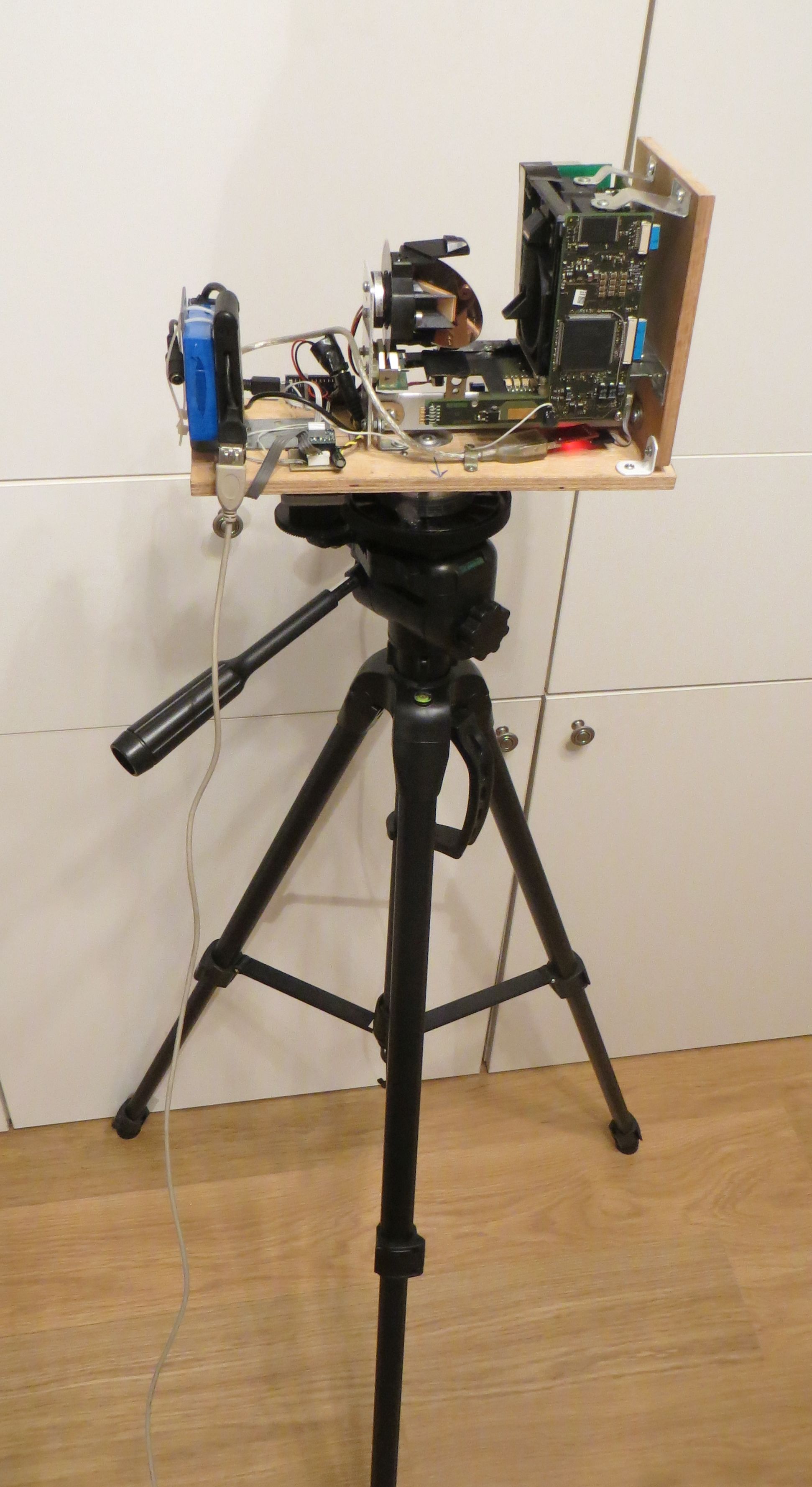
0_10ea1b_776cdc71_origPour yourself a nice hot cup of tea, because [iliasam]’s latest work on a laser rangefinder (in Russian, translated here) is a long and interesting read. The shorter version is that he got his hands on a broken laser security scanner, nearly completely reverse-engineered it, got it working again, put it on a Roomba that was able to map out his apartment, and then re-designed it to become a tripod-mounted, full-room 3D scanner. Wow.

The scanner in question has a spinning mirror and a laser time-of-flight ranger, and is designed to shut down machinery when people enter a “no-go” region. As built, it returns ranges along a horizontal plane — it’s a 2D scanner. The conversion to a 3D scanner meant adding another axis, and to do this with sufficient precision required flipping the rig on its side, salvaging the fantastic bearings from a VHS machine, and driving it all with the surprisingly common A4988 stepper driver and an Arduino. A program on a PC reads in the data, and the stepper moves another 0.36 degrees. The results speak for themselves.

This isn’t [iliasam]’s first laser-rangefinder project, naturally. We’ve previously featured his homemade parallax-based ranger for use on a mobile robot, which is equally impressive. What amazes us most about these builds is the near-professional quality of the results pulled off on a shoestring budget.

Continue reading “Amazing 3D-Scanner Teardown And Rebuild”

Keytar Made Out Of A Scanner To Make Even The 80s Jealous

Do any of you stay awake at night agonizing over how the keytar could get even cooler? The 80s are over, so we know none of us do. Yet here we are, [James Cochrane] has gone out and turned a HP ScanJet Keytar for no apparent reason other than he thought it’d be cool. Don’t bring the 80’s back [James], the world is still recovering from the last time.

Kidding aside (except for the part of not bringing the 80s back), the keytar build is simple, but pretty cool. [James] took an Arduino, a MIDI interface, and a stepper motor driver and integrated it into some of the scanner’s original features. The travel that used to run the optics back and forth now produce the sound; the case of the scanner provides the resonance. He uses a sensor to detect when he’s at the end of the scanner’s travel and it instantly reverses to avoid collision.

A off-the-shelf MIDI keyboard acts as the input for the instrument. As you can hear in the video after the break; it’s not the worst sounding instrument in this age of digital music. As a bonus, he has an additional tutorial on making any stepper motor a MIDI device at the end of the video.

If you don’t have an HP ScanJet lying around, but you are up to your ears in surplus Commodore 64s, we’ve got another build you should check out.

Hackaday Prize Entry: Measuring 3D Magnetic Fields

Sometimes you have to start out with big goals. Ninth-graders [Finja Schneider] and [Myrijam Stoetzer] are aiming to make a magnetic field scanner that would be helpful in finding large underground metallic objects, like unexploded WWII bombs that pose a real threat whenever a new parking garage is excavated in Germany. But even big goals have to start out somewhere, so they’re gaining experience with the sensors and the math necessary to recreate 3D magnetic flux vector fields on household objects like sawblades and magnetized screwdrivers.

Magnetized screwdriver in the "valley"
Magnetized screwdriver in the “valley”

For their science-fair project, [Finja] and [Myrijam] took a mid-80s fischertechnik “toy” 2D scanner kit, mounted a 3D magnetic sensor to it, and wrote some firmware to scan around and pass the data back to a computer where they reconstructed the field lines and made some nice visualizations. Along the way, they tried a number of designs, from a DIY chassis on carbon-fiber rails to sensors with ferrofluid. They document their successes and failures equally nicely in their lab report (PDF, German). You can get a lot of the gist, however, from [Myrijam]’s blog and their Hackaday.io entry.

You might also recognize [Myrijam] from her work with [Paul Foltin] on their eye-controlled wheelchair interface. These are some really cool projects! We’re excited to see how they develop, and are stoked that the future of hacking is in such capable hands.