Microcontrollers Now Substitute For CPUs

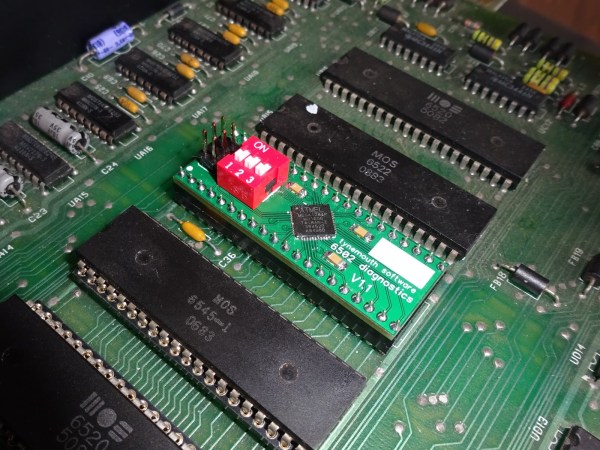
Microcontrollers are getting faster and faster, as is most of the rest of the computing world. Just like you can play Nintendo console games on the newest Nintendo handhelds, it seems that modern microcontrollers can replace CPUs on personal computers from the 80s. At least, that’s what [Dave] has shown with his latest project: an Atmel microcontroller that directly attaches to the CPU slot on a Commodore PET.

Essentially, the project started out as a test rig of sorts for the Commodore. [Dave] wanted to see if some of the hardware on the Commodore was still functional and behaving properly. From there, it somewhat snowballed. The address bus was easy enough to investigate, but adding only a few more pins on the microcontroller he was already using would be enough to access the databus too. A character table was soon added, a test algorithm, and more useful insights. It’s a masterful manipulation of this older hardware with modern technology and is definitely worth a look.

There’s a lot more going on in the retrocomputing world than meets the eye. One might think these old computers were all in landfills by now, but there is a devoted fanbase that does everything from building new hard drives for old computers or investigating their true audio-visual potential.

Thanks to [Mike w] for the tip!
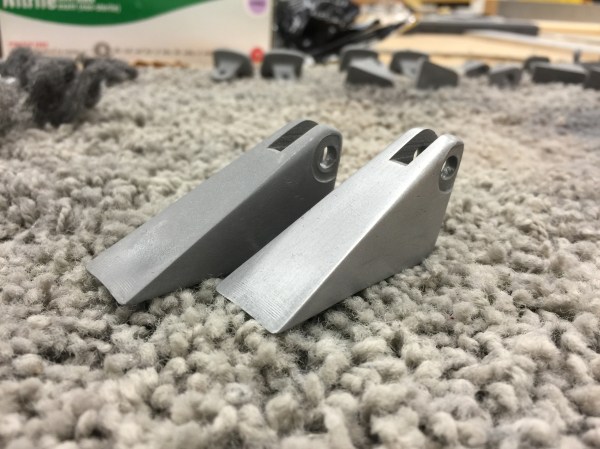
A quick brush over the part with some sand paper and it quickly transforms from obviously plastic to metallic.

Learn Resin Casting Techniques: Cold Casting

Sometimes we need the look, feel, and weight of a metal part in a project, but not the metal itself. Maybe you’re going for that retro look. Maybe you’re restoring an old radio and you have one brass piece but not another. It’s possible to get a very metal like part without all of the expense and heat required in casting or the long hours in the metal fabrication shop.

Before investing in the materials for cold casting, it’s best to have practical expectations. A cold cast part will not take a high polish very well, but for brushed and satin it can be nearly indistinguishable from a cast part. The cold cast part will have a metal weight to it, but it clinks like ceramic. It will feel cool and transfers heat fairly well, but I don’t have numbers for you. Parts made with brass, copper, and iron dust will patina accordingly. If you want them to hold a bright shine they will need to be treated with shellac or an equivalent coating afterward; luckily the thermoset resins are usually pretty inert so any coating used on metal for the same purpose will do.

It is best to think of the material as behaving more or less like a glass filled nylon such as the kind used for the casing of a power tool. It will be stiff. It will flex a relatively short distance before crazing and then cracking at the stress points. It will be significantly stronger than a 3D printed part, weaker than a pure resin part, and depending on the metal; weaker than the metal it is meant to imitate.

Continue reading “Learn Resin Casting Techniques: Cold Casting”

A Drone Photosphere Is Worth 4000 Times Pi Words

One of the problems with a cheap drone is getting good video, especially in real time. Cheap hobby quadcopters often have a camera built-in or mounted in a fixed position. That’s great for fun shots, but it makes it hard to get just the right shot, especially as the drone tilts up and down, taking the camera with it. Pricey drones often have a gimbal mount to keep the camera stable, but you are still only looking in one direction.

Some cheap drones now have a VR (virtual reality) mode to feed signal to a headset or a Google Cardboard-like VR setup. That’s hard to fly, though, because you can’t really look around without moving the drone to match. You can mount multiple cameras, but now you’ve added weight and power drain to your drone.

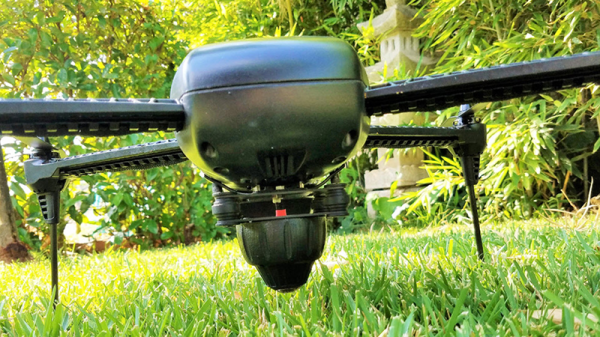
MAGnet Systems wants to change all that with a lightweight spherical camera made to fit on a flying vehicle. The camera is under 2.5 inches square, weighs 62 grams, and draws less than 3 watts at 12 volts. It picks up a sphere that is 360 degrees around the drone’s front and back and 240 degrees centered directly under the drone. That allows a view of 30 degrees above the horizon as well as directly under the drone. There is apparently a different lens that can provide 280 degrees if you need that, although apparently that will add size and weight and be more suitable for use on the ground.

The software (see video below) runs on Windows or Android (they’ve promised an iOS version) and there’s no additional image processing hardware needed. The camera can also drive common VR headsets.

Continue reading “A Drone Photosphere Is Worth 4000 Times Pi Words”

Riding Shotgun In The Apollo 12 Lunar Lander

Last week we had a walk through of the Lunar Module’s source code with Don Eyles, who wrote the landing programs. Now you can take a rather thrilling ride to see Don’s code in action.

Below is an annotated video of the Apollo 12 landing, in real-time. It’s worth setting aside a quarter-hour to check it out. In an age where everyone is carrying around an HD (or way better) camera in their pocket, following along with radio broadcasts, still images, and small slivers of video might not sound that awesome. But it is!

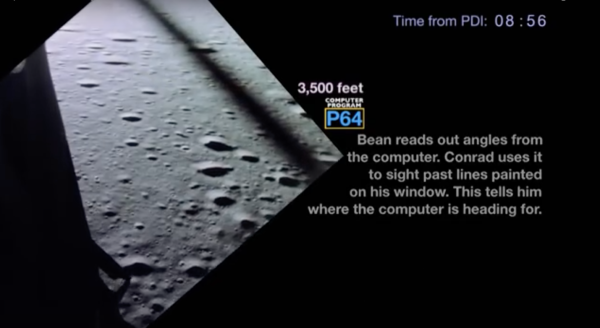
p63-apollo-12-codeThe video takes us from Powered Descent Initiation through touchdown on the Moon with Pete Conrad and Alan Bean. As the audio plays out the video has annotations which explain what is going on and that translate the jargon used by the team. With the recently celebrated push to publish the source code you can even follow along as the video displays which program is running at that time. Just search for the program code and you’ll find it, like this screenshot of the P63 routine. The code comments are more than enough to get the gist of it all.

If you enjoy this, the description of the YouTube video below includes links to similar videos for Apollo 11, 14, 15, 16, and 17.

http://www.youtube.com/watch?v=8WEEFHJsZ0k

[Thanks to Paul Becker for sending along this video]

Nirvana Like You’ve Never Heard Them Before

If you were an early 1990s youth, the chances are [Nirvana]’s Smells Like Teen Spirit is one of those pieces of music that transports you straight back to those times. As your writer it evokes a student radio studio and the shelves of its record library, and deafening badly-lit discos with poorly adjusted PA systems and unpleasantly sticky dance floors.

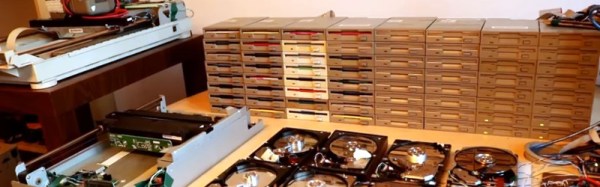
One of our finds this morning therefore comes as an evocative diversion, Smells Like Teen Spirit on [SileNT]’s Floppotron. The Floppotron is a music player composed of a huge array of floppy drives, hard drives, and a couple of flatbed scanners. The scanners are controlled by off-the-shelf Arduino boards and the hard drives have ATMega16s with H-bridge drivers.

This build is the most refined floppy drive organ we’ve seen yet. The floppies are divided into single-voice blocks of eight controlled by an ATMega16, with dynamic volume envelopes mad possible by the number of simultaneously running drives, so the sounds can fade in and out like “natural” musical instruments. The hard drives and scanners are run against their mechanical stops, providing percussion. All the boards are daisychained via SPI to an Arduino that acts as a PC interface, and the PC schedules the performance with a Python script.

He’s provided a couple of pieces as YouTube videos, the floppy motors work particularly well for [Nirvana]’s grunge, but perhaps a bit more mechanical for Hawaii Five-O. This last track will be more evocative than the first if you attended a particular university in the North of England where it was the end-of night record played as the lights came up in one of the discos that had a much better-adjusted PA because the technician knew what she was doing. For those of you with different childhoods, there’s also the Imperial March.

Continue reading “Nirvana Like You’ve Never Heard Them Before”

Hackaday Prize Entry: The World’s First Tampon Monitor

[Amanda], [Jacob], [Katherine], and [vyshaalij] had a class project for their ‘Critical Making’ class at UC Berkeley. The task was to design a ‘Neo-Wearable’ that would fulfill an unmet need. Realizing women make up about 50% of the population and experience monthly periods for about half of their lives, they decided to make what can only be described as a tampon monitor. It’s a small device that monitors the… uh… ‘fullness’ of a tampon. Yes, it’s wearable technology that is actually useful, and a great entry for the Hackaday Prize.

The my.Flow, as the team are calling it, uses mechanical means to measure the saturation level of a tampon. Why would anyone want to do this? Because of leakage, anxiety, and risk of Toxic Shock Syndrome (TSS).

A ‘smart’ tampon needs some electronics, and the team’s solution to this is rather ingenious. They’re using a small, flat, wearable clip that attaches to the user’s undergarments and is connected to the tampon by an elongated tail.

Already the team is seeing a lot of success – the market research for this product showed a whopping 82% of women are ready to buy a product that would help prevent TSS. This fledgling startup was picked up by the HAX accelerator and moved to China to bring this product to life. It’s a great idea, and also a great entry for the Hackaday Prize.

The HackadayPrize2016 is Sponsored by:

Lightweight Game Console Packs A Punch

Any maker worth their bits will look for new ways to challenge themselves. [Robert Fotino], a computer science student at the University of California, is doing just that: designing and building his own lightweight hobbyist game console that he has appropriately named Consolite.

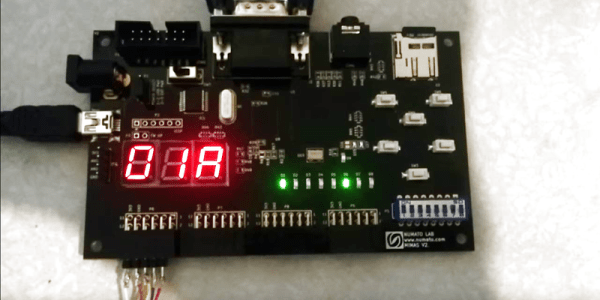
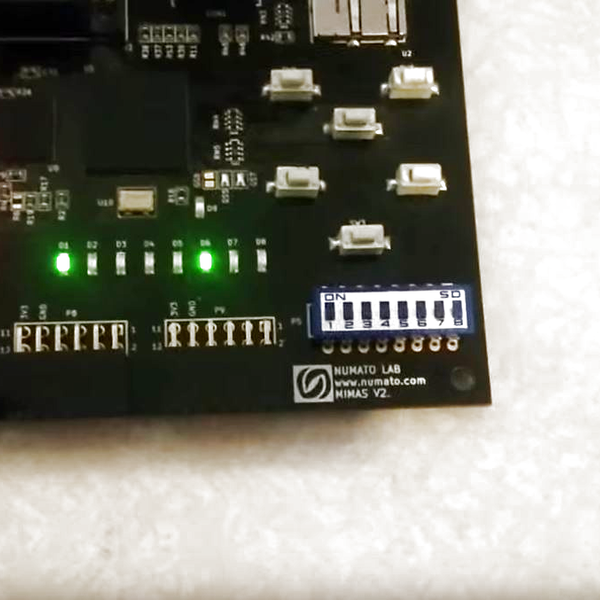
[Fotino] wrote his own compiler in C++ that converts from C-like languages to a custom-designed assembler that he has dubbed Consolite Assembly. To test his code, he also wrote an emulator before loading it onto the Mimas V2 FPGA board. Presently, Consolite  uses 64KiB of main memory and 48 KiB of video memory; a future version will have 32 bit support to make better use of the Mimas’ 64 MiB of on board ram, but the current 16-bit version is a functional proof of concept.

consolite-status-leds-and-hardware-switches_thumbnailAn SD card functions as persistent storage for up to 256 programs, which can be accessed using the hardware switches on the Mimas, with plans to add user access in the form of saving game progress, storage outside of main memory, etc. — also in a future update that will include audio support.

As it stands, [Fotino] has written his own versions of Breakout, Tetris, and Tron to show off his project.

Not wanting for diligence, [Fotino] has provided thorough documentation of nearly every step along the way in his blog posts and on GitHub if you are looking for guidelines for any similar projects you might have on the back burner — like an even tinier game console.

[via r/FPGA]